- Company Articles
- Products and Technology
- Product knowledge
- Flat Rigid Castor Wheel Sizing for Turnover Carts: Ensuring Safe Load Distribution

Flat Rigid Castor Wheel Sizing for Turnover Carts: Ensuring Safe Load Distribution
Related Product
Flat Rigid Castor Wheel
Chair Casters Ball Bearing Wheels Rubber Base. Resistant to abrasion, impact and corrosion. Heavy payload can hold 70Kgs per pcs,which can make it works at a stable and smooth status.
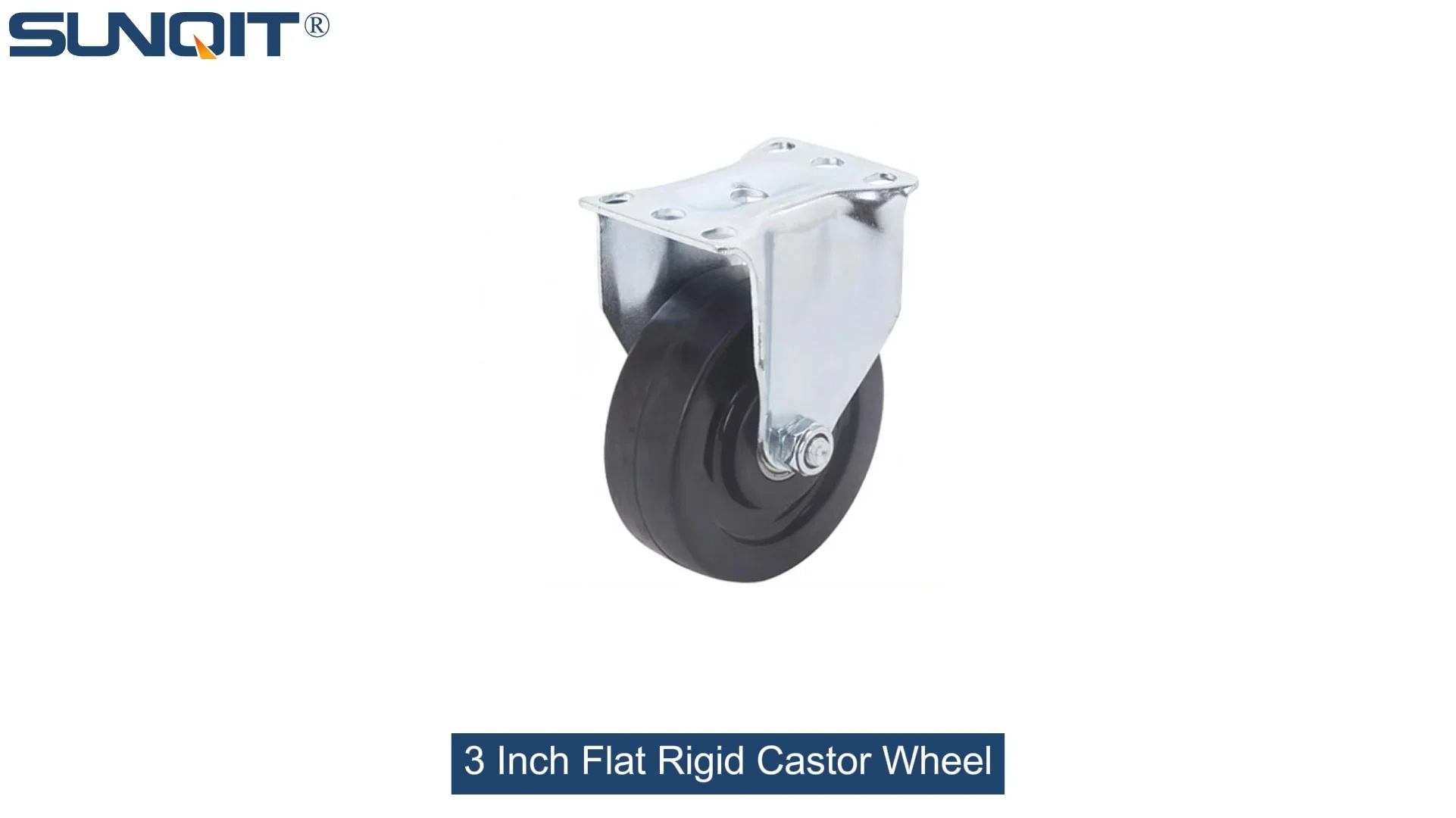
Walk into any busy warehouse, manufacturing plant, or retail stockroom, and you'll likely hear the faint hum of turnover carts gliding across the floor—carrying everything from raw materials to finished products, tools to inventory. These unassuming workhorses are the backbone of efficient material handling, but their performance hinges on a component so small it's often overlooked: the castor wheels. Specifically, flat rigid castor wheels, which provide stability and straight-line mobility, are critical for keeping turnover carts rolling smoothly. But here's the catch: if these wheels are the wrong size, the consequences can range from frustrating inefficiencies to serious safety hazards. In this guide, we'll dive deep into how to properly size flat rigid castor wheels for turnover carts, why it matters, and how to avoid common pitfalls that could derail your operations.
Understanding Turnover Trolleys and Racks: More Than Just "Carts"
Before we get into wheel sizing, let's clarify what we mean by "turnover carts." These are not your average shopping carts—they're rugged, purpose-built tools designed to transport heavy loads, stack materials, or organize inventory. Turnover trolley and rack systems come in all shapes: some have shelves for parts, others have bins for small items, and many are customizable with adjustable heights or foldable designs. Whether you're moving 500 pounds of automotive parts or 50 pounds of electronics components, the right turnover cart can cut down on manual labor, reduce errors, and speed up workflows. But none of that matters if the wheels fail.
Flat rigid castor wheels are a popular choice for these carts for a reason. Unlike swivel casters, which rotate 360 degrees, rigid casters lock into a straight line, making them ideal for carts that need to move in fixed paths—like along assembly lines or between storage racks. They're also more stable under heavy loads, as they don't swivel unexpectedly, which reduces the risk of tipping. But stability and mobility depend entirely on getting the size right. A wheel that's too small might sink into cracks in the floor; one that's too large could throw off the cart's balance. So, how do you find the sweet spot?
Key Factors in Sizing Flat Rigid Castor Wheels
1. Load Capacity: The Foundation of Safe Sizing
The first and most critical factor is load capacity. Every flat rigid castor wheel has a maximum weight it can support, and exceeding that limit is a recipe for disaster. But here's where many operators go wrong: they only consider the "static" load (the weight when the cart is stationary) and forget about "dynamic" loads (the weight when the cart is moving, which includes momentum and vibrations). For example, a cart loaded with 800 pounds might feel manageable when parked, but when you push it, the force of starting and stopping can add 20% or more to the effective load on the wheels. That's why experts recommend a safety factor of at least 1.5x the maximum dynamic load.
Let's break it down with an example. Suppose your turnover cart needs to carry 600 pounds of materials. If you use four wheels (the standard for stability), each wheel would need to support 150 pounds under static load. But with a 1.5x safety factor for dynamic loads, each wheel should have a capacity of at least 225 pounds (150 x 1.5). Ignore this, and you could end up with wheels that crack, bearings that seize, or even a cart that collapses mid-move—putting workers and products at risk.
2. Floor Conditions: The Unsung Variable
Your warehouse floor might look smooth, but up close, it's probably full of imperfections: tiny cracks, uneven joints, or even debris like loose screws or dust bunnies. These details matter for wheel sizing. A small-diameter wheel (say, 2 inches) will struggle to roll over even minor obstacles, requiring more force to push and increasing wear on the wheel. A larger wheel (4 inches or more), by contrast, can glide over cracks and debris with ease, reducing strain on both the cart and the person pushing it.
Floor material also plays a role. Concrete floors, common in industrial settings, are durable but can be rough if not properly finished. Rubber or polyurethane wheels are better here, as they absorb shocks and reduce noise. If your floor is smooth (like polished concrete or tile), a smaller wheel might work, but you'll still need to account for any moisture or oil that could make the surface slippery. In wet environments, a wheel with a tread pattern (even a subtle one) can improve traction—though rigid casters, by nature, don't swivel, so traction is more about preventing slips than steering.
3. Cart Design and Dimensions: Balance is Everything
The size of your turnover cart itself affects wheel sizing. A tall, narrow cart with a high center of gravity (like one loaded with stacked boxes) is more prone to tipping, so you'll need larger, wider wheels to stabilize it. Conversely, a low, wide cart with a low center of gravity might handle smaller wheels, but you'll still need to ensure the wheels are spaced far enough apart to distribute weight evenly.
Wheel placement is another key detail. Most turnover carts have four wheels: two rigid (usually at the back) and two swivel (at the front) for steering. But if your cart uses only rigid casters (common for straight-line paths), the distance between the front and rear wheels (the wheelbase) matters. A longer wheelbase improves stability, but it also means the cart is harder to maneuver in tight spaces. In that case, slightly larger wheels can help, as they reduce the effort needed to push the cart despite its length.
4. Operational Environment: Temperature, Chemicals, and Wear
Where your turnover cart operates matters as much as how it's used. If you're working in a cold storage facility, for example, standard rubber wheels might harden and crack in sub-zero temperatures—so you'd need a wheel made of polyurethane or nylon, which stays flexible in the cold. Similarly, in environments with oils, solvents, or chemicals (like automotive shops), a wheel resistant to corrosion and chemical damage (like stainless steel or polypropylene) is a must.
Even in "normal" environments, wear and tear add up. A cart that's used 8 hours a day, 5 days a week, will put more stress on wheels than one used occasionally. In high-traffic areas, larger wheels tend to last longer because they distribute wear over a larger surface area. For example, a 4-inch wheel has twice the circumference of a 2-inch wheel, so it rotates half as many times to travel the same distance—meaning less friction and slower wear.

Types of Flat Rigid Castor Wheels: Material Matters
Flat rigid castor wheels come in a variety of materials, each with its own strengths and weaknesses. The material you choose will influence not just load capacity, but also how the wheel interacts with the floor, how long it lasts, and how much maintenance it needs. Here's a breakdown of the most common options:
| Wheel Material | Typical Load Capacity (Per Wheel) | Best Floor Types | Pros | Cons |
|---|---|---|---|---|
| Rubber | 100–500 lbs | Concrete, tile, hardwood (non-abrasive) | Quiet, shock-absorbent, good traction | Prone to wear on rough floors; not chemical-resistant |
| Polyurethane (PU) | 200–1,500 lbs | All floor types (including rough concrete) | Durable, chemical-resistant, low rolling resistance | More expensive than rubber; can soften in high heat |
| Nylon | 500–2,000 lbs | Smooth concrete, metal, or industrial floors | High load capacity, chemical-resistant, low friction | Noisy on hard floors; can mark soft surfaces (like wood) |
| Steel | 1,000–5,000+ lbs | Rough concrete, asphalt, or outdoor surfaces | Extremely durable, high load capacity | Very noisy; can damage smooth floors; prone to rust (unless stainless steel) |
For most turnover cart applications, polyurethane (PU) wheels are a safe bet. They balance load capacity, durability, and floor friendliness, making them versatile enough for warehouses, retail, and light manufacturing. But if you're hauling extremely heavy loads (like machinery parts), steel or nylon might be necessary. The key is to match the material to both the load and the environment.

Calculating Load Per Wheel: Avoiding Overloading
We touched on load capacity earlier, but let's formalize the process of calculating how much weight each wheel will bear. This is critical for ensuring you don't overload individual wheels, which is the single biggest cause of caster failure.
Step 1: Determine the total maximum load. This includes the weight of the cart itself (the "tare weight") plus the heaviest load you'll ever put on it. For example, if the cart weighs 100 lbs and you'll load it with 500 lbs of materials, the total load is 600 lbs.
Step 2: Decide how many wheels the cart will have. Most carts use 4 wheels, but some larger models use 6 or 8 for extra stability. For 4 wheels, assume the load is distributed evenly (though in reality, the front or rear wheels might bear slightly more weight, depending on how the cart is loaded). For safety, we'll assume 100% of the load is supported by all wheels, even if in practice it's slightly uneven.
Step 3: Divide the total load by the number of wheels. For a 600-lb total load on 4 wheels, that's 600 ÷ 4 = 150 lbs per wheel (static load).
Step 4: Apply a safety factor. As mentioned earlier, dynamic loads (moving) add stress, so multiply the static load by 1.5–2.0. For a cart used frequently, use 2.0; for occasional use, 1.5 is okay. So, 150 lbs x 1.5 = 225 lbs per wheel (dynamic load capacity required).
Step 5: Check the wheel manufacturer's specs. Ensure the flat rigid castor wheel you choose has a dynamic load rating of at least 225 lbs. If the cart will be used on uneven floors or in rough conditions, bump that up by another 10–20% to account for extra strain.
Pro tip: If your cart has a mix of rigid and swivel casters (common for maneuverability), the rigid casters often bear more weight when the cart is moving. In that case, size the rigid wheels for 60% of the total load and swivel wheels for 40%. For example, 600 lbs total: rigid wheels (2) would need to handle 360 lbs total (180 lbs each), swivel wheels (2) 240 lbs total (120 lbs each). Then apply the safety factor to each.

Common Sizing Mistakes and Their Costly Consequences
Even with the best intentions, it's easy to get wheel sizing wrong. Let's look at some of the most common mistakes and what happens when you make them:
Mistake 1: Underestimating the Total Load
It's tempting to "round down" when calculating load capacity—after all, "we'll never load it that full, right?" But in busy operations, corners get cut. A worker might add an extra box "just this once," or inventory might be heavier than expected. One warehouse we worked with sized their wheels for 500 lbs, only to find that their carts were regularly loaded with 650 lbs. Within months, the wheels started cracking, and one cart collapsed, spilling expensive electronics components. The fix? Upgrading to wheels with a 400-lb dynamic capacity (for 4 wheels, 650 lbs total ÷ 4 = 162.5 lbs per wheel x 2.0 safety factor = 325 lbs; they went with 400 lbs to be safe). The cost of new wheels was a fraction of the lost inventory.
Mistake 2: Ignoring Floor Irregularities
A warehouse floor might look smooth, but over time, cracks form, joints settle, and debris accumulates. A 2-inch wheel that works perfectly on a new floor might start getting stuck in cracks after a year. We saw this at a food processing plant: they used small, hard plastic wheels on their turnover carts, and as the floor aged, the wheels began catching on cracks, causing workers to strain their backs pushing the carts. Switching to 3-inch polyurethane wheels solved the problem—they rolled over cracks easily, and push force dropped by 40%.
Mistake 3: Choosing the Wrong Material for the Environment
Using rubber wheels in a chemical plant is a disaster waiting to happen. Rubber breaks down when exposed to oils and solvents, leading to cracks and loss of traction. One automotive shop learned this the hard way: they used rubber wheels on carts near the assembly line, where oil drips were common. Within weeks, the wheels became sticky, then brittle, and finally split. The solution? Nylon wheels, which are resistant to oil and chemicals. The new wheels lasted 18 months, compared to 2 months for the rubber ones.
Mistake 4: Overlooking Caster Accessories
Wheels don't work alone—they rely on caster accessories like axles, bearings, and mounting plates. A high-capacity wheel is useless if the axle is made of weak steel, or if the bearing seizes up. We once encountered a cart with 4-inch steel wheels rated for 1,000 lbs each, but the axles were thin, cheap metal. When loaded with 800 lbs, the axles bent, causing the wheels to wobble. The fix? Upgrading to thicker axles and sealed bearings (which prevent dust and debris from jamming the wheel). Sometimes, the "small parts" make the biggest difference.
Choosing the Right Caster Accessories: The Unsung Heroes
When it comes to flat rigid castor wheels, the wheel itself gets all the attention—but caster accessories are just as important. Let's break down the key ones:
Bearings: Smooth Rolling Starts Here
Bearings reduce friction between the wheel and axle, making the cart easier to push. There are two main types: plain bearings (simple metal sleeves) and ball bearings (steel balls in a race). Plain bearings are cheap but wear quickly under heavy loads; ball bearings are smoother and more durable. For most turnover carts, ball bearings are worth the investment—they reduce push force and extend wheel life.
Mounting Plates: Securing the Wheel to the Cart
The mounting plate connects the caster to the cart frame. It needs to be strong enough to handle the load without bending. Look for plates made of steel (preferably 1/4-inch thick or more) with multiple bolt holes for secure attachment. Avoid plastic plates—they're fine for light loads but will crack under heavy use.
Axles: The Backbone of the Wheel
The axle holds the wheel in place, so it must be strong and straight. Most axles are made of steel, but the diameter matters: a 5/8-inch axle is stronger than a 1/2-inch one. If you're using heavy-duty wheels, ensure the axle is rated for the same load capacity as the wheel itself.
Brakes (Yes, Even for Rigid Casters)
While rigid casters don't swivel, they can still roll if the cart is on an incline. A simple brake (like a foot-operated lever that presses against the wheel) can prevent the cart from rolling away when parked. This is especially important in warehouses with sloped floors or near loading docks.
Case Study: How Proper Sizing Transformed a Manufacturing Plant's Workflow
Let's look at a real-world example of how flat rigid castor wheel sizing improved operations. A mid-sized electronics manufacturer was struggling with their turnover carts: workers complained about back pain from pushing heavy carts, wheels were constantly needing replacement, and carts occasionally tipped over when loaded with tall stacks of circuit boards.
Our team started by auditing their setup: they were using 2.5-inch rubber wheels on 4-wheel carts, with a total load capacity of 400 lbs (100 lbs per wheel, no safety factor). The carts were loaded with 500–600 lbs of materials daily, and the plant floor had numerous small cracks from years of use. The rubber wheels were also deteriorating from occasional exposure to cleaning chemicals.
Here's what we recommended:
- Wheel Size: Upgrade to 4-inch polyurethane wheels (dynamic load capacity of 250 lbs each). With 4 wheels, that's 1,000 lbs total capacity (well above the 600-lb max load, even with a 2.0 safety factor).
- Material: Polyurethane, which is chemical-resistant and rolls over cracks easily.
- Accessories: Ball bearings for smoother rolling, steel mounting plates (1/4-inch thick), and axle brakes to prevent rolling on sloped areas.
The results were dramatic: Push force dropped by 55%, reducing worker complaints of back pain. Wheel replacements went from once every 3 months to once every 18 months. And with the larger, more stable wheels, cart tipping incidents stopped entirely. The plant estimated the upgrade saved them $20,000 a year in reduced labor costs, fewer replacements, and less downtime.
Maintenance Tips: Making Your Flat Rigid Castor Wheels Last
Even the best-sized wheels won't last forever without proper care. Here's how to extend their lifespan:
Clean Regularly
Dust, debris, and chemicals can build up in the wheel bearings and around the axle, causing friction and wear. Wipe wheels down with a damp cloth weekly, and use a brush to clean out debris from the bearings. For wheels in dirty environments (like construction sites), hose them off monthly (if the bearings are sealed).
Lubricate Bearings
Sealed bearings don't need lubrication, but if your wheels have open bearings, apply a few drops of machine oil every 3 months. This keeps them rolling smoothly and prevents rust.
Inspect for Wear
Check wheels weekly for cracks, flat spots, or uneven wear. If a wheel is worn on one side, it might be misaligned—tighten the axle or mounting plate. If the tread is worn down, replace the wheel before it fails.
replace Accessories as Needed
Axles, bearings, and mounting plates wear out too. If a wheel wobbles, the axle might be bent; if it's hard to push, the bearings might be seized. replace these parts promptly to avoid damaging the wheel itself.
Conclusion: Sizing for Success
Flat rigid castor wheels might seem like a small part of your turnover cart, but they're the difference between a smooth, efficient workflow and a frustrating, unsafe one. By considering load capacity, floor conditions, cart design, and environment, you can choose wheels that keep your carts rolling safely and reliably. And don't forget the accessories—bearings, axles, and mounting plates are just as critical as the wheel itself.
At the end of the day, investing time in proper wheel sizing saves money: fewer replacements, less downtime, and happier, healthier workers. So the next time you're shopping for turnover cart wheels, remember: it's not just about picking a wheel—it's about picking the right wheel for your unique needs. Your team (and your bottom line) will thank you.