- Company Articles
- Products and Technology
- Product knowledge
- Flexible Conveyor Systems: Four Way Straight Lean Pipe Joint for Smooth Material Flow

Flexible Conveyor Systems: Four Way Straight Lean Pipe Joint for Smooth Material Flow
Related Product
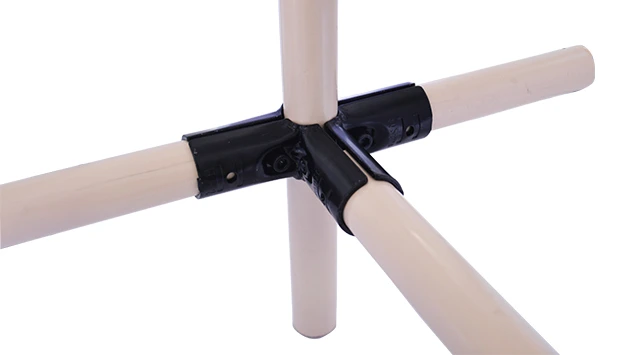
Four Way Straight Lean Pipe Joint
Four way lean pipe joint for 4 pcs 28MM lean pipe connection in straight angle, which used widely in workbench, flow rack, hand trolley frame connection.
The Hidden Cost of Clunky Material Flow
Walk into any busy factory or warehouse, and you'll quickly spot the heartbeat of operations: material flow. It's the silent dance of parts moving from storage to assembly lines, finished products shifting to packaging stations, and components gliding between workbenches. When this dance is smooth, everything hums—workers stay focused, deadlines are met, and waste melts away. But when it stumbles? Bottlenecks form like traffic jams, workers waste precious minutes fetching stuck parts, and production schedules spiral into chaos.
For decades, many facilities relied on rigid, one-size-fits-all conveyor systems. These heavy metal behemoths were built to last, but "last" often meant "stuck in time." Need to rearrange your assembly line for a new product? Good luck—you'd be tearing out bolts, welding new tracks, and halting production for days. Want to adjust the height of a workbench to fit a taller operator? That meant custom fabrication, not a quick tweak. And don't even think about scaling up during peak seasons; those old systems couldn't handle extra load without groaning (and sometimes breaking).
The problem wasn't just inconvenience—it was cost. A 2023 study by the Manufacturing Excellence Association found that inefficient material flow eats up 15-20% of total production time in average facilities. That's hours every day lost to workers waiting for parts, rerouting jams, or manually moving items that should glide on their own. Multiply that by your team's hourly rate, and suddenly "minor inefficiencies" add up to six-figure losses annually.
Flexible Conveyor Systems: The Solution to Rigidity
Enter flexible conveyor systems—a game-changer for modern manufacturing. Unlike their rigid predecessors, these systems are built on adaptability. Think of them as the modular furniture of material handling: easy to assemble, reconfigure, and expand, without needing a team of engineers or a shutdown. At the core of this flexibility? Components like lean pipes, roller tracks, and smart joints that work together to create a material flow system that bends to your needs, not the other way around.
But what makes these systems truly "flexible"? It starts with the building blocks. Traditional conveyors use fixed metal frames and welded joints, locking you into a single layout. Flexible systems, by contrast, rely on lightweight yet durable materials like aluminum lean pipes and versatile connectors. These components snap together (or apart) with minimal tools, letting you adjust layouts in hours, not weeks. Need to add a new branch to your conveyor line for a secondary assembly station? Done. Want to lower a section of roller track to feed parts directly into a turnover trolley? No problem. It's material flow on demand.
And at the heart of this modular magic lies a small but mighty component: the four way straight lean pipe joint. It might not look like much—a simple, often chrome-plated connector with threaded ports—but this unassuming part is what turns individual lean pipes into a dynamic, customizable network. Let's dive into why it matters, how it works, and why it's become a cornerstone of lean manufacturing systems worldwide.

The Four Way Straight Lean Pipe Joint: Small Part, Big Impact
What Even Is a Four Way Straight Lean Pipe Joint?
Let's start with the basics. A lean pipe joint is the "glue" that holds lean pipe systems together. Lean pipes—often made of steel, aluminum, or stainless steel—are hollow tubes that form the backbone of workbenches, flow racks, and conveyors. The joints connect these pipes at various angles, allowing you to build structures of all shapes and sizes. The four way straight lean pipe joint, as the name suggests, is designed to connect four pipes in a straight line or perpendicular directions (think of a cross or a T-shape), making it ideal for building multi-lane roller tracks or branching conveyor paths.
Unlike traditional welded joints, these connectors are mechanical: they clamp onto the pipes with set screws or bolts, creating a secure hold without permanent bonding. That means you can twist, turn, add, or remove pipes as needed—no welding, no drilling, no hassle. It's like using Lego blocks for industrial equipment: intuitive, versatile, and infinitely reconfigurable.
Why It's a Game-Changer for Conveyor Systems
So, why is this specific joint so critical for smooth material flow? Let's break it down:
1. Seamless Branching: In a busy facility, material flow rarely moves in a single straight line. Parts might come from a flow rack on the left, merge onto a main conveyor, then split into two paths—one feeding a workbench, the other a packaging station. The four way joint makes branching easy. Attach a roller track to two ports, and suddenly you've got a Y-shaped conveyor that directs parts where they need to go, no extra hardware required.
2. Adaptable to Loads: These joints aren't just flexible—they're tough. Made from high-grade steel or aluminum, they can handle the daily grind of heavy parts sliding over roller tracks. A well-built four way joint can support loads up to 200kg per connection, making it suitable for everything from small electronics components to larger automotive parts.
3. Quick Setup, Quicker Changes: Remember those old conveyor systems that took days to install? With four way joints, a team of two can assemble a basic roller track conveyor in under an hour. And when your needs change? Loosen the set screws, reposition the pipes, and tighten—done. A facility in Ohio recently reconfigured their entire assembly line for a new product launch in just 8 hours using lean pipe joints and roller tracks, compared to the 3 days it took with their old system.
4. Compatibility with Roller Tracks: The real magic happens when four way joints pair with roller tracks. Roller tracks—those lines of small wheels that let parts glide with minimal friction—are the workhorses of material flow. By attaching roller track sections to four way joints, you can create custom paths that adjust to your workflow. Need a downhill slope to let gravity move lightweight parts? Angle the joint slightly. Want to add a flat section for workers to inspect parts? Level it out. The joint adapts, so your conveyor adapts.

Building a Smarter Flow: How the Joint Works with Other Components
A four way straight lean pipe joint doesn't work alone. It's part of an ecosystem of components that together create a lean system—one designed to eliminate waste, boost efficiency, and keep material flowing like water. Let's look at how it teams up with three key players: roller tracks, flow racks, and workbenches.
Roller Tracks: The Glide Path
Roller tracks are the "highways" of material flow. Made from aluminum or steel, they feature small wheels (rollers) that reduce friction, letting parts slide from point A to B with minimal effort. When paired with four way joints, roller tracks become dynamic routes that can change direction, merge, or split in seconds.
For example, a electronics manufacturer might use a 40 steel roller track (yellow wheel) for printed circuit boards (PCBs). The lightweight PCBs glide smoothly over the yellow wheels, and a four way joint splits the track—one branch leading to a workbench where operators install components, the other to a quality control station. If a new model requires an extra inspection step? Add another branch with a quick joint adjustment. No tools, no downtime, just instant adaptability.
Flow Racks: The Supply Station
Flow racks are the "storage units" of lean systems, designed to hold parts and feed them directly onto conveyors. They're typically tilted slightly so gravity moves parts forward as the front ones are taken, ensuring workers always have easy access. The four way joint shines here, too: it lets you build flow racks with multiple levels or lanes, each feeding into a different roller track.
Imagine a flow rack with three rows and three floors (Material Rack B, as it's often called). Each floor has a roller track that feeds into a main conveyor via a four way joint. When the top floor runs out of parts, workers can restock it without stopping the conveyor—the other two floors keep feeding parts. It's a continuous supply chain, all made possible by the joint's ability to connect racks and tracks into a single, cohesive system.
Workbenches: The Final Stop
At the end of the conveyor line, workbenches are where the magic happens—where parts become products. A well-designed workbench should be at the perfect height, have tools within arm's reach, and connect seamlessly to the conveyor so parts arrive exactly where the operator needs them. The four way joint makes building these workbenches a breeze.
Take the Workbench E (Single Deck—Without Caster), a popular model in lean facilities. Its frame is built with lean pipes and four way joints, allowing you to attach a roller track directly to the bench edge. Parts glide off the conveyor, onto the track, and stop right in front of the operator—no bending, no reaching, no wasted motion. And if the operator changes, or the task requires a different setup? Adjust the joint to raise or lower the track, or angle it for easier access. The workbench adapts to the worker, not the other way around.
From Chaos to Order: A Real-World Example
Let's put this all together with a story. Meet PrecisionTech, a mid-sized electronics manufacturer in Texas. A year ago, their assembly line was a mess. Their old conveyor system was a single, rigid track that fed into a single workbench. When they launched a new smartphone model, they needed to add a second assembly station—but the conveyor couldn't branch, so workers had to carry parts from the main line to the new bench. Productivity dropped by 15%, and errors spiked as tired workers made mistakes.
They decided to switch to a flexible lean system, centered around four way straight lean pipe joints, roller tracks, and flow racks. Here's what happened:
Step 1: They built a main roller track using 38 aluminum roller track (yellow wheels) and four way joints. This track ran the length of the facility, feeding into two new workbenches (Workbench E models) via T-shaped branches.
Step 2: They added a three-row, three-floor flow rack (Material Rack B) next to the main track. Each floor had a mini aluminum roller track that connected to the main line via a four way joint, ensuring a steady supply of parts to both workbenches.
Step 3: They installed swivel roller balls (1 inch) at the end of each workbench track, letting operators easily rotate parts without picking them up.
The result? Productivity jumped by 22% in the first month. Workers no longer carried parts—they glided on the roller tracks. The line could be reconfigured in 30 minutes when they switched to a new phone model. And because the system was modular, they added a third workbench during peak season with just a few extra pipes and joints. "It's like night and day," said Maria, a line supervisor. "We used to spend half our time fixing jams or moving parts. Now, we just focus on building."
Traditional vs. Flexible: The Numbers Speak for Themselves
| Feature | Traditional Conveyor Systems | Flexible Lean Pipe Systems (with Four Way Joints) |
|---|---|---|
| Installation Time | 2-3 days for a basic line | 1-2 hours for a basic line |
| Reconfiguration Time | 1-2 weeks (requires welding/drilling) | 30 minutes to 2 hours (no tools needed) |
| Cost (Initial) | $10,000-$20,000 for a 50ft line | $3,000-$5,000 for a 50ft line |
| Cost (Long-Term) | High (custom modifications, downtime) | Low (reusable components, no downtime) |
| Load Capacity | High (but fixed) | High (adjustable via joint/pipe selection) |
| Scalability | Limited (requires full replacement for expansion) | Unlimited (add pipes/joints as needed) |
The Future of Material Flow: Lean, Flexible, and Human-Centered
As manufacturing continues to evolve—with shorter product cycles, higher customization, and a focus on worker well-being—flexible conveyor systems are no longer a luxury; they're a necessity. The four way straight lean pipe joint might seem like a small part, but it's the key to building systems that adapt to change, reduce waste, and put workers first.
Whether you're running a small workshop or a large factory, the message is clear: rigid systems belong in the past. Today's material flow demands flexibility, and that starts with the right components—lean pipes, roller tracks, flow racks, and yes, those unassuming but powerful four way joints. They're not just building blocks; they're the foundation of a smarter, smoother, and more human way of working.
So, the next time you walk through your facility and spot a bottleneck, ask yourself: What would a little flexibility do here? With the right tools, that stuck conveyor could become a dynamic, flowing system that keeps pace with your team—and your dreams.