- Company Articles
- Products and Technology
- Product knowledge
- Flexible Workstations: Five Way Straight Lean Pipe Joint Design Principles

Flexible Workstations: Five Way Straight Lean Pipe Joint Design Principles
Related Product
Five Way Straight Lean Pipe Joint
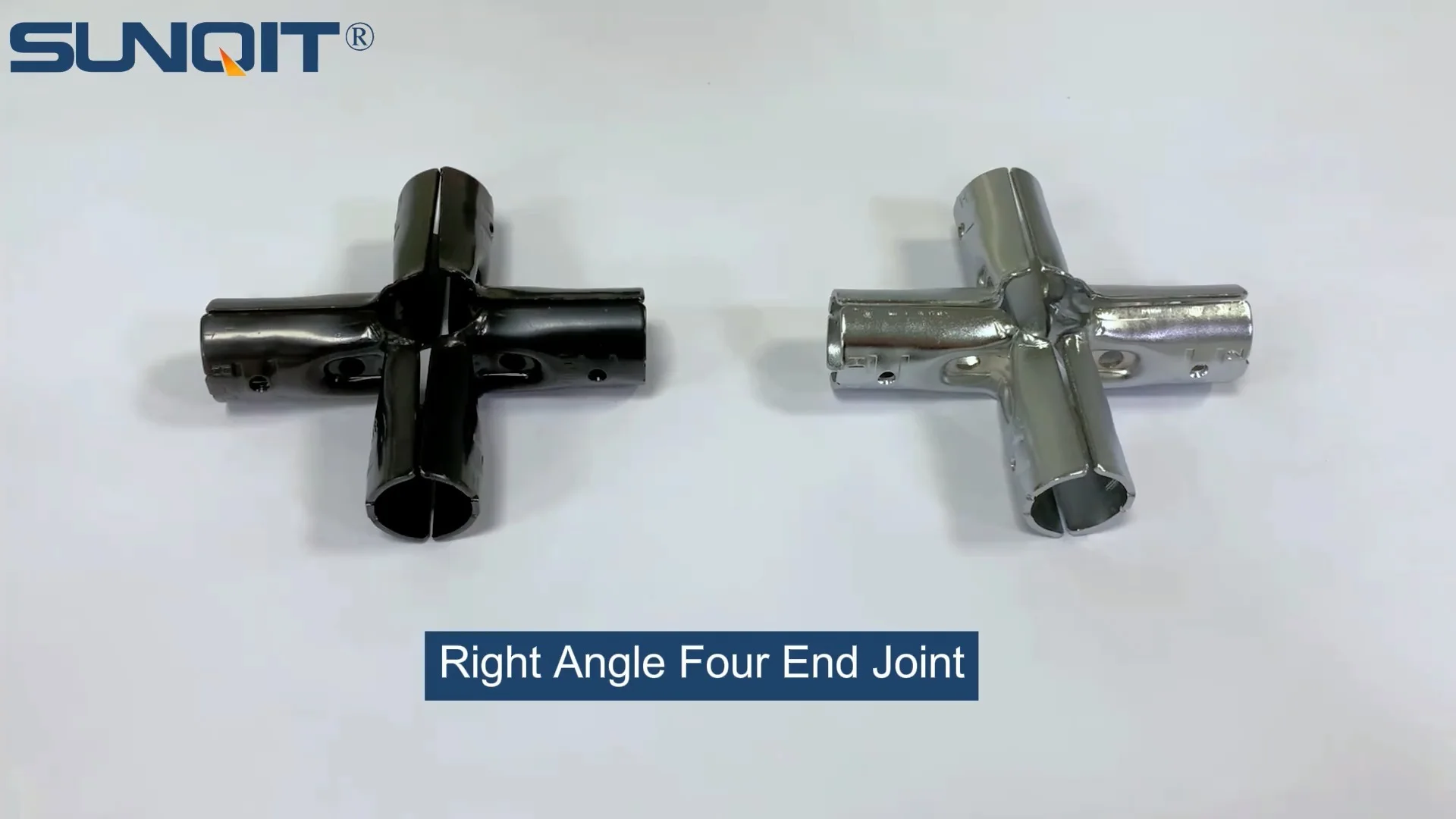
Five way straight lean pipe joint, for 5 pcs 28mm lean pipe connect in straight angle,which used widely in workbench, flow rack, hand trolley frame connection.
The Evolution of Workstations and the Need for Flexibility
Walk into any modern manufacturing facility, warehouse, or assembly plant today, and you'll likely notice a shift from the rigid, one-size-fits-all workstations of the past. Gone are the days of heavy, immovable steel structures bolted to the floor—replaced instead by sleek, modular setups that adapt as quickly as production demands change. This evolution isn't just about aesthetics; it's a response to the pressures of modern business: shorter product lifecycles, customizable orders, and the constant drive to eliminate waste while boosting efficiency. At the heart of this transformation lies the concept of "flexible workstations," and few components are as critical to their design as the lean pipe system. And within that system, the five-way straight lean pipe joint stands out as a quiet innovator, enabling configurations that once seemed impossible.
Think about the challenges manufacturers face daily. A electronics plant might need to retool a production line overnight to accommodate a new smartphone model. A automotive parts supplier could suddenly scale up orders for a critical component, requiring more assembly stations. A warehouse might need to reorganize its picking area to reduce travel time for workers. In each case, rigid workstations become bottlenecks. They take too long to modify, cost too much to replace, and often end up collecting dust when no longer needed. Flexible workstations, by contrast, are designed to evolve—growing, shrinking, or reconfiguring with minimal effort and expense. And that's where lean pipe systems, with their modular pipes and joints, shine.
But what exactly makes a lean pipe system so flexible? It starts with the basics: lightweight pipes, versatile joints, and a design philosophy that prioritizes adaptability. Unlike traditional fixed structures, lean pipe systems are built from components that can be assembled, disassembled, and reassembled repeatedly without losing structural integrity. This modularity not only reduces upfront costs but also minimizes waste, as components can be repurposed when needs change. And among the many joints available in lean pipe systems, the five-way straight lean pipe joint is a standout. As its name suggests, it allows for the connection of five separate pipes at a single point, opening up a world of possibilities for custom configurations. Whether you're building a workbench with integrated tool storage, a flow rack for material handling, or a mobile trolley for transporting goods, this joint is the unsung hero that holds it all together—literally and figuratively.
Understanding Lean Pipe Systems: The Backbone of Modern Manufacturing
Before diving into the specifics of the five-way straight lean pipe joint, it's important to ground ourselves in what lean pipe systems are and why they've become so integral to modern manufacturing. At their core, lean pipe systems—also known as "flexible pipe systems" or "Kitagawa systems," named after their Japanese inventor—are modular construction systems designed to create custom workbenches, racks, trolleys, and other industrial furniture. They consist of two primary components: pipes (typically made of steel, aluminum, or plastic-coated steel) and joints (connectors that link pipes together at various angles). What makes them "lean" is their alignment with lean manufacturing principles: they eliminate waste by being reusable, reduce setup time with quick assembly, and optimize workflow by adapting to specific tasks.
Let's break down the components. The pipes themselves are often 28mm in diameter (though sizes can vary) and come in lengths that can be easily cut to fit specific needs. Early lean pipes were typically steel with a plastic coating (often called "PE coated lean pipe"), which provided durability while protecting delicate parts from scratches. Today, aluminum lean pipe has grown in popularity, thanks to its lighter weight, corrosion resistance, and sleek appearance—especially in industries like electronics or pharmaceuticals where cleanliness and aesthetics matter. Aluminum profile systems, which use extruded aluminum pipes with T-slots for attaching accessories, have also emerged as a complement to traditional lean pipes, offering even more customization options with accessories like brackets, shelves, and tool holders.
Then there are the joints—the unsung heroes of the system. Joints come in countless shapes and sizes, each designed for a specific purpose: 90-degree joints for corners, 45-degree joints for angled connections, swivel joints for adjustable components, and so on. They're typically made of die-cast aluminum or steel, with internal mechanisms (like set screws or friction clamps) that secure the pipes in place. The beauty of these joints is their simplicity: no welding or specialized tools are needed. With a hex key or a simple wrench, workers can assemble or disassemble a workstation in minutes, not hours.
The benefits of lean pipe systems are hard to overstate. First, they're cost-effective. Compared to custom-built steel furniture, lean pipe systems cost a fraction of the price, especially when considering their reusability. If a workstation is no longer needed, its components can be stripped down and rebuilt into something else—a shelving unit, a trolley, or a new workbench. Second, they're adaptable. Need to add a shelf to a workbench? Just cut a few pipes, attach some joints, and you're done. Want to raise the height of a flow rack? Swap out shorter pipes for longer ones. Third, they're lightweight yet durable. Aluminum and plastic-coated steel pipes are easy to maneuver during assembly, but when properly joined, they can support significant weight—often up to several hundred kilograms, depending on the configuration. Finally, they promote a culture of continuous improvement. Since workers can easily modify their own workstations, they're more likely to take ownership of their space, suggesting tweaks that boost their productivity or comfort.
Common applications of lean pipe systems include workbenches (think assembly stations, packing areas, or quality control desks), flow racks (used to store and transport materials from receiving to production lines), turnover trolleys (mobile carts for moving goods between departments), and material racks (for organizing tools, parts, or finished products). In each case, the system's modularity ensures that the setup can evolve with the task at hand. And at the center of many of these configurations lies the five-way straight lean pipe joint—a component that, despite its unassuming name, unlocks a level of versatility that simpler joints can't match.

The Five-Way Straight Lean Pipe Joint: A Closer Look at Its Design
If lean pipe systems are the backbone of flexible workstations, then the five-way straight lean pipe joint is the vertebra that allows for multidirectional movement and support. At first glance, it might look like just another metal connector, but a closer inspection reveals a design engineered for both simplicity and performance. Let's start with the basics: what is a five-way straight lean pipe joint? As the name suggests, it's a joint that allows five separate lean pipes to connect at a single point. Typically, this means four pipes aligned in a horizontal plane (like the points of a compass) and one pipe extending vertically—though configurations can vary based on the manufacturer. This design makes it ideal for creating structures that need support in multiple directions, such as a workbench with shelves above, tool rails on the sides, and a lower shelf for storage.
But why five ways? Why not just use multiple three-way or four-way joints? The answer lies in efficiency and stability. Using a single five-way joint eliminates the need for overlapping joints, which can create weak points or add unnecessary bulk. It also ensures that all connected pipes share a common anchor point, distributing weight more evenly across the structure. Imagine building a workbench with a shelf above: using a five-way joint, you can connect the vertical legs of the bench, the horizontal frame of the lower work surface, and the horizontal frame of the upper shelf—all in one go. Without the five-way joint, you'd need separate joints for each connection, increasing assembly time and the risk of misalignment.
Core Design Principles: The Five Pillars of the Five-Way Joint
The design of the five-way straight lean pipe joint isn't arbitrary. It's guided by five core principles that ensure it meets the demands of industrial environments. Let's explore each one:
| Design Principle | Description |
|---|---|
| Load Distribution | The joint is engineered to distribute weight evenly across all connected pipes, preventing stress concentrations that could lead to bending or failure. Internal ribbing and reinforced contact points ensure that vertical loads (like the weight of a shelf full of parts) and horizontal loads (like the push/pull of materials on a flow rack) are spread out. |
| Ease of Connection | Despite its complexity, the joint is designed for quick, tool-based assembly. Most models use set screws (often with hex heads) that tighten against the pipe, creating a secure friction fit. No welding, glue, or specialized training is needed—just a hex key and a few minutes of work. |
| Compatibility | The joint is universal, fitting standard lean pipe sizes (typically 28mm outer diameter for steel pipes or 30mm for aluminum). This ensures it works seamlessly with other components from the same system, as well as with aluminum profile accessories like brackets or shelves. |
| Durability | Constructed from high-strength materials (usually die-cast aluminum or steel), the joint is built to withstand the wear and tear of industrial use. Corrosion-resistant coatings (like chrome plating for steel or anodization for aluminum) protect against rust, while precision machining ensures a tight fit that doesn't loosen over time. |
| Adaptability | The joint's five-way design isn't just about connecting pipes—it's about enabling endless configurations. Whether you need to build a T-shape, a cross, or a multi-level structure, the joint adapts to the task, eliminating the need for custom parts. |
Material Selection: Aluminum vs. Steel—Choosing the Right Joint for the Job
The performance of a five-way straight lean pipe joint depends heavily on the materials used in its construction. The two most common options are aluminum and steel, each with its own strengths and ideal applications.
Aluminum joints are lightweight (up to 40% lighter than steel equivalents), making them easier to handle during assembly and reducing the overall weight of the workstation—critical for mobile setups like turnover trolleys with caster wheels. They're also naturally corrosion-resistant, thanks to a thin oxide layer that forms on the surface, making them a good choice for humid environments or industries like food processing or pharmaceuticals where cleanliness is key. Aluminum joints are often anodized (a process that thickens the oxide layer) for added durability and a sleek, professional finish. However, they have lower tensile strength than steel, so they're best suited for medium-weight applications, such as workbenches or light-duty flow racks.
Steel joints, by contrast, are all about strength. Made from high-carbon steel (often with a plastic or chrome coating), they can support heavier loads—think industrial workbenches with heavy machinery or flow racks storing metal parts. Steel is also more rigid, which helps maintain structural integrity in high-vibration environments (like near manufacturing equipment). The downside? Steel is heavier, which can make assembly more labor-intensive, and it's prone to rust if not properly coated. For this reason, steel joints are often used in heavy manufacturing or outdoor settings where durability trumps weight.
A newer player in the market is the stainless steel joint, which combines the strength of steel with the corrosion resistance of aluminum. Stainless steel is ideal for cleanrooms, medical device manufacturing, or marine environments, where exposure to chemicals or saltwater would quickly degrade other materials. However, it comes with a higher price tag, so it's typically reserved for specialized applications.
Engineering for Durability and Adaptability
Beyond material selection, the engineering of the five-way joint is a study in balancing form and function. Let's take a closer look at the internal mechanics. Most joints feature a central hub with five equally spaced ports (one for each pipe). Each port contains a threaded hole for a set screw, which, when tightened, presses against the pipe, creating friction that holds it in place. The key here is precision: the ports must be aligned perfectly to ensure pipes connect at the correct angles (usually 90 degrees for straight joints), and the set screws must bite into the pipe without damaging it. Some manufacturers use knurled set screws (with a textured surface) to improve grip, while others add rubber O-rings inside the ports to dampen vibration and prevent loosening over time.
Another engineering consideration is the joint's profile. A low-profile design (with minimal protrusion from the pipes) is preferred, as it reduces the risk of workers bumping into sharp edges or materials getting caught on the joint. Rounded corners and smooth surfaces are standard, enhancing both safety and aesthetics. For applications where space is tight—like under a workbench or inside a flow rack—some manufacturers offer compact versions of the five-way joint, with shorter ports that keep the overall size down.
Perhaps the most innovative aspect of the five-way joint's design is its reusability. Unlike welded connections, which are permanent, the joint can be disassembled and reassembled dozens of times without losing functionality. This aligns perfectly with lean manufacturing principles, as it allows components to be repurposed rather than discarded. A joint that once held together a workbench can, with a few twists of a hex key, be reused to build a new flow rack or trolley—reducing waste and lowering long-term costs.

Practical Applications: How the Five-Way Joint Transforms Workspaces
Theory is important, but the true value of the five-way straight lean pipe joint lies in its real-world applications. Let's explore how this unassuming component is used to build the flexible workstations that power modern manufacturing, warehousing, and assembly.
Workbenches: Custom Configurations for Every Task
Workbenches are the most common application for lean pipe systems, and the five-way joint is often the key to making them truly functional. Consider a typical assembly workbench in an electronics plant. The base might consist of four vertical lean pipes (the legs), connected at the bottom by horizontal pipes (for stability) and at the top by a rectangular frame (to support the work surface). But to make this workbench useful, you need more: a shelf above for tools, a bin below for scrap materials, a light bar overhead, and maybe a power strip for tools. This is where the five-way joint comes in.
At each corner of the top frame, a five-way joint can connect the vertical leg, the horizontal frame pipe, and three additional pipes: one extending upward (to support the overhead shelf), one extending outward (to hold the light bar), and one extending downward (to attach the lower bin). This single joint eliminates the need for multiple separate connectors, streamlining the assembly and ensuring all components are securely anchored. Workers can adjust the height of the overhead shelf by moving the joint up or down the vertical leg, or reposition the light bar by rotating the outward pipe—all without disassembly.
In a warehouse packing station, the five-way joint might be used to add a roller track to the edge of the workbench, allowing boxes to slide smoothly from the packing area to a shipping trolley. Or in a quality control lab, it could support a tilted shelf for holding inspection documents, with a small tool rack attached to the side. The possibilities are limited only by imagination—and the number of five-way joints on hand.
Flow Racks: Streamlining Material Movement
Flow racks (also called "gravity flow racks") are designed to move materials from the back of the rack to the front using gravity, reducing the need for manual lifting and speeding up production. They're a staple in lean manufacturing, where minimizing waste (including worker movement) is a priority. Building an effective flow rack requires precise alignment of roller tracks, multiple levels for different part types, and stability to support heavy loads—all of which the five-way joint facilitates.
A typical flow rack might have a frame made of vertical and horizontal lean pipes, with inclined shelves (each fitted with roller track) where bins or boxes rest. The five-way joint is used at the intersections of the vertical frame pipes, horizontal support pipes, and the pipes that hold the roller track. For example, a three-level flow rack would have five-way joints at each vertical column, connecting the main frame, the three shelf supports (one per level), and a diagonal brace for stability. This ensures each shelf is level and securely attached, even when fully loaded with parts.
Aluminum roller track is often used in these racks, thanks to its lightweight and smooth operation. The five-way joint can also support accessories like side guides (to keep bins from sliding off the rack) or dividers (to separate different part types on the same shelf). And because the joint is modular, adding a fourth level or expanding the rack's width is as simple as adding more pipes and joints—no need to replace the entire structure.
Turnover Trolleys: Enhancing Mobility Without Sacrificing Stability
Turnover trolleys (mobile carts) are essential for moving materials between workstations, storage areas, and shipping docks. But building a trolley that's both lightweight and stable is a challenge—one the five-way joint helps solve. The frame of a typical trolley might consist of a rectangular base (with caster wheels attached to the corners) and vertical pipes supporting a shelf or two. To maximize storage space, many trolleys have multiple levels, which require strong, stable connections between the vertical and horizontal pipes.
Here, the five-way joint shines. At each corner of the base frame, a five-way joint can connect the two horizontal base pipes, the vertical pipe, and two diagonal braces (front and back) for stability. This creates a rigid "corner cube" structure that resists twisting, even when the trolley is loaded with heavy parts and rolled over uneven floors. On the vertical pipes, additional five-way joints can support the shelves, allowing them to be adjusted up or down to fit different bin sizes. Some trolleys even include a fold-down handle, attached with a swivel joint, that can be locked into place using—you guessed it—a five-way joint as the anchor point.
The mobility of the trolley is also enhanced by the five-way joint's lightweight design. Aluminum joints, in particular, reduce the overall weight of the trolley, making it easier for workers to push or pull. And because the joint allows for quick disassembly, damaged trolleys can be repaired by replacing individual components (like a bent pipe or a broken joint) rather than the entire cart—saving time and money.
Material Racks: Organizing Chaos with Modular Design
Material racks are used to store everything from raw materials to finished products, and their design must balance accessibility, density, and flexibility. A typical material rack might have multiple vertical columns, horizontal beams for supporting shelves, and dividers to separate different part numbers. The five-way joint is used at the intersections of these components, ensuring the rack can be customized to fit specific storage needs.
For example, a "3 row and 3 floor" material rack (as referenced in some supplier catalogs) would use five-way joints at each vertical column to connect the horizontal beams for each floor. This allows the height of each floor to be adjusted independently—taller for bulky items, shorter for small parts. The joints also support accessories like bin dividers (attached to the horizontal beams) or label holders (to identify contents), making the rack both functional and organized. In high-density storage areas, the five-way joint can even be used to create double-sided racks, with shelves extending from both sides of the vertical columns—doubling storage capacity without increasing the rack's footprint.

Installation and Maintenance: Ensuring Longevity and Performance
Even the best-designed component will underperform if installed incorrectly or neglected. The five-way straight lean pipe joint is no exception. Proper installation and maintenance are critical to ensuring it delivers the durability and flexibility it's designed for. Let's walk through best practices for both.
Best Practices for Assembly
Assembling a lean pipe structure with five-way joints is relatively straightforward, but attention to detail is key. Start by gathering the necessary tools: a hex key (matching the size of the joint's set screws), a tape measure, a pipe cutter (for cutting pipes to length), and a level (to ensure everything is straight). If working with aluminum pipes, you may also need a deburring tool to smooth the edges after cutting, preventing cuts or snags.
Step 1: Plan the configuration. Sketch out the structure (or use a design tool) to determine pipe lengths and joint positions. Measure twice, cut once—wasted pipes are a common source of unnecessary cost. Step 2: Cut pipes to the required lengths, ensuring ends are square (perpendicular to the pipe axis). This ensures a tight fit in the joint's ports. Step 3: insert pipes into the five-way joint's ports, hand-tightening the set screws to hold them in place temporarily. Step 4: Use a level to ensure the structure is plumb (vertical pipes) and level (horizontal pipes). Adjust as needed by sliding pipes in or out of the joints. Step 5: Tighten the set screws fully using the hex key. Be careful not to overtighten—this can strip the threads or damage the pipe. A good rule of thumb is to tighten until you feel resistance, then give an additional quarter-turn.
For large structures (like tall flow racks or wide workbenches), it's best to assemble on a flat surface first, then move the structure into place. Enlist a helper to hold components steady during assembly—this reduces the risk of misalignment. If the structure will support heavy loads, consider using torque wrench to tighten set screws to the manufacturer's recommended torque (usually around 20-25 Nm for steel joints, slightly less for aluminum).
Troubleshooting Common Issues
Even with careful assembly, issues can arise. Here are some common problems and how to fix them:
Loose joints: Over time, vibration or heavy loads can cause set screws to loosen. Check joints monthly and retighten as needed. If a joint repeatedly loosens, inspect the set screw—if it's worn or stripped, replace it. Adding a drop of thread-locking fluid (like Loctite) to the set screw can also help prevent loosening, though this makes disassembly harder if needed later.
Misaligned pipes: If pipes don't line up correctly (e.g., a horizontal shelf is tilted), the joint may have been assembled with pipes inserted at different depths. Disassemble the joint, ensure pipes are inserted equally into the ports, then retighten.
Bent pipes: Pipes can bend if overloaded or hit by heavy equipment. replace bent pipes immediately—they weaken the structure and can cause other joints to loosen. When replacing, cut the new pipe to the same length as the old one to maintain alignment.
Corrosion: Steel joints or pipes may rust if exposed to moisture. Clean rust with a wire brush and apply a corrosion-resistant coating (like spray paint or rust inhibitor). For severe corrosion, replace the component.
Long-Term Care for Maximum ROI
To get the most out of your five-way joints (and the entire lean pipe system), regular maintenance is key. Here's a simple checklist:
- Monthly inspections: Check all joints for tightness, pipes for bends or damage, and accessories (like roller track or caster wheels) for wear.
- Quarterly cleaning: Wipe down pipes and joints with a damp cloth to remove dust and debris. For aluminum components, use a mild detergent to remove grease or oil.
- Annual overhaul: Disassemble heavily used structures (like workbenches or flow racks) completely, clean all components, and replace any worn parts (joints, set screws, or accessories). Reassemble with fresh set screws for a like-new structure.
- Storage of unused components: Keep extra pipes, joints, and accessories in a dry, organized area. Hang pipes horizontally to prevent bending, and store joints in bins to avoid loss.
By following these steps, a lean pipe system with five-way joints can last 10 years or more—far longer than traditional fixed furniture—delivering a strong return on investment.
Choosing the Right Supplier: Key Considerations for Sourcing Lean Pipe Components
The quality of your lean pipe system—including the five-way straight lean pipe joint—depends largely on the supplier you choose. With so many options on the market, it can be overwhelming to decide which supplier to trust. Here are the key factors to consider:
Quality Standards to Look For
Start by checking the supplier's quality control processes. Reputable suppliers will have certifications like ISO 9001 (for quality management) or ISO 14001 (for environmental management), indicating they adhere to strict standards. Ask about material testing: Do they test pipes for tensile strength? Are joints inspected for dimensional accuracy? Can they provide material certificates (like mill test reports) for steel or aluminum components?
Pay attention to the finish of the components. For steel joints, a smooth chrome plating or powder coating indicates attention to detail. For aluminum, anodization (a protective oxide layer) should be uniform and free of scratches. Avoid suppliers with joints that have rough edges, uneven ports, or set screws that feel flimsy—these are signs of poor manufacturing.
Customization Capabilities
While standard components work for most applications, there may be times when you need a custom solution: a longer pipe, a specialized joint angle, or a unique color for safety purposes. Choose a supplier that offers customization options, whether through made-to-order components or modifications to standard parts. Ask about lead times for custom orders—some suppliers can deliver in as little as a week, while others may take months.
Support and Expertise
A good supplier isn't just a seller—they're a partner. Look for suppliers with technical support teams that can help with design questions, troubleshooting, or installation advice. Many suppliers offer CAD drawings or 3D models of their components, making it easier to plan your workstation design. Some even provide on-site consultation to help optimize your layout for maximum efficiency.
Also, consider the supplier's inventory and delivery capabilities. Do they stock common components (like five-way joints, lean pipe, and roller track) for quick shipping? Can they deliver to your location reliably, with minimal delays? For global operations, check if the supplier has international distribution centers to reduce shipping costs and lead times.
Cost vs. Value
Price is always a consideration, but it shouldn't be the only one. A cheap five-way joint might save money upfront, but if it fails after a few months, the cost of replacement and downtime will far exceed the initial savings. Instead, focus on value: the combination of quality, durability, and support. Compare total cost of ownership (TCO) rather than just the purchase price—factoring in lifespan, maintenance costs, and reusability.
Don't hesitate to ask for references. A reputable supplier will be happy to put you in touch with existing customers who can speak to the quality of their products and service. Online reviews and industry forums can also provide insights into a supplier's reputation.
Conclusion: The Future of Flexible Manufacturing with Lean Pipe Innovations
As manufacturing continues to evolve, the demand for flexible workstations will only grow. And at the heart of that flexibility will be lean pipe systems, with the five-way straight lean pipe joint playing a starring role. This unassuming component—with its clever design, durable construction, and endless adaptability—enables the kind of customization and efficiency that modern businesses need to thrive.
From workbenches that adjust to worker height, to flow racks that speed up material handling, to trolleys that move goods with ease, the five-way joint transforms static spaces into dynamic environments that respond to change. It's a testament to the power of simplicity: by focusing on core principles like modularity, durability, and reusability, lean pipe systems prove that sometimes the most innovative solutions are the ones that work with, not against, human ingenuity.
So the next time you walk through a manufacturing facility and admire the sleek, adaptable workstations, take a moment to look closer. Chances are, you'll spot a five-way straight lean pipe joint holding it all together—quietly, reliably, and flexibly. And as technology advances, we can only expect these systems to become more sophisticated, with new materials, smarter joints, and even greater customization options. But for now, the five-way joint remains a cornerstone of lean manufacturing, proving that sometimes the best way to build the future is to start with a simple, well-designed connection.