- Company Articles
- Products and Technology
- Product knowledge
- Flow Racks Built with 3060 National Standard Profile A: Design & Efficiency

Flow Racks Built with 3060 National Standard Profile A: Design & Efficiency
Related Product
3060 National Standard Profile A
Workbench, production line, logistic rack, warehouse rack Industry: Manufacturer workshop, Automobile, Electronic, Assembling, logistic
Walk into any thriving manufacturing facility, and you'll notice a quiet rhythm: parts glide smoothly from one workstation to the next, tools are within arm's reach, and workers move with purpose, not frustration. Behind this harmony often lies a humble yet powerful tool: the flow rack. These unassuming structures—with their sloped shelves and rolling tracks—are the backbone of organized, efficient material handling, ensuring that everything from small components to bulky assemblies reaches the right place at the right time. But not all flow racks are created equal. The difference between a flow rack that slows operations and one that supercharges them? The materials it's built with. And in the world of industrial aluminum profiles, few options stand out like the
3060 National Standard Profile A
.
What Is a Flow Rack, and Why Does It Matter?
Let's start with the basics. A flow rack is a storage system designed to keep materials moving—literally. Typically sloped at a slight angle, its shelves are fitted with
roller track
or ball bearings that allow items to "flow" forward as the front items are removed. This first-in, first-out (FIFO) setup minimizes waste, reduces picking errors, and keeps production lines fed without constant manual restocking. Think of it as a conveyor belt for your inventory: parts arrive at the back, glide to the front, and are ready for use exactly when needed.
In lean manufacturing—where the goal is to eliminate non-value-added activities—flow racks are game-changers. They cut down on time spent searching for parts, reduce overstocking by keeping only what's needed at hand, and free up floor space by utilizing vertical storage. But here's the catch: to deliver these benefits, a flow rack needs to be sturdy enough to handle daily use, flexible enough to adapt to changing needs, and lightweight enough to be reconfigured without heavy machinery. That's where the 3060 National Standard Profile A comes into play.
Meet the Star Material: 3060 National Standard Profile A
If flow racks are the unsung heroes of the factory floor, then aluminum extrusion profiles are their trusty sidekicks. These profiles—long, hollow beams made by forcing aluminum through a die—are the building blocks of modular industrial systems. And among the many profiles available, the 3060 National Standard Profile A stands out for a simple reason: it strikes the perfect balance between strength, versatility, and cost-effectiveness.
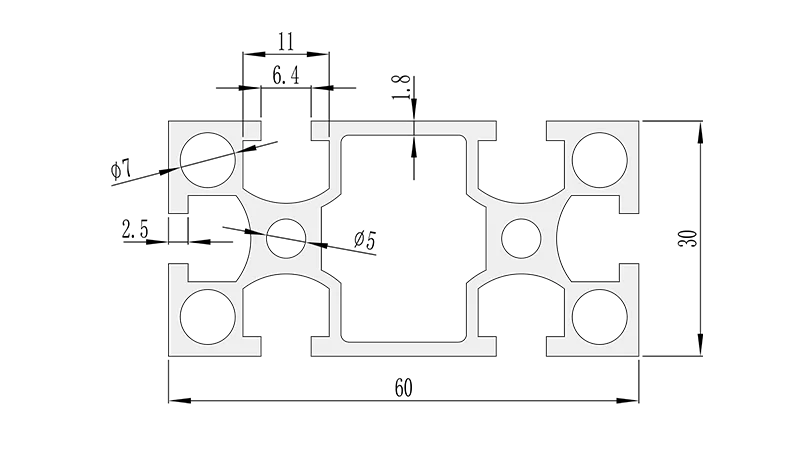
Let's break down the name: "3060" refers to its dimensions—30 millimeters in width and 60 millimeters in height. "National Standard" means it adheres to strict manufacturing guidelines, ensuring consistency across suppliers. And "Profile A" denotes its specific cross-sectional design, which includes T-slots (those handy grooves running along the length) that make attaching accessories a breeze.
So, what makes this profile ideal for flow racks? Let's start with its physical properties. Aluminum is naturally lightweight, which means even a fully assembled flow rack won't require a forklift to move—great for facilities that need to rearrange layouts quickly. But don't let the lightness fool you: the 3060 profile is surprisingly strong. Thanks to its extrusion process, the aluminum is dense and rigid, capable of supporting heavy loads without bending or warping. We're talking about holding hundreds of pounds of parts day in and day out, year after year.
Then there's corrosion resistance. Unlike steel, aluminum doesn't rust, making it perfect for environments where moisture or chemicals are present—think food processing plants or electronics manufacturing facilities. And if you need extra protection, many suppliers offer anodized or powder-coated finishes that add a layer of durability while also letting you match your facility's color scheme (pro tip: yellow or grey roller tracks pop nicely against silver aluminum).
But perhaps the biggest advantage of the 3060 profile is its modularity. Those T-slots we mentioned? They're like the Swiss Army knife of industrial design. With the right
aluminum profile accessories
—connectors, brackets, end caps, and even roller track mounts—you can build a flow rack that's tailored to your exact needs. Need an extra shelf? Slide in a bracket. Want to adjust the angle of the roller track? Tighten a bolt in the T-slot. This modularity means your flow rack isn't a one-and-done purchase; it's an investment that can grow and change with your business.
Designing a Flow Rack with 3060 Profile A: From Idea to Assembly
Building a flow rack with 3060 National Standard Profile A isn't rocket science, but it does require some planning. Let's walk through the design process step by step, so you can see how this profile shines in real-world applications.
Step 1: Define Your Needs
Before picking up a single profile, ask: What will the flow rack hold? Small electronic components? Heavy automotive parts? The weight and size of your items will dictate the rack's dimensions and load capacity. For example, if you're storing 50-pound toolboxes, you'll need sturdier supports than if you're organizing screws and washers. The 3060 profile is versatile enough for both—just adjust the spacing between vertical supports.
Next, consider the workflow. Where will the rack be placed? Will workers access it from one side or both? How many levels do you need? A typical flow rack has 2-4 levels, but with the 3060 profile's strength, you could add more if space allows. Also, think about the angle of the roller track: steeper angles work for lighter items, while heavier parts need a gentler slope to prevent sliding too quickly.
Step 2: Choose Your Accessories
Here's where the 3060 profile's T-slots really shine. To build a functional flow rack, you'll need more than just the profile itself—you'll need accessories to hold everything together and make the rack "flow." Let's start with the basics:
- Roller Track: The heart of the flow rack. These tracks, often made of steel or aluminum, contain rollers or balls that let items glide forward. For 3060 profiles, look for roller tracks designed to mount directly into T-slots using roller track placon mount for aluminum profile flat —these handy brackets secure the track to the profile without drilling.
- Connectors: To join profiles at corners or intersections, you'll need 90° aluminum profile connectors. These fit into the T-slots and tighten with bolts, creating a strong, wobble-free joint.
- End Caps: These plastic or rubber caps snap onto the ends of the profiles, preventing sharp edges and keeping dust out of the T-slots.
- Leveling Feet: To keep the rack stable on uneven floors, adjustable leveling feet screw into the bottom of vertical profiles. Look for anti-slip versions to prevent movement.
The beauty of these accessories is that they're standardized. That means you can mix and match from different suppliers (though sticking with a single
flow rack supplier
often ensures better compatibility). And if you need to reconfigure later, just unscrew the accessories and start fresh—no cutting or welding required.
Step 3: Assemble Like Building Blocks
Once you have your profiles and accessories, assembly is surprisingly straightforward. Think of it like putting together a giant Erector set. Start by cutting the 3060 profiles to your desired lengths (most suppliers will do this for you, saving time). Then, use connectors to build the frame: vertical posts for height, horizontal beams for width, and cross-braces for stability.
Next, attach the roller track to the horizontal beams using placon mounts. Make sure the track is sloped slightly—usually 5-10 degrees—to encourage flow. Finally, add end stops at the front of each track to prevent items from sliding off, and level the rack with the adjustable feet. In less than an hour, you've got a custom flow rack ready to boost your workflow.
Efficiency in Action: How 3060 Flow Racks Transform Workflows
Okay, so we've talked about design and materials—but how does a flow rack built with 3060 National Standard Profile A actually improve efficiency? Let's look at a real-world example to see the impact.
Imagine a mid-sized electronics manufacturer that assembles smartphones. Before using flow racks, their assembly line workers spent 15 minutes per hour walking to a central storeroom to fetch components like circuit boards, batteries, and screens. Parts were often misplaced, leading to delays, and overstocking was common to avoid running out—wasting valuable shelf space.
Then, they invested in flow racks built with 3060 profiles. Each workstation now has a dedicated flow rack holding exactly the parts needed for that step: screens on the top level, batteries on the middle, circuit boards on the bottom. Parts arrive at the back of the rack via a small conveyor, glide forward as needed, and workers simply reach over and grab what they need—no more walking, no more searching.
The results? Picking time dropped by 75%, freeing up workers to focus on assembly. Overstocking decreased by 40% because the flow rack's FIFO system ensured parts were used before they expired. And because the racks are lightweight, the facility was able to rearrange the assembly line to accommodate a new product line in just a day—something that would have taken a week with steel racks.
This isn't just anecdotal. Studies show that well-designed flow racks can increase productivity by 20-30% in manufacturing settings. And when those racks are built with modular materials like 3060 profile, the benefits compound over time—adaptable to new products, scalable with growth, and durable enough to last for years.
3060 Profile vs. the Competition: Why It's the Smart Choice
You might be wondering: Why not use a different profile or material? Let's compare the 3060 National Standard Profile A to some common alternatives to see why it's the top pick for flow racks.
| Feature | 3060 National Standard Profile A (Aluminum) | 4040 Aluminum Profile | Steel Angle Iron | Plastic Shelving |
|---|---|---|---|---|
| Dimensions | 30mm x 60mm | 40mm x 40mm | Varies (typically 25mm x 25mm) | Varies by brand |
| Weight (per meter) | ~1.2kg | ~1.8kg | ~3.5kg (mild steel) | ~0.5kg |
| Max Load Capacity (per shelf) | 150-200kg | 200-250kg | 300-400kg | 30-50kg |
| Modularity | High (T-slots for easy accessory attachment) | High (similar T-slot design) | Low (requires welding or drilling) | Low (fixed shelves, limited adjustment) |
| Corrosion Resistance | High (natural aluminum oxide layer) | High | Low (rusts without coating) | High (but prone to cracking) |
| Cost | Moderate | Higher (larger profile) | Low upfront, high long-term (maintenance) | Low upfront, low durability |
| Best For | Medium to heavy loads, modular flow racks | Heavy loads, fixed structures | Extremely heavy loads, permanent installations | Lightweight, temporary storage |
As the table shows, the 3060 profile hits the sweet spot. It's lighter than steel, stronger than plastic, and more affordable than larger aluminum profiles like the 4040. For flow racks—where flexibility and strength are equally important—this balance is invaluable.
Choosing the Right Supplier: What to Look For
Now that you're convinced the 3060 National Standard Profile A is the way to go, the next step is finding a reliable supplier. Not all suppliers are created equal, and the quality of your flow rack depends on the quality of the materials and accessories you use. Here are a few key factors to consider:
- Material Quality: Ensure the aluminum profiles are made from high-grade aluminum (6063-T5 is standard for industrial use) and meet national standards for consistency.
- Accessory Range: Look for a supplier that offers a full line of aluminum profile accessories—connectors, roller tracks, leveling feet, etc.—to avoid compatibility issues.
- Customization: Can they cut profiles to your exact length? Offer custom colors or finishes? The more flexible the supplier, the better they'll meet your unique needs.
- Support: A good supplier should offer technical support, whether it's helping you design your flow rack or troubleshooting assembly issues.
Remember, a flow rack is an investment in your facility's efficiency. Spending a little more on quality materials and a reliable supplier will pay off in the long run with fewer repairs, less downtime, and a rack that grows with your business.
Final Thoughts: Building a Leaner, Smarter Workspace
In the fast-paced world of manufacturing and logistics, every detail matters. Flow racks might not be the most glamorous part of your operation, but they're one of the most impactful. And when those flow racks are built with the right materials—like the 3060 National Standard Profile A—they become more than just storage: they're a tool for leaner, smarter, and more efficient workflows.
From its perfect balance of strength and lightness to its modular design and compatibility with endless accessories, the 3060 profile is the unsung hero of modern flow rack design. It's a material that doesn't just hold parts—it holds the key to a more productive, more adaptable, and more profitable operation.
So, whether you're setting up a new assembly line, revamping an existing workspace, or just looking to cut down on waste, consider the 3060 National Standard Profile A. Your workers will thank you for the easier access to parts, your bottom line will thank you for the boosted productivity, and your facility will thank you for the flexibility to grow. After all, in manufacturing, the best systems are the ones that flow—and with 3060 profile, the possibilities are endless.