- Company Articles
- Products and Technology
- Product knowledge
- Four Way Straight Lean Pipe Joint Chrome: Compatibility with Different Lean Pipe Sizes

Four Way Straight Lean Pipe Joint Chrome: Compatibility with Different Lean Pipe Sizes
Related Product
Four Way Straight Lean Pipe Joint Chrome
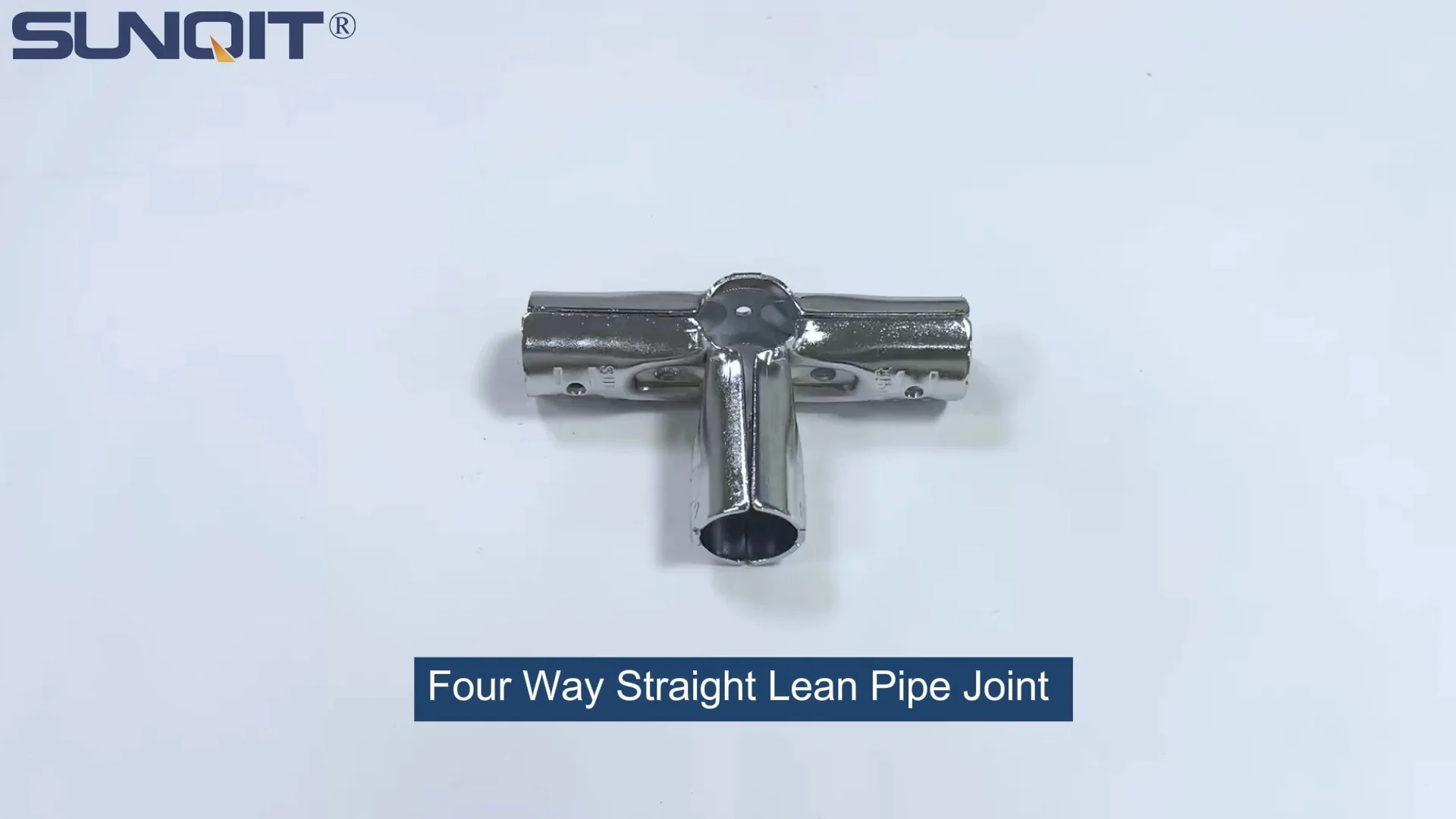
Four way lean pipe joint for 4 pcs 28MM lean pipe connection in straight angle, which used widely in workbench, flow rack, hand trolley frame connection.
Walk into any efficient manufacturing facility, and you'll notice a rhythm—a quiet hum of materials moving, workstations adjusting, and teams collaborating without unnecessary friction. Behind that rhythm lies a carefully designed system, often built on the backbone of lean principles. Lean manufacturing isn't just about cutting costs; it's about creating spaces that adapt to change, reduce waste, and empower people to do their best work. And at the heart of those adaptable spaces? Components like the four way straight lean pipe joint chrome. Small in size but massive in impact, this unassuming connector is the unsung hero that turns rigid structures into flexible, dynamic work environments.
If you've ever struggled with a material rack that couldn't be reconfigured for a new product line, or a conveyor system that took days to adjust, you know the frustration of working with inflexible components. Pipes that don't fit, joints that loosen under pressure, or setups that require custom fabrication—these are the roadblocks that slow down progress. That's why understanding how components like the four way straight lean pipe joint chrome interact with different pipe sizes isn't just a technical detail; it's the key to unlocking the full potential of your lean system.
Understanding Lean Pipe Systems: More Than Just Pipes and Joints
Before we dive into the specifics of the four way straight lean pipe joint chrome, let's take a step back and talk about lean pipe systems as a whole. At their core, these systems are built on the idea that workspaces should be as adaptable as the teams using them. Traditional fixed structures—welded steel racks, permanent conveyor lines—lock you into a single workflow, making it nearly impossible to pivot when product designs change, demand fluctuates, or new efficiency strategies emerge. Lean pipe systems, by contrast, are modular. They use lightweight pipes, connectors, and accessories to create everything from workbenches and material racks to assembly lines and turnover trolleys—all of which can be disassembled, reconfigured, or expanded in hours, not weeks.
The magic of these systems lies in their simplicity. Most lean pipe setups rely on two main components: the pipes themselves and the joints that hold them together. Pipes come in various materials—PE-coated steel, stainless steel, aluminum lean pipe—and sizes, each suited to different loads, environments, and budgets. Joints, on the other hand, determine how those pipes connect: at angles, in straight lines, or in multi-directional configurations. And when it comes to multi-directional connections, few joints are as versatile as the four way straight lean pipe joint chrome.
The Role of Joints in Lean Setups: Why Compatibility Matters
Think of a lean pipe system as a language. Pipes are the words, and joints are the grammar that gives them structure and meaning. A poorly chosen joint—one that doesn't fit the pipe size, or can't handle the load—breaks that grammar, turning a coherent sentence into gibberish. Suddenly, your "adaptable" rack wobbles under weight, your "reconfigurable" workstation takes hours to adjust, or your "durable" conveyor line starts to sag. That's why compatibility between joints and pipes isn't just a box to check on a spec sheet; it's the foundation of safety, efficiency, and longevity.
Take, for example, a small electronics manufacturer that recently switched to producing a new, larger circuit board. Their existing material rack, built with 1.2mm PE-coated lean pipe and basic two-way joints, couldn't be widened to accommodate the bigger boards. Instead of buying a whole new rack, they wanted to reconfigure the existing one by adding a crossbar. But when they tried to connect the new pipe to the old joints, they realized the joints were too rigid—they couldn't support the extra weight or the multi-directional stress of the crossbar. The solution? Swapping out those basic joints for four way straight lean pipe joint chrome. Suddenly, they could add crossbars, adjust shelf heights, and even extend the rack—all without replacing the pipes themselves. That's the power of a compatible, well-designed joint.
Deep Dive: What Makes the Four Way Straight Lean Pipe Joint Chrome Unique?
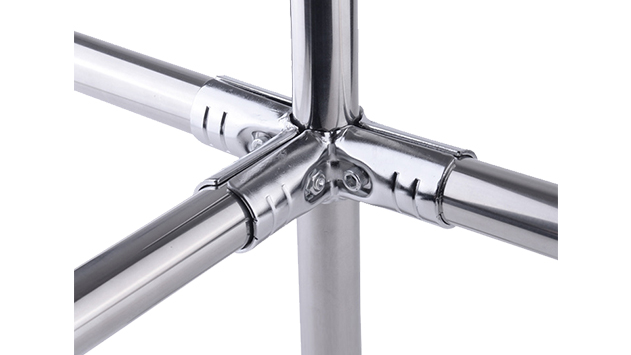
Let's get up close with the star of the show: the four way straight lean pipe joint chrome. At first glance, it might look like any other connector—a small, metallic piece with ports for pipes. But look closer, and you'll notice the details that set it apart. First, the chrome plating. Unlike uncoated or painted joints, chrome-plated ones offer superior corrosion resistance, making them ideal for environments with moisture, oils, or chemicals—think automotive plants or food processing facilities. The chrome finish also adds a layer of durability, reducing wear from repeated assembly and disassembly.
Then there's the design: four ports, all aligned in a straight, perpendicular configuration (two along one axis, two along the other), allowing pipes to connect in four directions. This isn't just about adding more pipes; it's about creating stable, multi-dimensional structures. Need a workbench with a side shelf and a overhead tool rack? The four-way joint lets you connect horizontal pipes for the bench, vertical pipes for the legs, and diagonal supports for stability—all in one compact connector. And unlike some multi-way joints that require special tools or adhesives, most four way straight lean pipe joint chrome models use simple set screws or clamping mechanisms, making installation and adjustments a one-person job.
But perhaps the most critical feature is its engineered tolerance. Lean pipes come in different wall thicknesses, outer diameters, and materials—from 1.0mm PE-coated steel to 2.0mm stainless steel, or lightweight aluminum lean pipe. A well-designed four-way joint accounts for these variations, with internal dimensions that grip pipes securely without damaging them. It's this tolerance that makes compatibility possible across so many pipe sizes.

Compatibility Factors: What Determines If a Pipe and Joint Work Together?
So, how do you know if a four way straight lean pipe joint chrome will work with your existing pipes? It all comes down to a few key factors. Let's break them down:
1. Outer Diameter (OD) of the Pipe: This is the most critical measurement. Joints are designed to fit a specific range of pipe ODs. For example, a standard four-way joint might be sized for 28mm OD pipes, which is common for PE-coated lean pipe. If your pipe has an OD of 25mm (like some stainless steel pipes) or 30mm (like certain aluminum lean pipes), you'll need to check if the joint can accommodate that—or if an adapter is required.
2. Wall Thickness: Even pipes with the same OD can have different wall thicknesses, which affects how tightly the joint grips them. A 1.2mm PE-coated pipe will be slightly more flexible than a 2.0mm stainless steel pipe of the same OD. The joint's clamping mechanism (set screws, friction fit, etc.) needs to account for this to ensure a secure hold without crushing the pipe.
3. Pipe Material: Aluminum lean pipe, for instance, is softer than steel. A joint that works perfectly with a rigid steel pipe might damage aluminum if over-tightened. Similarly, PE-coated pipes have a plastic layer that can wear if the joint's internal edges are too sharp. High-quality four-way joints often have rounded internal edges or rubberized grips to protect coated or soft materials.
4. Load Capacity: Compatibility isn't just about fit—it's about performance under pressure. A joint that fits a 2.0mm steel pipe might still fail if the pipe is carrying a load heavier than the joint's rated capacity. Always check the joint's load specs (usually listed in kilograms or pounds per port) and ensure it aligns with your application.
Compatibility Chart: Four Way Straight Lean Pipe Joint Chrome and Common Pipe Sizes
| Pipe Type | Wall Thickness (mm) | Outer Diameter (mm) | Compatible with Four-Way Joint? | Installation Tips |
|---|---|---|---|---|
| PE Coated Lean Pipe | 1.0mm | 28mm | Yes | Use minimal torque on set screws to avoid piercing the PE coating; ideal for light-duty racks. |
| PE Coated Lean Pipe | 1.2mm | 28mm | Yes | Most common size; standard torque (15-20 Nm) works well for general use like workbenches. |
| PE Coated Lean Pipe | 1.5mm | 28mm | Yes | Tighter fit due to thicker walls; hand-tighten first, then secure with a hex key. |
| PE Coated Lean Pipe | 2.0mm | 28mm | Yes | For heavy-duty applications (e.g., loaded material racks); ensure joint is rated for ≥50kg per port. |
| Stainless Steel Pipe | 1.2mm | 25mm | Yes (with adapter) | Use a 25mm-to-28mm stainless steel adapter to fit the joint's 28mm ports. |
| Aluminum Lean Pipe | 1.2mm | 30mm | Yes (with oversized joint) | Look for four-way joints specifically designed for 30mm OD aluminum pipes; avoid over-tightening to prevent bending. |
| Stainless Steel Pipe | 2.0mm | 28mm | Yes | Chrome-plated joints pair well with stainless steel for corrosion resistance; ideal for cleanrooms. |
Note: Compatibility can vary by manufacturer. Always test a small sample of pipes and joints before full-scale installation.
Real-World Applications: How Compatibility Solves Everyday Problems
Let's ground this in real scenarios—because knowing the specs is one thing, but seeing how they solve problems is where it clicks. Take Maria, a facility manager at a mid-sized automotive parts plant. Her team recently needed to reconfigure their assembly line to accommodate a new component that was 10cm longer than the old one. The existing line used 1.5mm PE-coated lean pipe with basic two-way joints, and the material racks along the line were too narrow. Maria's first thought was to buy new racks, but that would take weeks and blow her quarterly budget.
Instead, she turned to the four way straight lean pipe joint chrome. By swapping out the two-way joints on the rack posts with four-way ones, her team could add horizontal extension pipes to widen the racks by 15cm—more than enough for the new component. They reused the existing pipes, only buying a handful of new joints and a few extra pipes for the extensions. The entire project took one afternoon, cost a fraction of new racks, and the team could even adjust the width again later if needed. "It wasn't just about saving money," Maria said. "It was about keeping our production line running without skipping a beat. The four-way joints made that possible."
Another example: Raj, a warehouse supervisor at an e-commerce fulfillment center. His team was struggling with a static picking rack that couldn't keep up with seasonal demand spikes. During peak times, they needed extra shelving, but during slow periods, the extra shelves took up valuable floor space. Using 1.2mm PE-coated lean pipe and four way straight lean pipe joint chrome, Raj's team built a modular rack system. When demand spiked, they added vertical pipes and crossbars (connected via four-way joints) to create extra levels. When demand dropped, they disassembled the extra levels and stored the pipes and joints—no wasted space, no wasted money.
Choosing the Right Supplier: Why Quality Matters for Compatibility
You've got the specs, you've checked the compatibility chart, and you're ready to buy—now what? Choosing the right lean pipe supplier is just as important as choosing the right joint. Not all suppliers are created equal, and even a well-designed joint can fail if it's made with subpar materials or shoddy manufacturing.
Start by looking for suppliers who specialize in lean pipe components, not just general hardware. These suppliers understand the nuances of lean systems and can help you navigate compatibility questions. Ask for material certificates: Reputable suppliers will provide details on the metal alloys used in the joint (e.g., zinc alloy, steel) and the thickness of the chrome plating. Avoid joints that feel lightweight or have rough, unfinished edges—these are red flags for poor quality.
Also, don't underestimate the value of technical support. A good supplier won't just sell you a joint and disappear; they'll help you test compatibility with your existing pipes, recommend installation tools, and troubleshoot issues if they arise. Some suppliers even offer sample kits—small sets of pipes, joints, and accessories—so you can test configurations before placing a large order. As Raj put it, "The best supplier we worked with didn't just send us a catalog. They sent a technician to our warehouse to look at our existing setup and make sure the four-way joints would work with our pipes. That level of support made all the difference."
Troubleshooting Compatibility Issues: When Pipes and Joints Don't Play Nice
Even with careful planning, you might run into compatibility hiccups. Here's how to troubleshoot common issues:
Pipes are loose in the joint: First, check if you're using the correct pipe OD. If the pipe is too small, an adapter might be needed. If the OD is correct, ensure the set screws are tight (but not over-tightened—stripping the screws will make things worse). For PE-coated pipes, loose connections might mean the coating is worn; try wrapping a thin layer of electrical tape around the pipe end for a tighter fit (temporary fix) or replace the pipe.
Pipes won't fit into the joint: This is usually an OD mismatch. Measure the pipe with a caliper—sometimes "standard" sizes vary by manufacturer. If the pipe is slightly oversized, check if the joint has a split design (some do, to allow minor expansion). If not, sanding the pipe end lightly (for metal pipes) or warming the PE coating (for plastic-coated pipes) might help—use caution to avoid damaging the pipe.
Joints loosen under load: This could be a load capacity issue. Check the joint's rated load and compare it to the weight of your materials. If the load is within spec, the issue might be installation: ensure all pipes are cut straight (angled cuts cause uneven stress) and that joints are spaced evenly to distribute weight.
Future Trends: Where Lean Pipe Components Are Headed
As manufacturing and warehousing evolve, so too do the components that power lean systems. What does the future hold for joints like the four way straight lean pipe joint chrome? One trend is smart integration: imagine joints with built-in sensors that alert you when a connection is loose or a pipe is under excessive stress. This could prevent failures before they happen, reducing downtime and improving safety.
Another trend is material innovation. While chrome plating is currently the gold standard for durability, we might see more eco-friendly coatings or composite materials that offer the same strength with less environmental impact. Lightweight materials like carbon fiber-reinforced polymers could also become more common, making joints easier to handle without sacrificing load capacity.
And as automation becomes more prevalent, lean pipe systems will need to work seamlessly with robots and automated guided vehicles (AGVs). This means joints and pipes that can integrate with sensors, cable management systems, and even power delivery—turning simple racks into smart, connected workstations.
Final Thoughts: The Power of Compatibility in Lean Systems
At the end of the day, the four way straight lean pipe joint chrome is more than just a connector. It's a symbol of what lean manufacturing is all about: flexibility, efficiency, and the belief that workspaces should adapt to people, not the other way around. By understanding how this joint interacts with different pipe sizes—from 1.2mm PE-coated lean pipe to sturdy stainless steel—you're not just solving a technical problem; you're building a foundation for a workspace that can grow, change, and thrive.
Whether you're a facility manager reconfiguring a production line, a small business owner building your first workspace, or a team lead looking to empower your crew with better tools, remember this: the best lean systems aren't built with the most expensive components—they're built with the right components. And when it comes to connecting those components, few do it better than the four way straight lean pipe joint chrome. It's not just about pipes and joints; it's about creating spaces where your team can focus on what matters—making great products, serving customers, and driving success.