- Company Articles
- Products and Technology
- Product knowledge
- Four Way Straight Lean Pipe Joint Chrome: Cost-Effective Solutions for Startups

Four Way Straight Lean Pipe Joint Chrome: Cost-Effective Solutions for Startups
Related Product
Four Way Straight Lean Pipe Joint Chrome
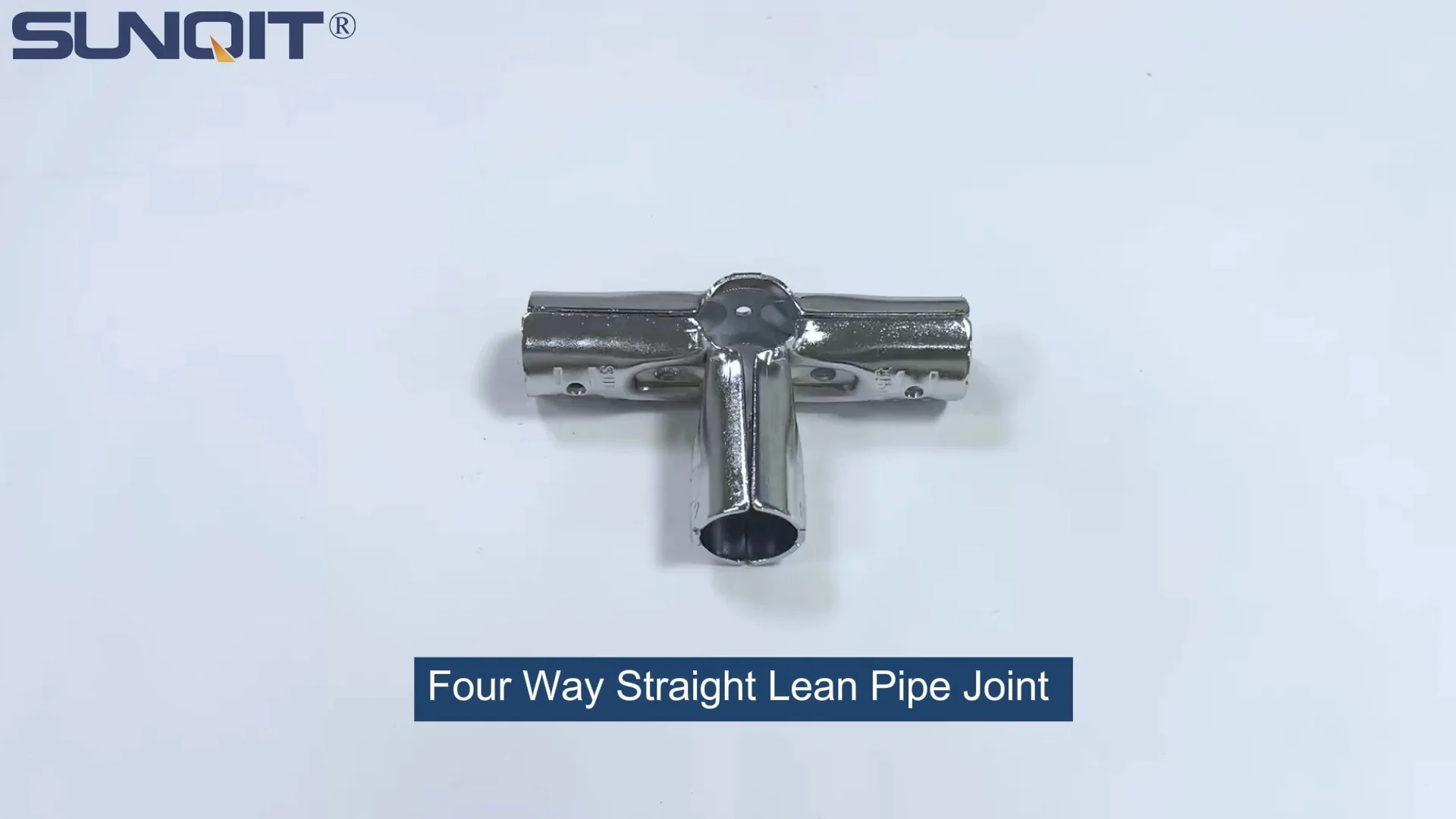
Four way lean pipe joint for 4 pcs 28MM lean pipe connection in straight angle, which used widely in workbench, flow rack, hand trolley frame connection.
Starting a business is like building a house with a shoestring budget—you need every nail, plank, and beam to pull double duty. For startups, especially those in manufacturing, logistics, or assembly, the pressure to do more with less is constant. You're not just trying to turn a profit; you're trying to build a foundation that can scale, adapt, and survive the inevitable pivots. That's where lean systems come in. And at the heart of these systems, often overlooked but absolutely critical, is a small but mighty component: the Four Way Straight Lean Pipe Joint Chrome .
If you're new to lean manufacturing, you might be wondering: "What's the big deal about a joint?" But here's the thing: lean systems are all about modularity, flexibility, and cost-savings. They let you build, break down, and rebuild workstations, racks, and trolleys as your needs change—without shelling out for custom metal fabrication or expensive pre-built equipment. And the Four Way Straight Lean Pipe Joint Chrome? It's the unsung hero that makes this modular magic possible. Let's dive into why this humble joint deserves a spot on your startup's must-have list.
The Startup Struggle: Why Rigid Systems Fail
Let's start with the obvious: startups don't have the luxury of big budgets. When you're bootstrapping, every dollar spent on equipment is a dollar not spent on hiring, R&D, or marketing. Traditional manufacturing setups—think heavy steel workbenches, fixed shelving, or custom conveyor systems—are the opposite of startup-friendly. They're expensive (we're talking $1,000+ for a single workstation), hard to modify, and if your product line changes or you move to a smaller space? You're stuck with a white elephant.
Take a hypothetical example: Sarah runs a startup that assembles small IoT devices. She leases a 500 sq ft warehouse and needs three workstations, a place to store components, and a way to move parts between stations. If she buys pre-built steel workbenches ($800 each), a static shelving unit ($500), and a basic conveyor ($1,200), she's already out $3,100. Six months later, she lands a bigger client and needs to add two more workstations. Now she's looking at another $1,600—and if she moves to a larger space next year? Those fixed workbenches might not fit the new layout. Suddenly, that "investment" becomes a liability.
This is where lean systems shine. Instead of buying rigid, one-size-fits-all equipment, you build with lean pipe (think lightweight, durable tubes) and joints. Need a new workstation? Grab some pipes, a few joints, and assemble it in an hour. Need to reconfigure your material flow? Take apart the old setup and rebuild it in the afternoon. And the cost? A fraction of traditional systems. Which brings us back to the star of the show: the Four Way Straight Lean Pipe Joint Chrome.
What Is the Four Way Straight Lean Pipe Joint Chrome, Anyway?
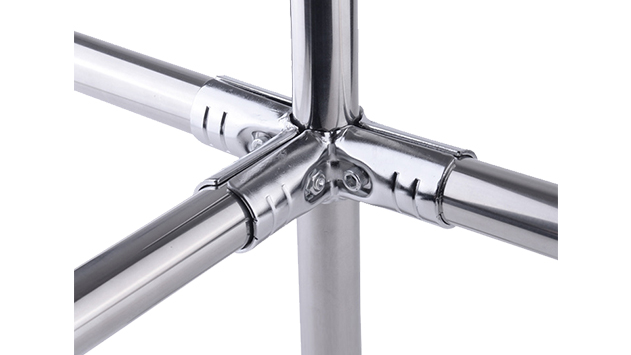
Let's keep it simple: the Four Way Straight Lean Pipe Joint Chrome is a connector that lets you join four pieces of lean pipe at 90-degree angles. Picture a small cube with threaded holes on four sides (up, down, left, right) that screws onto the ends of lean pipes. It's made of high-quality steel with a chrome plating, which means it's resistant to rust, easy to clean, and strong enough to support the weight of tools, components, or even small machinery.
But its real superpower? Versatility. With this joint, you can build almost anything: a cube-shaped material rack, the frame of a workstation, or the base of a mobile trolley. Unlike welded joints or one-off brackets, it's reusable. Unscrew it, move it, and reuse it in a new project. For startups, that reusability is gold. You're not just buying a joint—you're buying a tool that can adapt as your business grows.
Let's break down its key features:
- Chrome Plating: Prevents corrosion, which is crucial if your workspace is humid (looking at you, coastal startups) or if you're handling liquids. It also gives a clean, professional look—no more rust stains on your workbench.
- Standard Sizing: Fits most 28mm lean pipes (the industry standard), so you won't get locked into a proprietary system. Mix and match pipes from different suppliers without worrying about compatibility.
- No Tools Needed (Mostly): Many models twist-lock onto pipes, so you can assemble a basic structure in minutes. No welding, no drilling, no calling a handyman.
- Weight Capacity: A single joint can support up to 50kg (depending on the pipe thickness), which is more than enough for most startup tasks—think holding a laptop, tools, and a bin of components on a workstation.
Building Blocks: How the Joint Powers Lean Systems
Okay, so the joint is versatile. But how does that translate into real-world solutions for startups? Let's look at three common startup needs and how the Four Way Straight Lean Pipe Joint Chrome solves them.
1. Lean Pipe Workbenches: Your Startup's Swiss Army Knife
A workstation is the cornerstone of any assembly or packing operation. With the Four Way Straight Lean Pipe Joint Chrome, you can build a custom lean pipe workbench for a fraction of the cost of a pre-built one. Here's how:
Start with four vertical pipes (say, 1.2m tall) as legs. Use four Four Way Joints to connect horizontal pipes at the top (for the tabletop frame) and halfway up (for a lower shelf). Add a plywood or aluminum top, and boom—you've got a workstation. But wait, it gets better. Want to add a pegboard for tools? Use two more joints to attach vertical pipes on the back. Need a bin for scrap? Screw a small shelf to the side with a few joints. And if Sarah (from our earlier example) needs to add a second level later? Just add two more horizontal pipes and joints—no need to buy a new bench.
Cost breakdown: A pre-built steel workbench costs ~$800. A lean pipe workbench? $200 for pipes, $50 for joints (including the four way ones), and $30 for a plywood top. Total: $280. That's a 65% savings per workstation. For three workstations, Sarah saves $1,560—enough to hire a part-time assistant for a month.
2. Flow Racks: Keeping Materials Moving (Without the Conveyor Price Tag)
If your startup involves assembly, you know that time wasted fetching parts is time not spent building products. Flow racks solve this by using gravity to feed components to your workstation—think a sloped shelf where bins slide forward as you take the front one. Traditional flow racks are expensive, but with the Four Way Straight Lean Pipe Joint Chrome, you can build one in an afternoon.
Here's how: Build a frame with vertical pipes and four way joints (to create a stable base). Then, attach horizontal roller tracks (another lean component) to the frame using angle joints. Tilt the tracks slightly, and you've got a flow rack that feeds resistors, screws, or circuit boards right to your assembly line. Best of all, if you need to add more levels (because you're now making three product variants instead of one), just add more horizontal tracks and joints. No need for a new rack—just expand the old one.
3. Mobile Trolleys: From Static to Dynamic
Startups are all about agility. Maybe today you're assembling in one corner; tomorrow, you need to clear space for a photo shoot. That's where mobile trolleys come in—and the Four Way Joint is key to building them. By attaching caster wheels (another lean staple) to the base of a lean pipe frame (built with four way joints), you turn a static shelf into a rolling cart. Need to move components from storage to the assembly line? Roll it over. Done for the day? Tuck it in a corner. It's like having a portable storage unit that costs $100 instead of $500.
Example: Mike runs a startup that packs subscription boxes. He uses a lean pipe trolley (built with four way joints and caster wheels) to hold packing materials—tape, boxes, stickers. In the morning, he rolls it to his packing station; at night, he rolls it into a closet, freeing up floor space. If he needs to add more storage, he adds a second level with—you guessed it—more four way joints.

Cost vs. Quality: Why Chrome Joints Are a Smart Investment
You might be thinking: "Why not just buy cheap plastic joints?" It's a fair question—plastic joints cost half as much. But here's the catch: plastic cracks under stress, warps in heat, and won't last a year in a busy startup. Chrome-plated steel joints, on the other hand, last 5+ years with minimal maintenance. For startups, durability matters because replacement costs add up. If a plastic joint breaks every 6 months, you're not saving money—you're just kicking the can down the road.
Let's do the math: A pack of 10 plastic four way joints costs $20. A pack of 10 chrome joints costs $50. If the plastic joints break every 6 months, you'll spend $40 over two years. The chrome joints? $50 once. Over five years, that's $100 (plastic) vs. $50 (chrome). And that's just for 10 joints—multiply by the dozens you'll need for workbenches, racks, and trolleys, and the savings pile up.
| Aspect | Plastic Joints | Chrome Steel Joints |
|---|---|---|
| Initial Cost (10 joints) | $20 | $50 |
| Expected Lifespan | 6–12 months | 5+ years |
| Replacement Cost (5 years) | $100 (5 replacements) | $50 (one-time purchase) |
| Weight Capacity | 20kg max | 50kg max |
| Resistance to Humidity/Rust | Poor (prone to cracking) | Excellent (chrome plating) |
Real-World Win: How a Startup Scaled with Lean Pipes and Chrome Joints
Let's get concrete with a real (disguised) example: Alex founded a startup in 2022 that makes eco-friendly packaging materials. He started with 2 employees and a 300 sq ft garage. His first purchase? A pack of 50 lean pipes, 20 Four Way Straight Lean Pipe Joints, and 10 caster wheels. Total cost: $350.
With those materials, he built:
- 2 lean pipe workbenches (with caster wheels for mobility)
- 1 flow rack (3 levels) for storing raw materials
- 2 turnover trolleys (to move finished products to shipping)
Six months later, Alex hired 3 more employees. Instead of buying new workbenches, he bought 20 more pipes and 10 more four way joints ($150) and built 3 more workstations. A year later, he moved to a 1,000 sq ft space and reconfigured all his existing setups—disassembling the old flow rack and rebuilding it as a double-wide unit with the same joints. Today, he has 10 employees and a lean system that cost him $500 total—vs. $10,000+ for traditional equipment. "The four way joints were the glue," he told me. "I could never have scaled this fast with fixed workbenches."
Getting Started: Tips for First-Time Lean Builders
Ready to dive in? Here's how to start building with Four Way Straight Lean Pipe Joint Chrome without overcomplicating it:
- Start Small: Build one workstation first. See how it works, tweak the height, add a shelf if needed. Once you're comfortable, scale up.
- Buy a Starter Kit: Many suppliers sell kits with pipes, joints, caster wheels, and a workbench top. They're cheaper than buying components separately and take the guesswork out of sizing.
- Measure Twice, Cut Once: Lean pipes can be cut with a hacksaw, but measure your space first. A workstation that's 6 inches too tall is useless.
- Don't Overbuild: Start with the basics. You can always add shelves, hooks, or roller tracks later with extra joints.
- Source Locally: Look for a lean pipe supplier near you to avoid shipping delays. Most will send free samples of joints so you can test quality.
Final Thought: Lean Joints, Lean Startup
Startups thrive on innovation, but innovation doesn't have to mean fancy gadgets or VC money. Sometimes, it's about using simple tools—like the Four Way Straight Lean Pipe Joint Chrome—to build a system that grows with you. This joint isn't just a connector; it's a symbol of the startup mindset: resourceful, adaptable, and focused on what matters. So skip the overpriced workbenches. Grab some pipes, some chrome joints, and start building something that can keep up with your ambition.
After all, the best startups aren't built on rigid systems—they're built on flexibility. And flexibility? It all starts with a joint.