- Company Articles
- Products and Technology
- Product knowledge
- Four Way Straight Lean Pipe Joint: Structure, Function & Importance in Lean Systems

Four Way Straight Lean Pipe Joint: Structure, Function & Importance in Lean Systems
Related Product
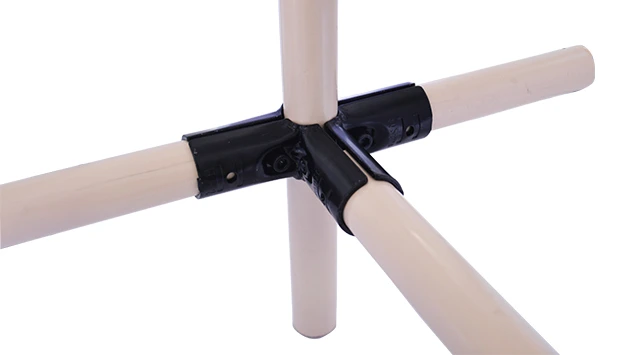
Four Way Straight Lean Pipe Joint
Four way lean pipe joint for 4 pcs 28MM lean pipe connection in straight angle, which used widely in workbench, flow rack, hand trolley frame connection.
In the world of manufacturing, where efficiency is king and waste is the enemy, the unsung heroes often lie in the smallest components. Take, for example, the humble four way straight lean pipe joint. At first glance, it might seem like little more than a metal connector—unassuming, even forgettable. But in the context of lean systems, this unpretentious piece plays a starring role. It's the quiet force that holds together the modular workbenches, flow racks, and material trolleys that keep production lines agile, adaptable, and aligned with lean principles. In this article, we'll take a deep dive into the structure, function, and critical importance of the four way straight lean pipe joint, exploring how it empowers businesses to build the flexible infrastructure that modern manufacturing demands.
1. Lean Systems: The Backbone of Modern Manufacturing
Before we zoom in on the four way straight lean pipe joint, it's essential to understand the bigger picture: lean systems. Born from the Toyota Production System (TPS) in the mid-20th century, lean manufacturing is a philosophy centered on eliminating waste (or muda , as it's known in Japanese) and maximizing value for the customer. Its core principles—value, value stream, flow, pull, and perfection—guide everything from workflow design to physical infrastructure. At its heart, lean is about creating systems that are responsive, efficient, and capable of evolving with changing demands.
A key enabler of lean systems is modularity . Traditional manufacturing setups often rely on fixed, welded structures: think heavy steel workbenches bolted to the floor or rigid material racks that can't be adjusted. These might work for static production lines, but in today's fast-paced market—where product lifecycles shrink and customization is expected—rigidity equals waste. If a new product requires a wider workbench or a taller flow rack, you're stuck replacing the entire structure, wasting time, money, and materials. Modular systems, by contrast, solve this problem. Built from interchangeable components like lean pipe, aluminum profile, and connectors (including our star player, the four way straight lean pipe joint), they can be quickly disassembled, reconfigured, or repurposed. This flexibility turns "set it and forget it" infrastructure into a dynamic tool that adapts to your needs—exactly what lean manufacturing demands.
2. Meet the Four Way Straight Lean Pipe Joint: A Small Part with a Big Job
So, what exactly is a four way straight lean pipe joint? In simplest terms, it's a connector designed to join four lengths of lean pipe (or aluminum profile) in a straight, multi-directional configuration. Picture a central hub with four ports—one on each side—allowing pipes to extend in four directions (typically up, down, left, right, or combinations thereof, depending on orientation). This might sound straightforward, but its simplicity is its strength. Unlike specialized connectors that only work in one scenario, the four way straight joint is a versatile workhorse, capable of forming the backbone of everything from simple workbenches to complex material handling systems.
To appreciate its role, consider this: every modular structure is only as strong as its weakest link. A poorly designed joint can lead to wobbly workbenches, unstable racks, or even safety hazards. The four way straight lean pipe joint, when well-engineered, distributes weight evenly across connected pipes, ensuring structural integrity while maintaining the flexibility to reconfigure. It's part of a broader ecosystem of lean pipe and accessories, working in tandem with components like caster wheels (for mobility), roller track (for smooth material flow), and aluminum profile accessories (for added functionality like shelves or tool holders).

3. Structure: The Anatomy of a Reliable Connector
Let's break down the structure of the four way straight lean pipe joint. While designs vary slightly by manufacturer, most share core components that determine their performance, durability, and ease of use.
Materials: Balancing Strength and Versatility
The material of the joint is critical. Most are made from metal, with zinc-plated steel being the industry standard. Zinc plating adds corrosion resistance, making these joints suitable for typical factory environments—think warehouses, assembly lines, or workshops. For heavier-duty applications (like supporting loaded material racks), some suppliers offer reinforced steel joints with thicker walls or stronger alloys. In specialized settings, such as cleanrooms or food processing facilities, you might find stainless steel pipe series joints, which resist rust and are easy to sanitize. For lighter loads or applications where weight matters (like mobile trolleys), aluminum lean pipe joints are a popular choice; they're lighter than steel, non-corrosive, and blend well with aluminum profile structures.
Ports: Precision for a Perfect Fit
At the heart of the joint are its ports—the openings where lean pipes or aluminum profile are inserted. These ports are machined to precise diameters to match standard pipe sizes (common diameters include 28mm for lean pipe and 20mm–40mm for aluminum profile). A snug fit is crucial: too loose, and the joint will wobble; too tight, and assembly becomes frustrating. Quality joints often feature chamfered edges on ports to guide pipes into place, reducing installation time. Some designs also include internal ribs or knurling to grip the pipe, enhancing stability even before locking.
Locking Mechanism: Keeping It Secure
Once pipes are inserted, the joint needs to hold them firmly. Most four way straight joints use a set screw locking mechanism: small screws (typically hex-head) that thread through the joint's body and press against the pipe, creating friction to prevent slipping. Some advanced designs feature cam levers or quick-release bolts for tool-free assembly, ideal for applications where frequent reconfiguration is needed. The number of set screws per port varies—high-quality joints often have two per port (opposite sides) to distribute pressure evenly, reducing the risk of pipe damage or loosening over time.
Design Variations: Tailored to the Task
Not all four way straight joints are created equal. Suppliers offer variations to suit different needs: - Standard vs. Heavy-Duty: Heavy-duty joints have thicker walls and larger set screws for higher load capacities (up to 500kg per joint in some cases). - Material-Specific: Joints designed for aluminum lean pipe may have smoother ports to avoid scratching the aluminum's anodized finish. - Cleanroom-Grade: These feature rounded edges (to prevent dust buildup) and materials like stainless steel or anodized aluminum, ideal for pharmaceutical or electronics manufacturing. - Integrated Features: Some joints include built-in cable management channels or mounting points for accessories like tool hooks, reducing the need for extra components.

4. Functionality: How the Four Way Joint Powers Modular Systems
The four way straight lean pipe joint's functionality is rooted in its ability to enable multi-directional connectivity . Let's break down how this works in practice and why it matters for lean systems.
Creating Complex Structures with Simple Components
Imagine building a material rack B (3 row and 3 floor)—a common setup for storing and organizing parts in assembly lines. This rack needs vertical support columns, horizontal beams to connect the columns, and shelves or roller track (for flow) on each level. The four way straight joint shines here: vertical columns are connected to horizontal beams on both the left and right sides using four way joints, creating a rectangular frame. Additional horizontal beams (front and back) can be added using the same joints, turning the frame into a stable cube. This cube forms the "unit" of the rack; stack three such units vertically, and you have your 3-floor structure. Each floor's roller track is then mounted to the aluminum profile beams, using brackets connected via—you guessed it—more joints.
What makes this powerful is that you're not limited to rectangles. Need a corner in your rack? Swap in a 90° lean pipe joint. Want to add a diagonal brace for extra stability? Use a three way joint. The four way joint is the Swiss Army knife in this toolkit, handling the most common multi-directional connections and freeing up other joints for specialized tasks.
Balancing Strength and Flexibility
A common misconception about modular systems is that they're "flimsy" compared to fixed structures. In reality, when designed correctly with quality joints, they can be surprisingly strong. The four way joint's symmetric design distributes weight evenly across all connected pipes, reducing stress concentrations. For example, a workbench built with four way joints and 28mm lean pipe can easily support 100kg or more—plenty for most assembly tasks. And because the joints allow for incremental adjustments (e.g., adding a cross-brace if a heavier load is needed), you can scale strength without rebuilding from scratch.
Speed of Assembly and Reconfiguration
In lean manufacturing, time is money. Traditional welded structures take hours (or days) to fabricate, install, and modify. Modular systems with four way joints? A team of two can assemble a basic workbench in under an hour. Reconfiguring it—say, adding a shelf or extending the length—takes even less time. This speed is a game-changer for "changeover" events, where production lines switch from one product to another. Instead of shutting down for a day to rebuild infrastructure, you can reconfigure in minutes, keeping the value stream flowing and reducing idle time (a classic form of waste).
5. Comparing Lean Pipe Joints: Why Four Way Straight Stands Out
To truly appreciate the four way straight joint, it helps to compare it with other common lean pipe joints. The table below highlights key differences in structure, use cases, and load capacities.
| Joint Type | Number of Ports | Primary Use Case | Max Load Capacity (Per Port) | Key Advantage |
|---|---|---|---|---|
| Four Way Straight | 4 (straight directions) | Multi-directional frames (e.g., material racks, workbench corners) | 150–300kg | Enables complex, symmetric structures with minimal components |
| Three Way | 3 (e.g., T-shape or Y-shape) | Branching structures (e.g., adding a side shelf to a workbench) | 100–250kg | Ideal for simple splits in pipe runs |
| Two Way | 2 (straight line) | Extending pipe lengths (e.g., long horizontal beams) | 200–400kg | Highest load capacity for straight runs |
| 90° Crossing | 4 (crossing at 90°) | Overhead structures or intersecting pipe runs | 100–200kg | Allows pipes to cross without blocking each other |
The four way straight joint's unique advantage is its ability to balance complexity and simplicity. It can replace multiple two or three way joints in certain setups, reducing the number of components needed and simplifying assembly. For example, a corner where four pipes meet (up, down, left, right) would require two three way joints; a single four way joint does the job faster and with fewer parts.
6. Importance in Lean Systems: Enabling the Principles of Lean
The four way straight lean pipe joint isn't just a connector—it's a lean tool. Here's how it directly supports lean manufacturing principles:
Eliminating Waste (Muda)
Lean identifies seven types of waste, and the four way joint helps fight several: - Waste of Overproduction: By enabling quick reconfiguration, it prevents overbuilding fixed structures that may not be needed long-term. - Waste of Waiting: Fast assembly reduces downtime during line changes. - Waste of Transportation: Modular carts (built with four way joints and caster wheels) can be customized to transport materials efficiently, reducing unnecessary movement. - Waste of Inventory: Material racks built with four way joints can be sized to hold exactly what's needed (no excess storage space), aligning with just-in-time (JIT) principles.
Supporting Flow and Pull
Lean systems thrive on "flow"—the smooth movement of products through the value stream. The four way joint enables this by supporting structures like flow racks with roller track, where parts glide from storage to assembly without manual lifting. A well-designed flow rack, built with four way joints to align roller track at the optimal angle, ensures parts arrive exactly when needed (pull system), reducing bottlenecks.
Empowering Continuous Improvement (Kaizen)
Kaizen, or continuous improvement, is a cornerstone of lean. It encourages workers to suggest small, incremental changes to improve processes. With modular systems, these changes are easy to test: if a team proposes raising a workbench by 10cm to reduce bending, you can adjust it in minutes using four way joints. If the change works, keep it; if not, revert just as quickly. This low-risk experimentation fosters a culture of innovation, something fixed structures stifle.
Respecting People
Lean isn't just about processes—it's about people. Uncomfortable workstations lead to fatigue, errors, and high turnover. The four way joint enables ergonomic customization: workbenches can be adjusted to each worker's height, flow racks positioned at eye level, and tool holders placed within easy reach. This reduces strain, boosts morale, and improves productivity—proof that lean success starts with respecting the people who power your operations.
7. Choosing the Right Joint: Key Considerations for Buyers
Not all four way straight lean pipe joints are created equal. To ensure you're getting a product that supports your lean goals, keep these factors in mind:
Load Capacity
Always check the manufacturer's load ratings. A joint rated for 150kg per port may not suffice for a material rack holding heavy components. When in doubt, overspecify—opting for a heavy-duty joint adds minimal cost compared to the risk of structural failure.
Compatibility
Ensure the joint fits your existing lean pipe or aluminum profile. Standard lean pipe is typically 28mm in diameter, but aluminum profile comes in various sizes (2020, 3030, 4040, etc.). A reliable lean pipe supplier will provide compatibility charts to avoid mismatched components.
Material and Finish
Consider your environment: - Humid/Outdoor: Zinc-plated or stainless steel joints resist corrosion. - Cleanrooms/Electronics: Anodized aluminum or stainless steel with smooth finishes prevent particle shedding. - Heavy Industry: Reinforced steel joints withstand impact and vibration.
Supplier Support
A good lean pipe supplier offers more than just products. Look for those that provide: - Technical support (e.g., help designing structures). - Samples for testing fit and load capacity. - Fast delivery (to avoid production delays). - Warranty coverage (at least 1 year) for defects.
8. Conclusion: The Unsung Hero of Lean Infrastructure
In the grand scheme of lean manufacturing, the four way straight lean pipe joint may seem like a small detail. But as we've explored, its impact is anything but minor. It's the connector that turns simple pipes into dynamic, adaptable systems—systems that eliminate waste, support flow, and empower continuous improvement. It's the tool that lets manufacturers respond to change not with frustration, but with flexibility. And it's a reminder that lean success often lies in the unassuming components that make the big picture possible.
Whether you're building a workbench, a flow rack, or an entire production line, choosing the right four way straight lean pipe joint is an investment in your lean journey. Pair it with quality lean pipe, reliable aluminum profile accessories, and a trusted supplier, and you'll have the foundation to create systems that don't just keep up with change—they drive it. After all, in lean manufacturing, the best infrastructure is the kind that grows with you.