- Company Articles
- Products and Technology
- Product knowledge
- Free Flow Chain Conveyor Drive Systems: Motor Types and Efficiency

Free Flow Chain Conveyor Drive Systems: Motor Types and Efficiency
Related Product
Free Flow Chain Conveyor
The free flow conveyor system uses a free flow chain that can increase the speed of the tooling board that supports the products. This can improve the efficiency and quality of the production process, as well as reduce the wear and tear of the system.
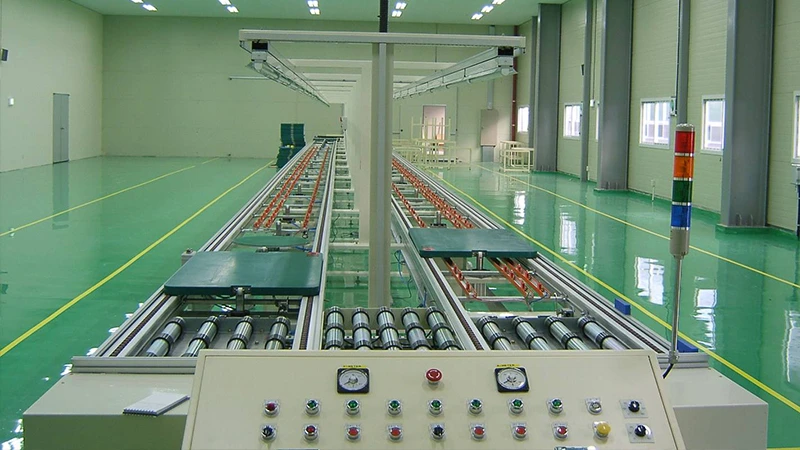
In the bustling world of manufacturing and logistics, where every second counts and efficiency is the name of the game, free flow chain conveyors stand as unsung heroes. These systems quietly power the movement of materials, components, and finished products across assembly lines, warehouses, and distribution centers, ensuring that production assemble processes run like well-oiled machines. But what makes these conveyors tick? At the heart of their performance lies the drive system—and more specifically, the motor that fuels it. The choice of motor type not only dictates how smoothly a conveyor operates but also has a direct impact on energy consumption, maintenance costs, and overall productivity. In this article, we'll dive deep into the world of free flow chain conveyor drive systems, exploring the various motor types available, their unique characteristics, and how they influence efficiency. Whether you're a plant manager looking to optimize your existing setup or a newcomer to industrial automation, understanding these fundamentals is key to building a lean system that delivers results.
Understanding Free Flow Chain Conveyors: Beyond the Basics
Before we zoom in on motors, let's take a moment to appreciate what free flow chain conveyors are and why they matter. Unlike traditional belt conveyors or gravity-fed roller tracks, free flow chain conveyors use a series of interconnected chains (often with attached rollers or slats) to move items along a fixed path. What sets them apart is their ability to handle heavy loads, accommodate variable speeds, and integrate seamlessly with other production equipment—think robotic arms, sorting stations, or flow racks. This versatility makes them a staple in industries ranging from automotive and electronics to food and beverage.
A typical free flow chain conveyor system consists of several key components: the chain (or roller track, in some configurations), a frame for structural support, guides to keep items on track, and the all-important drive system. The drive system's job is to convert electrical energy into mechanical motion, propelling the chain (and thus the materials) forward. Without a reliable, efficient motor, even the most well-designed conveyor can become a bottleneck, slowing down production and driving up operational costs. That's why selecting the right motor isn't just a technical decision—it's a strategic one that affects your bottom line.
The Drive System: Powering Productivity
Imagine a conveyor as a marathon runner: the motor is its heart, pumping energy to keep it moving. The drive system, in turn, is the circulatory system, ensuring that energy is distributed efficiently to where it's needed most. In free flow chain conveyors, the drive system typically includes a motor, a gearbox (to adjust speed and torque), a drive pulley or sprocket (to transfer motion to the chain), and a control unit (to regulate speed, direction, and start/stop functions). Each component plays a role, but the motor is the star of the show.
The primary goal of any drive system is to deliver the right amount of power at the right speed, regardless of the load. For example, in an automotive assembly line, a conveyor might need to move a heavy engine block at a slow, steady pace, while in a packaging facility, it might switch between high speeds for empty boxes and slower speeds for filling stations. The motor must adapt to these demands without sacrificing efficiency or reliability. Let's now explore the most common motor types used in these systems and how they stack up.
Motor Types: Choosing Your Conveyor's "Engine"
Not all motors are created equal. Each type has its own strengths, weaknesses, and ideal applications. Let's break down the four main players in the world of free flow chain conveyor drives:
AC Induction Motors: The Workhorses of Industry
When you picture an industrial motor, chances are you're thinking of an AC induction motor. These tried-and-true machines have been around for over a century, and for good reason: they're simple, robust, and cost-effective. AC motors work by using electromagnetic induction to rotate a rotor within a stator (the stationary part of the motor). Most free flow chain conveyors use three-phase AC motors, which offer higher torque and smoother operation than their single-phase counterparts. One of their biggest advantages is their low maintenance requirements—no brushes to replace or complex electronics to troubleshoot. This makes them a favorite for heavy-duty applications, such as moving pallets in warehouses or feeding components into flow racks.
However, traditional AC motors have a downside: they run at a fixed speed (determined by the frequency of the electrical supply, typically 50 or 60 Hz). To adjust speed, you'll need a variable frequency drive (VFD), which converts fixed AC power into adjustable-frequency AC. While VFDs add some cost, they transform AC motors into versatile performers, allowing them to match speed to production demands. Modern AC motors also come in energy-efficient models (rated IE3 or IE4), which consume up to 20% less power than older designs—a boon for companies aiming to reduce their carbon footprint and energy bills.
DC Motors: Precision and Control for Dynamic Applications
If AC motors are the workhorses, DC motors are the precision instruments of the conveyor world. DC motors use direct current to power a rotor, offering superior speed control and torque at low speeds—two traits that make them ideal for applications where items need to start, stop, or change direction frequently. There are two main types: brushed and brushless. Brushed DC motors are the simpler of the two, with a commutator and brushes that transfer current to the rotor. They're affordable and easy to control (using a simple variable resistor), but the brushes wear out over time, requiring regular replacement. This makes them less suitable for clean environments like electronics manufacturing or applications where downtime is costly.
Brushless DC (BLDC) motors, on the other hand, eliminate the need for brushes by using electronic commutation. This design not only reduces maintenance but also improves efficiency, extends motor life, and reduces electromagnetic interference (EMI)—a critical feature in settings where sensitive equipment is nearby. BLDC motors are often paired with pulse-width modulation (PWM) controllers, which adjust speed by varying the voltage sent to the motor. This level of precision makes them a top choice for free flow chain conveyors in industries like pharmaceuticals, where even minor speed fluctuations can compromise product quality.
Servo Motors: When Precision Meets Power
For applications that demand pinpoint accuracy—think synchronizing conveyor movement with robotic assembly or positioning items within millimeters—servo motors are the gold standard. These high-performance motors combine a DC or AC motor with a feedback device (usually an encoder or resolver) that continuously sends position and speed data back to a controller. This closed-loop system allows the motor to adjust its output in real time, ensuring that it meets exact speed and position targets. Servo motors excel at rapid acceleration and deceleration, making them perfect for conveyor systems that handle delicate or high-value items, such as circuit boards in electronics production assemble lines.
The tradeoff? Servo motors are more expensive than AC or basic DC motors, both in upfront costs and complexity. They require specialized controllers and programming, and their high precision comes with a higher energy draw at low speeds. That said, for operations where downtime or errors are costly, the investment often pays off. Imagine a conveyor that needs to stop exactly at a welding station, then restart the moment the weld is complete—servo motors make that level of coordination possible, turning a once-manual process into a seamless, automated workflow.
Stepper Motors: Step-by-Step Control for Low-Speed Tasks
Last but not least, we have stepper motors—unique in that they rotate in discrete "steps" rather than continuously. Each step corresponds to a fixed angle (e.g., 1.8 degrees per step), giving them exceptional positional accuracy without the need for feedback (though some systems add encoders for added precision). Stepper motors are often used in low-speed, high-torque applications, such as moving small parts along a mini roller track or positioning tools on a workbench. They're affordable, easy to control with simple microcontrollers, and excel at holding a position without drifting—useful for tasks like labeling or inspection, where items need to remain stationary for short periods.
However, stepper motors have limitations. They can lose steps under heavy loads or when accelerating too quickly, leading to positioning errors. They also tend to run hot at high speeds, which can shorten their lifespan if not properly cooled. For these reasons, they're best suited for light-duty conveyors or auxiliary systems, rather than mainline free flow chain conveyors handling large volumes of materials.
Efficiency Metrics: What Really Matters?
Now that we've covered the motor types, let's talk about efficiency—a term that gets thrown around a lot, but what does it actually mean for conveyor systems? In simplest terms, motor efficiency is the ratio of mechanical power output (the power used to move the conveyor and its load) to electrical power input (the power drawn from the grid). A motor with 90% efficiency converts 90% of the electricity it uses into useful work; the remaining 10% is lost as heat, noise, or vibration. While 10% might seem small, multiply that by hundreds of motors running 24/7, and the costs add up quickly.
Several factors influence motor efficiency, starting with load matching. Over-sizing a motor—installing a 5 HP motor when a 3 HP would suffice—is a common mistake that leads to "light loading." Motors are most efficient when running at 75-100% of their rated load; below that, efficiency drops off significantly. For example, an AC motor operating at 25% load might only be 50% efficient, wasting half the energy it consumes. On the flip side, under-sizing a motor forces it to work beyond its limits, leading to overheating, premature wear, and frequent breakdowns.
Speed control is another critical factor. As we mentioned earlier, AC motors paired with VFDs can adjust speed to match demand, but VFDs themselves introduce some energy loss (typically 2-5%). BLDC motors, with their PWM controllers, often maintain higher efficiency across a wider speed range, making them a better choice for conveyors that need to frequently speed up or slow down. Maintenance also plays a role: dirty motors, misaligned shafts, or worn bearings increase friction, forcing the motor to work harder and consume more power. Regular cleaning, lubrication, and alignment checks can go a long way toward keeping efficiency high.
Motor Types Compared: A Practical Guide
To help you navigate the motor maze, let's compare the four main types side by side. The table below highlights key factors like efficiency, cost, maintenance, and ideal applications—so you can make an informed decision based on your conveyor's needs.
| Motor Type | Efficiency (Typical Range) | Upfront Cost | Maintenance Needs | Speed Control | Best For |
|---|---|---|---|---|---|
| AC Induction (with VFD) | 75-95% | Low to Moderate | Low (no brushes, minimal parts) | Good (variable speed via VFD) | Heavy loads, continuous operation (e.g., pallet conveyors, flow racks) |
| DC Brushed | 65-85% | Low | High (brush replacement every 1,000-3,000 hours) | Excellent (simple voltage control) | Low-speed, low-cost applications (e.g., small parts conveyors) |
| DC Brushless (BLDC) | 85-95% | Moderate to High | Low (no brushes, sealed design) | Excellent (PWM control for precision) | Clean environments, sensitive products (e.g., pharmaceuticals, electronics) |
| Servo | 80-90% (varies by speed) | High | Moderate (requires encoder calibration, specialized care) | Exceptional (closed-loop feedback for exact positioning) | High-precision tasks (e.g., robotic assembly lines, synchronized conveyors) |
| Stepper | 50-70% (low at high speeds) | Low to Moderate | Low (no brushes, simple design) | Good (step-by-step control) | Low-speed, positional tasks (e.g., labeling, small-part handling) |
Real-World Applications: From Factory Floors to Lean Systems
To put these concepts into context, let's look at how different motor types perform in real-world settings. Take a large automotive plant, for example. The main assembly line uses free flow chain conveyors to move car bodies from one station to the next—tasks like welding, painting, and interior installation. Here, AC induction motors with VFDs are the go-to choice. They're rugged enough to handle the weight of a half-assembled car, and the VFDs allow the conveyor to slow down at each workstation, then speed up once the task is done. The plant also uses servo motors on smaller conveyors that feed parts like bolts and wiring harnesses to the main line. These servos ensure that parts arrive exactly when needed, minimizing wait times and keeping the lean system running smoothly.
Over in the electronics industry, a manufacturer of smartphones relies on BLDC motors for its circuit board conveyors. These conveyors must move delicate boards through soldering and testing stations without jostling or vibrating—any misalignment could damage tiny components. BLDC motors provide the smooth, precise motion needed, and their brushless design eliminates dust from worn brushes, keeping the cleanroom environment intact. Meanwhile, the plant's packaging line uses a combination of AC motors (for moving bulk boxes) and stepper motors (for positioning boxes under a labeling machine).
Even warehouses benefit from strategic motor selection. A distribution center that handles e-commerce orders might use gravity-fed roller tracks for light items (no motor needed!) and AC-powered free flow chain conveyors for heavier packages. The AC motors here are paired with smart sensors that detect when a package is present, only running the motor when needed—a classic example of lean system principles in action, reducing energy waste and extending motor life.
Optimizing Efficiency: Tips for Getting the Most from Your Motor
Choosing the right motor is just the first step—optimizing its performance is where the real savings lie. Here are some practical tips to keep your free flow chain conveyor drive system running at peak efficiency:
- Right-Size Your Motor: Use load calculations to determine the minimum horsepower needed. Oversized motors waste energy, while undersized ones fail prematurely. Many manufacturers offer online calculators to help with this.
- Invest in Energy-Efficient Models: Look for AC motors rated IE3 or higher, or BLDC motors with high-efficiency controllers. The upfront cost is offset by lower energy bills over time.
- Maintain Regularly: Clean motors and heat sinks to prevent overheating, lubricate bearings as recommended, and check alignment between the motor, gearbox, and conveyor chain. A misaligned drive system can increase energy use by 10-15%.
- Upgrade Controls: Adding a VFD to an AC motor or a PWM controller to a DC motor can improve speed control and reduce energy consumption during idle times.
- Monitor Performance: Use sensors to track motor temperature, vibration, and energy use. Unexpected spikes could indicate a problem (e.g., a failing bearing) that, if caught early, can prevent costly downtime.
Future Trends: What's Next for Conveyor Motors?
As industries push for greater sustainability and automation, conveyor motor technology is evolving fast. One trend to watch is the rise of integrated motor-gearbox units—compact, pre-assembled systems that reduce installation time and improve efficiency by minimizing power loss between components. Another is the adoption of permanent magnet motors (PMMs), which use rare-earth magnets to deliver higher torque density and efficiency than traditional induction motors. PMMs are already making waves in electric vehicles, and their use in conveyors is growing as costs come down.
Smart technology is also playing a bigger role. IoT-enabled motors with built-in sensors can communicate real-time data to a central system, allowing for predictive maintenance (e.g., alerting you when a bearing is wearing thin) and adaptive control (e.g., slowing down the conveyor during peak energy hours to reduce costs). Artificial intelligence (AI) is even being used to optimize motor performance, learning from historical data to adjust speed and torque based on production schedules, weather, and other variables.
Finally, sustainability is driving innovation in materials and design. Manufacturers are developing motors with recyclable components, and some are even exploring "energy recovery" systems that capture kinetic energy when the conveyor decelerates, feeding it back into the grid. These advancements aren't just good for the planet—they're good for business, helping companies meet ESG goals and stay competitive in a market that increasingly values sustainability.
Conclusion: Powering the Future of Conveying
Free flow chain conveyors are the backbone of modern manufacturing and logistics, and their drive systems—especially the motors—are the key to unlocking their full potential. From the workhorse AC induction motor to the precision-driven servo, each motor type brings unique strengths to the table. By understanding your application's needs—load, speed, precision, and environment—you can select a motor that balances performance and efficiency, building a lean system that reduces waste, cuts costs, and boosts productivity.
As technology advances, the line between motor types will blur, with smarter, more efficient designs emerging. But for now, the fundamentals remain the same: choose wisely, maintain regularly, and optimize relentlessly. Whether you're moving car parts, circuit boards, or packages, the right motor will keep your conveyor—and your business—moving forward.