- Company Articles
- Products and Technology
- Solution
- Free Flow Chain Conveyor for 3C Assembly: Optimizing Small-Part Handling

Free Flow Chain Conveyor for 3C Assembly: Optimizing Small-Part Handling
Related Product
Free Flow Chain Conveyor
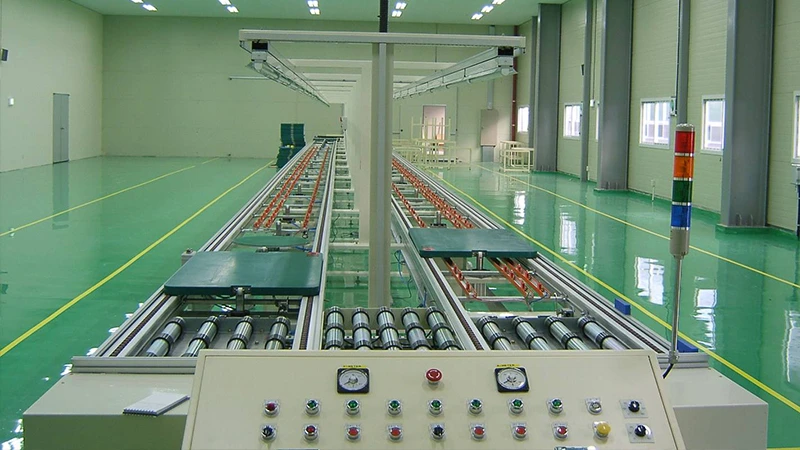
The free flow conveyor system uses a free flow chain that can increase the speed of the tooling board that supports the products. This can improve the efficiency and quality of the production process, as well as reduce the wear and tear of the system.
The Hidden Struggle of Small-Part Handling in 3C Factories
Walk into any 3C (computers, communications, consumer electronics) assembly plant, and you'll likely see a flurry of activity: workers hunched over workbenches, carefully placing microchips the size of a fingernail onto circuit boards; conveyor belts humming with half-assembled smartphones; bins overflowing with tiny screws, connectors, and capacitors. But beneath this busy surface lies a quiet, persistent challenge: handling small parts efficiently without sacrificing speed, precision, or safety. For decades, this has been the unsung headache of production managers and line workers alike.
Imagine Maria, a line operator at a smartphone factory. Her station is responsible for attaching 0.5mm-thick camera modules to device frames—parts so small that even a slight tremor in her hand could misalign the component, leading to a defective unit. Each morning, she starts by unpacking trays of these modules from boxes stacked under her workstation, then manually passes them to the next station once assembled. By midday, her shoulders ache from repeatedly reaching for parts, and she's already noticed two modules that slipped from her fingers and cracked on the floor. "It's not just about speed," she sighs during a break. "It's about not feeling like I'm fighting the process every step of the way."
This isn't an isolated problem. In 3C manufacturing, where products shrink in size but grow in complexity—think smartwatches with 100+ tiny components or laptops with millimeter-thin internal parts—traditional handling methods (manual passing, static bins, basic gravity-fed chutes) often fall short. They slow down production, increase error rates, and even contribute to worker fatigue. The question isn't just how to move parts from A to B, but how to do it in a way that respects the delicacy of the components, the rhythm of the workers, and the demands of a 24/7 production line. Enter the free flow chain conveyor: a solution designed to turn chaos into calm, one small part at a time.
What Is a Free Flow Chain Conveyor, Anyway?
At first glance, a free flow chain conveyor might look like any other conveyor system—metal tracks, rollers, a simple frame. But its magic lies in its name: "free flow." Unlike traditional belt conveyors that move at a fixed speed, or chain conveyors that require constant power, free flow chain conveyors use gravity and lightweight, low-friction components to let parts glide smoothly from one workstation to the next. Think of it as a supercharged slide for small parts, but engineered with precision to prevent jams, scratches, or misalignment.
The core of the system is its roller track—a series of small, rotating rollers mounted on a sturdy frame (often made from aluminum profile for durability and lightweight strength). These rollers are spaced just right to cradle small parts: not too far apart to risk dropping components, not too close to create friction. When a worker places a tray of microchips or a bin of screws onto the track, gravity takes over, and the load moves gently toward the next station. Some systems even include adjustable speed controls or brakes for delicate parts, ensuring that a 0.5mm capacitor isn't jostled en route.
But what really sets free flow chain conveyors apart is their adaptability. Unlike rigid, one-size-fits-all conveyor systems, they're built using modular components—think aluminum pipe, roller track connectors, and plastic guide rails—that can be reconfigured in hours, not days. Need to add a detour for quality checks? Swap out a straight section for a curved roller track. Scaling production for a new product launch? Attach extra roller track placon mounts to extend the line. This flexibility is a game-changer in 3C manufacturing, where product cycles are measured in months, not years.
Why Free Flow Chain Conveyors Solve Small-Part Headaches
To understand why free flow chain conveyors are revolutionizing 3C assembly, let's break down the specific pain points they address—starting with the most obvious: speed without sacrifice .
Gentle Handling for Fragile Components
Small parts in 3C devices are often delicate. A single scratch on a microchip's surface can render it useless; a misaligned connector can cause a device to fail quality control. Traditional conveyors, with their rough belts or jerky movements, are risky. Free flow chain conveyors, however, use roller tracks with soft, plastic or rubber wheels (like the 1-inch swivel roller balls or 0.5-inch swivel roller balls common in these systems) that cradle parts instead of dragging them. For example, a batch of 0.5mm-thick flex cables—used in everything from earbuds to laptops—can glide down the track without bending or kinking, reducing defect rates by up to 40% in some factories, according to industry reports.
Ergonomics: Less Strain, More Focus
Go back to Maria, our line operator. With a free flow chain conveyor installed, she no longer has to bend down to retrieve parts from bins under her workstation. Instead, a small roller track is mounted at waist height, feeding parts directly to her hands. The result? Her shoulder pain has eased, and she's more focused on precision than on reaching for tools. "I used to spend 10 minutes every hour just organizing parts," she says. "Now, they're right there when I need them. It's like having an extra pair of hands."
This isn't just about comfort—it's about productivity. The U.S. Bureau of Labor Statistics estimates that ergonomic improvements in manufacturing reduce worker fatigue by 25%, leading to a 15% boost in output. In 3C plants, where margins are tight and volume is king, that 15% can mean the difference between meeting a quarterly target and falling short.
ESD Protection: Safety for Sensitive Parts
Static electricity is the silent killer of 3C components. A tiny spark—too small for the human eye to see—can fry a circuit board or corrupt data in a memory chip. That's why ESD workstations (electrostatic discharge-safe workbenches) are non-negotiable in these factories. But what good is an ESD workstation if the conveyor moving parts to it isn't ESD-safe?
Free flow chain conveyors solve this by integrating seamlessly with ESD systems. Many models use black ESD wheels on their roller tracks, which dissipate static charges before they reach sensitive parts. Aluminum profile frames, which are naturally conductive, can be grounded to the factory's ESD network, ensuring that even if a part brushes against the track, static is safely channeled away. For Maria's camera modules, this means zero risk of static damage during transport—something she no longer has to worry about during her shift.
From Chaos to Flow: Integrating with Lean Systems
In the world of manufacturing, "lean" isn't just a buzzword—it's a philosophy centered on eliminating waste (time, motion, materials) and creating continuous, efficient flow. For 3C factories, which operate on razor-thin margins, lean is survival. But traditional small-part handling methods often clash with lean principles: manual part passing creates bottlenecks (waste of time), disorganized bins lead to excess inventory (waste of space), and misaligned components cause rework (waste of materials).
Free flow chain conveyors, by contrast, are lean by design. Take "just-in-time" (JIT) production, a cornerstone of lean systems. With a free flow conveyor, parts arrive at each workstation exactly when they're needed—not stacked in bins days in advance. For example, a line assembling smartwatch batteries can have a roller track feeding cells directly from the warehouse to the assembly station, with sensors that trigger a refill only when the track is 20% full. This cuts down on inventory costs and reduces the risk of parts becoming obsolete (a common issue in fast-paced 3C markets).
Then there's the "waste of motion." In a traditional setup, workers might walk 50+ steps per hour to retrieve parts from storage areas. With a free flow conveyor, parts come to them. A study by the Lean Enterprise Institute found that this alone can reduce non-value-added motion by 30%, freeing up workers to focus on tasks that require human skill—like inspecting components—instead of playing "fetch."
Perhaps most importantly, free flow chain conveyors make "continuous flow" a reality. In lean terms, continuous flow means producing one unit at a time, with each step feeding directly into the next. Without a reliable way to move small parts, this breaks down quickly: if one station falls behind, the entire line stalls. But with a free flow conveyor, parts move at a steady, predictable pace, keeping the line balanced. It's like a well-choreographed dance instead of a chaotic sprint.
Aluminum Profile: The Unsung Hero of Conveyor Flexibility
If free flow chain conveyors are the stars of the show, aluminum profile is their supporting actor—quietly making everything possible. Walk up to any modern free flow system, and you'll notice the frame isn't made of heavy steel or flimsy plastic. It's aluminum profile: lightweight, corrosion-resistant, and infinitely customizable.
Why aluminum? For starters, it's strong enough to support heavy loads (like trays of circuit boards) but light enough that a single worker can reposition a section of the conveyor without a forklift. This matters in 3C factories, where production lines are often rearranged to accommodate new products. Imagine needing to shift a conveyor section 10 feet to the left to make room for a new testing station—with steel, that would require a team and a crane; with aluminum profile, two workers can do it in 20 minutes.
Aluminum profile also plays nice with accessories, thanks to its T-slot design. Need to attach a side guard to prevent parts from sliding off the roller track? Slide a plastic guide rail into the T-slot and secure it with a bolt—no drilling or welding required. Want to add a shelf for tools above the conveyor? Use aluminum profile accessories like angle brackets to mount it in seconds. This modularity is why aluminum profile has become the backbone of flexible manufacturing systems worldwide.
And let's not forget cost. While aluminum might seem pricier upfront than steel, its durability and reusability make it cheaper in the long run. A steel conveyor frame, once welded, is fixed forever—if you redesign the line, you have to scrap it. An aluminum profile frame, however, can be disassembled, and the parts reused in a new configuration. For 3C factories that launch 5+ new products a year, this translates to thousands of dollars in savings on equipment.
Traditional vs. Free Flow: A Real-World Comparison
Still skeptical? Let's look at the numbers. Below is a comparison of traditional small-part handling methods (manual passing, basic gravity chutes) and free flow chain conveyors, based on data from a mid-sized 3C factory that switched to free flow systems in 2024.
| Metric | Traditional Methods | Free Flow Chain Conveyor | Improvement |
|---|---|---|---|
| Small-part error rate (per 1000 units) | 12 defects | 3 defects | 75% reduction |
| Worker fatigue (reported via surveys) | 6/10 (high fatigue) | 3/10 (low fatigue) | 50% reduction |
| Line throughput (units per hour) | 180 units | 240 units | 33% increase |
| ESD-related failures | 8 per month | 0 per month | 100% elimination |
| Time to reconfigure line for new product | 48 hours | 4 hours | 92% reduction |
These numbers tell a clear story: free flow chain conveyors don't just improve efficiency—they transform how 3C factories operate. For the factory in the example, the switch paid for itself in 6 months, thanks to reduced defects, higher throughput, and lower labor costs. But the intangible benefits might be even more valuable: workers like Maria report higher job satisfaction, and production managers no longer lose sleep over missed deadlines.
The Future of Small-Part Handling: More Than Just Conveyors
As 3C products continue to shrink and evolve—think foldable phones with 100+ moving parts or AR glasses with nanoscale sensors—the demand for smarter, gentler handling solutions will only grow. Free flow chain conveyors are just the beginning. Manufacturers are already integrating them with IoT sensors to track part flow in real time, alerting managers to bottlenecks before they happen. Some are pairing them with collaborative robots (cobots) that load parts onto the conveyor, freeing workers to focus on complex assembly tasks.
But perhaps the most exciting trend is the move toward fully integrated lean systems, where free flow conveyors, ESD workstations, aluminum profile frames, and flow racks work in harmony. Imagine a line where a smartphone's circuit board travels from the SMT (surface-mount technology) machine to the ESD workstation via a free flow conveyor, then to a testing station on a flow rack, with every step optimized for speed and safety. This isn't science fiction—it's happening in factories today.
For workers like Maria, this future means less strain, more focus, and the satisfaction of knowing they're part of a process that values both precision and people. For manufacturers, it means staying competitive in a market where innovation waits for no one. And for consumers? It means better, more reliable devices—built not just with technology, but with care.
Final Thoughts: Small Parts, Big Impact
In the grand scheme of 3C manufacturing, small parts might seem insignificant—after all, they're just tiny pieces in a much larger product. But anyone who's worked on an assembly line knows better: the way you handle these small parts defines the entire process. It determines how fast you can produce, how many defects you'll have, and even how happy your team is at the end of the day.
Free flow chain conveyors aren't just machines—they're tools that respect the complexity of small-part handling. They're designed to work with the rhythm of the factory, not against it. They protect delicate components, ease worker strain, and adapt to the ever-changing demands of 3C production. In a world where "good enough" is never enough, they're the difference between falling behind and leading the pack.
So the next time you pick up your smartphone or slip on a pair of wireless earbuds, take a moment to appreciate the journey of the small parts inside. Chances are, they traveled on a free flow chain conveyor—quietly, smoothly, and with the care they deserve. And that, in the end, is what great manufacturing is all about.