- Company Articles
- Products and Technology
- Product knowledge
- Free Flow Chain Conveyor for Automotive Assembly Lines: Reducing Cycle Time

Free Flow Chain Conveyor for Automotive Assembly Lines: Reducing Cycle Time
Related Product
Free Flow Chain Conveyor
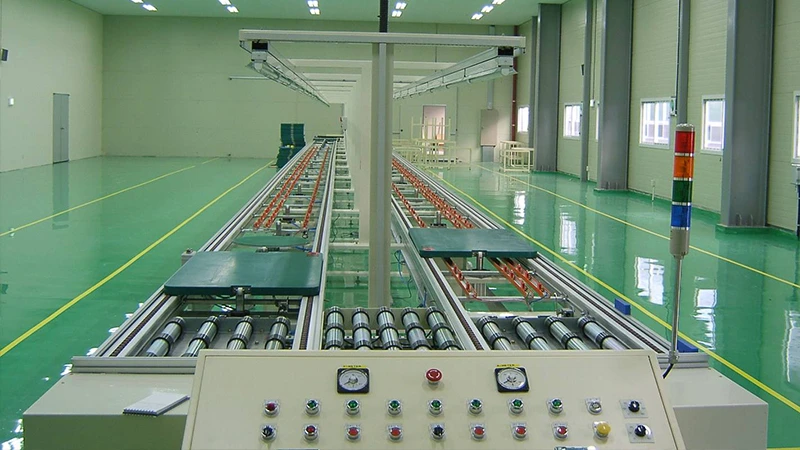
The free flow conveyor system uses a free flow chain that can increase the speed of the tooling board that supports the products. This can improve the efficiency and quality of the production process, as well as reduce the wear and tear of the system.
Picture this: It's 9 a.m. on a bustling automotive assembly line. The hum of machinery fills the air, workers in blue coveralls move with practiced precision, and every second counts. A team is racing to assemble the dashboard of the latest electric SUV—a model that's flying off dealership lots. But there's a bottleneck: the conveyor system transporting steering wheel components from the storage area to Station 12 is lagging. By 9:15, the delay has rippled down the line, and the supervisor is already calculating the impact on today's production quota. Sound familiar? In automotive manufacturing, cycle time—the total time it takes to produce one unit—isn't just a metric; it's the pulse of the operation. And when that pulse falters, so does profitability, customer satisfaction, and competitive edge.
Enter the free flow chain conveyor: a quiet hero in the quest to trim cycle times and keep assembly lines moving like well-oiled machines. More than just a "belt with wheels," this system is a cornerstone of modern lean manufacturing, designed to eliminate waste, boost efficiency, and adapt to the ever-changing demands of automotive production. In this article, we'll dive into how free flow chain conveyors transform assembly lines, why they're indispensable for lean systems, and how integrating components like aluminum profiles, roller tracks, and modular workbenches creates a seamless workflow that turns "almost on time" into "ahead of schedule."
What Is a Free Flow Chain Conveyor, Anyway?
Let's start with the basics. A free flow chain conveyor is a material handling system that uses a series of interconnected chains and rollers to move products or components along a fixed path—without the friction or rigidity of traditional belt conveyors. Unlike belt systems, which rely on continuous surface contact, free flow conveyors use rotating rollers (often made of steel or high-grade plastic) mounted on a track, allowing items to glide forward with minimal resistance. Think of it as a supercharged slide for industrial parts: smooth, fast, and surprisingly adaptable.
But what makes "free flow" different? The magic lies in its design. The conveyor's chain is typically mounted under the track, with rollers extending above to cradle the load. This under-the-hood setup reduces jamming, minimizes maintenance, and allows for "accumulation"—meaning products can pile up gently at certain points without stopping the entire line. For automotive plants, where components like door panels, engine blocks, or wiring harnesses come in all shapes and sizes, this flexibility is a game-changer. Imagine needing to pause the flow of seat frames while a worker at Station 8 fixes a minor issue: a free flow conveyor lets the frames stack up temporarily, then resumes moving them forward once the station is clear—no restart delays, no wasted motion.
At its core, the free flow chain conveyor is built for speed. Its low-friction rollers and precision-engineered tracks allow for faster material transfer than traditional systems. A typical belt conveyor might move at 30 feet per minute; a free flow chain conveyor? Up to 100 feet per minute, depending on the load. For automotive assembly, where even a 10-second delay per unit adds up to thousands of lost minutes per day, that speed translates directly to reduced cycle time.
The Automotive Assembly Challenge: Why Cycle Time Matters More Than Ever
Automotive manufacturing isn't what it was 20 years ago. Today's consumers demand more: electric vehicles with longer ranges, self-driving features, and customizable interiors. To keep up, automakers are churning out new models faster than ever—some launching 5–7 new vehicles per year, compared to 2–3 a decade ago. This "fast fashion" approach to cars means assembly lines must pivot quickly, switching between models, updating components, and scaling production up or down on a dime. All of this while keeping cycle times as low as possible.
Cycle time isn't just about speed, though. It's about predictability. If a plant expects to produce 500 cars per day, each unit must take exactly X minutes to assemble—no more, no less. Any variance (a slow conveyor, a missing part, a tool malfunction) throws off the entire schedule. And in an industry where profit margins can be as thin as 3–5%, even a 1% increase in cycle time can erase millions in annual revenue.
Consider this: A mid-sized automotive plant produces 200,000 vehicles per year. If cycle time increases by just 30 seconds per unit, that's 200,000 x 30 seconds = 6,000,000 seconds = 1,666 hours of lost production annually. At an average labor cost of $50 per hour, that's $83,300 in wasted wages alone—not counting the cost of missed delivery deadlines or overtime pay to catch up. For plant managers, reducing cycle time isn't just a goal; it's a survival strategy.
So, what's the biggest culprit behind cycle time delays? Waste. In lean manufacturing terms, there are seven types of waste (or "muda"): overproduction, waiting, transportation, processing, inventory, motion, and defects. On the assembly line, "transportation waste" is often the most visible. This includes time spent moving components from storage to stations, workers walking to retrieve parts, or conveyors that move too slowly, forcing operators to wait. A free flow chain conveyor attacks this waste head-on by ensuring materials arrive exactly when and where they're needed—fast, reliably, and with zero unnecessary motion.
Integrating Free Flow Chain Conveyors with Lean Systems: A Match Made in Manufacturing Heaven
Lean manufacturing isn't just a buzzword; it's a philosophy. Born from Toyota's legendary "Toyota Production System" (TPS), lean is all about maximizing value while minimizing waste. At its heart are principles like "just-in-time" (JIT) production (only making what's needed, when it's needed) and "continuous improvement" (kaizen). For these principles to work, material handling systems must be equally lean—and that's where free flow chain conveyors shine.
Let's take JIT production. In a JIT system, components arrive at the assembly line precisely when they're needed, not a minute earlier or later. This reduces inventory costs (no storing piles of unused parts) and frees up floor space. But JIT relies on a conveyor system that can deliver parts with pinpoint accuracy. A free flow chain conveyor, with its ability to start, stop, and accumulate products, makes JIT possible. For example, when the line calls for 10 brake calipers at Station 15, the conveyor can deliver exactly 10, then pause until the next signal. No excess, no shortage—just in time.
Then there's "motion waste"—the time workers spend walking to fetch tools or parts. A well-designed free flow conveyor eliminates this by bringing materials directly to the workbench. Imagine a worker assembling a car's center console: instead of walking 20 feet to a storage rack for screws, clips, and wiring, the conveyor delivers a bin of those parts right to their workstation. The result? Less walking, more assembling, and a cycle time that shrinks by 15–20 seconds per unit. Over 200,000 units, that's 5,555 hours saved—enough to produce an extra 1,000 cars annually.
But lean systems aren't static. They evolve as production needs change. That's why free flow chain conveyors are often paired with aluminum profiles—a lightweight, modular building material that makes reconfiguring the line a breeze. Unlike rigid steel conveyors, which require welding or heavy machinery to modify, aluminum profile-based conveyors use simple connectors and brackets. Need to add a detour for a new quality check station? Swap out a few aluminum sections, add a roller track, and you're done—all in an hour, not a day. This adaptability ensures the conveyor system grows with the lean system, not against it.
Key Components: How Aluminum Profiles, Roller Tracks, and Workbenches Elevate Performance
A free flow chain conveyor is only as good as its parts. To deliver the speed, durability, and flexibility automotive plants need, it relies on a few key components—many of which might sound familiar if you're in industrial manufacturing: aluminum profiles, roller tracks, and modular workbenches. Let's break down how each piece contributes to cycle time reduction.
Aluminum Profiles: The Backbone of Adaptability
Aluminum profiles are the unsung heroes of modern conveyor design. These extruded aluminum beams, with their T-slot grooves and lightweight yet sturdy construction, make building and modifying conveyors faster and cheaper than ever. Traditional steel conveyors are heavy, hard to cut, and require welding; aluminum profiles? They're lightweight (about 1/3 the weight of steel), easy to drill, and connect with simple bolts or brackets. For automotive plants, this means less downtime during reconfigurations and lower installation costs.
But it's not just about ease of use. Aluminum profiles are also incredibly strong. A standard 40x40mm aluminum profile can support up to 500 kg per meter—more than enough for automotive components like transmissions or axles. And because they're corrosion-resistant, they hold up to the oil, grease, and humidity of assembly lines, reducing maintenance costs over time. When paired with aluminum profile accessories like corner brackets, end caps, or T-slot nuts, they become a modular toolkit for building conveyors that fit any space or load requirement.
Roller Tracks: The Secret to Smooth, Fast Flow
If aluminum profiles are the backbone, roller tracks are the conveyor's "feet." These tracks—typically made of steel, aluminum, or high-density plastic—house the rotating rollers that carry the load. For free flow chain conveyors, the roller design is critical. Most use precision ball bearings to minimize friction, allowing even heavy parts to glide forward with minimal force. Some models, like the 40 steel roller track with yellow wheels (a common choice for automotive plants), are designed to reduce noise and wear, ensuring quiet operation and longer lifespans.
Roller tracks also come with a range of accessories to boost functionality. Take swivel roller balls, for example: these small, omnidirectional rollers can be embedded in the track to allow parts to rotate or change direction without manual lifting. Need to turn a door panel 90 degrees to align it with the car frame? Swivel roller balls let the worker twist the panel effortlessly, saving 5–10 seconds per unit. Other accessories, like plastic roller track guide rails (available in yellow or grey for visibility), keep parts centered on the track, preventing jams and ensuring a smooth flow—another key to reducing cycle time.
Workbench Integration: Bringing the Line to the Worker
A conveyor is only useful if it connects seamlessly with the workbenches where the actual assembly happens. That's why modern free flow chain conveyors are designed to integrate directly with modular workbenches—creating a "one-stop shop" where materials arrive, get assembled, and move on without the worker taking a single step.
Imagine a workbench E (single deck, without casters) positioned alongside a free flow conveyor. The conveyor delivers a bin of wiring harnesses to the bench; the worker assembles the harness into the dashboard, then slides the finished dashboard back onto the conveyor, which carries it to the next station. No walking to fetch parts, no lifting heavy bins—just continuous, focused work. Some workbenches even come with built-in tool holders or LED lighting, further reducing motion waste and keeping workers efficient.
For larger components, like engine blocks, workbenches can be paired with turnover trolleys or material racks (like Material Rack B, a 3-row, 3-floor unit) that feed parts directly to the conveyor. This "supply chain in a box" setup ensures workers never have to wait for materials, keeping the line moving and cycle times in check.
Traditional vs. Free Flow Chain Conveyors: A Side-by-Side Comparison
| Feature | Traditional Belt Conveyor | Free Flow Chain Conveyor |
|---|---|---|
| Speed | 30–50 feet per minute (limited by belt friction) | 50–100 feet per minute (low-friction rollers) |
| Accumulation | Limited; belt must stop to avoid product damage | Excellent; products can pile up gently without stopping the line |
| Maintenance | High; belts wear out, need tension adjustments, and are hard to clean | Low; rollers and chains require minimal lubrication and are easy to replace |
| Adaptability | Poor; hard to reconfigure (requires cutting/welding steel frames) | Excellent; aluminum profiles and modular parts allow quick redesigns |
| Load Capacity | Medium; belts can stretch under heavy loads | High; steel/aluminum rollers and tracks support up to 1,000 kg per meter |
| Cycle Time Impact | Neutral to negative; slow speeds and downtime increase cycle time | Positive; faster transfer, less waste, and adaptability reduce cycle time by 15–30% |
The Bottom Line: How Free Flow Chain Conveyors Cut Cycle Time (By the Numbers)
Let's get concrete. How much can a free flow chain conveyor really reduce cycle time? The answer depends on the plant, the product, and the existing system, but real-world examples paint a clear picture. Take a mid-sized automotive plant that switched from belt conveyors to free flow chain conveyors for its door panel assembly line. Before the switch, cycle time for door panels was 4.5 minutes per unit. After installing the new system, that dropped to 3.2 minutes—a 29% reduction. Over a year, that translated to 12,000 more door panels produced, or enough to build 3,000 extra cars.
Another example: a luxury car manufacturer using free flow conveyors to transport engine blocks. By integrating roller tracks with swivel roller balls, they cut the time to position each block for machining from 45 seconds to 15 seconds. Multiply that by 500 blocks per day, and they saved 250 minutes (over 4 hours) of production time daily—time that could be redirected to quality checks or accelerating other parts of the line.
The secret to these gains? It's not just speed—it's consistency. Free flow chain conveyors deliver materials with such reliability that workers can predict exactly when parts will arrive, allowing them to prep tools, review instructions, and stay focused. This predictability reduces "waiting waste," one of the biggest drains on cycle time. When workers aren't standing around waiting for parts, they're assembling, testing, or improving processes—all of which drive cycle time down.
Real-World Applications: From the Factory Floor to the Bottom Line
Let's step into the shoes of Maria, a production supervisor at a major automotive plant in Michigan. Six months ago, her line was struggling to meet cycle time targets for the new electric sedan. The old belt conveyors moved too slowly, jammed frequently, and were impossible to reconfigure when the design team added a new battery pack. Morale was low, and overtime was through the roof.
Then, the plant invested in free flow chain conveyors with aluminum profiles and roller tracks. Today, Maria's line runs like clockwork. The conveyors move battery packs from storage to the assembly station in 90 seconds flat (down from 3 minutes). When the design team changed the battery size last month, Maria's team reconfigured the conveyor in 2 hours using aluminum profile accessories—no welders, no downtime. Cycle time is down 22%, overtime has dropped by 40%, and the line is on track to exceed its annual production quota by 5%.
Maria's story isn't unique. Across the automotive industry, manufacturers are turning to free flow chain conveyors as a cost-effective way to boost efficiency. And it's not just about assembly lines: these conveyors are also used in warehouses (to move finished vehicles to shipping), in paint shops (to transport car bodies through coating stages), and even in aftermarket parts distribution (to speed up order fulfillment).
Conclusion: The Future of Automotive Assembly Is Free Flow
In the race to build better cars faster, every second counts. Free flow chain conveyors aren't just tools—they're partners in the quest for leaner, more efficient manufacturing. By combining speed, adaptability, and reliability, they attack waste, reduce cycle time, and give automotive plants the flexibility to keep up with changing demands.
Whether you're assembling electric vehicles, luxury sedans, or commercial trucks, the message is clear: to stay competitive, you need a material handling system that's as agile and efficient as your team. A free flow chain conveyor, paired with aluminum profiles, roller tracks, and modular workbenches, isn't just an upgrade—it's a transformation. It's the difference between "almost there" and "ahead of the game."
So, the next time you walk through an automotive plant and hear the smooth hum of a free flow chain conveyor, remember: it's not just moving parts. It's moving the industry forward—one second, one unit, one cycle time at a time.