- Company Articles
- Products and Technology
- Product knowledge
- Free Flow Chain Conveyor for Automotive Battery Production Lines

Free Flow Chain Conveyor for Automotive Battery Production Lines
Related Product
Free Flow Chain Conveyor
The free flow conveyor system uses a free flow chain that can increase the speed of the tooling board that supports the products. This can improve the efficiency and quality of the production process, as well as reduce the wear and tear of the system.
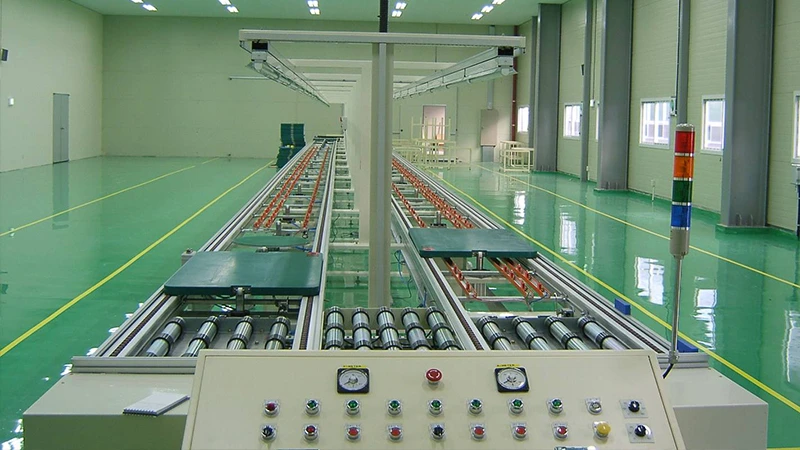
Walk into any cutting-edge automotive battery production facility today, and you'll immediately sense the pulse of progress. The air hums with precision, workers move with purpose, and materials flow seamlessly from one station to the next—no bottlenecks, no delays, just the kind of efficiency that powers the electric vehicle revolution. At the heart of this orchestration? The free flow chain conveyor. More than just a piece of equipment, it's the silent partner that turns complex manufacturing processes into a symphony of productivity. In this article, we'll dive into how this unassuming system is redefining automotive battery production, why it's become indispensable for modern factories, and how it integrates with lean systems, aluminum profiles, and roller tracks to create a workflow that's as flexible as it is reliable.
The Automotive Battery Boom: Why Production Lines Need a New Kind of Conveyor
Electric vehicles (EVs) aren't just a trend—they're the future. As demand for EVs skyrockets, so does the need for high-quality, high-volume batteries. But battery production is no small feat. These are delicate, precision-engineered components, often weighing tens of kilograms, that require careful handling at every step: from mixing electrode materials and coating foils to assembling cells into modules and, finally, into battery packs. Each stage demands speed, accuracy, and safety—three things traditional conveyors often struggle to deliver.
Older conveyor systems, like belt or chain-driven models, come with trade-offs. Belt conveyors, for example, can stretch or wear over time, leading to misalignment and product jams. Chain conveyors, while durable, are often noisy and require frequent lubrication, which risks contaminating sensitive battery components. Worse, many of these systems are rigid—once installed, they're hard to reconfigure if production needs change. In an industry where battery designs evolve rapidly (think larger capacities, faster charging times), rigidity is a death sentence for productivity.
Enter the free flow chain conveyor. Designed specifically for dynamic manufacturing environments, it's built to address these pain points head-on. Unlike its predecessors, it offers near-frictionless movement, minimal maintenance, and the kind of flexibility that lets factories adapt on the fly. But what makes it so special? Let's break it down.
What Is a Free Flow Chain Conveyor, Anyway?
At its core, a free flow chain conveyor is a material handling system that uses a series of interconnected chains and rollers to move products along a fixed path. But don't let the simplicity fool you—its genius lies in its design. Unlike traditional chain conveyors, where the entire chain moves continuously, free flow systems allow individual carriers (or "trolleys") to move independently. This means if one station needs to pause for quality checks or maintenance, the rest of the line keeps rolling. No more shutting down the entire production line because of a single hiccup.
Imagine a busy highway where cars (your battery components) can merge, slow down, or speed up without causing a traffic jam. That's the free flow concept in action. The chains are typically mounted on aluminum profiles—lightweight, corrosion-resistant, and infinitely customizable—while roller tracks ensure smooth, quiet movement. It's a system built for the realities of battery production: heavy loads, tight tolerances, and the need to keep things moving, even when the unexpected happens.
Key Features: Why Free Flow Chain Conveyors Stand Out
So, what makes free flow chain conveyors the go-to choice for automotive battery lines? Let's unpack their most critical features, and how they work hand-in-hand with other components like aluminum profiles and roller tracks to deliver results.
1. Aluminum Profiles: The Backbone of Flexibility
Walk up to a free flow chain conveyor, and the first thing you'll notice is its frame: sleek, sturdy, and surprisingly lightweight. That's because most modern systems are built using aluminum profiles. Unlike steel, aluminum is corrosion-resistant—essential in battery plants where humidity and chemical exposure are common. It's also easy to cut, drill, and assemble, which means factories can customize the conveyor's length, height, and layout to fit their unique space constraints. Need to add a new station? Simply bolt on additional aluminum profile sections. Want to reconfigure the path to accommodate a new battery size? Aluminum's modularity makes it a breeze. This isn't just about convenience; it's about future-proofing. As battery designs evolve, your conveyor can evolve with them.
2. Roller Tracks: Smooth Movement, Minimal Friction
Underneath the conveyor's chain, you'll find another unsung hero: roller tracks. These are precisely engineered rails with small, rotating rollers that support the chain and reduce friction. When a battery component is placed on the conveyor, the rollers glide it forward with minimal effort—even for heavy loads. This low-friction design means the conveyor uses less energy, runs quieter, and experiences less wear and tear. For battery production, where precision is everything, roller tracks also ensure consistent movement speeds, reducing the risk of component damage. No more jostling, no more sudden stops—just a steady, reliable flow that keeps production on track.
3. Integration with Lean Systems: Waste Not, Want Not
In automotive manufacturing, lean systems aren't just a buzzword—they're a way of life. Lean principles focus on eliminating waste: wasted time, wasted motion, wasted materials. Free flow chain conveyors are lean by design. Take "just-in-time" production, for example. With independent carriers, components arrive at each workstation exactly when they're needed, not a minute earlier or later. This cuts down on inventory storage (no more piling up components waiting for the next step) and reduces the risk of damage from overhandling. The conveyor also minimizes worker movement. Instead of walking back and forth to retrieve materials, components come to the worker—freeing up time for more skilled tasks. It's a small change, but it adds up: studies show lean-integrated conveyors can reduce labor costs by up to 20% while boosting throughput.
4. Durability: Built to Handle the Heavy Lifting
Battery modules and packs are heavy—some can weigh over 50 kg. A flimsy conveyor just won't cut it. Free flow chain systems are built tough, with high-strength chains and reinforced aluminum profiles that can handle continuous loads without bending or warping. The chains themselves are often made from hardened steel, treated to resist wear, and designed to run for thousands of hours with minimal maintenance. Even the roller tracks are built to last, with precision bearings that stand up to constant use. For factories running 24/7, this durability isn't just a nice-to-have; it's a requirement. Downtime is expensive, and a conveyor that can keep up with round-the-clock production is worth its weight in gold.
From Blueprint to Factory Floor: How Free Flow Chain Conveyors Transform Workflows
Let's paint a picture of how a free flow chain conveyor operates in a real-world battery production line. Imagine a mid-sized factory producing battery modules for a popular EV model. The line has five stations: mixing electrode paste, coating the paste onto copper/aluminum foils, assembling cells into modules, testing for defects, and packaging. Here's how the conveyor ties it all together:
At the coating station, workers finish applying electrode paste to a roll of foil. They place the foil roll onto a carrier on the free flow chain conveyor. With a press of a button, the carrier glides forward on roller tracks, moving at a steady 0.5 meters per second—slow enough for workers to monitor, fast enough to keep up with demand. It arrives at the assembly station, where a robot picks up the foil and begins folding it into cells. Meanwhile, the empty carrier automatically returns to the coating station via a separate return track—no need for manual retrieval. This "loop" design ensures carriers are always where they're needed, eliminating downtime.
Later, when the factory decides to add a sixth station for thermal management (a critical step for next-gen batteries), they don't need to replace the entire conveyor. Using aluminum profiles, they simply extend the track by 10 meters, add a new set of roller tracks, and reprogram the carrier routing. The whole process takes a weekend, with minimal disruption to production. That's the power of modularity.
Workers love it too. Maria, an assembly line operator with five years of experience, puts it this way: "Before we had the free flow conveyor, I was constantly walking to fetch materials—up to 5,000 steps a day! Now, the modules come right to me. I can focus on making sure each cell is assembled perfectly, not on moving heavy boxes. And because the conveyor is so quiet, the shop floor feels less stressful. It's like night and day."
| Feature | Free Flow Chain Conveyor | Traditional Belt Conveyor |
|---|---|---|
| Speed Flexibility | Independent carriers allow variable speeds per station | Fixed speed for entire line; hard to adjust |
| Maintenance | Minimal (aluminum profiles resist corrosion; roller tracks need occasional lubrication) | High (belts stretch/wear; require frequent replacement) |
| Flexibility | Modular aluminum profiles; easy to reconfigure | Rigid; requires major overhauls to modify |
| Lean System Compatibility | Optimized for just-in-time production; reduces waste | Often leads to bottlenecks and inventory buildup |
| Noise Level | Quiet (roller tracks reduce friction) | Noisy (belt friction and motor hum) |
Beyond the Conveyor: Building a Unified Production Ecosystem
A free flow chain conveyor doesn't work in isolation. To truly maximize efficiency, it needs to integrate with other components of the production line—like workbenches, material racks, and even automated guided vehicles (AGVs). Let's explore how these pieces come together to create a seamless ecosystem.
Take workbenches, for example. In many battery plants, the conveyor runs alongside ergonomically designed workbenches where workers assemble or inspect components. Since both the conveyor and workbenches are often built using aluminum profiles, they can be easily aligned to the same height, ensuring workers can slide components from the conveyor to the workbench without bending or lifting. Some workbenches even feature built-in roller tracks, allowing materials to flow directly from the conveyor onto the bench surface. It's these small, thoughtful integrations that turn a collection of tools into a cohesive system.
Material racks are another key partner. Placed strategically along the conveyor, these racks hold spare parts, tools, and consumables (like electrode paste or packaging materials). Using aluminum profile accessories, racks can be customized to fit the exact size of the items they store, reducing clutter and ensuring workers always have what they need within arm's reach. When combined with the conveyor's just-in-time delivery, this creates a workflow where nothing is out of place—and nothing slows down.
The Future of Battery Production: Why Free Flow Chain Conveyors Are Here to Stay
As EV demand continues to grow, battery production lines will only get more complex. Factories will need to produce larger batteries, faster, while maintaining stricter quality standards. In this environment, the free flow chain conveyor isn't just a tool—it's a strategic advantage. Its ability to adapt to new designs, integrate with lean systems, and work seamlessly with aluminum profiles and roller tracks makes it indispensable.
But perhaps the biggest reason for its staying power is its impact on people. At the end of the day, manufacturing is a human endeavor. A conveyor that reduces physical strain, minimizes frustration, and lets workers focus on what they do best—crafting high-quality batteries—isn't just good for productivity; it's good for morale. And in an industry where talent is in high demand, a happy, efficient workforce is the ultimate competitive edge.
So the next time you see an electric vehicle on the road, remember: beneath its sleek exterior lies a battery that was built with care, precision, and a little help from a silent partner. The free flow chain conveyor may not grab headlines, but it's the unsung hero powering the EV revolution—one smooth, efficient step at a time.