- Company Articles
- Products and Technology
- Solution
- Free Flow Chain Conveyor for E-Mobility Battery Production: Safety and Efficiency

Free Flow Chain Conveyor for E-Mobility Battery Production: Safety and Efficiency
Related Product
Free Flow Chain Conveyor
The free flow conveyor system uses a free flow chain that can increase the speed of the tooling board that supports the products. This can improve the efficiency and quality of the production process, as well as reduce the wear and tear of the system.
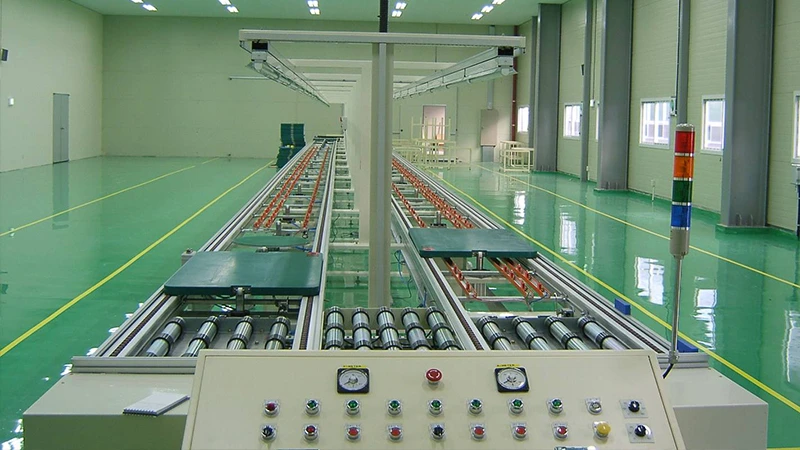
The global shift toward e-mobility has turned battery production into the backbone of an entire industry. As automakers race to meet soaring demand for electric vehicles (EVs), battery manufacturers face a dual challenge: ensuring uncompromising safety in handling sensitive, high-energy components and achieving scalable efficiency to keep up with production targets. In this high-stakes environment, every piece of equipment matters—and few tools deliver on both safety and efficiency quite like the free flow chain conveyor . More than just a conveyor system, it's a linchpin in modern lean manufacturing, designed to streamline workflows, reduce waste, and protect both workers and products. Let's explore how this unassuming yet powerful tool is transforming e-mobility battery production, and why it's become indispensable for forward-thinking manufacturers.
The Critical Intersection of Safety and Efficiency in Battery Production
Before diving into the specifics of free flow chain conveyors, it's important to understand why safety and efficiency are non-negotiable in battery manufacturing. Lithium-ion batteries, the current standard for EVs, are marvels of engineering—but they're also inherently sensitive. Even minor damage to a cell (a scratch, a misalignment, or static discharge) can lead to thermal runaway, fires, or compromised performance. At scale, these risks multiply: a single faulty cell in a module can ruin an entire batch, costing manufacturers thousands in wasted materials and downtime.
On the efficiency side, the pressure to scale is relentless. Major automakers like Tesla, Volkswagen, and BYD are investing billions in gigafactories, aiming to produce millions of batteries annually. To hit these targets, production lines can't afford bottlenecks. Traditional conveyor systems, with their rigid layouts and frequent maintenance needs, often fall short. They slow down workflows, create unnecessary handling steps, and struggle to adapt to evolving battery designs (think larger cells for longer-range EVs or new chemistries like solid-state batteries).
This is where lean manufacturing principles come into play. A lean system —focused on minimizing waste, optimizing flow, and empowering workers—aligns perfectly with the demands of battery production. And at the heart of many lean systems lies the free flow chain conveyor, a tool built to embody flexibility, reliability, and safety.
What Is a Free Flow Chain Conveyor, and How Does It Work?
At its core, a free flow chain conveyor is a material handling system designed to move products smoothly, continuously, and with minimal friction. Unlike traditional belt conveyors (which rely on a single moving belt) or roller conveyors (which use gravity or motorized rollers), free flow chain conveyors use a series of interconnected chains with attached rollers. These chains glide along a track, allowing products to move freely—either by gravity or gentle motorized assistance—while maintaining precise control over speed and alignment.
The "free flow" name comes from its ability to let products move independently. If one station downstream is temporarily blocked (e.g., a worker pausing to inspect a battery module), products upstream can accumulate without jamming the entire line. This flexibility is a game-changer in battery production, where tasks like cell testing, module assembly, and final inspection often have variable cycle times.
But what truly sets free flow chain conveyors apart is their adaptability. They're compatible with a range of materials, from lightweight battery cells to heavy modules, and can be customized with accessories like roller track guides, side guards, and ESD-safe components. This versatility makes them ideal for integrating with other lean tools, such as workbenches, material racks, and automated assembly stations.
Safety First: Protecting Workers and Sensitive Battery Components
In battery production, safety isn't just a compliance checkbox—it's a daily priority. Free flow chain conveyors are engineered with this in mind, incorporating features that mitigate risks at every step. Let's break down the key safety benefits:
1. ESD Protection for Sensitive Electronics
Electrostatic discharge (ESD) is a silent threat in battery manufacturing. Even a small static charge can damage delicate battery cells, leading to performance issues or safety hazards down the line. Free flow chain conveyors address this by using ESD-safe materials throughout their design. Components like the chain, rollers, and roller track guide rails are often made from conductive plastics or coated metals that dissipate static, preventing buildup. Some models even include grounding straps to ensure any charge is safely redirected away from the product.
2. Smooth, Jam-Free Operation to Prevent Damage
Rough handling is one of the biggest causes of battery cell damage. A sudden jolt or misalignment can crack a cell's casing, exposing its flammable electrolyte. Free flow chain conveyors minimize this risk with precision-engineered chains and rollers that move products with near-zero vibration. The chains are tensioned evenly, and the rollers are spaced to support the product's weight without sagging. This smooth movement ensures cells and modules stay intact, even during high-speed transport.
3. Non-Sparking and Fire-Resistant Materials
Lithium-ion batteries are highly reactive, and any spark could ignite a fire. Free flow chain conveyors mitigate this risk by using non-sparking materials like stainless steel or aluminum for critical components. Even the lubricants used in the chain are often fire-resistant, reducing the chance of ignition in the unlikely event of a battery thermal event.
4. Integrated Safety Guards and Sensors
Worker safety is equally important. Free flow chain conveyors come with optional safety features like retractable guards, emergency stop buttons, and photoelectric sensors. These sensors detect if a worker's hand or tool enters the conveyor path, instantly pausing operation to prevent injury. For high-speed lines, laser scanners can create a "safety curtain" around the conveyor, ensuring no one gets too close during operation.
Efficiency Boost: Streamlining Workflows and Reducing Waste
While safety is foundational, free flow chain conveyors also deliver tangible efficiency gains that directly impact the bottom line. Here's how they help manufacturers meet (and exceed) production targets:
1. Continuous Flow for Higher Throughput
Traditional conveyor systems often rely on stop-start motion, where products wait for the entire line to cycle. Free flow conveyors eliminate this by allowing products to move as soon as the next station is free. This continuous flow reduces idle time, increasing throughput by 15-30% in many cases. For example, a gigafactory producing 500,000 batteries per year could see an extra 75,000-150,000 units annually—just by switching to a free flow system.
2. Flexibility to Adapt to Changing Production Needs
Battery designs evolve rapidly. A conveyor system that works for 21700 cells today might not fit the larger 4680 cells of tomorrow. Free flow chain conveyors solve this with modular components. Tracks can be extended, shortened, or reconfigured with minimal downtime. Aluminum profile frames, lightweight and easy to assemble, make adjustments even simpler—no welding or heavy machinery required. This adaptability future-proofs production lines, saving manufacturers from costly overhauls every few years.
3. Reduced Manual Handling and Labor Costs
Manual material handling is a major source of waste in lean manufacturing—think workers lifting heavy modules, pushing carts, or repositioning products. Free flow chain conveyors automate these tasks, moving products directly to the next workstation with minimal human intervention. This not only cuts labor costs but also reduces the risk of worker fatigue and injury, further boosting productivity.
4. Integration with Automation and Data Tracking
| Feature | Traditional Conveyor Systems | Free Flow Chain Conveyors |
|---|---|---|
| ESD Protection | Limited; often requires add-ons | Built-in with conductive materials and grounding |
| Throughput | Fixed speed; prone to bottlenecks | Variable speed; independent product flow reduces bottlenecks |
| Flexibility | Rigid; difficult to reconfigure | Modular design with aluminum profiles for easy adjustments |
| Maintenance | Frequent; complex belt/roller replacements | Low; self-lubricating chains and durable components |
Modern free flow chain conveyors aren't just mechanical—they're smart. Many models come with sensors that track product location, speed, and status in real time. This data integrates with manufacturing execution systems (MES), giving managers visibility into bottlenecks, downtime, and throughput. For example, if a section of the conveyor is consistently slow, the MES can flag it for maintenance before it causes a breakdown. Some systems even sync with robotic arms, ensuring batteries are precisely positioned for automated tasks like cell stacking or welding.
Integrating Free Flow Chain Conveyors into a Lean Workbench Ecosystem
A conveyor is only as effective as the system around it. In lean battery production, free flow chain conveyors shine when paired with ergonomic workbenches and material racks. Let's imagine a typical module assembly line:
Step 1: Cell Delivery – Battery cells arrive via free flow conveyor, gently moving to a workstation where an operator loads them into a fixture. The conveyor's adjustable speed ensures cells arrive exactly when needed, eliminating waiting or rushing.
Step 2: Module Assembly – The operator works at a height-adjustable workbench, with tools and components within arm's reach (thanks to overhead racks fed by another mini-conveyor). Once the module is assembled, the operator pushes it onto the free flow conveyor, which carries it to the next station.
Step 3: Testing and Inspection – The module stops at a testing workbench, where sensors check voltage, temperature, and structural integrity. If it passes, the conveyor resumes, moving the module to final packaging. If not, it's diverted to a rework station via a side branch in the conveyor—no need to halt the entire line.
This seamless flow minimizes waste (no unnecessary movement of products or workers), reduces errors (consistent positioning), and keeps the line moving—all hallmarks of a lean system. The workbench itself, often built with aluminum profiles, is lightweight and customizable, allowing manufacturers to tailor it to the task (e.g., adding ESD mats, tool holders, or integrated scales).
Real-World Impact: A Case Study in Gigafactory Efficiency
To put these benefits into perspective, let's look at a hypothetical (but realistic) case study. A mid-sized battery manufacturer was struggling to meet demand for EV modules, with throughput stuck at 1,000 modules per day and a 2% defect rate due to handling errors. Their existing belt conveyors were rigid, frequently jammed, and required 8 hours of maintenance weekly.
The manufacturer invested in a free flow chain conveyor system, paired with aluminum profile workbenches and ESD-safe roller tracks. Within three months, the results were striking:
- Throughput increased by 25%: From 1,000 to 1,250 modules per day, thanks to continuous flow and reduced downtime.
- Defect rate dropped to 0.5%: Smoother product handling and ESD protection minimized cell damage.
- Maintenance time cut by 60%: Self-lubricating chains and modular components reduced weekly upkeep to just 3 hours.
- Labor costs down by 15%: Automated material handling eliminated the need for 5 full-time workers to move products manually.
The ROI? The system paid for itself in under a year, with ongoing savings from higher output and lower waste. For a manufacturer scaling to meet EV demand, these gains aren't just financial—they're strategic, helping the company secure long-term contracts with automakers.
Future-Proofing with Sustainable Materials: Aluminum Profiles and Beyond
As the e-mobility industry focuses on sustainability, manufacturers are looking for ways to reduce their carbon footprint. Free flow chain conveyors are evolving to meet this demand, with a shift toward eco-friendly materials like aluminum profiles. Aluminum is not only lightweight and strong but also 100% recyclable, with a low carbon footprint compared to steel. Many suppliers now offer conveyors made from recycled aluminum, further reducing environmental impact.
Another trend is the use of biodegradable lubricants for chains and food-grade plastics for rollers (important for cleanroom environments). Some manufacturers are even experimenting with solar-powered conveyor motors for low-energy sections of the line, aligning with the industry's green goals.
Conclusion: The Free Flow Chain Conveyor—A Catalyst for E-Mobility Growth
In the fast-paced world of e-mobility battery production, safety and efficiency aren't competing priorities—they're two sides of the same coin. Free flow chain conveyors bridge this gap, offering a flexible, reliable solution that protects sensitive components, empowers workers, and scales with demand. When integrated into a lean system, paired with aluminum profile workbenches and smart automation, they become more than equipment—they're a strategic asset.
As gigafactories multiply and battery technology advances, the need for tools that balance safety, efficiency, and adaptability will only grow. Free flow chain conveyors, with their proven track record and ongoing innovations, are poised to remain at the forefront of this revolution. For manufacturers looking to build the future of e-mobility, the message is clear: invest in systems that move as fast as your ambition—and do it safely.