
In the world of semiconductor manufacturing, where the tiniest particle or static charge can derail production and compromise billions of dollars in technology, every detail matters. From the air filtration systems that maintain ISO Class 5 cleanliness to the precision tools that etch nanoscale circuits onto silicon wafers, the industry demands perfection at every turn. Yet, one often overlooked hero in this high-stakes environment is the material handling system—the invisible backbone that ensures components, wafers, and tools move seamlessly through the production process without introducing contamination or damage. Among these systems, the free flow chain conveyor has emerged as a critical solution, designed to meet the unique challenges of semiconductor cleanrooms while aligning with modern manufacturing principles like lean efficiency. Let's dive into why this technology has become indispensable, how its design caters to cleanroom demands, and the role it plays in keeping semiconductor production both precise and efficient.
The Cleanroom Challenge: Why Material Handling Matters in Semiconductor Manufacturing
Semiconductor fabrication facilities, or "fabs," are among the most controlled environments on Earth. A single dust particle—smaller than 0.5 micrometers (about 1/50th the diameter of a human hair)—can ruin a batch of wafers, each containing hundreds of microchips. Similarly, electrostatic discharge (ESD) as low as 250 volts can damage sensitive electronic components, a risk that's ever-present when materials are moved, touched, or even just exposed to friction. Add to this the need for high throughput—modern fabs produce thousands of wafers daily—and the pressure to minimize downtime, and it's clear: material handling isn't just a logistical afterthought; it's a make-or-break factor in semiconductor production.
Traditional conveyor systems, while effective in general manufacturing, often fall short in cleanrooms. Many use belts or chains with crevices that trap particles, lubricants that outgas harmful vapors, or materials that generate static. They may lack the precision to handle delicate wafers or the flexibility to adapt to changing production layouts—key issues in an industry where production lines are frequently reconfigured to accommodate new chip designs. For semiconductor manufacturers, the ideal material handling system must check three boxes: contamination control , ESD protection , and operational flexibility . Enter the free flow chain conveyor.
What Is a Free Flow Chain Conveyor? Breaking Down the Basics
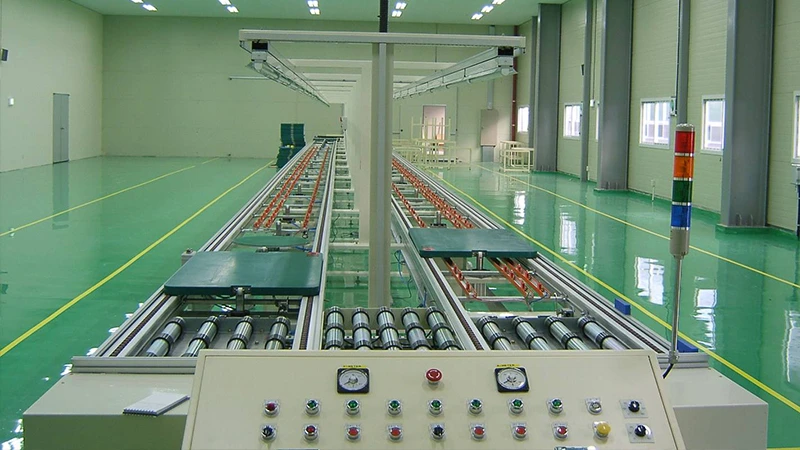
At its core, a free flow chain conveyor is a material handling system that uses a series of interconnected chains, mounted on precision roller tracks , to move products along a path with minimal friction. Unlike traditional belt conveyors, which rely on a continuous belt surface, free flow chain conveyors use discrete chain links with low-friction rollers, allowing for smooth, controlled movement of loads. This design offers two key advantages for cleanrooms: first, it eliminates the need for bulky belts that can shed particles or harbor contaminants; second, it allows for "free flow" movement, meaning products can start, stop, or change direction without jolting—critical for delicate semiconductor components like wafers or photomasks.
But what truly sets free flow chain conveyors apart is their adaptability. They can be configured in straight lines, curves, or even vertical elevations, making them suitable for complex fab layouts. They're also modular, built from standardized components that can be easily adjusted or expanded as production needs change. This modularity aligns perfectly with lean system principles, which emphasize minimizing waste—whether in time, space, or resources—by designing processes that are both efficient and flexible.
Design Features for Cleanroom Compatibility: Built to Keep Contamination Out
Cleanroom compatibility isn't an afterthought for free flow chain conveyors; it's engineered into every component. Let's break down the key design elements that make these systems suitable for semiconductor fabs:
1. Material Selection: Aluminum Profile for Purity and Durability
The frame and structural components of free flow chain conveyors are typically constructed from aluminum profile —a material chosen for its unique combination of properties. Aluminum is naturally corrosion-resistant, so it won't rust or degrade in the humid, controlled environments of cleanrooms. Its smooth, non-porous surface is easy to clean and sanitize, with no cracks or crevices where particles can hide. Unlike steel, aluminum doesn't require heavy paints or coatings that might flake off and contaminate the air, and it can be anodized to create an even harder, more wear-resistant surface that further reduces particle generation.
But aluminum's benefits go beyond cleanliness. It's lightweight, making the conveyor system easier to install, reconfigure, and maintain—important in fabs where floor space is limited and production lines are frequently updated. Aluminum profiles are also precision-extruded, meaning they can be manufactured to tight tolerances, ensuring the conveyor runs smoothly without vibration that could dislodge particles or damage sensitive materials.
2. Low-Particle Generation: Sealed Components and Minimal Friction
In a cleanroom, even the conveyor's moving parts must be designed to minimize particle shedding. Free flow chain conveyors achieve this through several innovations: sealed roller bearings that prevent lubricant leakage (critical, as many lubricants outgas volatile organic compounds, or VOCs, which can contaminate wafers); smooth, polished chain links that reduce friction and wear; and precision-machined roller tracks that ensure the chain glides without jarring or scraping. Some models even use self-lubricating materials for moving parts, eliminating the need for external lubricants entirely.
Another key feature is the use of "low-outgassing" materials for non-metallic components, such as plastic guides or chain links. These materials are tested to ensure they don't release harmful vapors when exposed to the high temperatures or chemicals sometimes present in semiconductor processes. For example, conveyor guides might be made from PEEK (polyether ether ketone), a high-performance plastic known for its chemical resistance and low particle emission.
3. ESD Protection: Safeguarding Against Static Damage
Semiconductor components are extremely sensitive to ESD. A static charge buildup on a conveyor or a product can discharge suddenly, creating a voltage spike that damages microchips or corrupts data on wafers. To mitigate this risk, free flow chain conveyors are integrated into broader ESD control systems, often working alongside ESD workstations and grounding equipment to maintain a static-safe environment.
How does this work in practice? The aluminum profile frame of the conveyor is electrically grounded, providing a path for static charges to dissipate harmlessly into the facility's grounding system. Chains and roller tracks may be coated with conductive materials, such as carbon-infused plastics, to ensure they don't accumulate static. Even the casters (if the conveyor is mobile) are designed with conductive wheels to prevent charge buildup as the system moves. When paired with ESD workstations—equipped with grounded surfaces, wrist straps, and ionizers—free flow chain conveyors create a seamless ESD-protected zone, from wafer intake to final packaging.
Lean System Integration: Making Semiconductor Production More Efficient
Semiconductor manufacturing is a complex, multi-step process, with wafers moving through hundreds of stages—from deposition and lithography to etching and testing—before becoming finished chips. In such a complex workflow, inefficiencies can quickly snowball into delays, wasted materials, and increased costs. This is where lean system principles come into play, and free flow chain conveyors are a natural fit for lean-driven fabs.
Lean manufacturing focuses on eliminating "muda," or waste, in all its forms: waste of time (waiting), waste of space (overproduction), waste of movement (unnecessary transportation), and more. Free flow chain conveyors address these wastes in several ways:
- Reduced Waiting Time: By enabling continuous, smooth movement of materials, free flow chain conveyors eliminate bottlenecks where wafers might sit idle, waiting for manual transport or a slow conveyor. This keeps production flowing at a steady pace, aligning with the lean goal of "takt time" (matching production speed to customer demand).
- Flexible Layouts: Modular design allows conveyors to be reconfigured quickly, so production lines can adapt to changes in chip design or batch sizes without major overhauls. This reduces the "waste of overprocessing" (spending time/money on inflexible systems).
- Space Optimization: Unlike bulky traditional conveyors, free flow chain systems are compact, with a small footprint that maximizes usable floor space in fabs—critical in facilities where every square foot costs thousands of dollars.
- Integration with Automation: Free flow chain conveyors easily connect with automated guided vehicles (AGVs), robotic arms, and other smart systems, reducing the need for manual material handling (a major source of human error and contamination).
For example, a leading semiconductor manufacturer in Taiwan recently reconfigured its wafer inspection line using free flow chain conveyors and lean principles. By replacing a manual cart-based system with a modular conveyor layout, the company reduced wafer transport time by 40%, cut contamination incidents by 65%, and freed up 15% of floor space for new equipment. The result? A 20% increase in daily wafer output—all while maintaining strict cleanroom compliance.
Comparing Conveyor Systems: Why Free Flow Chain Stands Out for Cleanrooms
To understand why free flow chain conveyors are preferred in semiconductor cleanrooms, let's compare them to two common alternatives: belt conveyors and roller conveyors. The table below highlights key differences in contamination risk, ESD safety, flexibility, and cost-effectiveness.
| Feature | Belt Conveyor | Roller Conveyor (Traditional) | Free Flow Chain Conveyor |
|---|---|---|---|
| Particle Generation | High (belts shed fibers; crevices trap dust) | Moderate (rollers may accumulate debris; gaps between rollers trap particles) | Low (sealed components, smooth surfaces, minimal friction) |
| ESD Protection | Limited (belts often non-conductive; hard to ground effectively) | Moderate (metal rollers can be grounded, but plastic components may generate static) | High (conductive materials, integrated grounding, compatible with ESD workstations) |
| Flexibility | Low (fixed belt paths; hard to reconfigure curves/elevations) | Moderate (can be curved, but limited to gravity or motorized movement) | High (modular design; configurable for curves, inclines, and variable speeds) |
| Maintenance Requirements | High (belts need frequent replacement; lubrication risks contamination) | Moderate (rollers may jam; bearings require regular cleaning) | Low (sealed bearings, minimal lubrication, easy-to-replace modular parts) |
| Cleanroom Compatibility | Poor (not suitable for ISO Class 5+ environments) | Fair (usable in ISO Class 7-8, but risks in higher-class cleanrooms) | Excellent (designed for ISO Class 5-6; meets SEMI S2/S8 safety standards) |
Maintenance and Validation: Keeping Free Flow Chain Conveyors Cleanroom-Ready
Even the most well-designed conveyor system will fail in a cleanroom if not properly maintained. For free flow chain conveyors, maintenance focuses on two priorities: preventing particle buildup and ensuring ESD protection remains effective . Let's explore best practices for both:
Preventing Particle Buildup: Regular Cleaning and Inspection
Cleanroom maintenance teams typically follow a strict schedule for conveyor cleaning, using HEPA-filtered vacuums and lint-free wipes with isopropyl alcohol (IPA) to remove dust and debris from chain links, roller tracks, and aluminum profiles. Sealed bearings are inspected quarterly to ensure they're not leaking lubricant, and any worn components—such as chain links or rollers—are replaced immediately to prevent friction-induced particle generation.
Some advanced conveyors also feature built-in particle monitoring sensors that alert operators to debris levels, allowing for proactive cleaning before contamination becomes an issue. This is especially critical in "mini-environments"—small, ultra-clean zones within fabs where wafers are processed—that require ISO Class 4 or higher cleanliness.
ESD Validation: Testing and Calibration
ESD protection isn't a "set it and forget it" feature. Over time, conductive coatings on chains or roller tracks can wear thin, and grounding connections may loosen, increasing the risk of static buildup. To prevent this, fabs perform regular ESD testing using instruments like surface resistance meters, which measure how effectively the conveyor dissipates static charges. These tests ensure that the conveyor's surface resistance remains within the safe range (typically 10^6 to 10^9 ohms), as specified by standards like ANSI/ESD S20.20.
Additionally, free flow chain conveyors are often integrated with the fab's overall ESD monitoring system, which tracks grounding continuity in real time. If a connection fails, the system triggers an alert, halting conveyor operation until the issue is resolved—preventing ESD damage to sensitive components.
Future Trends: Innovations in Free Flow Chain Conveyors for Semiconductors
As semiconductor technology advances—with chips shrinking to 3nm and beyond, and new materials like gallium nitride (GaN) and silicon carbide (SiC) entering production—the demands on material handling systems will only grow. Free flow chain conveyors are evolving to meet these challenges, with three key trends emerging:
1. Smart Conveyors with IoT Integration
The next generation of free flow chain conveyors will feature Internet of Things (IoT) sensors that monitor everything from chain tension and roller wear to particle counts and ESD levels in real time. This data will be fed into AI-powered analytics platforms, allowing for predictive maintenance—repairing components before they fail—and optimizing conveyor speed and routing to reduce energy use and contamination risks.
2. Ultra-Low Profile Designs for Tighter Spaces
As fabs pack more equipment into limited space, conveyor systems are being designed with thinner aluminum profiles and lower heights. Some models now have a vertical clearance of less than 100mm, making them ideal for under-bench transport or integration with automated tools that have minimal clearance.
3. Sustainable Materials and Energy Efficiency
With semiconductor manufacturers under increasing pressure to reduce their carbon footprint, free flow chain conveyors are moving toward recycled aluminum profiles and energy-efficient motors. Some systems now use regenerative braking, where energy from decelerating loads is captured and reused, cutting power consumption by up to 30%.
Conclusion: The Indispensable Role of Free Flow Chain Conveyors in Semiconductor Manufacturing
In the high-precision world of semiconductor manufacturing, where contamination, ESD, and efficiency can make or break a fab's success, the free flow chain conveyor has proven itself as more than just a material handling tool—it's a strategic asset. By combining cleanroom-friendly design (think aluminum profile frames and sealed components), ESD protection (complementary to ESD workstations ), and lean system compatibility, these conveyors ensure that materials move through the production process safely, efficiently, and without compromise.
As semiconductors continue to shrink in size and grow in complexity, the demand for smarter, more adaptable material handling systems will only increase. Free flow chain conveyors, with their modularity, low contamination risk, and integration with emerging technologies like IoT and AI, are poised to remain at the forefront of this evolution. For semiconductor manufacturers, investing in these systems isn't just about moving materials—it's about moving forward, one precise, particle-free step at a time.