- Company Articles
- Products and Technology
- Product knowledge
- Free Flow Chain Conveyor for Small-Batch Production: Flexibility Advantages

Free Flow Chain Conveyor for Small-Batch Production: Flexibility Advantages
Related Product
Free Flow Chain Conveyor
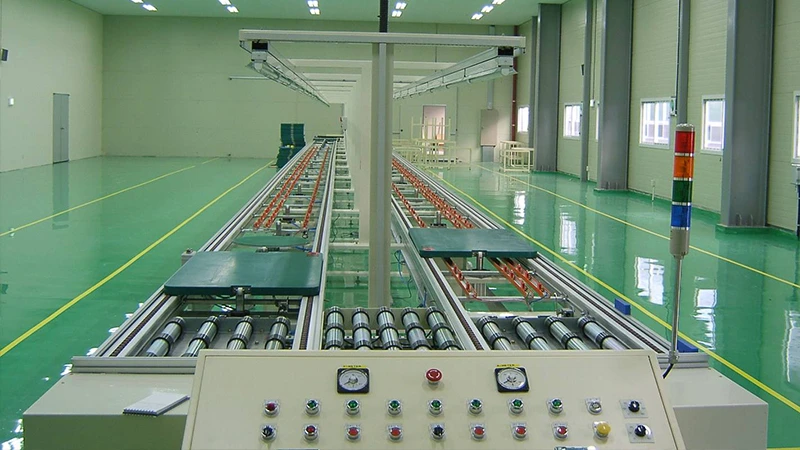
The free flow conveyor system uses a free flow chain that can increase the speed of the tooling board that supports the products. This can improve the efficiency and quality of the production process, as well as reduce the wear and tear of the system.
The Rise of Small-Batch Production and the Need for Flexible Material Handling
Walk into any modern manufacturing facility today, and you'll notice a shift: gone are the days of mass-produced, one-size-fits-all products. Today's consumers crave customization—whether it's a personalized electronic gadget, a bespoke automotive part, or a limited-edition consumer good. This demand has given rise to small-batch production, where manufacturers pivot quickly between product runs, often with batch sizes as small as 10 or 20 units. But while small-batch production unlocks creativity and customer satisfaction, it also throws a curveball at traditional material handling systems.
Imagine a small electronics workshop that assembles smart home sensors. One week, they're building motion detectors for a local retailer; the next, they're switching to temperature sensors for a healthcare client. Each product has different components, assembly steps, and packaging requirements. If their material handling system is fixed—a rigid conveyor belt bolted to the floor, or a static workbench setup—every changeover becomes a logistical nightmare. Workers waste hours disassembling, reconfiguring, and rebalancing the line. Parts get misplaced, bottlenecks form, and deadlines slip. In short, rigidity kills efficiency in small-batch environments.
This is where free flow chain conveyors step in. Designed with flexibility at their core, these systems act as the adaptable backbone of small-batch production lines. They're not just conveyors—they're problem-solvers that grow, shrink, and reorient with your changing needs. In this article, we'll dive into how free flow chain conveyors transform material handling for small-batch manufacturers, why their flexibility matters, and how they integrate seamlessly with lean system principles to cut waste and boost productivity.
What Are Free Flow Chain Conveyors? Breaking Down the Basics
Let's start with the basics: What exactly is a free flow chain conveyor? At its simplest, it's a material handling system that uses a series of interconnected chains to move products along a track. Unlike traditional belt conveyors, which rely on a continuous belt, or roller conveyors, which use gravity or motors to roll items, free flow chain conveyors use low-friction chains mounted on a track. This design allows products to glide smoothly—hence "free flow"—with minimal resistance, even when stopping, starting, or changing direction.
But what really sets them apart is their modularity. Think of a free flow chain conveyor as a set of building blocks. The track is made of sections that connect via simple fasteners, and the chains are designed to be easily extended or shortened. This means if you need to add a 5-foot section to accommodate a new workbench, or angle the conveyor 30 degrees to feed into a packaging station, you can do it without calling in a team of engineers. Most systems even work with standard tools—no welding or heavy machinery required.
Key components include:
- Chain Links: Typically made of durable plastic or stainless steel, these interlock to form a flexible, continuous surface. Plastic chains are lightweight and ideal for light-to-medium loads (like small electronics), while stainless steel chains handle heavier items (up to 500 lbs per linear foot in some cases).
- Tracks/Rails: The "road" the chain travels on. Tracks are often made from aluminum profile—a material prized for its strength-to-weight ratio. Aluminum profiles are not only lightweight (making reconfiguration easy) but also resistant to corrosion, which is a boon for clean environments like food packaging or medical device assembly.
- Guides and Stops: Adjustable plastic or metal guides keep products centered on the chain, while manual or automated stops pause items at workstations. This is crucial for small-batch production, where workers might need to inspect, assemble, or label products mid-flow.
- Drives and Motors (Optional): Some systems use electric motors to power the chain, while others rely on gravity for downhill flow. For small-batch lines, gravity-fed systems are popular—they're energy-efficient and require less maintenance.
The result? A system that feels less like a permanent fixture and more like a tool you can reshape on the fly. One day, it's a straight line feeding parts to a workbench; the next, it's a U-shape connecting three assembly stations. That adaptability is why free flow chain conveyors have become a go-to for manufacturers who can't predict their next production run—and wouldn't have it any other way.
Flexibility in Action: How Free Flow Chain Conveyors Solve Small-Batch Pain Points
Small-batch production isn't just about making fewer units—it's about making different units, often with little warning. Let's say a furniture manufacturer gets a rush order for 20 custom bookshelves, each with unique dimensions. Their previous conveyor system, a fixed belt model, was great for standard bookshelves but couldn't handle the wider, heavier custom versions without extensive modifications. Enter free flow chain conveyors: here's how they'd turn that challenge into a non-issue.
1. Quick Changeovers, No Downtime
Changeover time is the enemy of small-batch production. Every minute spent reconfiguring your line is a minute not spent making products. Free flow chain conveyors slash changeover time thanks to their modular track design. Aluminum profile tracks connect via simple bolts or clips, so adding a new section takes 10 minutes instead of 2 hours. Need to widen the track for larger items? Swap out the aluminum guides—no need to replace the entire conveyor.
For example, a small automotive parts shop in Ohio recently switched to free flow chain conveyors and reduced changeover time from 3 hours to 45 minutes. Their secret? They pre-assembled "changeover kits"—sets of tracks, guides, and stops tailored to their most common product runs. When a new order comes in, workers simply swap the kit, and the line is ready to go.
2. Adapting to Diverse Product Sizes and Weights
Small-batch manufacturers rarely stick to one product size. One day, you're moving circuit boards (light, flat, small); the next, you're moving toolboxes (heavy, bulky, irregularly shaped). Free flow chain conveyors handle this diversity with ease. By adjusting the chain spacing (how far apart the chain links are) and adding custom guides, you can accommodate everything from 1-pound widgets to 300-pound machinery parts.
Take a medical device company that produces both tiny insulin pumps and larger hospital monitors. Their free flow conveyor uses plastic chains for the pumps (gentle on delicate components) and stainless steel chains for the monitors (extra strength). The aluminum profile track stays the same—only the chain and guides change. This versatility means they don't need separate conveyors for each product line, saving floor space and money.
3. Integrating with Workbenches and Flow Racks
A conveyor is only as useful as the workflow around it. Free flow chain conveyors play well with other lean tools, like workbenches and flow racks, to create a seamless production ecosystem. For instance, a workbench positioned alongside the conveyor lets assemblers grab parts from a flow rack, build the product, and slide it back onto the conveyor—all without leaving their station.
A California-based toy manufacturer exemplifies this. Their line features a free flow conveyor snaking through six workbenches, each equipped with flow racks stocked with different toy components (wheels, gears, plastic bodies). As the conveyor moves toy frames past each bench, workers add parts, and the finished toys roll to packaging. When they launch a new toy, they simply reposition the workbenches and flow racks—no need to rebuild the entire line.
The Lean Connection: Aligning with Lean System Principles
Small-batch production and lean system thinking go hand in hand. Lean is all about eliminating waste—whether it's wasted time, wasted space, or wasted effort—and free flow chain conveyors are lean's perfect partner. Here's how they align with core lean principles:
1. Continuous Flow: Keeping Products Moving
Lean manufacturing thrives on continuous flow—ensuring products move from raw material to finished goods with minimal stops. Traditional conveyors often create bottlenecks: if one workstation is slow, the entire line backs up. Free flow chain conveyors solve this with "non-powered" zones. In gravity-fed systems, products glide until they hit a stop at a workstation. Once the worker finishes, they release the stop, and the product continues—no waiting for the entire line to catch up.
A bakery in Portland used this to their advantage. They switched from a belt conveyor to a free flow chain system for their artisanal bread line. Now, dough trays flow to each station (mixing, shaping, baking) independently. If the shaping station gets backed up, the mixing station can still send trays—they just pause at a stop until shaping is ready. Waste from stale dough dropped by 40%.
2. Just-In-Time (JIT) Delivery: Feeding Workstations Exactly What They Need
JIT manufacturing means delivering parts to workstations right when they're needed—not too early (wasting space) or too late (causing delays). Free flow chain conveyors excel at this, especially when paired with flow racks. Flow racks store components at the front of the line, and the conveyor delivers them to workers as needed. For example, a smartphone repair shop uses a free flow conveyor to move phones to repair stations. Each station has a flow rack with screens, batteries, and tools, and the conveyor ensures only one phone arrives at a time—no piles of phones cluttering the workspace.
3. Kaizen (Continuous Improvement): Easy to Tweak and Optimize
Lean isn't a one-and-done process—it's about constant small improvements (kaizen). Free flow chain conveyors are built for kaizen. Since they're modular, workers can experiment with small changes: moving a workbench 2 feet closer to the conveyor, adding a new stop to reduce errors, or angling a track to speed up flow. These tweaks don't require approval from upper management or expensive overhauls—just a few tools and a willingness to try.
A electronics manufacturer in Texas empowered their line workers to suggest conveyor improvements. One worker noticed that parts often fell off the conveyor at a sharp turn, so they added a plastic guide rail (yellow, to match their safety standards) and reduced defects by 75%. Another worker suggested raising the conveyor 6 inches at the packaging station to reduce bending—cutting worker fatigue and increasing packaging speed by 15%.
Comparing Material Handling Solutions: Why Free Flow Chain Conveyors Stand Out
Not all conveyors are created equal. To understand why free flow chain conveyors are ideal for small-batch production, let's compare them to two common alternatives: roller conveyors and belt conveyors. The table below breaks down key factors like flexibility, changeover time, and maintenance needs.
| Conveyor Type | Flexibility | Changeover Time | Load Capacity | Maintenance Needs | Best For |
|---|---|---|---|---|---|
| Free Flow Chain Conveyor | High: Modular tracks, adjustable guides, easy to reconfigure. | 30–60 minutes (with pre-assembled kits). | Light to medium (up to 500 lbs/linear ft with steel chains). | Low: Occasional chain lubrication, guide cleaning. | Small-batch production, custom products, frequent changeovers. |
| Roller Conveyor | Medium: Fixed roller spacing; hard to adjust for different product sizes. | 2–4 hours (requires changing rollers or tracks). | Medium to heavy (up to 1,000 lbs/linear ft). | Medium: Rollers can jam; require regular cleaning/lubrication. | Heavy, uniform products (e.g., pallets, large boxes). |
| Belt Conveyor | Low: Fixed belt width; hard to change direction or length. | 4–8 hours (requires replacing belt or entire section). | Light to medium (up to 300 lbs/linear ft). | High: Belts wear, stretch, or tear; require frequent replacement. | High-volume, uniform products (e.g., packaged goods, mass-produced items). |
The takeaway? For small-batch manufacturers, free flow chain conveyors offer the best balance of flexibility, speed, and low maintenance. Roller conveyors are great for heavy loads but too rigid for frequent changeovers, while belt conveyors excel at high volume but fail when product sizes vary.
Real-World Success: A Day in the Life of a Small Manufacturer with Free Flow Conveyors
Let's step into the shoes of Maria, a production manager at a small cosmetics company in Colorado. Her team makes custom skincare kits—think serums, moisturizers, and masks tailored to customer skin types. With batch sizes ranging from 10 to 100 kits, and 5–7 product changes per week, Maria's biggest headache used to be keeping the line moving.
8:00 AM: Morning Setup
Today, Maria's team is switching from "Dry Skin" kits to "Acne-Prone" kits. With their old belt conveyor, this would take 2 hours: changing the belt guides, adjusting the speed, and repositioning workbenches. Now, with their free flow chain conveyor, it's a 45-minute process. The team grabs their "Acne-Prone" kit—a pre-assembled set of aluminum guides (grey, to match the kit's packaging), narrower chain spacing (to fit smaller serum bottles), and extra stops at the labeling station. They unbolt the old guides, snap in the new ones, and test the flow with a dummy kit. Done.
10:30 AM: Mid-Morning Rush
A rush order comes in: 20 "Sensitive Skin" kits, due by 3 PM. Maria doesn't panic. She grabs a portable section of free flow conveyor (stored on a turnover trolley) and connects it to the main line with a roller track connector. Now, the line splits: one branch for "Acne-Prone" kits, one for "Sensitive Skin." Workers at the new branch use a workbench E (single deck, no casters) to assemble the rush order, while the main line keeps running. No downtime, no chaos.
2:00 PM: Problem-Solving on the Fly
A worker notices that the serum bottles are tipping over on a sharp turn. Maria grabs a pack of swivel roller balls (1 inch, stainless steel) from the supply closet and attaches them to the track. The balls reduce friction, keeping bottles upright. By 2:15 PM, the issue is fixed—no production delay.
4:00 PM: End-of-Day Kaizen Meeting
The team gathers to discuss improvements. One worker suggests raising the conveyor 4 inches at the packaging station to reduce back strain. Maria nods—they'll adjust it tomorrow using aluminum profile accessories (height-adjustable brackets). Another worker mentions that the plastic roller track guide rail (yellow) at the end of the line is cracked. They'll order a replacement from their lean system supplier, who offers next-day delivery.
By the end of the day, the team has completed 80 "Acne-Prone" kits and 20 "Sensitive Skin" kits—all on time. With their old system, they'd be lucky to hit 60 kits. Maria smiles: the conveyor didn't just save time—it made her team feel empowered to solve problems and adapt.
Choosing the Right Free Flow Chain Conveyor: Key Considerations
Ready to invest in a free flow chain conveyor? Here's what to keep in mind to ensure you pick the right system for your small-batch needs:
1. Load Capacity and Product Weight
Start with your heaviest product. If you're moving 50-pound toolboxes, opt for stainless steel chains and heavy-duty aluminum profiles. For 1-pound electronics, plastic chains and lightweight aluminum will do. Most suppliers offer load capacity charts—don't guess; ask for a demo with your actual products.
2. Space and Layout
Measure your floor space and sketch your ideal layout. Do you need straight sections, curves, or inclines? Free flow chain conveyors can handle slopes up to 15 degrees with gravity, or steeper angles with motorized drives. Also, consider storage: modular sections should be easy to store on racks or trolleys when not in use.
3. Supplier Support
A good conveyor is only as good as its supplier. Look for a lean system supplier who offers:
- Fast delivery on replacement parts (e.g., roller tracks, joints, casters).
- Customization options (e.g., colored guides, branded components).
- Training for your team on reconfiguration and maintenance.
Don't be afraid to ask for references. A supplier who's worked with small-batch manufacturers will understand your unique needs better than a one-size-fits-all industrial supplier.
Conclusion: Building a Future-Proof Production Line
Small-batch production isn't a trend—it's the future of manufacturing. As consumers demand more customization, manufacturers need systems that can keep up. Free flow chain conveyors aren't just a tool for moving products—they're a strategic investment in flexibility, efficiency, and lean thinking. They turn changeovers from headaches into quick tasks, adapt to diverse products with ease, and empower workers to continuously improve.
Whether you're assembling electronics, packaging cosmetics, or building custom furniture, a free flow chain conveyor can transform your production line from a rigid obstacle into a flexible partner. And with components like aluminum profiles, workbenches, and flow racks working in harmony, you'll create a system that grows with your business—no matter what the next batch brings.
So, if you're tired of fighting against your material handling system, it's time to switch to one that fights for you. Free flow chain conveyors: because in small-batch production, flexibility isn't a luxury—it's essential.