
Introduction: The Invisible Backbone of 3C Manufacturing
Walk into any 3C (computers, communications, consumer electronics) factory, and you'll see a symphony of activity: robots assembling circuit boards, technicians testing smartphone screens, and conveyor belts humming with components. But amid this chaos, there's an unsung hero keeping everything moving: material transport systems. For 3C products—where a single scratch on a laptop casing or a misaligned chip can cost brands millions in recalls—testing lines are the final gatekeepers of quality. And at the heart of these testing lines? The free flow chain conveyor, a quiet workhorse that ensures products glide from station to station with the precision of a ballet dancer.
In an industry where production cycles shrink by the month and consumer expectations soar, testing lines can't afford bottlenecks. A delayed smartphone model launch or a batch of defective smartwatches can erode trust faster than a cracked screen. That's why manufacturers are turning to solutions that don't just move products, but elevate how testing happens. Free flow chain conveyors aren't just pieces of equipment—they're partners in reliability, designed to keep testing lines efficient, workers focused, and products flawless.
Why Material Transport Makes or Breaks Testing Lines
The Hidden Cost of "Good Enough" Transport
Let's start with a scenario many factory managers know too well: A technician at a visual inspection station waits 10 minutes for the next batch of tablets to arrive. The manual cart that was supposed to deliver them got stuck at a bottleneck down the line, and now the testing schedule is off by an hour. By the end of the shift, that delay has snowballed into 50 fewer units tested—units that could have been shipped to eager customers. This isn't just inefficiency; it's lost revenue.
Testing 3C products isn't a one-and-done process. A typical smartphone, for example, passes through 7–10 testing stations: screen dead-pixel checks, battery life tests, camera focus calibration, water resistance trials, and more. Each station requires the product to arrive in perfect condition—no scuffs, no loose connectors, no static damage. Traditional transport methods, like manual carts or basic roller track systems, often fail here. Carts jostle products; rigid roller tracks can't handle sudden direction changes; and uneven movement leads to misalignment during automated tests.
The stakes are even higher for delicate components. A 0.5mm misalignment in a laptop's motherboard during transport can cause a functional test failure later, leading to rework that costs 3x more than catching the issue upfront. For 3C manufacturers, transport isn't just about moving things—it's about preserving product integrity at every step.
| Transport Method | Speed | Product Safety | Scalability |
| Manual carts | Slow (dependent on labor) | High risk of drops/scratches | Limited (requires more workers) |
| Basic roller track | Moderate (gravity-dependent) | Risk of jamming with irregular loads | Low (fixed paths) |
| Free flow chain conveyor | High (adjustable speed, low friction) | Minimal risk (smooth, controlled movement) | High (easily extended with aluminum profile frames) |
What Is a Free Flow Chain Conveyor, and Why Does It Matter?
Beyond the Belt: The Science of "Free Flow"
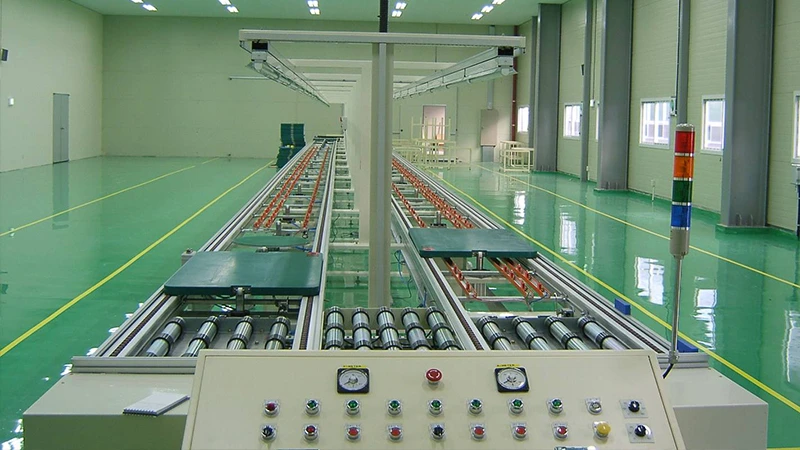
At first glance, a free flow chain conveyor looks deceptively simple: a series of interconnected chain links, each fitted with small rollers, mounted on a frame. But its genius lies in its design. Unlike belt conveyors, which rely on friction between the belt and product, or heavy-duty roller conveyors that use motorized drums, free flow chain conveyors let products move with minimal resistance. The rollers on the chain reduce friction to near-zero, allowing even lightweight items—like smartwatch batteries or earbud cases—to glide forward with a gentle push, whether by motor or by hand.
This "free flow" is a game-changer for testing lines. Imagine a technician needs to pause a batch of circuit boards mid-transport to recheck a reading—no problem. The conveyor's low-friction design lets them stop, adjust, and restart without disrupting the entire line. For 3C products, which often require careful handling between tests, this flexibility is priceless. It's not just about speed; it's about control.
Built to Last: The Role of Aluminum Profile and Materials
A conveyor is only as reliable as its frame, and here's where aluminum profile shines. Unlike flimsy plastic or rust-prone steel, aluminum profile brings three critical benefits: strength , lightweight , and customizability . Free flow chain conveyors built with aluminum profile frames can support heavy loads—think 20kg laptop chassis stacked on trays—without bending, while remaining easy to install and reconfigure. Need to extend the conveyor by 2 meters next quarter? Simply add more aluminum profile sections and connect them with standard brackets—no welding or heavy tools required.
The chain itself is often made of hardened steel or food-grade plastic (for ESD-sensitive environments), with rollers coated in rubber or nylon to prevent scratches. For 3C factories where dust and moisture are constant threats, stainless steel components are available, ensuring the conveyor resists corrosion even in humid conditions. It's a system designed not just for today's products, but for tomorrow's—whether that's a foldable tablet or a slimline VR headset.
5 Ways Free Flow Chain Conveyors Transform Testing Lines
1. Precision Alignment for Automated Testing
Automated testing machines—like those that check touchscreen responsiveness or camera autofocus—demand pinpoint accuracy. If a product is misaligned by even 2mm, the test fails, wasting time and resources. Free flow chain conveyors solve this with adjustable side guides and stop mechanisms. Using sensors, the conveyor can position a product within ±0.5mm of the testing fixture, ensuring the machine's probes or cameras hit their marks every time. One electronics manufacturer in Dongguan reported a 40% reduction in false test failures after switching to free flow conveyors, simply because alignment errors dropped to near-zero.
2. ESD Protection: Safeguarding Sensitive Components
Static electricity is the silent killer of 3C components. A single electrostatic discharge (ESD) can fry a microchip or corrupt a circuit board, turning a perfect product into scrap. That's why free flow chain conveyors are often integrated with ESD workstations—testing stations equipped with anti-static mats, grounded tools, and ionizers. The conveyor's chain and rollers can be grounded, too, channeling static away from products as they move. For factories testing components like 5G modems or OLED displays, this integration isn't optional—it's a lifeline.
3. Seamless Integration with Testing Stations
Testing lines aren't linear—products need to diverge, merge, and sometimes loop back. Free flow chain conveyors adapt to these complexities with modular designs. Need to send defective products to a rework station? Add a diverter arm. Want to merge two product streams into one final inspection line? Use a merging conveyor with sensors to prevent collisions. And because the frame is built with aluminum profile, these add-ons can be installed in hours, not days. It's like building with industrial Legos—flexible, fast, and tailored to your line's unique needs.
4. Reducing Worker Fatigue, Boosting Focus
Let's not forget the human element. Technicians spend 8+ hours a day testing products; if they're also hauling carts or lifting trays, fatigue sets in, and focus wanes. Free flow chain conveyors take the physical strain out of transport. Products arrive at each station at waist height, eliminating bending or reaching. A survey of workers at a Shenzhen smartphone plant found that after installing conveyors, reported fatigue dropped by 25%, and attention to detail—measured by catching minor defects—increased by 18%. When workers aren't exhausted from moving products, they're better at their jobs: ensuring quality.
5. Low Maintenance, High Uptime
In manufacturing, downtime is the enemy. A conveyor breakdown can halt an entire testing line, costing thousands per minute. Free flow chain conveyors are built for reliability. The chain requires lubrication only every 6 months (less than belt conveyors, which need monthly checks), and worn rollers can be replaced individually—no need to swap out the entire chain. With aluminum profile frames that resist warping, these conveyors often run for 5+ years with minimal repairs. One factory manager put it simply: "We used to have a guy dedicated to fixing our old belt conveyors. Now? He spends his days optimizing the line instead of troubleshooting."
Case Study: How a Tablet Manufacturer Cut Testing Time by 35%
The Challenge: A leading tablet brand in Guangzhou was struggling to meet demand for its new 10-inch model. Their testing line, using manual carts and basic roller track, could only process 200 units per shift. Bottlenecks emerged when products got stuck on the roller track, and technicians wasted 2 hours daily just moving batches between stations.
The Solution: The manufacturer partnered with a supplier to install a free flow chain conveyor system with aluminum profile framing, ESD workstations at key testing points, and sensor-based diverters for defective units. The conveyor was configured to snake around existing equipment, maximizing space, and integrated with their MES (Manufacturing Execution System) to track product flow in real time.
The Results: Within 2 weeks of installation, testing line throughput jumped to 350 units per shift—a 35% increase. Defect rates dropped by 20% because products weren't jostled during transport, and workers reported less fatigue. "The conveyor doesn't just move tablets," said the plant manager. "It moved our entire operation forward."
Choosing the Right Free Flow Chain Conveyor: Key Considerations
Not all free flow chain conveyors are created equal. To get the most out of your investment, start with these questions:
- Product Weight & Size: A conveyor for 500g earbuds needs different specs than one for 3kg laptops. Check the conveyor's load capacity per meter and roller spacing to ensure stability.
- Speed Requirements: Testing lines with quick checks (e.g., barcode scanning) need faster conveyors; stations with detailed inspections (e.g., water resistance tests) may require slower, stop-start movement. Look for variable speed controls.
- Environment: Humid factories need rust-resistant components; ESD-sensitive areas require grounded chains and rollers. Ask about material options (stainless steel, plastic, aluminum).
- Future Growth: Will you add testing stations next year? Choose a modular system with aluminum profile frames that can be extended or reconfigured without major overhauls.
And don't forget to partner with a supplier who understands 3C manufacturing. A good supplier won't just sell you a conveyor—they'll audit your line, suggest optimizations, and provide training for your team. After all, the best conveyor is one that grows with your business.
The Future of Testing Lines: Smart Conveyors and Beyond
As 3C products get smaller, smarter, and more complex, testing lines will demand even greater precision. Free flow chain conveyors are evolving to meet these needs with IoT integration: sensors that monitor chain wear, predict maintenance, and adjust speed based on real-time line conditions. Imagine a conveyor that alerts your team when a roller is wearing thin, or slows down automatically when a testing station falls behind. This isn't science fiction—it's the next frontier of smart manufacturing.
Sustainability is also taking center stage. Manufacturers are increasingly choosing aluminum profile frames not just for flexibility, but for recyclability. Conveyors with energy-efficient motors and low-friction designs are cutting power usage by up to 20%, aligning with global goals to reduce carbon footprints.
Conclusion: More Than a Conveyor—A Partner in Quality
In the fast-paced world of 3C manufacturing, every second counts. Testing lines are the last defense against defects, and free flow chain conveyors are the backbone of these lines. They don't just move products—they protect them, empower workers, and keep lines running when deadlines loom. With features like aluminum profile frames for durability, ESD integration for safety, and modular designs for growth, they're more than equipment; they're investments in reliability.
So the next time you unbox a smartphone or power up a laptop, take a moment to appreciate the journey it took. Behind that flawless screen and seamless performance is a free flow chain conveyor, quietly ensuring that every test was passed, every component protected, and every product ready to shine. In the end, it's not just about moving forward—it's about moving forward flawlessly .