- Company Articles
- Products and Technology
- Application Cases
- Free Flow Chain Conveyor in Consumer Electronics Production: Case Studies

Free Flow Chain Conveyor in Consumer Electronics Production: Case Studies
Related Product
Free Flow Chain Conveyor
The free flow conveyor system uses a free flow chain that can increase the speed of the tooling board that supports the products. This can improve the efficiency and quality of the production process, as well as reduce the wear and tear of the system.
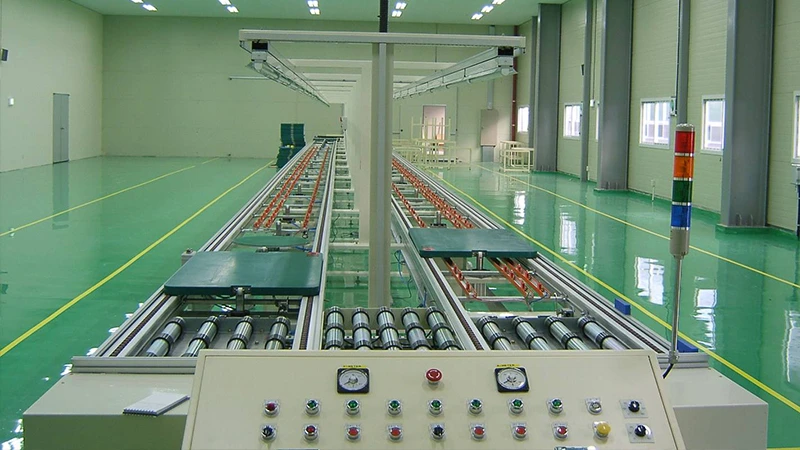
How a component is revolutionizing efficiency on the factory floor
The Unsung Hero of Modern Electronics Manufacturing
Walk into any consumer electronics factory today, and you'll likely be met with a symphony of precision: robotic arms assembling microchips, workers in antistatic suits testing circuit boards, and a steady hum of machinery that feels almost orchestral. But amid this high-tech chaos, there's a quiet workhorse keeping everything moving in harmony: the free flow chain conveyor. It's not flashy, it rarely gets featured in tech demos, but without it, the seamless production of smartphones, laptops, and smartwatches we take for granted would grind to a halt.
Consumer electronics production is a balancing act of speed, precision, and scalability. A single smartphone contains over 300 components, each needing to move from station to station with pinpoint accuracy—often in milliseconds. Traditional conveyors, with their rigid paths and clunky mechanisms, struggle to keep up. Enter the free flow chain conveyor: a lightweight, low-friction system designed to let materials glide smoothly, adapt to changing production needs, and integrate effortlessly with other lean system tools like workbenches and roller tracks. Made from durable materials like aluminum profile, these conveyors are the backbone of modern lean manufacturing, turning chaotic production floors into models of efficiency.
In this article, we'll dive deep into how free flow chain conveyors are transforming electronics production. We'll explore their design, their role in lean systems, and share real-world case studies of manufacturers who've cut waste, boosted throughput, and redefined what's possible on the factory floor. Whether you're a production manager looking to optimize your line or simply curious about the machinery behind your favorite gadgets, this is the story of how a simple conveyor system is making big waves in an industry that never stops evolving.
What Is a Free Flow Chain Conveyor, Anyway?
At its core, a free flow chain conveyor is exactly what it sounds like: a conveyor system where items move freely along a track, powered by gravity or minimal external force. Unlike motorized belt conveyors that pull items at a fixed speed, free flow systems use a series of rollers or balls mounted on a chain or track, allowing products to glide forward as soon as the path ahead clears. This "on-demand" movement is critical in electronics production, where bottlenecks can cost manufacturers thousands of dollars per minute.
But what really sets free flow chain conveyors apart is their design flexibility. Most are built using aluminum profile frames—lightweight yet strong extrusions that can be customized with accessories like guide rails, stops, and dividers. This modularity means a single conveyor can be reconfigured in hours to handle a new product line, whether it's switching from assembling smartwatch batteries to laptop hinges. The aluminum profile also resists corrosion and wear, essential in factories where dust, moisture, and constant use can degrade lesser materials.
Another key feature is low friction. The chain (or roller track) is typically made from high-density plastic or stainless steel, reducing the force needed to move items. This not only cuts energy costs but also minimizes wear on delicate electronics components. Imagine a circuit board for a tablet: it weighs less than 100 grams and can be easily damaged by jostling. A free flow conveyor moves it gently, at speeds tailored to the assembly process, ensuring it arrives at the next workbench in perfect condition.
Finally, integration is where these conveyors shine. They're designed to work hand-in-hand with other lean tools: workbenches where operators assemble components, roller tracks that split or merge product flows, and even automated sorting systems. In a typical smartphone factory, for example, a free flow chain conveyor might carry PCBs from the soldering station to a testing workbench, then on to a packaging line—all without a single manual push. It's this seamless coordination that makes them indispensable in lean systems.
Free Flow Conveyors and Lean Systems: A Match Made in Manufacturing Heaven
Lean manufacturing isn't just a buzzword—it's a philosophy built on eliminating waste, streamlining workflows, and creating value for the customer. At its heart are principles like "continuous flow," "just-in-time production," and "respect for people." Free flow chain conveyors embody these principles, acting as the circulatory system that keeps the lean system alive.
Let's start with waste reduction. In traditional production lines, "motion waste" is a common culprit: workers walking to retrieve parts, products sitting idle at bottlenecks, or conveyors moving empty because upstream stations are slow. Free flow conveyors tackle this by ensuring materials arrive exactly when they're needed, where they're needed. For example, in a lean system, a workbench operator assembling camera modules doesn't have to wait for a batch of lenses to arrive—they glide in on the conveyor just as the previous module is finished. This "pull" system (instead of a "push" system) cuts idle time by up to 30%, according to industry studies.
Then there's flexibility—a cornerstone of lean. Electronics manufacturers rarely stick to one product for long. A factory might produce 50,000 units of a budget smartphone in Q1, then switch to a premium model with a larger screen and more components in Q2. Traditional conveyors, bolted to the floor and rigidly designed, can't adapt. Free flow chain conveyors, with their aluminum profile frames and modular components, can be disassembled, reconfigured, and reassembled in a fraction of the time. A 2023 study by the Manufacturing Technology Association found that factories using modular conveyors reduced retooling time by 45% compared to those with fixed systems.
To visualize the impact, let's compare traditional and free flow conveyors in a lean context:
| Lean Principle | Traditional Conveyor | Free Flow Chain Conveyor |
|---|---|---|
| Continuous Flow | Fixed speed; often creates bottlenecks if stations slow down | Items move only when the next station is ready, eliminating backups |
| Flexibility | Rigid path; requires major rework to change layout | Modular aluminum profile design; reconfigurable in hours |
| Waste Reduction | High energy use; frequent jams cause downtime | Low friction, gravity-powered; minimal energy waste |
| Worker Ergonomics | Fixed height; requires bending or reaching | Adjustable aluminum profile legs; aligns with workbench heights |
But perhaps the most powerful aspect of free flow chain conveyors in lean systems is their ability to "visualize" waste. In a typical setup, the conveyor acts as a visual signal: if products start piling up at a station, it's an instant red flag that something's wrong—maybe a machine is malfunctioning, or a worker needs help. This immediate feedback loop lets supervisors address issues before they snowball into larger problems, keeping the production line running like a well-oiled machine.
Case Study 1: How a Smartphone Giant Cut Cycle Time by 20% with Free Flow Conveyors
The Challenge: Bottlenecks in PCB Assembly
In 2022, a leading global smartphone manufacturer (we'll call them "TechNova") faced a critical problem: their PCB (Printed Circuit Board) assembly line was struggling to keep up with demand for their latest flagship model. The line, which used a traditional motorized belt conveyor, was plagued by bottlenecks. PCBs would pile up at the soldering station, then rush through the testing station once the jam cleared, leading to errors and rework. The result? A cycle time of 45 seconds per PCB—well below the target of 35 seconds—and a defect rate that had crept up to 2.3%, eating into profit margins.
TechNova's production team knew they needed a change. Their lean system audit identified the conveyor as the main culprit: the fixed speed belt didn't account for variations in soldering time (some PCBs required more touch-ups than others), and the rigid track made it hard to add buffer zones between stations. They needed a system that could let PCBs "wait" at the soldering station until the operator was ready, then flow smoothly to testing—without human intervention.
The Solution: Free Flow Chain Conveyors with Aluminum Profile Frames
After evaluating options, TechNova partnered with a supplier to install a free flow chain conveyor system along the 50-meter PCB line. The new system featured:
- Aluminum profile frames: Lightweight yet strong, allowing the conveyor to be mounted at a slight incline (1-2 degrees) to use gravity for movement, reducing energy costs by 80% compared to the motorized belt.
- Plastic roller track guide rails: Yellow and grey guides (to match TechNova's color-coded work zones) that kept PCBs aligned and prevented jams.
- Integrated stops: Pneumatic sensors at each station that held PCBs in place until the operator pressed a button, ensuring no two PCBs arrived at the testing station at once.
- Modular design: Sections could be added or removed in 15-minute increments, making it easy to adjust for future product changes.
The team also reconfigured the workbenches alongside the conveyor, raising them to match the conveyor's height (750mm) to reduce worker bending. Each workbench was fitted with ESD mats and tool holders, creating a seamless "flow" from assembly to testing.
The Results: Faster, Smoother, and Leaner
Within six weeks of installation, the results were staggering:
Cycle Time: Reduced from 45 seconds to 36 seconds per PCB—a 20% improvement.
Defect Rate: Dropped from 2.3% to 0.8%, as PCBs were no longer rushed through testing.
Worker Satisfaction: 92% of operators reported less fatigue, thanks to the ergonomic alignment with workbenches.
Energy Costs: Saved $120,000 annually on conveyor electricity alone.
"It was like night and day," said Maria Gonzalez, TechNova's Production Manager. "Before, we were always putting out fires—chasing down jams, reworking defective PCBs. Now, the line just… flows. The free flow conveyor doesn't just move products; it moves the whole team toward our lean goals."
Case Study 2: Laptop Manufacturer Eliminates Material Handling Waste with Roller Track Integration
The Challenge: Heavy Components, Heavy Waste
In 2023, a mid-sized laptop manufacturer ("LapTech") faced a different problem: their chassis assembly line was drowning in material handling waste. Laptops are heavier than smartphones—an average chassis weighs 1.2kg—and moving them between workbenches required two workers per station, one to lift and one to position. This not only slowed production but also increased the risk of injury (the factory had seen three back strain incidents in six months).
LapTech's lean team calculated that 15% of total labor hours were spent just moving chassis—time that could be better spent on assembly or quality checks. Their traditional roller conveyor was part of the problem: it was noisy, required constant maintenance, and the metal rollers often scratched the aluminum chassis, leading to rework.
The Solution: Free Flow Chain Conveyors with Roller Track Transitions
LapTech's solution was a hybrid system: a main free flow chain conveyor for long-distance transport, paired with shorter roller track sections at each workbench for easy loading/unloading. Here's how it worked:
- Main Conveyor: A 100-meter free flow chain conveyor with aluminum profile frames and black ESD wheels (to prevent static damage to internal components). The conveyor was split into zones, each controlled by sensors to ensure chassis moved only when the next zone was clear.
- Roller Track Workstations: At each assembly station, a 2-meter roller track (fitted with plastic wheels to avoid scratches) branched off from the main conveyor. Workers could slide chassis onto the roller track, position them at the workbench, then push them back onto the main conveyor when done—all with minimal effort.
- Adjustable Height: The main conveyor and roller tracks were mounted on aluminum profile legs with adjustable feet, allowing each station to be set to the optimal height for workers (ranging from 720mm to 800mm based on operator height).
The team also added "buffer zones" along the conveyor—sections where chassis could wait if a station was temporarily down—preventing the entire line from stopping.
The Results: Safer, Faster, and More Human-Centric
After three months of operation, the improvements were clear:
Material Handling Time: Reduced by 65%—from 15% of labor hours to just 5.2%.
Injury Incidents: Zero back strains reported in the six months post-installation.
Scratch Defects: Dropped from 4.1% to 0.5% thanks to plastic roller tracks.
Worker Morale: A survey found 88% of operators felt "more valued" now that they could focus on skilled work instead of lifting.
"We used to think of conveyors as just 'moving belts,'" said LapTech's Lean Coordinator, James Chen. "Now we see them as tools to empower our workers. The free flow system didn't just cut waste—it made the job better for everyone."
Case Study 3: High-Volume Component Testing: How Free Flow Conveyors Solved a "Tiny Parts" Nightmare
The Challenge: Lost Time with Small, Delicate Components
Not all electronics production lines handle large items like smartphones or laptops. Consider "MicroComponents Inc.," a supplier that produces tiny sensors for fitness trackers (each sensor is about the size of a pencil eraser). In 2023, MicroComponents was struggling with a unique problem: their testing line for these sensors was losing 10% of parts to "conveyor gaps." The traditional belt conveyor they used had small spaces between the belt and the guides, where sensors would fall through or get stuck—costing the company $50,000 annually in lost parts and downtime.
Compounding the issue: the sensors were so small that workers had to handle them with tweezers, slowing down testing. The lean team at MicroComponents needed a conveyor system that could handle these delicate parts with zero gaps, while also integrating with their automated testing machines.
The Solution: Mini Free Flow Conveyors with Precision Guides
MicroComponents turned to a specialized free flow chain conveyor designed for small parts. The system featured:
- Mini aluminum roller track: Narrow (50mm wide) tracks with 0.5-inch swivel roller balls—small enough to cradle the sensors without gaps. The tracks were made from anodized aluminum to prevent corrosion and static buildup.
- Precision aluminum guide rails: Custom-machined "U-shaped" guides that kept sensors centered on the track, even at high speeds (up to 1 meter per second).
- Integration with Testing Machines: The conveyor was linked to automated testers via a "pick-and-place" robot arm. Sensors would flow into a staging area on the conveyor, the robot would lift them for testing, and place them back on the conveyor—all without human touch.
- ESD Protection: The entire system was grounded, and the roller balls were made from conductive plastic to dissipate static, critical for protecting the sensitive sensors.
The team also added small plastic dividers along the conveyor, creating "lanes" for different sensor types (e.g., heart rate vs. accelerometer), reducing mix-ups.
The Results: Zero Lost Parts, 30% Faster Testing
The impact was immediate:
Part Loss: Dropped from 10% to 0%—no more sensors falling through gaps.
Testing Speed: Increased from 120 sensors per hour to 156 per hour—a 30% boost.
Worker Time: Employees were redeployed from "searching for lost parts" to quality control, improving overall defect detection.
Machine Uptime: Testing machines ran 95% of the time (up from 80%), as there were no more jams to clear.
"We'd tried everything—tape, foam inserts, even manual feeding—but nothing worked like the free flow conveyor," said MicroComponents' Operations Director, Lisa Wong. "It's not just about moving parts; it's about respecting the precision of the work we do. These sensors are tiny, but they matter—and the conveyor treats them like they do."
Beyond the Conveyor: How Free Flow Systems Integrate with the Entire Production Ecosystem
Free flow chain conveyors don't work in isolation—they're part of a larger ecosystem of lean tools that together create a seamless production flow. Let's break down how they integrate with three key components: workbenches, roller tracks, and aluminum profile structures.
Workbenches: The Conveyor's "Sidekicks"
Workbenches are where the "magic" happens—where workers assemble, test, or inspect components. For a lean system to work, the conveyor and workbench must be in perfect sync. Modern free flow conveyors are designed to align with workbench heights (typically 750-800mm for standing workstations), so operators can slide parts from the conveyor to the bench with a simple push. Many workbenches now feature built-in "cutouts" where the conveyor fits, creating a continuous surface that reduces reaching. For example, a workbench with a "U-shaped" design might have the conveyor running through the middle, letting two operators work on opposite sides without ever crossing paths.
Materials matter, too. Workbenches used with free flow conveyors often have aluminum profile frames (matching the conveyor's material) for consistency and durability. Some even include adjustable shelves or tool hooks that attach directly to the conveyor's aluminum profile, keeping tools within arm's reach. At TechNova, for instance, the PCB assembly workbenches had magnetic strips along the edge (aligned with the conveyor) to hold tweezers and screwdrivers—eliminating time spent searching for tools.
Roller Tracks: The Flexible Connectors
While free flow chain conveyors handle long-distance transport, roller tracks excel at short, flexible movements. Think of them as the "side roads" to the conveyor's "highway." Roller tracks are often used to connect the main conveyor to workstations, or to merge/split product flows (e.g., diverting defective parts to a rework area). At LapTech, the roller track sections at each workbench allowed workers to easily maneuver heavy chassis without lifting—a small change that had a huge impact on efficiency.
What makes roller tracks so versatile is their modularity. They can be straight, curved, or even inclined, and they connect to free flow conveyors using simple aluminum profile brackets. For example, a 40 steel roller track with yellow wheels might carry completed laptops from the main conveyor to a packaging station, while a smaller 38 aluminum roller track could shuttle defective units to a repair bench. The key is that both integrate seamlessly with the free flow system, creating a "flow network" rather than a single rigid line.
Aluminum Profile: The "Glue" That Holds It All Together
Aluminum profile is the unsung hero of this ecosystem. Lightweight, strong, and infinitely customizable, it's the material that makes free flow conveyors, workbenches, and roller tracks work as a single system. Aluminum profile comes in standard sizes (like 40x40mm or 20x20mm), with T-slots along the sides that let you attach accessories—conveyor tracks, workbench tops, guide rails—without drilling or welding. This means a manufacturer can reconfigure their entire line in a weekend by simply sliding new components into the T-slots.
At MicroComponents, the mini roller tracks were mounted on 20x20mm aluminum profile legs, which could be adjusted in 1mm increments to ensure the track was perfectly level (critical for small parts that might get stuck on uneven surfaces). The aluminum also dissipates heat, which is important in electronics factories where machinery can generate significant warmth. And because it's recyclable, aluminum profile aligns with the sustainability goals many manufacturers now prioritize—a win-win for lean and green initiatives.
The Future of Free Flow Chain Conveyors: Smarter, Greener, and More Adaptive
As consumer electronics continue to evolve—think foldable phones, AR glasses, or tiny IoT sensors—so too will the systems that produce them. Free flow chain conveyors are no exception. Here's a glimpse of what the future might hold:
Smart Conveyors with IoT Sensors: Imagine a free flow conveyor that can "talk" to the rest of the production line. Sensors embedded in the aluminum profile could track part flow, detect jams in real time, or even predict maintenance needs (e.g., "this roller is wearing out—replace it before it fails"). At a pilot facility in Japan, a manufacturer is already testing conveyors with RFID tags that log each part's journey, providing granular data on bottlenecks and cycle times. The result? A 12% reduction in unplanned downtime.
Sustainable Materials: While aluminum is already recyclable, future conveyors might use even greener materials—like bioplastic roller balls or recycled aluminum profile. Some suppliers are experimenting with "energy-harvesting" conveyors that generate small amounts of electricity from the motion of parts, powering the sensors or lights along the line. It's a small step, but in a factory with thousands of conveyors, it could add up to significant energy savings.
AI-Driven Adaptability: AI could take conveyor flexibility to the next level. Imagine a system that learns from production data and automatically adjusts the conveyor's speed or path based on demand. For example, if a sudden spike in laptop orders comes in, the AI could reconfigure the free flow and roller track network to prioritize laptop chassis over other components—all without human input. This "self-optimizing" lean system would make manufacturers even more responsive to market changes.
But perhaps the most exciting trend is the focus on "human-centric" design. As more factories adopt collaborative robots ("cobots") that work alongside humans, free flow conveyors will need to adapt to this new dynamic.,,,.:,.
Why Free Flow Chain Conveyors Are More Than Just "Conveyors"
At the end of the day, free flow chain conveyors are more than just tools to move parts—they're enablers of lean thinking, sustainability, and human-centric manufacturing. They turn chaotic production floors into symphonies of efficiency, where every component, every worker, and every machine has a role to play in creating value.
For manufacturers, the message is clear: investing in a free flow chain conveyor system isn't just about upgrading equipment—it's about transforming how you make things. It's about reducing waste, empowering workers, and building a production line that can adapt to whatever the future throws at it. Whether you're producing smartphones, sensors, or laptops, the free flow chain conveyor is the quiet partner that will help you stay competitive in an industry that never stops moving.
So the next time you unbox a new gadget, take a moment to appreciate the invisible journey it took to get to your hands. Behind that sleek design and cutting-edge technology is a free flow chain conveyor, gliding silently, keeping the magic of electronics production alive.