- Company Articles
- Products and Technology
- Application Cases
- Free Flow Chain Conveyor in E-Commerce Warehouses: Faster Order Fulfillment

Free Flow Chain Conveyor in E-Commerce Warehouses: Faster Order Fulfillment
Related Product
Free Flow Chain Conveyor
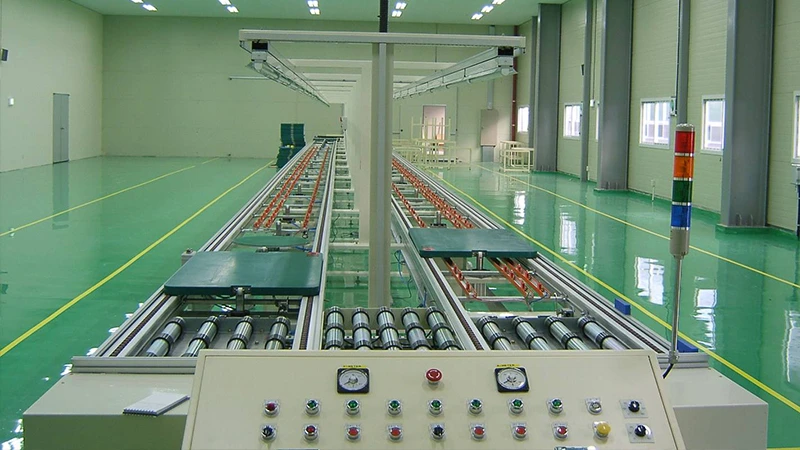
The free flow conveyor system uses a free flow chain that can increase the speed of the tooling board that supports the products. This can improve the efficiency and quality of the production process, as well as reduce the wear and tear of the system.
It's 2 PM on a Wednesday, and a customer in Texas has just ordered a birthday gift for their sibling in California. They need it delivered by Friday—no exceptions. Meanwhile, in a warehouse outside Chicago, thousands of similar orders are pouring in: a laptop for a college student, a batch of baby clothes for new parents, a replacement phone charger for someone whose dog chewed through the last one. In today's e-commerce world, "fast" isn't just a bonus anymore; it's the baseline. And for warehouses stuck in outdated workflows, keeping up feels like running a marathon with lead weights on your shoes. That's where the free flow chain conveyor comes in—a quiet workhorse that's redefining how e-commerce operations turn "ordered" into "shipped" in record time.
The Fulfillment Pressure Cooker: Why Speed Can't Wait
Let's start with the numbers. E-commerce sales hit $5.9 trillion globally in 2023, and by 2026, that number is projected to jump to $8.1 trillion. With that growth comes a customer expectation that's only gotten more demanding: 61% of online shoppers now expect same-day or next-day delivery, according to a recent survey by Shopify. For warehouse managers, this means one thing: your fulfillment process can't just be efficient—it needs to be agile .
Traditional warehouses often rely on manual labor or clunky, motorized conveyors that move at a fixed pace. Pickers dash between shelves with carts, items pile up at packing stations, and bottlenecks form faster than you can say "shipping deadline." During peak seasons—Black Friday, back-to-school, holiday rushes—this chaos multiplies. I spoke with Maria, a warehouse operations manager at a mid-sized e-commerce retailer, who summed it up perfectly: "Before we upgraded, our team was burning out. We had pickers running 10 miles a day, and we still missed 15% of our same-day shipping windows. It wasn't that they weren't working hard—it was that the system was working against them."
What Even Is a Free Flow Chain Conveyor? (Spoiler: It's Not Just Another Belt)
If you're picturing a typical conveyor belt—loud, motorized, and rigid—think again. A free flow chain conveyor is a gravity-powered system designed to move items smoothly, quickly, and with minimal effort. At its core, it's a series of roller tracks (often made of steel or aluminum) mounted on a slight incline. When you place a box or tote on one end, gravity takes over, and the item glides along the rollers to its destination—no motors, no complicated wiring, just simple physics.
What makes it "free flow"? Unlike traditional conveyors that move at a set speed, these systems let items travel independently. If a picker places three boxes on the track back-to-back, they'll roll at their own pace, spacing out naturally to avoid jams. It's like a highway with its own built-in traffic control—no more "one size fits all" movement.
And the components? They're surprisingly modular. Most systems use standard parts like swivel roller balls (to handle turns), plastic or aluminum guides (to keep items on track), and connectors that let you extend or reconfigure the track in hours, not days. This flexibility is a game-changer for warehouses that need to adapt to seasonal spikes or new product lines.
Why Free Flow Chain Conveyors Are a Fulfillment Game Changer
Let's cut to the chase: What makes these conveyors so much better than the alternatives? Let's break it down.
Speed: From "Plodding" to "Zooming"
Gravity is a powerful force, and free flow conveyors harness it to move items faster than manual labor or fixed-speed motors. A typical free flow system can move a 20-pound box 50 feet in under 10 seconds—about three times faster than a picker with a cart. Multiply that by thousands of orders a day, and the time savings add up fast. "We used to have items sitting at the end of the packing line for 20 minutes during rushes," Maria told me. "Now, they're there in 2 minutes flat. Our packing team can keep up without skipping a beat."
Less Labor, More Impact
Here's a hard truth: Labor costs are rising, and finding reliable workers is getting harder. Free flow conveyors don't replace your team—they empower them. Instead of spending hours pushing carts or carrying boxes, pickers can focus on what matters: accuracy, quality checks, and troubleshooting. "Our pickers used to spend 60% of their time just moving items," Maria said. "Now, that's down to 20%. They're happier, less tired, and our error rate has dropped by 22%."
Built for Chaos (AKA Peak Season)
Ever tried to add a new conveyor belt in the middle of December? It's a logistics nightmare. Free flow systems, though, are modular by design. Need to add a 20-foot track to handle holiday orders? A good conveyor supplier can ship the parts, and your team can install them in a afternoon—no need to shut down operations. And when the rush is over? Dismantle it just as easily. It's like having a temporary extra lane on your warehouse "highway" that disappears when you don't need it.
| Feature | Traditional Motorized Conveyor | Free Flow Chain Conveyor |
|---|---|---|
| Speed | Fixed pace (often 1-3 ft/sec) | Variable (gravity-driven, up to 5 ft/sec) |
| Installation Time | Weeks (requires wiring, motor setup) | Hours to days (modular, no motors) |
| Maintenance | High (motors, belts, wiring prone to wear) | Low (only rollers/guides need occasional cleaning) |
| Scalability | Rigid (hard to extend without major overhauls) | Modular (add/remove sections in hours) |
| Cost Over Time | Higher (electricity, repairs, labor) | Lower (no electricity, minimal upkeep) |
Beyond the Conveyor: How It Fits Into a Lean System
If you've heard of "lean manufacturing," you know the goal is to eliminate waste—whether that's time, labor, or materials. Free flow chain conveyors are a lean dream come true. Let's break down how they align with core lean principles:
- Eliminating Transport Waste: Instead of pickers carrying items across the warehouse, the conveyor does the moving. That's less walking, less fatigue, and fewer missed deadlines.
- Optimizing Flow: Items move directly from picking to packing to shipping without stopping. No more "batch processing" where boxes pile up waiting for the next step.
- Flexibility for Continuous Improvement: Since the system is modular, you can tweak it based on data. If you notice a bottleneck at the packing station, add a parallel track—no need to redesign the entire layout.
Mike, a lean consultant who's worked with dozens of e-commerce warehouses, put it this way: "Lean isn't about cutting corners—it's about making every second count. A free flow conveyor turns 'dead time' into 'productive time.' When items are moving smoothly, your team can focus on improving processes instead of fighting fires."
The Human Touch: Conveyors + Workbench = Fulfillment Harmony
A conveyor is only as good as the people using it—and that's where the workbench comes in. Picture this: A free flow track delivers a tote of items directly to a packing workbench. The packer, standing at a height-adjustable station, pulls out the items, scans them, boxes them up, and slides the package onto another conveyor that leads to shipping. No walking, no reaching, no wasted motion.
Modern workbenches are designed to pair seamlessly with free flow systems. Many have built-in slots to mount roller tracks, so items glide right onto the workspace. Some even include features like tool holders, LED lights, and anti-fatigue mats—small touches that add up to big gains in productivity. "Our packing stations used to look like a tornado hit them," Maria laughed. "Now, everything has a place. The conveyor brings the items to the packer, and the workbench keeps them organized. It's like a well-choreographed dance."
"Before free flow conveyors, we measured success by how many orders we
tried
to ship. Now? We measure by how many we
actually
ship—on time, every time. The difference isn't just in the numbers; it's in how our team shows up. They're proud of what they do now, and it shows in the work." — Maria, Warehouse Operations Manager
Choosing Your Partner: Why the Right Conveyor Supplier Matters
Not all free flow chain conveyors are created equal—and neither are the suppliers who sell them. When you're ready to upgrade, keep these three things in mind:
1. Experience in E-Commerce (Not Just Manufacturing)
E-commerce warehouses have unique needs: smaller, more varied items, unpredictable order spikes, and a focus on speed over heavy lifting. A supplier who specializes in automotive manufacturing might not get that. Look for a partner who can say, "We've helped 50+ e-commerce clients cut fulfillment times by 30%."
2. Customization (One Size Never Fits All)
Your warehouse layout, product mix, and peak season needs are unique. A good supplier will visit your facility, analyze your workflow, and design a system that fits you —not the other way around. "We had a supplier try to sell us a 'one-size-fits-all' conveyor," Maria recalled. "It was a disaster. The second supplier? They walked the floor, asked questions, and designed a system that worked with our quirks. That's the difference."
3. Support After the Sale
Installing the conveyor is just the start. What happens if a roller jams during a Black Friday rush? You need a supplier who offers 24/7 support, quick replacement parts, and training for your team. "Our supplier has a hotline we can call, and they'll walk us through fixes over the phone," Maria said. "Once, they even sent a technician out on a Sunday to help us with a last-minute track extension. That's partnership."
The Future of Fulfillment: Fast, Flexible, and Focused on People
Free flow chain conveyors aren't just a trend—they're a glimpse into the future of e-commerce fulfillment. As customer expectations keep rising, warehouses need tools that can keep up without burning out their teams. And that's what makes these systems so powerful: They're not just about moving boxes faster; they're about creating workplaces where people can thrive.
So, what's next? We're already seeing free flow systems integrated with IoT sensors that track item speed and flag jams in real time. Some warehouses are adding robotic arms to load/unload conveyors during peak times. But at the end of the day, the best systems will always put people first—because even in a world of automation, the human touch is what turns "shipped" into "delivered with care."
If you're tired of watching orders pile up while your team runs in circles, maybe it's time to talk to a conveyor supplier. Not tomorrow, not next quarter—today. Because in e-commerce, the race for faster fulfillment never stops. And with the right tools, you won't just keep up—you'll lead the pack.