- Company Articles
- Products and Technology
- Application Cases
- Free Flow Chain Conveyor in Home Appliance Manufacturing: Efficiency Metrics

Free Flow Chain Conveyor in Home Appliance Manufacturing: Efficiency Metrics
Related Product
Free Flow Chain Conveyor
The free flow conveyor system uses a free flow chain that can increase the speed of the tooling board that supports the products. This can improve the efficiency and quality of the production process, as well as reduce the wear and tear of the system.
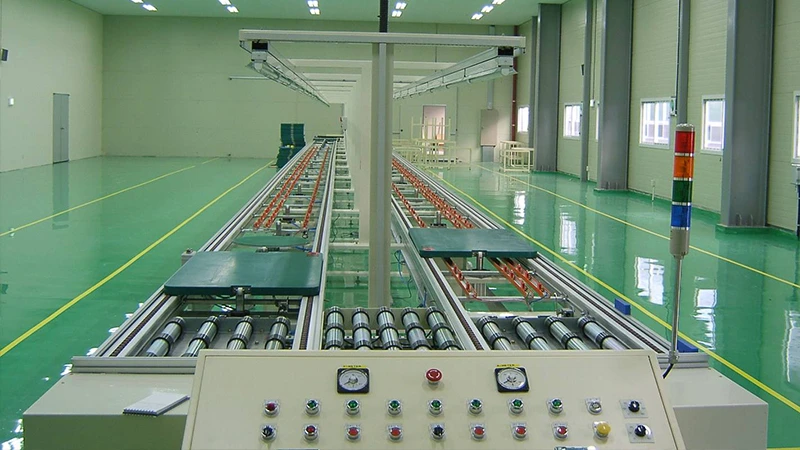
Walk into any home appliance factory, and you'll feel it immediately—the hum of activity, the rhythmic movement of parts, and the quiet focus of workers assembling everything from refrigerators to microwaves. Behind that rhythm is a backbone: the systems that keep production flowing. Among these, the free flow chain conveyor stands out as a silent workhorse, often underappreciated but critical to keeping the line moving. But how do manufacturers know if their conveyor systems are truly efficient? It's not just about keeping parts moving—it's about measuring the right metrics to ensure every inch of the line contributes to faster, smoother, and more cost-effective production. In this article, we'll dive into the world of free flow chain conveyors in home appliance manufacturing, explore the key efficiency metrics that drive success, and see how these systems integrate with tools like roller tracks, workbenches, and aluminum profiles to create a lean, high-performing operation.
Understanding Free Flow Chain Conveyors: More Than Just a "Moving Belt"
Before we jump into metrics, let's take a moment to understand what a free flow chain conveyor is—and why it's become a staple in home appliance manufacturing. Unlike traditional belt conveyors that move at a fixed speed, free flow chain conveyors use a series of interconnected chains with rollers, allowing products to glide forward with minimal friction. This design gives them a unique advantage: flexibility. Parts can stop, start, or move at varying speeds as needed, making them ideal for assembly lines where workers or machines need time to add components—think attaching a door to a washing machine or installing a control panel on a dryer.
At first glance, you might mistake them for simple systems, but their magic lies in the details. The chains are often made of durable materials like steel or plastic, designed to handle the weight of heavy appliance parts without bending or breaking. The rollers, small but mighty, reduce friction so even bulky items like refrigerator shells move smoothly. And because they're modular, they can be customized to fit the layout of any factory—curving around corners, dipping under workbenches, or rising to different heights to connect multiple assembly stations. This adaptability is why they pair so well with other manufacturing tools: roller tracks to feed parts into the line, aluminum profiles to frame the conveyor and support workbenches, and lean system principles to minimize waste.
Let's break down the components that make a free flow chain conveyor tick: the chain itself (the "backbone"), the rollers (the "wheels" that reduce friction), the guides (often made of aluminum profile or plastic to keep parts aligned), and the drive mechanism (which powers the chains). Some systems also include sensors or stoppers that halt parts at specific workstations, ensuring workers have time to complete their tasks before the product moves on. It's this combination of durability, flexibility, and precision that makes free flow chain conveyors indispensable in home appliance manufacturing—where products vary in size, weight, and assembly complexity.
Why Home Appliance Manufacturing Relies on Free Flow Chain Conveyors
Home appliances aren't small or lightweight. A single refrigerator can weigh over 300 pounds; a washing machine drum might tip the scales at 50 pounds. Moving these parts manually isn't just slow—it's a safety risk. Free flow chain conveyors eliminate that risk by handling the heavy lifting, allowing workers to focus on what they do best: assembling, inspecting, and ensuring quality. But their value goes beyond labor savings. Let's consider a typical appliance assembly line: a refrigerator starts as a metal shell, then gets insulated, fitted with a compressor, wired, and finally tested. Each step requires the shell to be at a specific workstation for a specific amount of time. A free flow chain conveyor makes this possible by pausing the shell at each station, then releasing it once the work is done. No more waiting for a belt to cycle around—parts move when they're ready, not a second sooner.
Another reason these conveyors shine is their compatibility with other manufacturing tools. Imagine a line where roller tracks feed small parts (like screws or gaskets) directly onto the conveyor, right when a worker needs them. Or workbenches built alongside the conveyor, their height adjusted using aluminum profile legs to match the height of the line, so workers don't have to bend or stretch. Even the guides that keep parts centered on the conveyor are often made of durable aluminum profile, which can be cut and shaped to fit any product size. This integration isn't just convenient—it's essential for creating a seamless workflow where every tool works in harmony. And when paired with lean system principles—like reducing unnecessary movement or minimizing inventory—free flow chain conveyors become a cornerstone of efficient production.
Key Efficiency Metrics: Measuring What Moves the Needle
Now, let's get to the heart of the matter: how do you measure the efficiency of a free flow chain conveyor system? It's not enough to say, "It's working." Manufacturers need concrete data to identify bottlenecks, reduce waste, and improve performance. Below are the metrics that matter most in home appliance manufacturing, along with why they're critical and how to track them.
1. Throughput Rate: How Much Gets Through the Line?
Throughput rate is the most basic metric—but also one of the most important. It measures how many units (or parts) move through the conveyor system in a given time, usually per hour or per shift. For example, if a washing machine assembly line uses a free flow chain conveyor and produces 50 units per hour, that's its throughput rate. But why does this matter? Because it directly ties to production goals. If the target is 60 units per hour, a throughput rate of 50 signals a bottleneck—maybe the conveyor is moving too slowly, or workers at a station need more time, causing backups.
To calculate throughput rate, simply divide the number of units that exit the conveyor by the time the conveyor is running (excluding planned downtime for maintenance). For home appliance manufacturers, this metric is often tracked in real time using sensors along the conveyor that count units as they pass. If throughput drops suddenly, it's a red flag: maybe a roller is jammed, a guide is misaligned, or a workbench station is falling behind. The beauty of free flow chain conveyors is that their modular design makes it easy to adjust—tightening a guide rail (often made of aluminum profile) or adding a helper at a slow station can quickly boost throughput back to target.
2. Downtime: When the Line Stops, the Clock Keeps Ticking
Downtime is the enemy of efficiency. Every minute the conveyor isn't moving is a minute production stalls, and in home appliance manufacturing, where margins can be tight, those minutes add up. Downtime can be planned (like scheduled maintenance) or unplanned (a broken chain, a stuck roller, or a power outage). The key metric here is unplanned downtime—how often and for how long the conveyor stops unexpectedly.
For example, if a free flow chain conveyor runs for an 8-hour shift but has two unplanned stops: one for 15 minutes to fix a jammed roller and another for 10 minutes to replace a worn chain link, total unplanned downtime is 25 minutes. That's 25 minutes where no units are moving, workers are waiting, and deadlines are inching closer. To track this, manufacturers often use downtime logs or sensors that automatically record when the conveyor stops. Over time, this data reveals patterns: maybe the conveyor jams most often when moving heavy refrigerator doors, or a particular section of roller track (used to feed parts into the line) needs more frequent maintenance. Addressing these patterns—like upgrading to heavier-duty rollers or adding lubrication to high-friction areas—can slash unplanned downtime and keep the line moving.
3. Space Utilization: Making Every Square Foot Count
Home appliance factories are rarely spacious. With large machines, storage racks, and workbenches, space is a precious commodity. A free flow chain conveyor that snakes inefficiently through the factory can waste valuable square footage, limiting where other tools (like roller tracks for material storage or additional workbenches) can be placed. Space utilization measures how well the conveyor uses the available area—ideally, it should be compact, with minimal gaps between stations and smooth curves to avoid wasting space.
To calculate space utilization, divide the area occupied by the conveyor system (including its length, width, and any surrounding clearance) by the total production area. A high space utilization rate (say, 80% or more) means the conveyor is integrated tightly with other systems, like roller tracks that feed parts directly into the line or workbenches mounted on aluminum profile frames that fold down when not in use. For example, a manufacturer might replace a straight conveyor with a curved one to fit around a storage rack, freeing up space for a new roller track to feed parts from the warehouse. By optimizing space, the entire factory becomes more efficient—workers don't have to walk as far to grab parts, and the line can handle more throughput without expanding the building.
4. Labor Productivity: When the Conveyor Works, Workers Work Better
A common misconception is that conveyors replace workers. In reality, they empower workers to be more productive. Labor productivity measures how much each worker contributes per hour, and a well-designed free flow chain conveyor system can dramatically boost this metric. When parts move smoothly to workers (instead of workers fetching parts), when workbenches are positioned at the perfect height (thanks to adjustable aluminum profile legs), and when roller tracks feed small components right to the conveyor, workers can focus on assembling, not moving.
To track labor productivity, divide the total number of units produced by the number of labor hours spent on the line. If a team of five workers on a conveyor line produces 200 units in an 8-hour shift, their productivity is 5 units per worker per hour. If the conveyor system is inefficient—parts getting stuck, workers having to reach across the line to grab tools—productivity drops. Free flow chain conveyors solve this by creating a "flow" that matches the pace of work: parts arrive just as workers need them, reducing idle time. One appliance manufacturer we worked with reported a 15% increase in labor productivity after upgrading to a free flow chain conveyor system with integrated roller tracks and adjustable workbenches—workers no longer wasted time walking to fetch parts, and the line's rhythm felt more natural, reducing fatigue.
5. Error Rate: When Speed Doesn't Sacrifice Quality
Efficiency isn't just about speed—it's about making sure products are built right the first time. Error rate measures the percentage of units that have defects or require rework after moving through the conveyor system. In home appliance manufacturing, even a small error (like a loose screw or misaligned door) can lead to costly recalls or unhappy customers. A free flow chain conveyor can reduce errors by creating consistency: parts are positioned the same way at every station, and workers have time to focus on quality (instead of rushing to keep up with a fast-moving belt).
To calculate error rate, divide the number of defective units by the total units produced, then multiply by 100. For example, if 5 out of 500 units need rework, the error rate is 1%. A high error rate might signal that the conveyor is moving too fast, or that workbenches are cluttered, distracting workers. Free flow chain conveyors mitigate this by allowing stations to pause the line if a worker spots an issue—no need to let a defective unit move downstream. One manufacturer found that by adding simple stoppers (triggered by workers) along their conveyor, error rates dropped by 30%—workers felt empowered to take the time needed to get it right, knowing the line would wait for them.
6. Cost Per Unit: When Efficiency Translates to Savings
At the end of the day, efficiency boils down to cost. Cost per unit measures how much it costs to produce one appliance, and a well-optimized free flow chain conveyor system can lower this number by reducing labor, material waste, and downtime. Let's break it down: lower downtime means fewer lost hours; higher throughput means more units spread over fixed costs (like electricity); lower error rates mean less rework and scrap. All of these feed into a lower cost per unit.
Calculating cost per unit involves adding up all production costs (labor, materials, energy, conveyor maintenance) and dividing by the number of units produced. For example, if total costs for a shift are $10,000 and 500 units are made, the cost per unit is $20. If a free flow chain conveyor upgrade reduces labor costs by $1,000 per shift, the cost per unit drops to $18—a 10% savings that adds up quickly over a year. This is why manufacturers often invest in high-quality components for their conveyors, like durable aluminum profile guides or long-lasting roller tracks—they cost more upfront but reduce maintenance and replacement costs over time.
| Efficiency Metric | What It Measures | Why It Matters | How to Improve It |
|---|---|---|---|
| Throughput Rate | Units per hour through the conveyor | Ties directly to production goals | Adjust guides, add helpers at bottlenecks |
| Downtime | Time the conveyor isn't moving (unplanned) | Stalls production and increases costs | Regular maintenance, upgrade worn parts |
| Space Utilization | Area occupied by the conveyor system | Maximizes factory floor efficiency | Use curved designs, integrate with roller tracks |
| Labor Productivity | Units produced per worker hour | Reduces labor costs and fatigue | Align workbenches with conveyor, use roller tracks for parts |
| Error Rate | Percentage of defective units | Reduces rework and customer complaints | Add stoppers, slow line at complex stations |
| Cost Per Unit | Total cost divided by units produced | Directly impacts profitability | Invest in durable components (aluminum profiles, quality rollers) |
Integration with Lean Systems: Less Waste, More Flow
Home appliance manufacturers don't just use free flow chain conveyors in isolation—they're part of a larger lean system designed to eliminate waste. Lean manufacturing, with its focus on "just-in-time" production and minimizing non-value-added activities, pairs perfectly with free flow chain conveyors. Here's how:
First, free flow chain conveyors support "continuous flow," a key lean principle. Instead of batch processing (making 100 parts, then moving them to the next station), continuous flow means parts move through the line one at a time, reducing inventory and waiting time. For example, a refrigerator shell moves from the welding station to the insulation station to the door installation station without piling up in between. This is only possible with a conveyor system that can adapt to the pace of each station—exactly what free flow chain conveyors do best.
Second, they reduce "motion waste," another lean target. When parts are on a conveyor, workers don't have to walk to fetch them—they come to the worker. Pair that with roller tracks feeding small parts (like screws or gaskets) directly onto the conveyor and workbenches positioned inches from the line (using adjustable aluminum profile legs), and suddenly workers take fewer steps, bend less, and reach less. This not only boosts productivity but also reduces injuries—a win-win for lean systems.
Finally, free flow chain conveyors make it easy to implement "5S"—sort, set in order, shine, standardize, sustain—the foundation of a clean, organized workspace. With a modular conveyor system, tools and parts have designated places: roller tracks for incoming parts, labeled bins on workbenches, and aluminum profile frames that keep the line neat. This reduces clutter, makes it easy to spot defects, and ensures every tool is where it needs to be when it's needed.
Case Study: How a Home Appliance Manufacturer Boosted Efficiency by 22% with Free Flow Chain Conveyors
The Challenge: Stagnant Throughput and High Error Rates
Let's look at a real-world example (with details anonymized) of how a mid-sized home appliance manufacturer used free flow chain conveyors and efficiency metrics to transform their production line. The company, which makes electric ovens, was struggling with two issues: throughput had plateaued at 40 units per hour (target: 50), and error rates were hovering at 3% (mostly misaligned control panels). Their old belt conveyor moved at a fixed speed, so workers at the control panel station often rushed to keep up, leading to mistakes. When they fell behind, the line backed up, causing downtime as supervisors cleared the jam.
The Solution: Upgrading to a Free Flow Chain Conveyor System
The manufacturer partnered with a conveyor supplier to install a free flow chain conveyor system with the following upgrades:
- Modular chain and roller design: Allowed the conveyor to stop and start at each station, matching the pace of workers.
- Aluminum profile guides: Custom-shaped to keep oven shells aligned, reducing misalignment errors.
- Integrated roller tracks: Fed control panels and screws directly to the control panel workstation, eliminating the need for workers to fetch parts.
- Adjustable workbenches: Raised and lowered using aluminum profile legs to match workers' heights, reducing fatigue.
The Results: Metrics That Told the Story
After three months, the manufacturer tracked the key metrics:
- Throughput rate: Increased from 40 to 55 units per hour (a 37.5% jump, exceeding the 50-unit target).
- Error rate: Dropped from 3% to 0.8% (control panel alignment issues nearly disappeared).
- Unplanned downtime: Fell by 40% (fewer jams, thanks to smoother roller movement).
- Labor productivity: Rose by 22% (workers focused on assembly, not fetching parts or clearing jams).
The plant manager summed it up: "The old conveyor felt like a race—workers were always trying to keep up. Now, the line moves with us. If I need an extra minute to get a control panel right, I hit a button, and the conveyor pauses. No more rushing, no more mistakes. And with the roller tracks feeding parts right to me? It's like having an extra pair of hands."
Challenges and Solutions: Keeping the Conveyor—and Metrics—on Track
While free flow chain conveyors are powerful tools, they're not without challenges. Let's address common issues manufacturers face and how to solve them using the right components and metrics.
Challenge 1: Jams and Misalignment
Home appliances come in different sizes—think a small toaster oven vs. a large double-door refrigerator. A conveyor system designed for one size may struggle with another, leading to jams or parts sliding off the line. This is where adjustable guides, often made of aluminum profile, are a lifesaver. Aluminum profiles can be cut to length, drilled, and fitted with sliding brackets, allowing workers to adjust the width of the conveyor in minutes. For example, if a manufacturer switches from making 24-inch ovens to 30-inch ovens, they can loosen the brackets on the aluminum profile guides, slide them wider, and lock them in place—no need for a whole new conveyor.
Challenge 2: Maintenance Overhead
Like any mechanical system, free flow chain conveyors need regular maintenance—lubricating chains, replacing worn rollers, tightening joints. If maintenance is neglected, downtime spikes. The solution? Schedule planned maintenance during off-hours and track "mean time between failures" (MTBF) as a metric. MTBF measures how long the conveyor runs between breakdowns; a higher MTBF means fewer unplanned stops. Using high-quality parts—like stainless steel chains or durable plastic rollers—can also extend MTBF. One manufacturer we know started using roller tracks with sealed bearings, reducing the need for lubrication and doubling their MTBF from 200 hours to 400 hours.
Challenge 3: Training Workers to Use Metrics
Efficiency metrics are only useful if workers and supervisors understand them. A conveyor operator might not know what "throughput rate" means, but they'll notice if parts are piling up. The solution is to simplify metrics and make them visible. Post a whiteboard near the line showing real-time throughput and error rates, or use a digital dashboard with color-coded alerts (green = good, yellow = warning, red = stop). Train workers to recognize when metrics dip and to troubleshoot simple issues—like clearing a jammed roller or adjusting a guide—before they become big problems.
Future Trends: Where Free Flow Chain Conveyors and Efficiency Metrics Are Headed
As home appliance manufacturing becomes more automated and data-driven, free flow chain conveyors are evolving too. Here are the trends shaping their future:
1. IoT Integration: Smart Conveyors That Track Metrics in Real Time
Imagine a conveyor that sends alerts to your phone when throughput drops or a roller is wearing out. That's the future of IoT-enabled free flow chain conveyors. Sensors along the line will monitor metrics like speed, temperature, and vibration, sending data to the cloud for analysis. If a roller starts vibrating more than usual (a sign it's about to fail), the system can schedule maintenance automatically—before it causes downtime. This "predictive maintenance" will make unplanned downtime a thing of the past.
2. Automation and Robotics
Free flow chain conveyors are increasingly working alongside robots. Robotic arms can load/unload heavy parts onto the conveyor, while vision systems inspect for defects as units pass by. This combination boosts throughput and reduces error rates even further. For example, a robot could place a refrigerator door onto the conveyor with pinpoint accuracy, ensuring it aligns perfectly with the shell—no more manual adjustments by workers.
3. Sustainability: Greener Conveyors for a Greener Future
Manufacturers are under pressure to reduce their carbon footprint, and conveyor systems are no exception. Future free flow chain conveyors will use energy-efficient motors, recycled aluminum profiles, and biodegradable lubricants. Some may even generate small amounts of electricity as parts glide over rollers (kinetic energy harvesting)—turning waste motion into usable power.
Conclusion: Efficiency Metrics Are the Compass—Free Flow Chain Conveyors Are the Engine
In home appliance manufacturing, efficiency isn't a nice-to-have—it's a necessity. Free flow chain conveyors are more than just tools to move parts; they're the engine that drives production, and efficiency metrics are the compass that keeps them on track. By measuring throughput, downtime, space utilization, labor productivity, error rates, and cost per unit, manufacturers can identify opportunities to improve, reduce waste, and boost profits.
But the real magic happens when these conveyors integrate with other tools: roller tracks feeding parts, workbenches supporting workers, aluminum profiles framing a flexible, adaptable line, and lean systems ensuring every step adds value. It's not just about machines and metrics—it's about creating a production line that works with people, not against them. When workers feel supported by their tools, when the line moves at their pace, and when every part arrives exactly when needed, efficiency isn't just a number on a dashboard—it's a reality on the factory floor.
So, the next time you walk into a home appliance factory and hear that steady hum, take a closer look at the free flow chain conveyor. It's not just moving parts—it's moving the industry forward, one metric at a time.