- Company Articles
- Products and Technology
- Application Cases
- Free Flow Chain Conveyor in Renewable Energy Equipment Manufacturing

Free Flow Chain Conveyor in Renewable Energy Equipment Manufacturing
Related Product
Free Flow Chain Conveyor
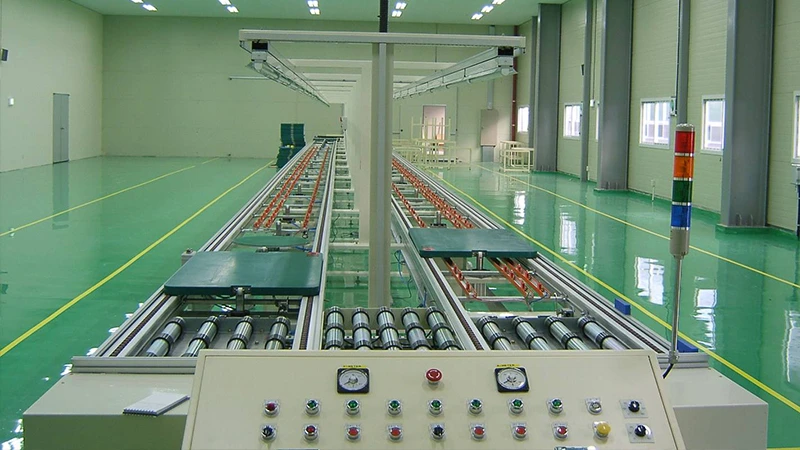
The free flow conveyor system uses a free flow chain that can increase the speed of the tooling board that supports the products. This can improve the efficiency and quality of the production process, as well as reduce the wear and tear of the system.
Free Flow Chain Conveyor in Renewable Energy Equipment Manufacturing
In the race to combat climate change, renewable energy has emerged as the backbone of a sustainable future. Solar panels glinting on rooftops, wind turbines slicing through the air, and batteries storing clean power—these technologies don't just appear out of thin air. Behind every solar module and wind blade lies a manufacturing process that demands precision, efficiency, and scalability. As factories ramp up production to meet global demand, the need for smart, adaptable workflows has never been clearer. This is where the free flow chain conveyor steps in, quietly revolutionizing how renewable energy equipment is built—one component at a time.
The Rise of Renewable Energy Manufacturing: A Call for Leaner Systems
Over the past decade, renewable energy manufacturing has exploded. The International Energy Agency reports that solar panel production alone has grown by over 40% annually since 2010, while wind turbine manufacturing has doubled in capacity. But with growth comes pressure: factories must produce more, faster, without compromising quality or driving up costs. Traditional manufacturing setups—rigid, wasteful, and slow to adapt—simply can't keep pace. Enter the lean system : a philosophy centered on eliminating waste, streamlining workflows, and prioritizing value for the customer. In renewable energy, where margins are tight and innovation is constant, lean isn't just a buzzword—it's a survival strategy.
At the heart of any lean system are tools that make efficiency tangible. Think of a solar panel factory: hundreds of components—from silicon wafers to junction boxes—need to move seamlessly from storage to assembly, then to testing and packaging. Any delay, bottleneck, or misstep in this journey eats into profits and slows the transition to clean energy. This is where material handling equipment becomes critical. Conveyors, workbenches , and flow racks aren't just metal and plastic; they're the circulatory system of the factory, ensuring every part reaches its destination at the right time, in the right condition.
What is a Free Flow Chain Conveyor, and Why Does It Matter?
A free flow chain conveyor (FFCC) is a material handling solution designed for high-speed, low-friction movement of goods. Unlike traditional belt or roller conveyors, which rely on continuous surfaces, FFCC uses a series of interconnected chains with free-rotating rollers. This design allows products to glide smoothly along the track, even at varying speeds, and makes it easy to merge, sort, or divert items without stopping the entire line. For renewable energy manufacturing, where components range from delicate solar cells (thinner than a human hair) to heavy wind turbine gears (weighing hundreds of pounds), this flexibility is game-changing.
But what truly sets FFCC apart is its alignment with lean principles. In a lean system, "waste" includes anything that doesn't add value—excess inventory, unnecessary movement, waiting time. FFCC minimizes all three: it keeps components moving (no waiting), reduces the need for manual lifting (less movement), and ensures just-in-time delivery to assembly stations (no excess inventory). For factory managers, this translates to lower operational costs and higher throughput. For workers, it means less strain and more focus on skilled tasks, like soldering solar cell connections or inspecting turbine blades.
Design & Materials: Built for the Demands of Renewable Energy
Not all conveyors are created equal, and renewable energy manufacturing demands equipment that can handle unique challenges. FFCCs excel here, thanks in large part to their construction—often leveraging aluminum profile for frames and components. Aluminum is a manufacturer's dream: lightweight yet strong, resistant to corrosion (critical in dusty or humid factory environments), and infinitely customizable. Unlike steel, which is heavy and prone to rust, aluminum profiles can be cut, drilled, and assembled on-site, allowing factories to adapt their conveyor lines as production needs change—say, switching from 60-cell to 72-cell solar panels or accommodating a new wind turbine model.
Aluminum's benefits extend beyond the frame. Many FFCCs use aluminum guide rails and roller tracks, which reduce friction and ensure smooth component movement. For example, solar wafers, which are fragile and easily scratched, glide safely on aluminum roller tracks with plastic or rubberized wheels, preventing damage. Wind turbine components, which are bulky and dense, rely on the strength of aluminum extrusions to support their weight without bending or warping. Even small details, like aluminum joints and connectors, contribute to the conveyor's durability—they're designed to withstand constant use, reducing downtime for repairs.
Another key material in FFCC design is plastic, used for rollers and guides. Yellow or grey plastic roller track guide rails, for instance, are common in renewable factories because they're non-conductive (important for handling sensitive electronic components in solar inverters or battery systems) and easy to clean. Unlike metal, plastic doesn't leave metal shavings or rust particles that could contaminate delicate parts—a small detail that saves hours of rework and quality control checks.
Integration with Workbenches and Flow Racks: A Lean Ecosystem
A conveyor is only as effective as the system it's part of. In renewable energy manufacturing, FFCCs rarely work alone—they're the "highway" connecting workbenches (where assembly happens) and flow racks (where materials are stored). This integration is what turns a collection of tools into a lean ecosystem.
Imagine a solar panel assembly line. At one end, flow racks hold stacks of glass sheets, EVA film, and backsheets—all the materials needed to build the panel's front and back layers. Each flow rack is tilted slightly, so materials slide forward as the top layer is used, ensuring workers never have to reach or bend (another lean win: reducing ergonomic strain). The FFCC runs parallel to these racks, with "pick stations" where workers load materials onto the conveyor. The conveyor then carries the materials to workbenches, where technicians laminate the layers together under heat and pressure.
At the workbench, the FFCC's speed is synchronized with the assembly process. If a technician is still laminating a panel, the conveyor slows down, preventing a backlog. If they finish early, it speeds up to keep the line moving. This "paced flow" eliminates the "hurry up and wait" scenario common in traditional factories, where workers rush to meet arbitrary quotas, then sit idle when materials run out. It's lean in action: every second is spent adding value, not waste.
Flow racks, too, play a role in this dance. They're stocked with just enough materials to keep the line running for a few hours, not days. This "kanban" system—pulling materials only when needed—reduces inventory costs and frees up factory space, which can be used for new production lines or R&D. When a flow rack is low, a signal (often a colored card or digital alert) is sent to the warehouse, triggering a restock. The FFCC then carries the new materials from the warehouse to the flow rack, closing the loop.
Comparing Conveyors: Why Free Flow Chain Stands Out
To understand FFCC's impact, it helps to compare it to other common conveyors in manufacturing. Below is a breakdown of how it stacks up against roller track and belt conveyors, two alternatives often used in factory settings:
| Conveyor Type | Key Features | Best For | Lean System Alignment |
|---|---|---|---|
| Free Flow Chain Conveyor | Interconnected chains with free-rotating rollers; low friction; easy merging/diverting; aluminum profile construction. | Delicate or heavy components; variable speeds; high-throughput lines (solar panels, batteries). | Excellent: Minimizes waste (waiting, inventory); integrates with workbenches/flow racks; adaptable to changing production. |
| Roller Track Conveyor | Fixed or gravity-fed rollers; simple design; low cost. | Uniform, lightweight items (small electronics, packaging). | Good, but limited: Less flexibility for speed changes; harder to integrate with complex workflows. |
| Belt Conveyor | Continuous belt (rubber or fabric); high stability for uneven loads. | Bulk materials (gravel, coal) or irregularly shaped items. | Poor: High maintenance (belts wear, stretch); hard to clean; not ideal for precision manufacturing. |
For renewable energy, the FFCC's adaptability is its biggest strength. Solar panel production, for example, involves both delicate steps (like placing thin-film solar cells) and heavy lifting (moving laminated panels). A roller track might handle the cells but struggle with the panels; a belt conveyor could handle the weight but risk scratching the glass. FFCC, with its mix of aluminum frames, plastic rollers, and variable speed control, does both with ease.
Applications in Renewable Energy: From Solar to Wind to Batteries
FFCCs aren't a one-size-fits-all solution—they're tailored to the unique needs of each renewable energy sector. Let's take a closer look at how they're transforming production across three key areas: solar panels, wind turbines, and energy storage batteries.
Solar Panel Manufacturing: Precision in Every Glide
Solar panels are marvels of precision. A single panel contains 60–72 solar cells, each just 0.2 mm thick—thinner than a sheet of paper. Mishandling a cell can crack it, rendering the entire panel useless. FFCCs address this with soft-touch rollers (often made of silicone or rubber) that cradle cells gently as they move from cutting to stringing (where cells are connected with thin copper wires). The conveyor's speed is also critical here: too fast, and workers can't align cells properly; too slow, and production lags. FFCCs solve this with variable frequency drives, allowing operators to adjust speed in real time based on worker feedback.
Later in the process, when panels are laminated and framed, FFCCs switch gears. Heavier panels (up to 25 kg for residential models) need sturdier support, so conveyors here use steel-reinforced aluminum profiles and larger rollers. Some systems even include tilting mechanisms, allowing panels to be rotated 90° for framing or testing—eliminating the need for workers to lift or flip panels manually. This not only speeds up production but also reduces workplace injuries, a win for both factory safety and morale.
Wind Turbine Component Handling: Powering Through Heavy Loads
Wind turbines are the giants of renewable energy—their blades can stretch 80 meters (the length of a football field) and weigh over 50 tons. Manufacturing these behemoths requires conveyors that can handle extreme weight without sacrificing precision. FFCCs rise to the challenge with heavy-duty aluminum extrusions and steel roller chains. For example, gearboxes, which transmit power from the turbine's rotor to the generator, weigh up to 3 tons. A standard belt conveyor would sag under that weight, but an FFCC with reinforced aluminum frames and high-tensile steel chains carries it smoothly from machining to assembly.
Wind factories also benefit from FFCCs' ability to handle uneven loads. Turbine blades, for instance, are curved and asymmetrical. Traditional conveyors might tip or jam when moving them, but FFCCs use adjustable guide rails and swivel roller balls (small, omnidirectional rollers) to keep blades centered. This adaptability reduces the need for custom fixtures, saving time and money when switching between blade models.
Battery Production: Clean, Consistent, and Safe
Energy storage batteries—whether for electric vehicles or grid storage—are the unsung heroes of renewable energy, ensuring power is available when the sun isn't shining or the wind isn't blowing. But battery manufacturing is a high-stakes game: even a tiny dust particle can short-circuit a battery, leading to fires or failures. FFCCs address this with enclosed tracks and anti-static components (like black ESD wheels, which dissipate static electricity). In lithium-ion battery factories, conveyors move battery cells through assembly in a cleanroom environment, with aluminum profiles that are easy to sanitize and plastic rollers that don't shed particles.
Consistency is also key in battery production. Cells must be filled with electrolyte, sealed, and tested in precise sequence. FFCCs use encoder sensors to track each cell's position, ensuring it stops exactly at each station for 3 seconds (for filling) or 5 seconds (for sealing). This level of precision reduces defects from 1 in 100 cells to less than 1 in 1,000—a massive improvement in yield that directly boosts factory profits.
Maintenance & Longevity: Keeping the Line Moving
In lean manufacturing, downtime is the enemy. A conveyor breakdown can halt an entire production line, costing thousands of dollars per hour. FFCCs are designed with this in mind—they're built to last and easy to repair. Aluminum profiles, for example, resist rust and corrosion, so they don't degrade in humid or dusty factories. Rollers and chains are modular, meaning a single worn part can be replaced in minutes, not hours. Many FFCCs also include self-lubricating bearings, reducing the need for frequent maintenance checks.
Preventive maintenance is simplified, too. Conveyors often come with diagnostic ports that connect to factory management software, alerting technicians to issues like misaligned tracks or worn rollers before they cause a breakdown. In one German solar factory, this predictive maintenance approach reduced conveyor downtime by 60% in the first year—freeing up technicians to focus on improving production, not fixing problems.
Longevity is another plus. A well-maintained FFCC can last 10–15 years, even in heavy-use environments. Compare that to belt conveyors, which often need belt replacements every 2–3 years, or roller tracks with plastic rollers that wear out in 3–5 years. Over time, the lower maintenance and replacement costs of FFCCs make them a smarter investment for renewable factories looking to scale long-term.
The Future of Free Flow Chain Conveyors: Smarter, Greener, More Connected
As renewable energy manufacturing evolves, so too will FFCCs. The next generation of conveyors will likely integrate with Industry 4.0 technologies, like IoT sensors and AI, to become even more efficient. Imagine a solar factory where FFCCs "talk" to flow racks: when a rack is low on glass sheets, the conveyor automatically diverts a delivery from the warehouse, all without human input. Or wind turbine conveyors that use machine learning to predict when a roller might fail, ordering a replacement part before the line stops.
Sustainability will also play a bigger role. Factories are already exploring recycled aluminum for conveyor profiles, reducing the carbon footprint of production. Some manufacturers are even testing solar-powered conveyors, using small solar panels mounted on the conveyor frame to power sensors and controls—a poetic nod to the renewable energy they help produce.
Finally, customization will become more accessible. Smaller renewable startups, which can't afford large-scale conveyor systems, will benefit from modular FFCC kits—pre-cut aluminum profiles, lightweight rollers, and simple connectors that can be assembled in a garage or small workshop. This democratization of lean manufacturing tools could accelerate innovation, allowing more players to enter the renewable energy market.
Conclusion: More Than a Conveyor—A Catalyst for Change
Free flow chain conveyors are more than just machines—they're enablers. They enable factories to produce solar panels faster, wind turbines more reliably, and batteries more safely. They enable workers to focus on skill, not strain. And they enable the renewable energy industry to scale, bringing clean power to more homes, businesses, and communities around the world.
In the end, the impact of FFCCs goes beyond the factory floor. Every solar panel assembled on a lean conveyor system, every wind turbine component moved efficiently, every battery produced with precision—these are steps toward a world powered by renewable energy. It's a quiet revolution, driven by aluminum profiles, plastic rollers, and a commitment to lean principles. And in the fight against climate change, quiet revolutions are often the most powerful.