- Company Articles
- Products and Technology
- Solution
- Free Flow Chain Conveyor System Integration with ERP and MES Software

Free Flow Chain Conveyor System Integration with ERP and MES Software
Related Product
Free Flow Chain Conveyor
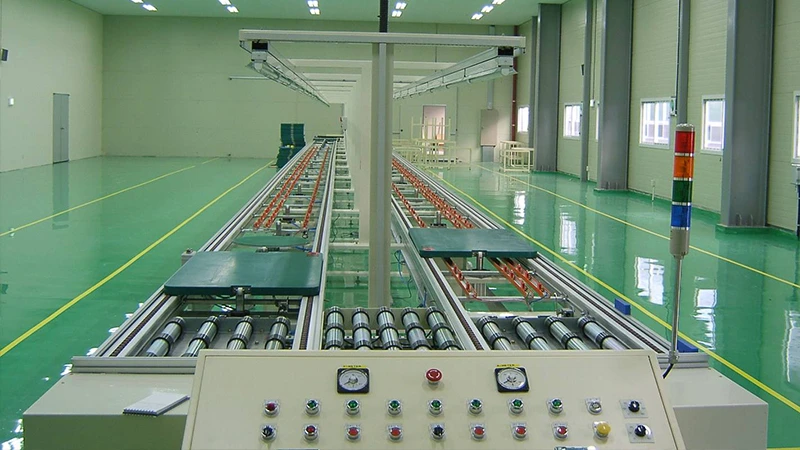
The free flow conveyor system uses a free flow chain that can increase the speed of the tooling board that supports the products. This can improve the efficiency and quality of the production process, as well as reduce the wear and tear of the system.
Introduction: The Evolving Landscape of Manufacturing Efficiency
In today's fast-paced manufacturing world, the pressure to do more with less has never been greater. Factories are no longer just about producing goods—they're about producing smartly : minimizing waste, reducing lead times, improving quality, and adapting quickly to changing customer demands. At the heart of this transformation lies the seamless connection between physical production processes and digital systems. While tools like ERP (Enterprise Resource Planning) and MES (Manufacturing Execution Systems) have become staples for managing data and workflows, one critical piece often gets overlooked: the material handling systems that move products through the factory floor. Enter the free flow chain conveyor —a workhorse of modern material handling that, when integrated with ERP and MES, becomes a catalyst for operational excellence. This article explores how combining these technologies creates a leaner, more responsive manufacturing ecosystem, and why components like roller tracks and a well-designed lean system are foundational to this integration.
Understanding Free Flow Chain Conveyors: Beyond Basic Material Handling
Before diving into integration, let's clarify what makes a free flow chain conveyor different from traditional conveyors. Unlike belt conveyors that move items at a fixed speed or gravity-fed systems limited by slope, free flow chain conveyors use a series of interconnected chains and rollers to allow products to move smoothly, often with minimal friction. Think of them as the "express lanes" of the factory floor: they can handle a variety of load sizes, adapt to different layouts (straight lines, curves, inclines), and, most importantly, allow for independent movement of items. This means if one product needs to pause for inspection, the rest can keep flowing—eliminating bottlenecks that plague rigid conveyor systems.
Central to their design are roller tracks —the unsung heroes that reduce friction and ensure consistent movement. These tracks, often made of steel or aluminum, feature evenly spaced rollers that let products glide along with little resistance. Depending on the application, roller tracks can be customized with different wheel materials (plastic for ESD-sensitive environments, steel for heavy loads) or configurations (staggered for stability, straight for speed). For example, a electronics manufacturer might use roller tracks with ESD-safe wheels to prevent static damage to circuit boards, while an automotive plant could opt for heavy-duty steel roller tracks to move engine components.
What truly sets free flow chain conveyors apart, though, is their flexibility. Unlike fixed conveyor systems that require major overhauls to reconfigure, these conveyors use modular components—think interchangeable tracks, adjustable supports, and quick-connect joints—that let factories adapt to new product lines or workflow changes in hours, not weeks. This flexibility is why they're a cornerstone of lean system principles: they minimize waste by ensuring material handling processes can evolve with production needs.
The Lean System Foundation: Why Integration Matters
A lean system is all about eliminating waste—whether that's excess inventory, unnecessary movement, or downtime. But lean isn't just a set of tools; it's a mindset that demands visibility into every step of the production process. Without real-time data on how materials are moving, when machines are idle, or where bottlenecks occur, even the most well-designed free flow chain conveyor can't deliver on its promise of efficiency. This is where ERP and MES come in.
ERP systems manage the "big picture" of a manufacturing business: inventory levels, order management, supply chain logistics, and financial data. MES, on the other hand, focuses on the factory floor, tracking production schedules, machine performance, and quality control in real time. When these systems operate in silos, however, critical information falls through the cracks. For example, ERP might show that a raw material shipment has arrived, but if MES isn't aware that the free flow chain conveyor is backed up at the receiving dock, the production schedule could be thrown off. Conversely, MES might flag a machine breakdown, but if ERP doesn't adjust the inventory forecast, the factory could end up overstocking parts or missing customer deadlines.
Integration bridges this gap. By connecting the free flow chain conveyor to ERP and MES, manufacturers create a closed-loop system where data flows seamlessly from the physical world (conveyor speed, product location, roller track performance) to the digital world (inventory updates, schedule adjustments, maintenance alerts). This not only reduces manual data entry errors but also empowers decision-makers with actionable insights. For instance, if sensors on the roller tracks detect that a particular section is slowing down, MES can automatically alert maintenance, while ERP adjusts the production timeline to avoid delays. It's lean manufacturing in action: data-driven, proactive, and waste-free.
ERP and MES: The Backbone of Smart Manufacturing
To appreciate the value of integration, let's take a closer look at what ERP and MES bring to the table. ERP systems, such as SAP or Oracle, act as the central nervous system of a business, finance, HR, supply chain, and sales data into a single platform. For manufacturing, this means visibility into raw material availability, customer orders, and production costs—all essential for strategic planning. MES, on the other hand, is the "eyes and ears" on the factory floor. Tools like Siemens SIMATIC IT or Rockwell FactoryTalk collect real-time data from machines, operators, and material handling systems to track production progress, enforce quality standards, and optimize workflows.
Individually, ERP and MES are powerful, but together, they create a "digital thread" that connects the entire manufacturing lifecycle: from order placement in ERP to production execution in MES, and back to inventory updates in ERP once goods are shipped. The missing link? The physical movement of materials that ties these stages together. A free flow chain conveyor isn't just moving boxes—it's moving data. Every time a product enters a conveyor, pauses at a workstation, or exits to shipping, that's a data point that ERP and MES need to know. Without this connection, the digital thread is broken, and the system relies on manual input—slow, error-prone, and disconnected from reality.
Integration in Action: How Free Flow Chain Conveyors Connect with ERP/MES
So, how exactly do free flow chain conveyors and roller tracks communicate with ERP and MES? The process starts with sensors and IoT (Internet of Things) devices installed along the conveyor system. These sensors can track everything from product location (via barcode or RFID scanners) to conveyor speed, roller performance, and even environmental conditions (temperature, humidity for sensitive goods). For example, a photoelectric sensor at the start of a roller track might detect when a product enters the conveyor and send that data to a local PLC (Programmable Logic Controller). The PLC then translates this into a message (e.g., "Product XYZ123 has entered Conveyor A at 10:15 AM") and sends it to the MES system via a protocol like OPC UA or MQTT.
Once in MES, this data is used to update the production schedule. If Product XYZ123 is supposed to be assembled by 11:00 AM, MES can compare its current position on the conveyor to the target timeline and flag if it's running late. MES then shares this information with ERP, which adjusts the inventory forecast: if the product is delayed, ERP might delay the shipment notice to the customer or reallocate resources to speed up production. Conversely, if the conveyor is moving faster than expected, MES can alert operators to prepare the next workstation, and ERP can update the inventory to reflect the early completion—ensuring that finished goods are ready for shipping as soon as they're done.
Another critical data point is maintenance . Sensors on roller tracks can monitor vibration, temperature, or roller rotation speed to detect signs of wear. For instance, if a roller starts rotating slower than normal, it could indicate a bearing issue. The sensor sends this data to MES, which generates a maintenance work order. ERP then ensures that replacement parts are in stock (or orders them if not) and schedules the repair during a planned downtime—avoiding unexpected breakdowns that halt production. This predictive maintenance is a game-changer for lean manufacturing, as it turns unplanned downtime (a major source of waste) into planned, controlled maintenance.
Technical Deep Dive: Data Points, Sensors, and Real-Time Communication
To make integration work, manufacturers need to define which data points are most critical. While every facility is unique, common metrics include:
- Product Identification: Barcode, QR code, or RFID scans to track individual products or batches.
- Location and Timestamp: When and where a product enters/exits a conveyor or workstation.
- Conveyor Performance: Speed, throughput rate, downtime events (jams, stops).
- Roller Track Health: Roller rotation speed, vibration, temperature, and wear indicators.
- Operator Input: Manual overrides (e.g., pausing a product for inspection) logged via touchscreens or buttons.
These data points are collected by a mix of sensors: photoelectric sensors for presence detection, encoders for speed measurement, accelerometers for vibration analysis, and cameras for visual inspection. The sensors feed data to a PLC or edge device, which acts as a "gateway" between the physical conveyor and the digital systems. The gateway processes the data (filtering out noise, aggregating trends) and sends it to MES/ERP via standardized protocols. OPC UA is particularly popular here, as it's platform-agnostic and designed for industrial environments, ensuring reliable communication even with legacy systems.
For example, let's walk through a typical workflow for a consumer electronics manufacturer using a free flow chain conveyor to assemble smartphones:
- A batch of circuit boards (Batch ABC789) arrives at the factory and is scanned into ERP, which records the inventory and triggers the production order.
- The circuit boards are placed on the free flow chain conveyor , and a barcode scanner at the entry point sends "Batch ABC789 entered Conveyor 3" to MES.
- MES checks the production schedule and directs the conveyor to route the batch to Workstation B for component installation.
- At Workstation B, an operator assembles the components and scans the batch again, updating MES that the step is complete. MES then sends the batch to the next station via the conveyor.
- A sensor on the roller track detects that one circuit board is misaligned and triggers a stop. The operator fixes the issue, scans the batch to resume, and MES logs the delay.
- Once assembled, the batch exits the conveyor, and MES sends "Batch ABC789 completed at 2:30 PM" to ERP. ERP updates inventory to reflect the finished goods and generates a shipping label.
In this scenario, every step is automated, with data flowing seamlessly between the conveyor, MES, and ERP. There's no need for manual data entry, and delays are addressed in real time—keeping the production line running smoothly.
Benefits of Integration: From Cost Savings to Quality Control
The benefits of integrating free flow chain conveyors with ERP and MES are tangible and far-reaching. Let's break them down:
1. Reduced Waste (The Core of Lean Manufacturing)
A lean system thrives on eliminating waste (muda), and integration directly targets several waste categories: waiting (products sitting idle on conveyors), defects (undetected issues causing rework), inventory (excess stock due to poor visibility), and overprocessing (unnecessary steps in material handling). By tracking product movement in real time, MES and ERP ensure that inventory levels are accurate, reducing the need for safety stock. Conveyor data also highlights bottlenecks, allowing managers to reconfigure workflows or add resources where needed—cutting down on waiting time.
2. Improved Quality Control
When a product pauses on a roller track for inspection, sensors can trigger a quality check in MES. If the product fails, MES can automatically divert it to a rework station via the conveyor, preventing defective goods from reaching the next stage. This real-time intervention reduces the cost of rework and minimizes the risk of shipping faulty products to customers. For example, a food manufacturer using a free flow conveyor with metal detectors can automatically reject contaminated packages and log the defect in MES/ERP—tracking trends to identify root causes (e.g., a faulty detector, contaminated raw materials).
3. Faster Decision-Making
With real-time data from the conveyor, managers no longer have to wait for end-of-shift reports to identify issues. If a roller track is underperforming, MES alerts maintenance immediately. If a product is off schedule, ERP adjusts the supply chain in real time. This agility is critical in today's market, where customer demands can shift overnight. For instance, if a customer expedites an order, ERP can flag the priority, and MES can reroute the product on the conveyor to a dedicated "express line"—ensuring on-time delivery without disrupting other orders.
4. Lower Labor Costs
Manual data entry and material handling are labor-intensive and error-prone. Integration automates these tasks: sensors track product movement, PLCs adjust conveyor routes, and ERP/MES update records—freeing up operators to focus on higher-value tasks like quality control or process improvement. In one case study, a automotive parts manufacturer reduced labor costs by 15% after integrating its free flow conveyors with MES/ERP, as operators were no longer needed to manually log product locations or trigger inventory updates.
| Metric | Traditional Conveyor System (No Integration) | Integrated Free Flow Chain Conveyor (ERP/MES Connected) |
|---|---|---|
| Inventory Accuracy | ~70-80% (relied on manual counts) | ~95-99% (real-time updates from conveyor sensors) |
| Unplanned Downtime | 10-15% of production time | 3-5% (predictive maintenance via roller track sensors) |
| Order Fulfillment Lead Time | 5-7 days | 2-3 days (faster material flow and schedule optimization) |
| Manual Data Entry Errors | 10-15% error rate | <1% (automated sensor data) |
| Waste Reduction (Lean Metrics) | Marginal (focused on physical waste only) | Significant (reduces waiting, inventory, and overprocessing waste) |
Case Study: A Real-World Example of Successful Integration
To illustrate the impact of integration, let's look at a mid-sized medical device manufacturer that specializes in surgical tools. Prior to integration, the company relied on a manual material handling system: operators pushed carts between workstations, and data was logged on paper forms. This led to frequent delays, inventory discrepancies (often discovering stockouts mid-production), and high rework rates due to missed quality checks. The company's lean system efforts were struggling, as they lacked visibility into where waste was occurring.
In 2023, they invested in a free flow chain conveyor system with roller tracks and integrated it with their existing ERP (Microsoft Dynamics) and MES (Epicor) systems. Here's what happened:
- Week 1: Sensors were installed on the conveyor and roller tracks to track product IDs, location, and conveyor speed. A PLC was connected to MES via OPC UA, and data flows were mapped (e.g., "Product enters conveyor → MES updates schedule → ERP adjusts inventory").
- Month 3: Inventory accuracy improved from 75% to 98%. With real-time tracking, the company reduced safety stock by 30%, freeing up warehouse space and capital.
- Month 6: Unplanned downtime dropped by 60%. Sensors on roller tracks detected early signs of wear, allowing maintenance to replace rollers during scheduled breaks instead of during production.
- Year 1: Lead times for customer orders decreased by 40%. The integrated system ensured that products moved smoothly from assembly to shipping, with MES and ERP coordinating to prioritize urgent orders.
- ROI: The company recouped its investment in 14 months, with ongoing savings from reduced labor, inventory, and waste.
The plant manager noted, "Before integration, we were flying blind. We knew we had waste, but we couldn't see where. Now, the conveyor data tells us exactly where products are getting stuck, which roller tracks need maintenance, or where operators are falling behind. It's like giving our lean system a pair of eyes."
Choosing the Right Components: Roller Tracks, Conveyors, and Software
Integration success depends on choosing the right components. For free flow chain conveyors , focus on modularity: systems that can be easily expanded or reconfigured as production needs change. Look for roller tracks with durable materials (steel for heavy loads, aluminum for lightweight or cleanroom environments) and compatible accessories (e.g., side guides to prevent product misalignment, brakes for controlled stopping). When selecting a conveyor supplier, ask about their experience with ERP/MES integration—do they provide sensor packages or PLC interfaces, or will you need a third-party integrator?
For software, ensure that your ERP and MES can communicate with industrial protocols (OPC UA, MQTT) and support real-time data processing. Cloud-based MES solutions are increasingly popular, as they allow for remote monitoring and easier scalability. If you're using legacy systems, consider middleware to bridge the gap between the conveyor and software—tools like Kepware or Inductive Automation's Ignition can translate PLC data into a format that ERP/MES understands.
Finally, don't overlook training. Operators and managers need to understand how the integrated system works: how to interpret MES dashboards showing conveyor data, how to respond to alerts, and how to troubleshoot minor issues (e.g., a sensor misalignment). A well-trained team ensures that the system is used to its full potential, maximizing ROI.
Future Trends: AI, IoT, and the Next Generation of Integrated Systems
The future of integration is even more exciting. As AI and IoT become more accessible, free flow chain conveyors will evolve from "data collectors" to "decision-makers." Imagine AI algorithms analyzing conveyor data in real time to predict bottlenecks before they occur—rerouting products automatically to less busy tracks. Or IoT-enabled roller tracks that self-diagnose issues and order replacement parts directly from ERP. For example, a roller track could detect that its bearings are wearing and send a request to ERP: "Order 5 replacement bearings (Part #RT-123) by Friday"—ensuring that maintenance has what it needs before a failure occurs.
Another trend is digital twins —virtual replicas of the conveyor system that mirror real-world performance. By combining conveyor data with 3D modeling, manufacturers can simulate changes (e.g., adding a new roller track, adjusting conveyor speed) in the digital twin before implementing them physically—reducing risk and downtime. When paired with ERP and MES, digital twins can also predict how these changes will impact inventory, production schedules, and costs.
Conclusion: Building a Resilient, Efficient Manufacturing Ecosystem
In the end, integrating free flow chain conveyors with ERP and MES isn't just about technology—it's about building a manufacturing ecosystem that's resilient, efficient, and customer-focused. By connecting the physical movement of products with the digital flow of data, manufacturers unlock unprecedented visibility into their operations, turning waste into opportunity and inefficiency into agility. Components like roller tracks and a strong lean system provide the foundation, but it's the integration that brings it all together.
As one industry expert put it, "The factory of the future isn't just automated—it's orchestrated . Every machine, every conveyor, every software system works in harmony, each knowing what the others are doing. When your conveyor can talk to your ERP, you're not just making products—you're making intelligence ." For manufacturers ready to take their lean journey to the next level, integration is the key. It's not always easy, but the rewards—lower costs, faster delivery, happier customers—are well worth the effort.