- Company Articles
- Products and Technology
- Product knowledge
- Free Flow Chain Conveyor vs. Chain Conveyor: Clarifying Terminology & Uses

Free Flow Chain Conveyor vs. Chain Conveyor: Clarifying Terminology & Uses
Related Product
Free Flow Chain Conveyor
The free flow conveyor system uses a free flow chain that can increase the speed of the tooling board that supports the products. This can improve the efficiency and quality of the production process, as well as reduce the wear and tear of the system.
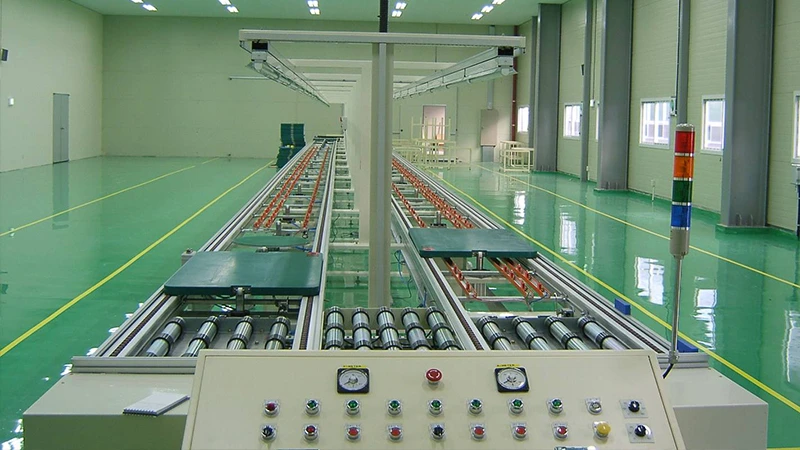
If you've ever walked through a manufacturing plant, warehouse, or assembly line, you've probably seen conveyors hard at work. These unassuming systems are the backbone of modern production—quietly moving parts, products, and materials from point A to point B, day in and day out. But not all conveyors are created equal. Two terms that often get tossed around (and sometimes confused) are free flow chain conveyors and chain conveyors . At first glance, they might sound similar, but dig a little deeper, and you'll find they're designed for very different jobs. In this article, we'll unpack what each of these systems is, how they work, and when to choose one over the other—all while keeping things conversational, because let's face it: no one needs another dry technical manual.
Whether you're setting up a new lean system, upgrading an existing production line, or just curious about the machinery that keeps our favorite products rolling off the shelves, understanding the difference between free flow chain conveyors and chain conveyors can save you time, money, and a lot of headaches. Let's start by breaking down the basics.
What Even Is a Chain Conveyor, Anyway?
Let's start with the more traditional of the two: the chain conveyor. Picture a heavy-duty belt, but instead of rubber or fabric, it's made of interlocking metal chains. These chains loop around sprockets (think of them as toothed wheels) that are powered by a motor, creating a continuous, moving surface. The idea is simple: attach products or pallets to the chains, and they'll be pulled along a fixed path from start to finish.
Chain conveyors are the workhorses of the conveyor world. They're built to handle tough conditions—think high temperatures, heavy loads, and even abrasive materials. You'll find them in industries like automotive manufacturing, where they might carry engine blocks or transmissions down an assembly line, or in mining, where they transport coal or ore over long distances. They're also common in distribution centers, moving pallets of goods from the warehouse to loading docks.
One of the key features of a chain conveyor is its predictability . Since the chains are driven by a motor, you can control their speed with precision. Need to slow down for a quality check? Speed up to meet a production quota? A chain conveyor can adjust on the fly. They're also highly customizable: you can add side guides to keep products aligned, or design them to incline or decline to move materials up or down between floors. And because the chains are made of metal (usually steel), they're durable enough to withstand years of heavy use—though they do require regular maintenance, like lubrication, to keep the sprockets and chains from wearing down.
But here's the catch: chain conveyors are active systems. They need power to run, and they follow a fixed route. If you need products to move freely or change direction without human intervention, a standard chain conveyor might not be the best fit. That's where free flow chain conveyors come into play.
Free Flow Chain Conveyors: When Gravity (and a Little Design) Do the Work
Free flow chain conveyors (sometimes called "gravity flow chain conveyors") are the laid-back cousins of chain conveyors. They don't rely on motors or sprockets to move products—instead, they use gravity, or sometimes a gentle push, to let items glide along a track. Imagine a slide at a playground: you set a product at the top, and it slides down on its own. That's the basic idea, but with a few industrial upgrades.
The magic here is in the design. Free flow chain conveyors typically use a series of small, rotating rollers or wheels (often part of a roller track system) that are mounted on a slight incline. When you place a product on the track, gravity takes over, and the rollers spin, letting the product move freely—hence the "free flow" name. Some systems might use minimal power (like a small motor to give products an initial nudge), but for the most part, they're passive, relying on the laws of physics to keep things moving.
So when would you use a free flow chain conveyor? Think of scenarios where you need products to move at their own pace, or where workers need to access items quickly. For example, in a picking station at a warehouse, a free flow conveyor might deliver bins of products to workers, who can then grab what they need and let the rest continue down the line. In assembly plants, they're often used to feed components to a workbench , where operators can pick up parts as they're needed, without waiting for a motorized conveyor to deliver them.
One of the biggest advantages of free flow chain conveyors is their flexibility . Since products aren't tied to a motorized chain, they can be easily rerouted, stopped, or redirected by workers. You can also design them with multiple lanes, so different products can flow side by side without interfering with each other. And because they don't have motors or complex drive systems, they're simpler to install and maintain. No need for electrical wiring or lubrication—just keep the roller track clean and make sure the incline is set correctly (too steep, and products might slide too fast; too shallow, and they might get stuck).
But free flow conveyors aren't without limitations. They're best for lighter loads—think boxes, cartons, or small parts. Heavy items, like engine blocks, would be too much for gravity to move, so you'd still need a chain conveyor for those. They also require a slight incline to work, which means they're not ideal for flat or vertical spaces. And while they're great for "free flow," they lack the speed control of motorized chain conveyors—products move as fast as gravity allows, which might not be suitable for processes that require precise timing.
Side-by-Side: Comparing the Two Systems
To really understand the difference between free flow chain conveyors and chain conveyors, let's put them head-to-head. The table below breaks down their key features, so you can see at a glance which one might be right for your operation.
| Feature | Chain Conveyor | Free Flow Chain Conveyor |
|---|---|---|
| Power Source | Electric motor (active system) | Gravity or minimal power (passive system) |
| Load Capacity | High (handles heavy loads: pallets, machinery parts) | Medium to low (best for lighter items: boxes, small components) |
| Speed Control | Precise (adjustable via motor speed) | Limited (depends on incline and product weight) |
| Path Flexibility | Fixed route (can be designed to incline/decline) | Free flow (products can change direction with minimal effort) |
| Typical Applications | Assembly lines, heavy material transport, long-distance conveying | Picking stations, workbench feeding, buffer storage, short-distance movement |
| Maintenance Needs | High (lubrication, motor upkeep, chain tension checks) | Low (clean roller track, check for debris) |
| Energy Use | High (requires continuous power) | Low to none (gravity-powered) |
As you can see, the choice between the two comes down to your specific needs. If you're moving heavy, bulky items along a fixed path and need precise control over speed, a chain conveyor is the way to go. But if you need lighter products to flow freely, with minimal energy use and maintenance, a free flow chain conveyor (with its trusty roller track) might be the better option.
Real-World Uses: Where Each Shines
Let's take a step back and look at how these conveyors actually perform in real production environments. Understanding their real-world applications can help you visualize which one might fit into your own lean system —the set of practices aimed at reducing waste and improving efficiency in manufacturing.
Chain Conveyors in Action: Automotive and Heavy Industry
Walk into any automotive plant, and you'll see chain conveyors everywhere. They're the backbone of assembly lines, moving car frames from one workstation to the next. As workers install engines, doors, or seats, the conveyor keeps the frame moving at a steady pace, ensuring each task is completed on time. Because car frames are heavy (often weighing thousands of pounds), chain conveyors are the only systems strong enough to handle the load. They're also designed to incline, so frames can be moved up to upper levels of the plant for painting or final assembly.
Mining is another industry that relies heavily on chain conveyors. In coal mines, for example, long chain conveyors stretch for miles, carrying coal from the mining face to the surface. These conveyors are built to withstand harsh conditions—dust, moisture, and constant use—and they're designed to operate 24/7 with minimal downtime. Without them, miners would have to haul coal manually, a process that would be slow, inefficient, and dangerous.
Free Flow Chain Conveyors: Keeping Workbenches Stocked and Picking Stations Efficient
Now, imagine a electronics manufacturing plant, where workers assemble smartphones or laptops at workbenches . Each workbench needs a steady supply of small components: circuit boards, screws, screens. Instead of having workers walk to a storage room every time they need parts, a free flow chain conveyor can deliver bins of components directly to the bench. The conveyor is slightly inclined, so when a worker takes a bin, the next one slides forward automatically. It's a simple system, but it eliminates wasted time and keeps the assembly line moving smoothly.
Free flow conveyors are also stars in distribution centers. Think of the last time you ordered something online: that package likely passed through a picking station, where a worker grabbed it from a shelf and placed it on a conveyor. Free flow conveyors here act as "buffer zones," holding packages until they're ready to be sorted into delivery trucks. Because packages can move freely, workers can quickly redirect them to different chutes or trucks without stopping the entire line—saving time and reducing bottlenecks.
Choosing the Right Conveyor for Your Lean System
At the end of the day, both chain conveyors and free flow chain conveyors have their place in a well-designed lean system. The goal of lean manufacturing is to eliminate waste—whether it's wasted time, energy, or space—and choosing the right conveyor can help you do just that.
If your process involves moving heavy, bulky items over long distances, and you need precise control over speed and timing, a chain conveyor will help you avoid waste by keeping production moving at a steady, predictable pace. On the other hand, if you need to feed materials to workbenches, manage buffer storage, or let products flow freely between stations, a free flow chain conveyor (with its low energy use and minimal maintenance) will reduce waste by cutting down on manual labor and energy costs.
Sometimes, the best solution is to use both. For example, a car parts manufacturer might use a chain conveyor to move heavy engine blocks to an assembly area, then switch to a free flow conveyor to feed smaller components (like bolts or gaskets) to the workbench where the engine is being assembled. This hybrid approach ensures that heavy loads are moved efficiently, while lighter items are delivered exactly where they're needed, when they're needed.
Final Thoughts: It's All About Flow
Conveyors might not be the most glamorous part of manufacturing, but they're essential for keeping things running smoothly. Whether you opt for a tough, motorized chain conveyor or a gravity-powered free flow system, the key is to match the conveyor to your specific needs: load size, distance, speed, and flexibility.
So the next time you're walking through a factory or warehouse, take a closer look at the conveyors. Chances are, you'll spot both chain and free flow systems hard at work, each doing what they do best. And if you're in the market for a conveyor yourself, remember: it's not about which one is "better"—it's about which one will help your production line flow like a well-oiled machine (pun intended).
After all, in the world of manufacturing, flow is everything. And with the right conveyor system, you'll be well on your way to a more efficient, productive, and lean operation.