- Company Articles
- Products and Technology
- Product knowledge
- Free Flow Chain Conveyor vs. Roller Conveyor: Critical Differences to Know

Free Flow Chain Conveyor vs. Roller Conveyor: Critical Differences to Know
Related Product
Free Flow Chain Conveyor
The free flow conveyor system uses a free flow chain that can increase the speed of the tooling board that supports the products. This can improve the efficiency and quality of the production process, as well as reduce the wear and tear of the system.
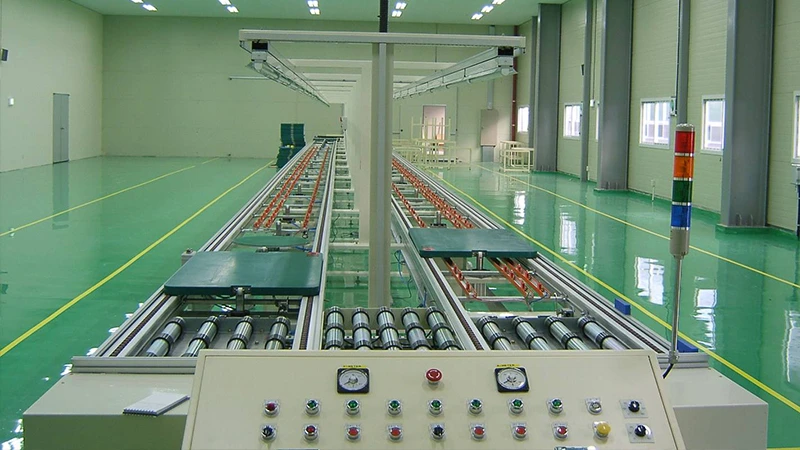
Walk into any bustling factory, warehouse, or assembly plant, and you'll notice a silent hero keeping operations moving: conveyors. These unassuming systems are the backbone of material handling, shuttling parts, products, and packages from one station to the next with precision. But not all conveyors are created equal. Two of the most common players in this space— free flow chain conveyors and roller conveyors —each bring unique strengths to the table. Choosing between them isn't just a matter of picking a "type"; it's about aligning with your team's daily needs, production goals, and the specific demands of your workflow. In this guide, we'll break down their differences, explore when to use each, and explain how they integrate with broader lean system principles to keep your operations running like a well-oiled machine.
What Are We Actually Comparing Here?
Before diving into the nitty-gritty, let's clarify what these two conveyors are at their core. Both are designed to move materials, but their mechanics, strengths, and ideal use cases couldn't be more different. Think of them as two tools in a toolbox: a free flow chain conveyor is like a precision screwdriver—great for delicate, repetitive tasks—while a roller conveyor is more like a heavy-duty wrench, built to handle bulk and weight. Let's start by unpacking each one.
Free Flow Chain Conveyor: The Gentle Workhorse
A free flow chain conveyor (sometimes called a "chain flow conveyor") uses a series of interconnected chain links to move items along a fixed path. Picture a bicycle chain, but larger, sturdier, and mounted on a frame—often made from lightweight aluminum profile for durability and easy customization. The chains are typically driven by a motor and sprockets, creating a smooth, continuous motion that's gentle enough for fragile or small parts but consistent enough for high-speed assembly lines.
These conveyors shine when you need to move lightweight to medium-weight loads (usually up to 50 kg per linear meter) with precision. Think of electronics factories assembling circuit boards, pharmaceutical plants transporting vials, or food packaging lines moving boxes of snacks. The chain's design minimizes friction, so items glide without jostling—critical for avoiding scratches, dents, or damage to sensitive components.
Roller Conveyor: The Heavyweight Champion
A roller conveyor, on the other hand, relies on a series of cylindrical rollers mounted on axles to transport goods. These rollers can be made of steel, aluminum, or plastic, and the conveyor itself can be "gravity-driven" (sloped slightly to let items roll downhill) or "powered" (with motors turning the rollers via belts or chains). Unlike chain conveyors, roller conveyors are all about versatility—they handle everything from small packages to heavy pallets, making them a staple in warehouses, distribution centers, and automotive plants.
The magic here is in the roller track : a framework of parallel rollers spaced evenly to support loads. For example, a gravity roller conveyor might be used to move boxes from a loading dock to a sorting station, while a powered roller conveyor could shuttle car parts between assembly stations in an auto plant. Their simplicity is their strength—fewer moving parts mean less to break, and they're easy to extend or reconfigure as your needs change.
Design & Mechanics: What Makes Them Tick?
To really understand the difference between these two, let's get under the hood. Their designs and mechanics directly impact how they perform, what they cost, and how they fit into your workflow.
| Feature | Free Flow Chain Conveyor | Roller Conveyor |
|---|---|---|
| Core Component | Interlocking metal chains (often steel or stainless steel) mounted on sprockets | Cylindrical rollers (steel, aluminum, or plastic) mounted on axles |
| Frame Material | Often aluminum profile for lightweight rigidity and easy customization | Steel, aluminum, or even wood (for lightweight, temporary setups) |
| Power Source | Almost always powered (electric motor driving sprockets) | Gravity (sloped) or powered (motorized rollers or belts) |
| Motion Type | Continuous, smooth movement (chain loops around sprockets) | Rollers rotate individually (gravity: items move as rollers spin; powered: rollers driven in sync) |
| Load Support | Full contact with chain surface (distributes weight evenly) | Point contact with rollers (needs stable, flat-bottomed loads) |
Free Flow Chain Conveyor: The "Smooth Operator"
Free flow chain conveyors are all about consistency. The chain moves in a continuous loop, driven by a motor that's usually mounted at one end. The chains themselves are attached to a track (often made of aluminum profile ), which keeps them aligned and prevents sagging. Because the entire chain moves as a single unit, items placed on top experience minimal vibration—perfect for delicate goods like glassware, electronics, or medical devices.
Another key design feature? The chain links are often spaced close together, creating a near-solid surface. This means even small items (like screws or small plastic parts) won't slip through the gaps—a common headache with roller conveyors. For example, in a toy factory assembling small action figures, a free flow chain conveyor ensures tiny accessories like capes or weapons don't fall between rollers and get lost (or worse, jam the system).
Roller Conveyor: The "Versatile Workhorse"
Roller conveyors are simpler by design, and that's intentional. Each roller is mounted on an axle, which is secured to a frame. In gravity models, the frame is tilted at a slight angle (usually 3-5 degrees), so items slide downhill using their own weight. In powered models, a motor turns the rollers via a belt, chain, or gear system, moving items even on flat surfaces.
The spacing between rollers matters here. For heavy loads like pallets, rollers are spaced close together (4-6 inches apart) to distribute weight. For lighter items, they can be farther apart. But this spacing is a double-edged sword: while it makes roller conveyors easy to adapt to different load sizes, it also means small or irregularly shaped items might get stuck. Imagine trying to move a bag of loose screws on a roller conveyor—chances are, some will fall through the gaps. That's why roller conveyors are best for sturdy, flat-bottomed items like boxes, crates, or pallets.
Performance in Action: When to Choose Which
At the end of the day, the "right" conveyor depends on your specific needs. Let's break down real-world scenarios where one outperforms the other.
Choose Free Flow Chain Conveyor When…
- You're handling fragile or small items. The smooth, gap-free surface prevents jostling and loss of tiny parts. Think electronics assembly lines moving circuit boards or watch components.
- Speed and precision are non-negotiable. Free flow chain conveyors excel at consistent, high-speed movement—up to 60 meters per minute in some cases. This makes them ideal for mass production lines, like those in automotive part manufacturing.
- You need to integrate with a lean system . Lean manufacturing thrives on minimizing waste, and free flow chain conveyors support this by reducing bottlenecks. For example, in a lean assembly cell, they can deliver parts directly to a workbench exactly when needed, eliminating "wait time" for workers.
- Your environment is clean or sterile. Many free flow chain conveyors are made with stainless steel chains and aluminum profile frames, which are easy to sanitize. This makes them a top choice for food processing, pharmaceuticals, or medical device manufacturing.
Choose Roller Conveyor When…
- You're moving heavy or bulky loads. Roller conveyors handle weights up to 500 kg per linear meter (for powered models), making them perfect for warehouses shipping pallets of goods or factories moving large machinery parts.
- You want simplicity and low maintenance. With fewer moving parts, roller conveyors are easier to repair. A stuck roller? Just replace the axle or roller—no need to adjust an entire chain system.
- Cost is a primary concern. Gravity roller conveyors, in particular, are budget-friendly—no motor means lower upfront and energy costs. They're great for temporary setups or low-volume operations.
- You need flexibility. Roller conveyors are easy to reconfigure. Need to extend a line? Add more roller sections. Need to change direction? Add a curve module. This adaptability is key in dynamic environments like e-commerce warehouses.
The Wildcard: Hybrid Systems
Sometimes, the best solution is a mix. Many facilities use free flow chain conveyors for delicate assembly steps and roller conveyors for transporting finished products to shipping. For example, a furniture factory might use a free flow chain to move wooden panels through a painting station (where vibration could ruin the finish) and then switch to a roller conveyor to move the painted panels to the packaging area (where weight and durability matter more).
Cost & Maintenance: The Hidden Tradeoffs
Beyond performance, cost and upkeep are major factors. Let's compare the two over their lifecycle.
Initial Cost
Free flow chain conveyors are generally pricier upfront. Why? They require motors, sprockets, and precision-aligned aluminum profile frames. A basic 10-meter system might cost $5,000–$8,000. Roller conveyors, especially gravity-driven ones, are cheaper—$2,000–$4,000 for the same length. Powered roller conveyors fall in the middle, around $3,000–$6,000.
Maintenance
Here's where the tables can turn. Free flow chain conveyors need regular love: chains must be lubricated every 200–300 hours of use to prevent rust and wear, and sprockets need occasional alignment. If a chain link breaks, it can halt the entire system until repaired—costing downtime.
Roller conveyors are lower-maintenance. Gravity models have almost no moving parts to fix—just occasional cleaning to remove debris from roller axles. Powered roller conveyors need motor checks and roller lubrication (every 500+ hours), but individual rollers can be replaced without stopping the entire line. For example, if a roller jams in a warehouse, a worker can swap it out in 10 minutes, whereas fixing a broken chain might take an hour or more.
Energy Costs
Free flow chain conveyors are powered by motors, which adds to your electricity bill. Roller conveyors, especially gravity-driven ones, use zero energy—they're powered by good old-fashioned physics. If you're running a conveyor 24/7, a gravity roller system could save thousands in energy costs annually.
Integrating with Lean Systems: More Than Just Moving Parts
In today's competitive manufacturing landscape, conveyors aren't just about moving stuff—they're about supporting lean system goals: reducing waste, improving flow, and empowering workers. Both free flow chain and roller conveyors play a role here, but in different ways.
Free flow chain conveyors excel at "just-in-time" (JIT) delivery. In a lean assembly line, parts need to arrive at a workbench exactly when the worker is ready for them—not early (cluttering the workspace) or late (causing idle time). The consistent speed of a free flow chain conveyor ensures this precision. For example, in a smartphone factory, a free flow chain might deliver screens to a workbench every 30 seconds, matching the assembly rate of the workers. No piles of screens stacking up, no waiting—just smooth, waste-free flow.
Roller conveyors, meanwhile, support lean principles like "continuous improvement." Their modular design makes it easy to adjust layouts as processes evolve. If a warehouse adopts a new sorting system, adding a few roller sections to redirect flow takes hours, not days. This flexibility keeps operations agile and reduces the "waste of overprocessing" (e.g., moving items unnecessary distances).
Final Verdict: It's About Your Unique Workflow
At the end of the day, there's no "winner" between free flow chain and roller conveyors—only what works best for you. Ask yourself: What do we move most? How heavy is it? How fragile? What's our budget for upfront costs vs. maintenance? And how does this conveyor fit into our broader lean system goals?
If you're moving small, delicate parts at high speeds and can invest in maintenance, go with a free flow chain conveyor—especially if you're using aluminum profile frames for durability and customization. If you need to handle heavy loads on a budget with minimal upkeep, a roller conveyor (gravity or powered) is your best bet.
Remember: the best conveyor is the one that fades into the background, letting your team focus on what they do best—creating great products, efficiently. Whether it's the smooth glide of a chain or the steady roll of a roller, the right choice will keep your operations moving forward, one part at a time.