- Company Articles
- Products and Technology
- Application Cases
- Gusset ALP 4040 in Home Appliance Manufacturing: Securing Assembly Workbenches

Gusset ALP 4040 in Home Appliance Manufacturing: Securing Assembly Workbenches
Related Product
Gusset ALP 4040
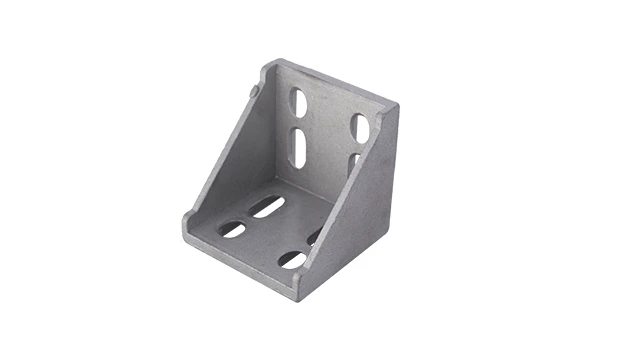
The 4040 bracket/Gusset is an external fastening method that creates a 90 degree connection. 4040 means this size is used for 40 series aluminum profile with a quick connection by bolt and nut. It is a lightweight bracket that requires no machining servic
The Heartbeat of Home Appliance Manufacturing – Assembly Workbenches
Walk into any home appliance factory, and you'll quickly realize: the magic doesn't happen in the glossy showrooms or the sleek design offices. It happens on the factory floor, where rows of assembly workbenches hum with activity. These aren't just tables with tools scattered on them—they're the backbone of production, the spots where raw components transform into the refrigerators that keep your groceries fresh, the washing machines that tackle your laundry, and the microwaves that heat up your leftovers in seconds.
Think about it: every part that goes into a modern appliance—from the tiny screws in a blender's motor to the large metal panels of a refrigerator door—passes through an assembly workbench at some point. Workers here don't just "put things together"; they align, test, adjust, and inspect with precision measured in millimeters. A single misstep, a slight wobble, or a moment of instability can turn a perfectly good part into scrap metal, or worse, a faulty appliance that ends up in a customer's home.
In this fast-paced world, where factories crank out hundreds (sometimes thousands) of appliances daily, assembly workbenches face relentless demands. They're subjected to constant movement: workers leaning on them, tools being set down with a thud, parts sliding across surfaces. They hold heavy loads—imagine a stack of steel brackets for oven doors or a crate of glass shelves for refrigerators. And let's not forget the vibrations: nearby machinery, the hum of conveyor belts, even the rhythmic motion of workers repeating the same task hundreds of times a day. All of this adds up, and over time, even the sturdiest workbench can start to show signs of wear.
But here's the thing: most factories don't talk about their workbenches. They're the quiet workhorses, taken for granted until something goes wrong. And when it does, the ripple effects are immediate. A wobbly workbench might slow down production as workers pause to steady parts. It might lead to misaligned components, requiring rework that eats into tight schedules. Worst of all, it could compromise safety—if a heavy tool slides off an unstable surface, or a worker strains to compensate for a wobbly bench, injuries become a real risk.
So, what's the secret to building assembly workbenches that can keep up with the chaos of home appliance manufacturing? It starts with choosing the right materials and, more importantly, the right components to hold everything together. And that's where a small but mighty part called the Gusset ALP 4040 comes into play.
The Hidden Challenge: Why Workbench Stability Matters More Than You Think
Let's paint a picture. It's a Tuesday morning at a mid-sized appliance factory outside Cincinnati. The line for dishwashers is running full tilt—today's goal is 300 units. Maria, a line worker with 12 years of experience, is stationed at her assembly workbench, attaching the spray arm to the dishwasher's interior. She's done this task thousands of times: align the arm, insert four screws, tighten them to exactly 8 Nm of torque, then give it a gentle spin to ensure smooth movement.
But this morning, something's off. Every time she leans forward to reach for her torque wrench, the workbench shifts slightly to the left. It's barely noticeable—maybe a centimeter at most—but it's enough to throw off her rhythm. When she tightens the first screw, the bench wobbles, and she overshoots the torque by 2 Nm. She catches it, loosens the screw, and tries again, but now she's 10 seconds behind. By 10 a.m., she's fallen a full minute behind schedule. Multiply that by eight hours, and the line is looking at 48 minutes of lost production—enough to miss the day's target by 24 dishwashers.
Maria's story isn't hypothetical. It's a scenario played out in factories worldwide, and it highlights a critical truth: workbench stability isn't just about "feeling solid." It's about precision, efficiency, and consistency. When a workbench isn't properly secured, even minor movements can have major consequences:
Product Defects: A misaligned workbench can cause parts to sit unevenly, leading to gaps, loose connections, or misfitted components. A dishwasher spray arm that's slightly off-center might not distribute water evenly, resulting in poor cleaning performance. A washing machine's drum mount that's tilted could cause excessive noise or vibration during the spin cycle.
Worker Fatigue: When a bench wobbles, workers unconsciously tense their muscles to steady themselves or the parts they're handling. Over time, this leads to fatigue, soreness, and even repetitive strain injuries. A study by the National Institute for Occupational Safety and Health (NIOSH) found that workers at unstable workstations reported 30% higher rates of lower back pain compared to those at stable ones.
Safety Risks: Tools, parts, or even heavy equipment sliding off an unstable bench can cause trips, falls, or impact injuries. In 2023, the Occupational Safety and Health Administration (OSHA) cited "unsecured work surfaces" as a contributing factor in 12% of factory floor accidents.
The root cause? More often than not, it's the joints where the workbench's frame comes together. Most modern assembly workbenches are built using aluminum profiles—lightweight, durable, and easy to customize. These profiles (think of them as metal beams with grooves) are connected using joints and brackets to form the bench's frame. But here's the weak link: the corners. When you connect two aluminum profiles at a 90-degree angle, the joint is only as strong as the bracket holding it. Over time, with repeated stress, those brackets can loosen, bend, or even snap, turning a rigid frame into a wobbly mess.
This is where the Gusset ALP 4040 enters the picture. It's not a flashy part—you won't see it in product brochures or factory tours. But for engineers and maintenance teams, it's the unsung hero that turns "good enough" workbenches into "rock-solid" ones.

Meet Gusset ALP 4040: The Unsung Hero of Workbench Stability
Let's get up close with the Gusset ALP 4040. At first glance, it looks like a simple metal bracket—small, triangular, and unassuming. But don't let its size fool you. This little piece of hardware is engineered to solve one big problem: reinforcing the corners of aluminum profile workbenches to prevent wobbling, bending, and failure under stress.
So, what makes it special? Let's break it down. The "ALP 4040" in its name gives a clue: it's designed specifically for 4040 aluminum profiles—the most common size used in assembly workbenches. These profiles are 40mm wide and 40mm tall, with T-slots running along their length that allow for easy attachment of accessories like shelves, tool hooks, and (you guessed it) gussets. The Gusset ALP 4040 fits snugly into these T-slots, creating a rigid connection between two perpendicular aluminum profiles.
But here's the genius: unlike basic L-shaped brackets, which only connect the surfaces of the profiles, the Gusset ALP 4040 wraps around the corner, reinforcing the joint from multiple angles. Imagine building a picture frame: if you just nail two pieces of wood together at the corner, it might hold, but it'll flex if you push on it. Add a triangular brace (a gusset) to the back, and suddenly it's rock solid. That's exactly what the Gusset ALP 4040 does for workbenches.
Made from high-grade aluminum alloy, the Gusset ALP 4040 is lightweight (so it doesn't add unnecessary bulk to the workbench) but incredibly strong. It can withstand tensile forces (pulling) and compressive forces (pushing) far beyond what standard brackets can handle. In lab tests, a single Gusset ALP 4040 was shown to increase the load-bearing capacity of a 4040 aluminum profile corner joint by up to 60%. That's the difference between a workbench that sags under a 50kg load and one that easily handles 80kg without a creak.
Another key feature? It's modular. Factories rarely use "one-size-fits-all" workbenches—some are long and narrow for assembly lines, others are compact for testing stations, and still others have shelves, drawers, or attached roller tracks for moving parts. The Gusset ALP 4040 works with all these configurations. Whether the bench is standing alone, bolted to the floor, or part of a larger system with conveyor belts, it can be installed at any 90-degree joint to add stability where it's needed most.
But perhaps the best thing about the Gusset ALP 4040 is how easy it is to install. You don't need specialized tools or a team of engineers. A maintenance worker with a hex key and a few minutes can attach it to an existing workbench. Just slide it into the T-slots of the aluminum profiles, tighten the bolts, and you're done. No welding, no drilling, no downtime. For factories that can't afford to halt production for hours of repairs, this is a game-changer.

How Gusset ALP 4040 Works: Engineering for Reliability
To really appreciate the Gusset ALP 4040, let's dive into the engineering behind it. At its core, it's all about distributing stress. When a workbench is in use, the corners bear the brunt of the force. Every time a worker leans on the edge, the weight transfers down through the legs and into the floor—but if the corner joint is weak, some of that force bends or twists the aluminum profiles instead. Over time, this repeated stress causes the joint to loosen, leading to the wobbling we saw in Maria's story.
The Gusset ALP 4040 stops this by creating a "stress path" that directs force away from the joint and into the gusset itself. Its triangular shape is no accident—triangles are the most stable geometric shape in engineering. Unlike squares or rectangles, which can flex into parallelograms under stress, triangles maintain their shape because each side supports the others. When you attach a triangular gusset to a corner joint, you essentially "lock" that joint into a rigid structure that resists bending or twisting.
Let's get technical for a second (but don't worry, we'll keep it simple). The Gusset ALP 4040 has two vertical flanges that fit into the T-slots of the aluminum profiles, and a horizontal flange that connects them. When the workbench is loaded, the vertical flanges take up the compressive force (pushing down) and the horizontal flange resists tensile force (pulling apart). This dual-action reinforcement means the joint can handle both upward and downward pressure, as well as side-to-side movement.
To put this in perspective, let's compare it to a standard L-bracket. An L-bracket has two flat sides that bolt to the surfaces of the profiles. When stress is applied, the bolts are the only thing holding the joint together. Over time, the bolts can loosen, or the bracket itself can bend at the corner. The Gusset ALP 4040, on the other hand, is thicker at the corner (where stress is highest) and uses multiple bolts (usually four—two per profile) to distribute the load. This reduces the strain on any single bolt, making the joint far more resistant to wear.
Another advantage is its compatibility with other aluminum profile accessories. Factories often customize workbenches with add-ons like tool rails, monitor mounts, or ESD (electrostatic discharge) mats to protect sensitive electronics. The Gusset ALP 4040 doesn't interfere with these accessories—in fact, it provides a stronger base for them. A tool rail mounted on a gusset-reinforced corner won't flex when a heavy wrench is hung from it, and an ESD mat laid over a stable bench won't develop wrinkles that could damage delicate circuit boards.
Even better, the Gusset ALP 4040 works with both fixed and mobile workbenches. Many factories use lean pipe workbenches on casters to move parts between stations. These mobile benches face extra stress from rolling over uneven floors or sudden stops. By adding Gusset ALP 4040 at the caster mounting points and along the frame, factories can ensure the bench stays stable whether it's parked or in motion.
Real-World Impact: Case Studies from Home Appliance Factories
Enough theory—let's look at how the Gusset ALP 4040 has made a difference in real factories. Take the example of a major appliance manufacturer in Mexico that produces washing machines for the North American market. In 2022, their assembly line was struggling with a recurring issue: workbenches in the "drum mounting" station kept wobbling, leading to misaligned drum bearings. This caused the washing machines to vibrate excessively during the spin cycle, resulting in a 5% defect rate—far above their 1% target.
The maintenance team initially tried tightening the bolts and adding extra L-brackets, but the problem persisted. Then, they consulted with their aluminum profile supplier, who recommended installing Gusset ALP 4040 at the four corners of each workbench. Within a week of the upgrade, the defect rate dropped to 0.8%. By the end of the month, it was down to 0.3%. The plant manager later reported that not only did they meet their defect targets, but worker satisfaction scores also improved—employees no longer complained about "fighting the bench" to get the drums aligned.
Another example comes from a small appliance factory in Germany that specializes in blenders and food processors. Their assembly workbenches were lightweight (to save on floor space) but struggled with the weight of the metal motor housings workers handled daily. The benches would flex when a housing was placed on them, causing the mounting holes to misalign with the base. The factory was spending 10 hours a week reworking parts—until they added Gusset ALP 4040 to the bench legs and crossbars. The flexing stopped, rework time dropped to 2 hours a week, and the factory was able to reallocate those 8 hours to producing an extra 400 blenders monthly.
Perhaps the most compelling story is from a U.S.-based refrigerator manufacturer that was expanding its production line to meet increased demand. They needed to build 20 new assembly workbenches quickly but didn't want to compromise on quality. By using 4040 aluminum profiles with Gusset ALP 4040 reinforcements, they were able to assemble each bench in under 2 hours (down from the 4 hours it took with their old steel frame benches). The new benches were 30% lighter, making them easier to reconfigure, and after six months of use, none had required maintenance—unlike the steel benches, which often needed bolt tightening or bracket replacements.
| Factory Type | Problem | Solution with Gusset ALP 4040 | Result |
|---|---|---|---|
| Washing Machine (Mexico) | Wobbly workbenches causing drum bearing misalignment; 5% defect rate | Installed Gusset ALP 4040 at bench corners | Defect rate dropped to 0.3%; worker satisfaction improved |
| Blender/Food Processor (Germany) | Lightweight benches flexing under motor housings; 10 hours/week rework | Added Gusset ALP 4040 to legs and crossbars | Rework time reduced to 2 hours/week; 400 extra blenders produced monthly |
| Refrigerator (U.S.) | Slow assembly of steel frame benches; high maintenance needs | Built new benches with 4040 profiles + Gusset ALP 4040 | Bench assembly time cut by 50%; 0 maintenance needed after 6 months |
Beyond Stability: The Ripple Effects of a Secure Workbench
When we talk about Gusset ALP 4040, we focus on stability—and for good reason. But the benefits don't stop there. A secure workbench creates a ripple effect that touches nearly every part of the production process, from quality control to employee morale to the bottom line.
Let's start with quality control . When a workbench is stable, parts are assembled more consistently. Workers don't have to adjust for wobbles or reposition parts mid-task, so each appliance comes off the line looking and functioning the same way. This reduces the need for post-assembly testing and rework, freeing up quality control teams to focus on other tasks (like inspecting incoming materials or developing new testing protocols). In the long run, this leads to fewer warranty claims, higher customer satisfaction, and a stronger brand reputation.
Then there's productivity . Unstable workbenches are silent time-wasters. Every second a worker spends steadying a part, re-tightening a bolt, or adjusting their position is a second not spent assembling appliances. By eliminating these interruptions, Gusset ALP 4040 helps workers stay in a rhythm, completing tasks faster and with fewer errors. The Mexico washing machine factory we mentioned earlier calculated that the stability from Gusset ALP 4040 increased worker productivity by 7%—that's an extra 28 appliances per day, just from more stable workbenches.
Employee safety and morale are also big winners. A wobbly workbench isn't just annoying—it's a safety hazard. Tools can slide off, parts can fall, and workers can strain their backs or shoulders trying to compensate. By making workbenches more secure, factories reduce the risk of accidents and injuries. This not only keeps workers healthy but also boosts morale. When employees feel that their employer cares about their comfort and safety, they're more engaged, more loyal, and less likely to leave for another job. In an industry where labor shortages are common, this is priceless.
Finally, there's cost savings . The upfront cost of Gusset ALP 4040 is minimal compared to the long-term savings. Reduced rework means less scrap material. Fewer defects mean lower warranty costs. Less maintenance (since stable benches don't need constant repairs) frees up maintenance teams for other tasks. And higher productivity means meeting demand without adding extra shifts or hiring more workers. The German blender factory estimated that the Gusset ALP 4040 upgrade paid for itself in just 3 months through reduced rework and increased output.
Choosing the Right Gusset ALP 4040: What to Look For
Not all Gusset ALP 4040 brackets are created equal. To get the full benefits, you need to choose the right one for your factory's needs. Here are a few key factors to consider:
Material Quality: Look for gussets made from high-grade aluminum alloy (like 6063-T5, which is commonly used in structural applications). Avoid cheap, low-density aluminum, which can bend or crack under stress. Reputable suppliers will provide material certificates, so don't hesitate to ask for them.
Compatibility: Ensure the gusset is designed for 4040 aluminum profiles. Some manufacturers make "universal" gussets that claim to fit multiple profile sizes, but these often don't provide the same tight fit as a profile-specific design. Check the dimensions: the gusset should slide easily into the T-slots of your 4040 profiles without gaps.
Load Capacity: Different workbenches face different loads. A bench used for small electronics assembly might only need a gusset rated for 50kg, while one handling heavy appliance parts could need 100kg or more. Ask your supplier for load-testing data to ensure the gusset meets your needs.
Finish: Most Gusset ALP 4040 brackets come with an anodized finish, which protects against corrosion and wear. This is especially important in factories with high humidity (like those producing washing machines) or where cleaning chemicals are used. Look for a smooth, even finish—rough spots or discoloration can indicate poor quality.
Supplier Support: Even the best product is useless if you don't know how to install it. Choose a supplier that provides clear installation instructions, technical support, and (ideally) samples so you can test the gusset before buying in bulk.
Installation Tips: Making Gusset ALP 4040 Work for Your Line
Installing Gusset ALP 4040 is straightforward, but a few tips can ensure you get the best results:
Clean the T-Slots First: Dust, dirt, or old adhesive can prevent the gusset from seating properly. Use a brush or compressed air to clean the slots before installation.
Tighten Bolts Evenly: When securing the gusset with bolts, tighten them in a crisscross pattern (like you would with a car tire). This ensures even pressure and prevents warping.
Reinforce High-Stress Areas: Focus on corners where the bench bears the most weight—usually the legs, crossbars, and areas where accessories (like shelves or tool rails) are mounted.
Check After Installation: Give the bench a gentle shake or apply pressure to the corners to test stability. If it still wobbles, check if the gusset is properly seated or if additional gussets are needed.
Train Your Team: Make sure maintenance workers know how to install and inspect Gusset ALP 4040. A quick 15-minute training session can prevent mistakes and ensure consistency.
The Future of Workbench Design: Why Gusset ALP 4040 is Here to Stay
As home appliance manufacturing evolves—with trends like automation, modular production, and sustainability—workbench design is evolving too. Factories are moving away from heavy, fixed steel benches toward lightweight, modular aluminum systems that can be reconfigured in minutes to adapt to new products or production methods. In this environment, the Gusset ALP 4040 isn't just a "nice-to-have"—it's a necessity.
Automation is a big driver here. Collaborative robots ("cobots") are increasingly working alongside humans on assembly lines, and they require precise, stable work surfaces to operate effectively. A cobot programmed to tighten screws won't tolerate a wobbly bench—it will either stop working or drive the screws in at the wrong angle. Gusset ALP 4040 ensures the workbench stays steady, allowing cobots to work at full speed without errors.
Sustainability is another trend. Aluminum is 100% recyclable, and using aluminum profile workbenches with Gusset ALP 4040 reduces the need for steel (which has a higher carbon footprint to produce). Factories can also reuse or repurpose the benches when they're no longer needed, simply by disassembling them and reusing the profiles and gussets elsewhere.
Finally, there's the push for "lean manufacturing"—eliminating waste in all forms. Unstable workbenches create waste: wasted time, wasted materials, wasted energy. By making workbenches more reliable, Gusset ALP 4040 helps factories become leaner, more efficient, and more competitive in a global market.
Conclusion: Investing in Stability – The Foundation of Quality Appliances
At the end of the day, home appliances are more than just machines—they're tools that make our lives easier. And behind every reliable appliance is a reliable assembly workbench. The Gusset ALP 4040 might be small, but it plays a huge role in ensuring those workbenches can handle the demands of modern manufacturing.
Whether you're running a large factory producing thousands of appliances a day or a small shop crafting specialty products, the message is clear: stability matters. It matters for quality, for productivity, for safety, and for your bottom line. And when it comes to securing assembly workbenches, few solutions deliver the value, reliability, and versatility of the Gusset ALP 4040.
So, the next time you walk into a factory, take a closer look at those assembly workbenches. Chances are, the ones that are running smoothly, turning out defect-free appliances, have a little triangular bracket quietly doing its job: the Gusset ALP 4040. It's not glamorous, but in the world of home appliance manufacturing, it's the unsung hero that keeps the heartbeat of production steady and strong.