- Company Articles
- Products and Technology
- Product knowledge
- Gusset ALP 4040 Manufacturing Process: From Extrusion to Precision Machining

Gusset ALP 4040 Manufacturing Process: From Extrusion to Precision Machining
Related Product
Gusset ALP 4040
The 4040 bracket/Gusset is an external fastening method that creates a 90 degree connection. 4040 means this size is used for 40 series aluminum profile with a quick connection by bolt and nut. It is a lightweight bracket that requires no machining servic
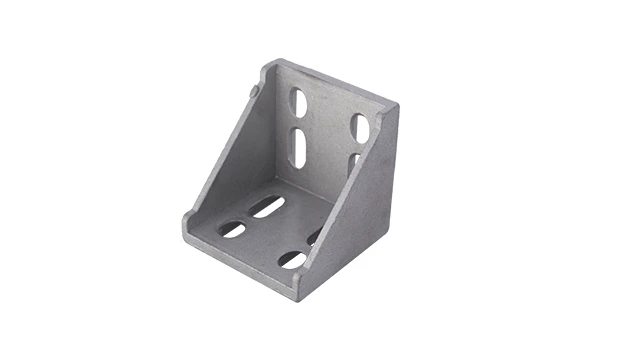
If you've ever walked through a busy factory floor, admired the sleek structure of a workbench, or marveled at how efficiently materials flow through a production line, chances are you've encountered aluminum extrusion profile at work. These versatile building blocks are the unsung heroes of modern manufacturing, and among them, the Gusset ALP 4040 stands out as a critical component. More than just a metal piece, this small but mighty accessory plays a pivotal role in reinforcing structures, ensuring stability, and bringing lean systems to life. Today, we're pulling back the curtain to explore how this unassuming part goes from raw aluminum to a precision-engineered solution—step by step, from the heat of the extrusion press to the precision of CNC machines.
1. The Foundation: Choosing the Right Aluminum Alloy
Every great product starts with the right materials, and Gusset ALP 4040 is no exception. Aluminum is chosen for its unbeatable combination of strength, lightweight, and corrosion resistance, but not all aluminum is created equal. For this gusset, manufacturers typically lean on two alloys: 6061 and 6063. Why these? Let's break it down.
| Alloy Type | Key Composition | Strength (Tensile) | Extrusion Ease | Corrosion Resistance | Best For |
|---|---|---|---|---|---|
| 6061 | Aluminum, magnesium, silicon | 310 MPa | Moderate | Excellent | Heavy-duty structures, high-stress applications |
| 6063 | Aluminum, magnesium, silicon (lower Mg/Si) | 215 MPa | Superior | Very Good | Intricate profiles, decorative or precision parts |
For Gusset ALP 4040, 6063 is often the alloy of choice. Its lower magnesium and silicon content makes it more malleable during extrusion—critical for forming the gusset's precise angles and thin walls. While 6061 is stronger, the gusset's design doesn't require extreme tensile strength, and 6063's ability to hold tight tolerances during machining gives it the edge. Think of it like choosing between a heavyweight boxer and a ballet dancer: both are strong, but the dancer's precision is what matters here.
Once the alloy is selected, the aluminum arrives at the factory in the form of cylindrical billets—think giant aluminum logs, typically 6 to 12 feet long and 8 to 12 inches in diameter. These billets aren't ready for extrusion yet, though. They first undergo homogenization: a controlled heating process that heats the billet to around 570°C (1058°F) and holds it there for 4–6 hours. This step ensures the alloy's microstructure is uniform, preventing weak spots or inconsistencies that could ruin the extrusion later. It's like preheating a cake mix to ensure the ingredients blend perfectly—no lumps, just smooth, even results.
2. Extrusion: Shaping Aluminum Like Clay
Now comes the magic: turning a solid billet into a complex aluminum extrusion profile . Extrusion is often called "metal modeling" because it works much like squeezing toothpaste from a tube—except instead of toothpaste, it's 500°C aluminum, and the "tube" is a precision-engineered die.
Step 2.1: Billet Heating and Preparation
The homogenized billet is loaded into a furnace, where it's reheated to around 480–520°C (896–968°F). This temperature is crucial: too cold, and the aluminum won't flow; too hot, and it becomes too soft, losing its structural integrity. Think of it as warming butter—soft enough to spread, but not so melty it drips off the knife.
Once heated, the billet is transferred to the extrusion press. But first, its surface is coated with a lubricant (usually graphite or a ceramic-based compound) to prevent it from sticking to the press or die. The billet's front end is also "scalped"—trimmed to a smooth, flat surface to ensure even pressure during extrusion.
Step 2.2: The Extrusion Press – Where Pressure Meets Precision
The extrusion press is a behemoth of a machine, often standing two stories tall and weighing hundreds of tons. At its heart is a hydraulic ram that can exert up to 10,000 tons of force. Here's how it works:
- The heated billet is placed in a cylindrical container (the "billet container").
- A dummy block (a metal plug) is placed behind the billet to protect the ram from direct contact with the hot aluminum.
- The ram pushes forward, forcing the billet through a die—a steel mold with a cross-sectional shape identical to the desired profile. For Gusset ALP 4040, the die has a specific L-shape with pre-drilled hole patterns (more on that later).
- As the aluminum exits the die, it emerges as a long, continuous profile with the gusset's shape. The speed here is carefully controlled—usually 5–15 meters per minute—to ensure the profile doesn't warp or develop cracks.
Watching this process is mesmerizing: the solid billet disappears into the press, and moments later, a perfectly shaped profile slides out the other side, like a metal ribbon unfurling. It's a testament to human ingenuity—turning brute force into delicate precision.
Step 2.3: Cooling, Stretching, and Cutting
Freshly extruded aluminum is still soft and prone to warping, so it's immediately guided into a cooling table. Here, fans or water sprays rapidly cool the profile to room temperature, locking in its shape. But even with cooling, extrusion can leave minor twists or bends. To fix this, the profile is stretched using a tensioner—a machine that grabs both ends of the profile and pulls with controlled force (usually 1–3% of the alloy's yield strength). This straightens the profile and relieves internal stresses, ensuring it won't warp later.
Finally, the continuous profile is cut into manageable lengths using a high-speed saw. For Gusset ALP 4040, these lengths are typically 3–6 meters, depending on customer needs. At this stage, the profile looks like a long, flat L-shape with rough edges—but it's far from finished.

3. Precision Machining: Turning a Profile into a Gusset
Extrusion gives the gusset its basic shape, but to make it functional, it needs precision machining. Gusset ALP 4040 is designed to connect aluminum profile s at 90-degree angles, so it needs holes for bolts, slots for adjustments, and smooth edges to avoid snags. This is where CNC (Computer Numerical Control) machines take over—turning the rough extrusion into a part that fits like a puzzle piece.
Step 3.1: CNC Milling – Carving Out the Details
The first stop after extrusion is the CNC milling machine. The gusset blank is clamped into place, and a rotating cutter (like a high-speed drill bit) carves out the necessary features. For ALP 4040, this includes:
- Mounting Holes: Typically 4–6 holes, precision-drilled to fit M6 or M8 bolts. Tolerances here are tight—±0.1mm (0.004 inches)—to ensure bolts thread smoothly without stripping.
- Counterbores: Recessed areas around the holes to allow bolt heads to sit flush with the gusset's surface, preventing snags or uneven connections.
- Edge Chamfering: Smoothing sharp edges to prevent injury during assembly and improve aesthetics. A 0.5mm chamfer might seem small, but it makes a big difference in usability.
CNC machines are programmed using CAD (Computer-Aided Design) models, so every gusset is identical. A single machine can produce hundreds of gussets per hour, each one matching the design to the thousandth of an inch. It's like having a master craftsman with a steady hand—and a million clones.
Step 3.2: Tapping – Creating Threads for a Secure Fit
Some gussets require threaded holes (instead of just drilled holes) to attach directly to aluminum profile accessories like brackets or hinges. This is where tapping comes in. A tap—a tool with spiral cutting edges—is screwed into the pre-drilled hole, cutting threads into the aluminum. For Gusset ALP 4040, common thread sizes are M5 or M6, depending on the application.
Tapping is a delicate process. If the tap is too fast, it can overheat and strip the threads; too slow, and it leaves rough edges. Modern CNC tapping centers use "rigid tapping," where the machine's spindle speed and feed rate are synchronized perfectly, ensuring clean, precise threads every time. It's the difference between a loose screw and a connection that lasts for years.

4. Surface Treatment: Protection and Personality
Raw aluminum extrusion is prone to oxidation—you've seen it: that dull, powdery white film that forms when aluminum is exposed to air. To protect the gusset and give it a professional finish, surface treatment is a must. The two most common methods are anodizing and powder coating.
4.1: Anodizing – Building a Protective Shield
Anodizing is an electrochemical process that grows a layer of aluminum oxide on the surface of the gusset. Here's how it works:
- The gusset is cleaned with a mild acid to remove oils or debris (think of it as giving the aluminum a deep clean).
- It's submerged in an electrolyte bath (usually sulfuric acid) and connected to an anode (positive terminal) of a power supply.
- When electricity is applied, oxygen ions react with the aluminum surface, forming a porous oxide layer. This layer is about 5–20 microns thick (for reference, a human hair is ~70 microns).
- The porous layer is then sealed (often with hot water or a chemical sealant), closing the pores and creating a hard, non-porous barrier.
Anodizing doesn't just protect—it adds color. By adding dyes to the electrolyte bath, gussets can be colored silver, black, blue, or even gold. For industrial applications, clear or black anodizing is most common, as it hides scratches and blends with other aluminum profile s. It's like giving the gusset a suit of armor that also looks sharp.
4.2: Powder Coating – A Durable, Colorful Option
For applications where color consistency or a matte finish is desired, powder coating is the go-to. Unlike liquid paint, powder coating uses dry powder (usually polyester) that's electrostatically charged and sprayed onto the gusset. The gusset is then baked in an oven at 180–200°C (356–392°F), melting the powder into a smooth, durable film.
Powder coating offers better chip and scratch resistance than paint, and it's available in thousands of colors. It's popular for gussets used in visible areas, like retail displays or office workbenches, where aesthetics matter as much as function. Imagine choosing a bright blue gusset to match a company's brand colors—powder coating makes that possible.
5. Quality Control: The Final Check
Before a Gusset ALP 4040 leaves the factory, it undergoes a battery of tests to ensure it meets strict standards. Quality control isn't just a final step—it's woven into every stage of production, but the final inspection is where the rubber meets the road.
5.1: Dimensional Inspection
Using calipers, micrometers, and coordinate measuring machines (CMMs), inspectors check critical dimensions: hole positions, thickness, angle (to ensure it's a perfect 90 degrees), and overall length. A CMM uses a probe to map the gusset's surface, comparing it to the CAD model with accuracy down to 0.001mm. If a gusset is even slightly out of spec—say, a hole is 0.2mm off-center—it's rejected. No exceptions.
5.2: Surface Quality Check
Inspectors visually check for scratches, dents, or discoloration. For anodized gussets, they look for uniform color and a smooth finish; for powder-coated ones, they check for orange peel (a bumpy texture caused by uneven powder application) or pinholes. It's like grading a report card—only instead of A's and B's, it's "pass" or "fail."
5.3: Mechanical Testing (Spot Checks)
Random samples are tested for strength: a hydraulic press applies force to the gusset until it bends or breaks, ensuring it meets the minimum yield strength (typically 145 MPa for 6063 alloy). Other tests include salt spray testing (to check corrosion resistance) and thread pull testing (to ensure threads don't strip under load). These tests are destructive, but they give manufacturers confidence that every gusset can handle real-world use.
6. Assembly: Gusset ALP 4040 in Action
Now that we've followed the gusset from billet to finished part, let's see how it fits into the bigger picture. Gusset ALP 4040 is all about connection—bridging aluminum profile s to create stable, rigid structures. Here are a few common applications:
6.1: Workbench Frames
Workbenches in factories or labs need to withstand heavy loads—think 500+ kg of tools, materials, or equipment. Without reinforcement, the corners of an aluminum profile frame can flex or twist. Enter the gusset: bolted to the inside or outside of the corner, it distributes weight evenly, turning a wobbly frame into a rock-solid work surface. It's like adding a corner brace to a bookshelf—suddenly, it can hold twice as many books without sagging.
6.2: Material Racks and Conveyors
Material racks (like the "Material Rack B (3 row and 3 floor)" from our keyword list) and conveyors rely on gussets to keep shelves and rails aligned. In a conveyor system, even a tiny misalignment can cause jams or slow down production. Gussets ensure the rails stay parallel and the structure doesn't shift under the weight of moving parts. It's the difference between a smooth, efficient workflow and a frustrating, stop-and-start mess.
6.3: Lean System Structures
Lean manufacturing is all about efficiency—minimizing waste, maximizing flow. Gusset ALP 4040 helps build lean systems by enabling modular, customizable structures. Need to reconfigure a production line? Simply unbolt the gussets, adjust the profiles, and reattach them. No welding, no cutting—just quick, tool-free changes. It's like building with Legos, but for factories.
7. Conclusion: The Small Part That Makes Big Things Possible
From the homogenization of a billet to the precision of CNC machining, the journey of Gusset ALP 4040 is a story of science, skill, and attention to detail. It's easy to overlook small parts like gussets, but without them, the aluminum extrusion profile s that power our factories, workplaces, and daily lives would be little more than flimsy metal sticks.
Next time you see a sturdy workbench, a smooth-running conveyor, or a neatly organized material rack, take a closer look—chances are, there's a Gusset ALP 4040 holding it all together. And now, you'll know the journey it took to get there: heated, shaped, machined, tested, and ready to build the future—one precision part at a time.