- Company Articles
- Products and Technology
- Application Cases
- Heavy-Duty Swivel Stem Caster Wheel with Brake: Case Study in Machinery Manufacturing

Heavy-Duty Swivel Stem Caster Wheel with Brake: Case Study in Machinery Manufacturing
Related Product
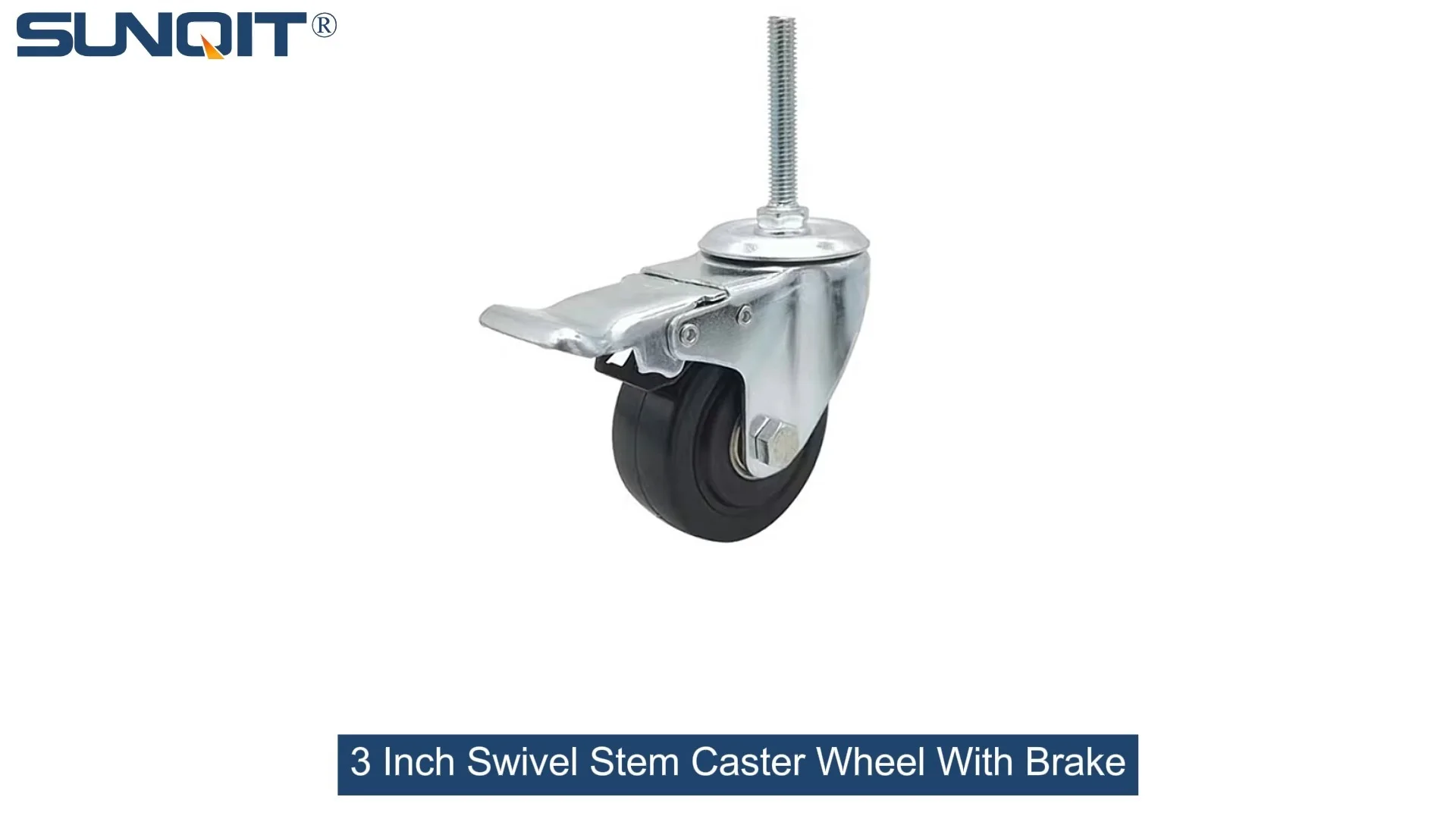
Swivel Stem Caster Wheel with Brake
360 Degree Swivel Stem Caster with brake. Threaded-post mount design, castors diameter 3 inch.Each swivel caster wheels loading 70KGS. Heavy enough and widely suit for carts, chairs, cabinet, flow rack, workbench, turnover rolley.
Introduction: The Heartbeat of the Assembly Line
Every manufacturing plant has a rhythm—a steady pulse of moving parts, hum of machinery, and coordinated motion of workers and equipment. At NexusMech Industries, a mid-sized machinery manufacturer specializing in industrial pumps and valves, that rhythm had been faltering for months. Located just outside Detroit, NexusMech prides itself on precision, but by early 2024, their production floor was struggling with a silent productivity killer: outdated material handling equipment. Specifically, the turnover trolleys and mobile workbenches that shuttled components between assembly stations were becoming a liability. Their wheels, once reliable, now stuck, squeaked, or locked unexpectedly, turning simple tasks into frustrating battles against inertia.
"It was like trying to dance in shoes with concrete soles," jokes Raj Patel, NexusMech's plant manager, recalling the chaos. "Our operators spend 20% of their shift just maneuvering these trolleys. By the time they reach the workbench, they're already drained. And don't get me started on safety—we had two minor back injuries in Q1 alone, all from straining to push a stuck trolley."
What NexusMech needed wasn't just new wheels. They needed a solution that aligned with their commitment to lean system principles—something that reduced waste, improved flow, and prioritized both efficiency and employee well-being. That's when their search led them to a but critical component: the heavy-duty swivel stem caster wheel with brake. This is the story of how a small upgrade transformed their production line, one wheel at a time.
"It was like trying to dance in shoes with concrete soles," jokes Raj Patel, NexusMech's plant manager, recalling the chaos. "Our operators spend 20% of their shift just maneuvering these trolleys. By the time they reach the workbench, they're already drained. And don't get me started on safety—we had two minor back injuries in Q1 alone, all from straining to push a stuck trolley."
What NexusMech needed wasn't just new wheels. They needed a solution that aligned with their commitment to lean system principles—something that reduced waste, improved flow, and prioritized both efficiency and employee well-being. That's when their search led them to a but critical component: the heavy-duty swivel stem caster wheel with brake. This is the story of how a small upgrade transformed their production line, one wheel at a time.
The Challenge: When Wheels Become a Bottleneck
To understand the problem, let's step onto NexusMech's factory floor. Their core product is a high-pressure industrial pump, assembled in 12 stages across a U-shaped production line. Each stage relies on turnover trolleys—metal-framed carts loaded with cast iron pump housings, impellers, and gaskets—to move parts from the warehouse to the assembly workbenches. These trolleys, some weighing up to 800 lbs when fully loaded, were equipped with generic, light-duty casters that came with the equipment a decade earlier.
"The casters were never designed for our workload," explains Maria Gonzalez, the production supervisor who first flagged the issue. "They're rated for 300 lbs max, and we're doubling that. The bearings wear out in weeks, the swivel mechanism seizes up, and the brakes? Half the time, they don't engage properly. Last month, a trolley rolled into a workbench because the brake failed, damaging $2,000 worth of components."
The consequences rippled beyond damaged parts. The production line, which should process 45 pumps daily, was averaging just 38. Operators spent 15-20 minutes per shift troubleshooting stuck casters, often using wrenches or brute force to free them. Morale dipped, too. "It's demoralizing to fight your tools every day," says Juan, an assembly line worker with 12 years at NexusMech. "You start to dread moving a trolley because you never know if it'll cooperate."
Worse, the inefficiencies clashed with NexusMech's lean system goals. Lean manufacturing is all about eliminating waste—whether it's time, effort, or resources. Here, they had all three: wasted time in maneuvering, wasted effort in pushing stuck wheels, and wasted resources in replacing broken casters (they were spending $1,200 monthly on replacements). "We'd done 5S training, optimized our workbench layouts, and streamlined our supply chain," Raj says. "But we overlooked the wheels. It's like fixing a sports car's engine but ignoring flat tires."
"The casters were never designed for our workload," explains Maria Gonzalez, the production supervisor who first flagged the issue. "They're rated for 300 lbs max, and we're doubling that. The bearings wear out in weeks, the swivel mechanism seizes up, and the brakes? Half the time, they don't engage properly. Last month, a trolley rolled into a workbench because the brake failed, damaging $2,000 worth of components."
The consequences rippled beyond damaged parts. The production line, which should process 45 pumps daily, was averaging just 38. Operators spent 15-20 minutes per shift troubleshooting stuck casters, often using wrenches or brute force to free them. Morale dipped, too. "It's demoralizing to fight your tools every day," says Juan, an assembly line worker with 12 years at NexusMech. "You start to dread moving a trolley because you never know if it'll cooperate."
Worse, the inefficiencies clashed with NexusMech's lean system goals. Lean manufacturing is all about eliminating waste—whether it's time, effort, or resources. Here, they had all three: wasted time in maneuvering, wasted effort in pushing stuck wheels, and wasted resources in replacing broken casters (they were spending $1,200 monthly on replacements). "We'd done 5S training, optimized our workbench layouts, and streamlined our supply chain," Raj says. "But we overlooked the wheels. It's like fixing a sports car's engine but ignoring flat tires."

The Lean System Lens: Redefining Material Flow
To tackle the problem, NexusMech turned to their lean system playbook. Lean isn't just about cutting costs—it's about creating value for customers by making processes smoother, safer, and more predictable. Material handling, they realized, was a critical piece of that puzzle.
"In lean terms, 'transportation waste' is any movement of materials that doesn't add value," explains Dr. Elise Carter, a lean consultant hired by NexusMech. "If an operator is pushing a trolley instead of assembling a pump, that's waste. If they're risking injury to do it, that's a failure of the system. The goal is to make material flow as effortless as water—no resistance, no delays."
The team mapped their current state: each trolley made 8 trips daily, each trip taking 7 minutes (vs. the target 4 minutes). They identified the casters as the root cause through a fishbone diagram, linking "equipment" to "caster failure" to "delays" and "injuries." The solution, they decided, wasn't just stronger wheels—it was a complete upgrade to their material handling ecosystem, starting with the casters.
"We needed something that could handle our load, swivel smoothly, brake reliably, and last," Maria says. "And since we're a lean shop, it had to integrate with our existing setup—no overhauls, just smart upgrades. That's when we started researching heavy-duty swivel stem caster wheels with brakes."
"In lean terms, 'transportation waste' is any movement of materials that doesn't add value," explains Dr. Elise Carter, a lean consultant hired by NexusMech. "If an operator is pushing a trolley instead of assembling a pump, that's waste. If they're risking injury to do it, that's a failure of the system. The goal is to make material flow as effortless as water—no resistance, no delays."
The team mapped their current state: each trolley made 8 trips daily, each trip taking 7 minutes (vs. the target 4 minutes). They identified the casters as the root cause through a fishbone diagram, linking "equipment" to "caster failure" to "delays" and "injuries." The solution, they decided, wasn't just stronger wheels—it was a complete upgrade to their material handling ecosystem, starting with the casters.
"We needed something that could handle our load, swivel smoothly, brake reliably, and last," Maria says. "And since we're a lean shop, it had to integrate with our existing setup—no overhauls, just smart upgrades. That's when we started researching heavy-duty swivel stem caster wheels with brakes."

The Search: From Catalogs to Criteria
The hunt for new casters began with a list of non-negotiables. Maria and Raj, along with the maintenance team, drafted criteria based on their pain points:
1. Load Capacity: Minimum 1,000 lbs per caster (to handle fully loaded trolleys with a safety margin).
2. Swivel Mechanism: 360-degree rotation with minimal friction—no more "sticky" turns around workbenches.
3. Brake Reliability: A robust brake system that locks both the wheel and swivel, preventing movement.
4. Durability: Sealed bearings to resist dust and debris (NexusMech's floor isn't always spotless).
5. Compatibility: Must fit existing turnover trolleys and mobile workbenches without major modifications.
They reached out to three suppliers, including their long-time lean pipe supplier, who specialized in material handling accessories. After reviewing catalogs and samples, one option stood out: a heavy-duty swivel stem caster wheel with a dual-lock brake from Streamline Components, a Michigan-based supplier with a reputation for industrial-grade parts.
"What sold us was the brake design," Maria recalls. "Most casters only lock the wheel, but this one locks the swivel too. So even if the trolley is on a slight incline, it won't roll or twist. We tested a sample for two weeks—we threw everything at it: grease, metal shavings, heavy loads. It kept rolling smoothly, and the brake engaged every single time."
The caster's stem design was another plus. Its 2-inch stem fit perfectly into the existing holes on their trolleys and workbenches, meaning no drilling or welding. "That was a game-changer for installation," says Mike, the maintenance lead. "We could swap out old casters in 10 minutes per trolley—no downtime for custom modifications."
1. Load Capacity: Minimum 1,000 lbs per caster (to handle fully loaded trolleys with a safety margin).
2. Swivel Mechanism: 360-degree rotation with minimal friction—no more "sticky" turns around workbenches.
3. Brake Reliability: A robust brake system that locks both the wheel and swivel, preventing movement.
4. Durability: Sealed bearings to resist dust and debris (NexusMech's floor isn't always spotless).
5. Compatibility: Must fit existing turnover trolleys and mobile workbenches without major modifications.
They reached out to three suppliers, including their long-time lean pipe supplier, who specialized in material handling accessories. After reviewing catalogs and samples, one option stood out: a heavy-duty swivel stem caster wheel with a dual-lock brake from Streamline Components, a Michigan-based supplier with a reputation for industrial-grade parts.
"What sold us was the brake design," Maria recalls. "Most casters only lock the wheel, but this one locks the swivel too. So even if the trolley is on a slight incline, it won't roll or twist. We tested a sample for two weeks—we threw everything at it: grease, metal shavings, heavy loads. It kept rolling smoothly, and the brake engaged every single time."
The caster's stem design was another plus. Its 2-inch stem fit perfectly into the existing holes on their trolleys and workbenches, meaning no drilling or welding. "That was a game-changer for installation," says Mike, the maintenance lead. "We could swap out old casters in 10 minutes per trolley—no downtime for custom modifications."

The Solution: Heavy-Duty Swivel Stem Caster Wheel with Brake
The caster chosen was Streamline's Model HD-200: a 6-inch heavy-duty swivel stem caster with a polyurethane wheel, dual-lock brake, and a 1,200-lb load rating. Let's break down why it addressed NexusMech's needs:
Polyurethane Wheels: Unlike the hard rubber wheels on their old casters, polyurethane offers a balance of grip and smoothness. It rolls quietly (reducing noise pollution on the floor), won't mark concrete, and absorbs shocks—gentler on both the trolley and the components inside.
Dual-Lock Brake: A foot pedal engages two locks: one on the wheel (preventing rotation) and one on the swivel raceway (preventing the caster from turning). This "double security" was critical for NexusMech, as their floor has a slight slope near the loading dock.
Sealed Precision Bearings: The wheel and swivel both use sealed ball bearings, keeping out dust, metal chips, and coolant. "Our old casters would get gunked up in days," Mike says. "These? We've had them six months, and I haven't needed to lubricate them once."
Stem Construction: The 2-inch steel stem is threaded for easy installation, with a zinc-plated finish to resist rust—important in NexusMech's humid environment (they use water-based coolants in machining).
But the caster wasn't the only upgrade. To fully align with their lean system, NexusMech also invested in caster accessories: replacement brake pads (for quick maintenance), stem extenders (to adjust height on uneven workbenches), and lubrication kits (though, as Mike noted, they've barely used them). "We wanted to be proactive," Raj explains. "If a brake pad wears out in a year, we don't want to wait for a replacement—we'll have spares on the shelf."
Polyurethane Wheels: Unlike the hard rubber wheels on their old casters, polyurethane offers a balance of grip and smoothness. It rolls quietly (reducing noise pollution on the floor), won't mark concrete, and absorbs shocks—gentler on both the trolley and the components inside.
Dual-Lock Brake: A foot pedal engages two locks: one on the wheel (preventing rotation) and one on the swivel raceway (preventing the caster from turning). This "double security" was critical for NexusMech, as their floor has a slight slope near the loading dock.
Sealed Precision Bearings: The wheel and swivel both use sealed ball bearings, keeping out dust, metal chips, and coolant. "Our old casters would get gunked up in days," Mike says. "These? We've had them six months, and I haven't needed to lubricate them once."
Stem Construction: The 2-inch steel stem is threaded for easy installation, with a zinc-plated finish to resist rust—important in NexusMech's humid environment (they use water-based coolants in machining).
But the caster wasn't the only upgrade. To fully align with their lean system, NexusMech also invested in caster accessories: replacement brake pads (for quick maintenance), stem extenders (to adjust height on uneven workbenches), and lubrication kits (though, as Mike noted, they've barely used them). "We wanted to be proactive," Raj explains. "If a brake pad wears out in a year, we don't want to wait for a replacement—we'll have spares on the shelf."
Implementation: Swapping Wheels, Not Workflows
In late March 2024, NexusMech ordered 40 HD-200 casters (10 trolleys × 4 casters each) plus 20 extra for their mobile workbenches. The plan was to swap out casters during a weekend shutdown to avoid disrupting production.
"We thought it'd take all Saturday," Mike laughs. "Turns out, we finished by noon. The stem fit perfectly, and the brake pedal was intuitive—even the new hires could figure it out." By Monday morning, the first trolley with the new casters rolled onto the floor. The reaction was immediate.
"I pushed it, and it glided," Juan remembers, grinning. "I stopped, hit the brake, and it stayed. I must've tested it 10 times because I couldn't believe it. No squeaking, no jerking—just smooth. It felt like pushing a shopping cart, not a tank."
The team also upgraded their turnover trolley and rack fleet, retrofitting all 15 mobile workbenches with the same casters. "The workbenches used to be stationary, but with these casters, we can reposition them in seconds," Maria says. "If a large order comes in, we rearrange the line to create a U-shape for faster flow. That's lean in action—flexibility without hassle."
Training was minimal. The dual-lock brake was intuitive: a single foot pedal to engage, another to release. Within a day, operators were using the new casters without issue. "The only 'training' needed was telling them, 'Yes, it's supposed to be this easy,'" Raj jokes.
"We thought it'd take all Saturday," Mike laughs. "Turns out, we finished by noon. The stem fit perfectly, and the brake pedal was intuitive—even the new hires could figure it out." By Monday morning, the first trolley with the new casters rolled onto the floor. The reaction was immediate.
"I pushed it, and it glided," Juan remembers, grinning. "I stopped, hit the brake, and it stayed. I must've tested it 10 times because I couldn't believe it. No squeaking, no jerking—just smooth. It felt like pushing a shopping cart, not a tank."
The team also upgraded their turnover trolley and rack fleet, retrofitting all 15 mobile workbenches with the same casters. "The workbenches used to be stationary, but with these casters, we can reposition them in seconds," Maria says. "If a large order comes in, we rearrange the line to create a U-shape for faster flow. That's lean in action—flexibility without hassle."
Training was minimal. The dual-lock brake was intuitive: a single foot pedal to engage, another to release. Within a day, operators were using the new casters without issue. "The only 'training' needed was telling them, 'Yes, it's supposed to be this easy,'" Raj jokes.
Results: The Numbers Speak for Themselves
NexusMech tracked key metrics for three months post-implementation. The results, compiled in the table below, exceeded their expectations:
"The biggest surprise was the operator satisfaction jump," Raj notes. "We thought productivity would improve, but the morale boost was unexpected. Our team feels like we're investing in their success, not just the bottom line."
Financially, the ROI was clear. The casters cost $65 each, totaling $4,550 for 70 units (40 for trolleys, 20 for workbenches, 10 spares). In the first month alone, they saved $1,200 on caster replacements and avoided $2,000 in damaged components. By Q2, production increases had generated $45,000 in additional revenue (9 extra pumps/day × $250 profit/pump × 60 workdays).
"It's a no-brainer," Raj says. "We spent $4k and got back $45k in three months. And that's not counting the intangibles—lower turnover, fewer workers' comp claims, and a production line that actually feels like it's moving forward."
| Metric | Before (Q1 2024) | After (Q2 2024) | Improvement |
|---|---|---|---|
| Daily Production (Pumps) | 38 | 47 | +24% |
| Time per Trolley Trip (Minutes) | 7 | 3.5 | -50% |
| Monthly Caster Replacements | 12 | 0 | -100% |
| Workplace Injuries (Material Handling) | 2 (Q1) | 0 (Q2) | -100% |
| Operator Satisfaction Score (1-10) | 5.2 | 8.7 | +67% |
"The biggest surprise was the operator satisfaction jump," Raj notes. "We thought productivity would improve, but the morale boost was unexpected. Our team feels like we're investing in their success, not just the bottom line."
Financially, the ROI was clear. The casters cost $65 each, totaling $4,550 for 70 units (40 for trolleys, 20 for workbenches, 10 spares). In the first month alone, they saved $1,200 on caster replacements and avoided $2,000 in damaged components. By Q2, production increases had generated $45,000 in additional revenue (9 extra pumps/day × $250 profit/pump × 60 workdays).
"It's a no-brainer," Raj says. "We spent $4k and got back $45k in three months. And that's not counting the intangibles—lower turnover, fewer workers' comp claims, and a production line that actually feels like it's moving forward."
Beyond the Wheels: A Leaner Future
The success of the caster upgrade has rippled through NexusMech's operations. Inspired by the results, they're now re-evaluating other material handling systems, including their flow racks and conveyor systems. "If better wheels made this much difference, imagine what upgrading our flow racks could do," Maria says. "We're already talking to our lean pipe supplier about aluminum profile workbenches—lighter, sturdier, and compatible with these casters, of course."
The team has also embraced a "continuous improvement" mindset around caster maintenance. They've added caster inspections to their weekly 5S checks, ensuring bearings stay clean and brakes remain adjusted. "Preventive maintenance is key," Mike says. "These casters are tough, but we're not taking them for granted. A quick wipe-down and brake test every Friday keeps them in top shape."
For Raj, the lesson is simple: lean system success often hinges on the smallest details. "We spent years optimizing big-ticket items—machinery, software, supply chains. But the wheels? They're the unsung heroes. You don't notice them until they fail. Now, we notice them every day—because they make everything else work better."
The team has also embraced a "continuous improvement" mindset around caster maintenance. They've added caster inspections to their weekly 5S checks, ensuring bearings stay clean and brakes remain adjusted. "Preventive maintenance is key," Mike says. "These casters are tough, but we're not taking them for granted. A quick wipe-down and brake test every Friday keeps them in top shape."
For Raj, the lesson is simple: lean system success often hinges on the smallest details. "We spent years optimizing big-ticket items—machinery, software, supply chains. But the wheels? They're the unsung heroes. You don't notice them until they fail. Now, we notice them every day—because they make everything else work better."
"It's not just about moving parts faster. It's about respecting your team enough to give them tools that don't fight back. These casters? They're a statement: 'We value your time, your safety, and your ability to do great work.'" — Raj Patel, Plant Manager, NexusMech Industries
Conclusion: The Power of the Right Wheel
NexusMech's journey from stuck casters to seamless flow is a reminder that innovation in manufacturing doesn't always require flashy technology. Sometimes, the most impactful upgrades are the ones that make the everyday tasks easier—like pushing a trolley or positioning a workbench. The heavy-duty swivel stem caster wheel with brake didn't just fix a problem; it unlocked potential. It turned material handling from a chore into a strength, aligning with lean system principles and making NexusMech's production line more efficient, safer, and adaptable.
As Raj puts it: "Manufacturing is about precision, but it's also about momentum. You can have the best designs and the most skilled team, but if your wheels are stuck, you're not moving forward. Now, we're rolling—and we're not stopping anytime soon."
For other manufacturers facing similar bottlenecks, the message is clear: don't overlook the small stuff. Your next big productivity gain might be hiding under a trolley, waiting for the right wheel to set it free.
As Raj puts it: "Manufacturing is about precision, but it's also about momentum. You can have the best designs and the most skilled team, but if your wheels are stuck, you're not moving forward. Now, we're rolling—and we're not stopping anytime soon."
For other manufacturers facing similar bottlenecks, the message is clear: don't overlook the small stuff. Your next big productivity gain might be hiding under a trolley, waiting for the right wheel to set it free.