- Company Articles
- Products and Technology
- Product knowledge
- Heavy-Duty Swivel Stem Caster Wheel with Brake: Load Capacity Guide

Heavy-Duty Swivel Stem Caster Wheel with Brake: Load Capacity Guide
Related Product
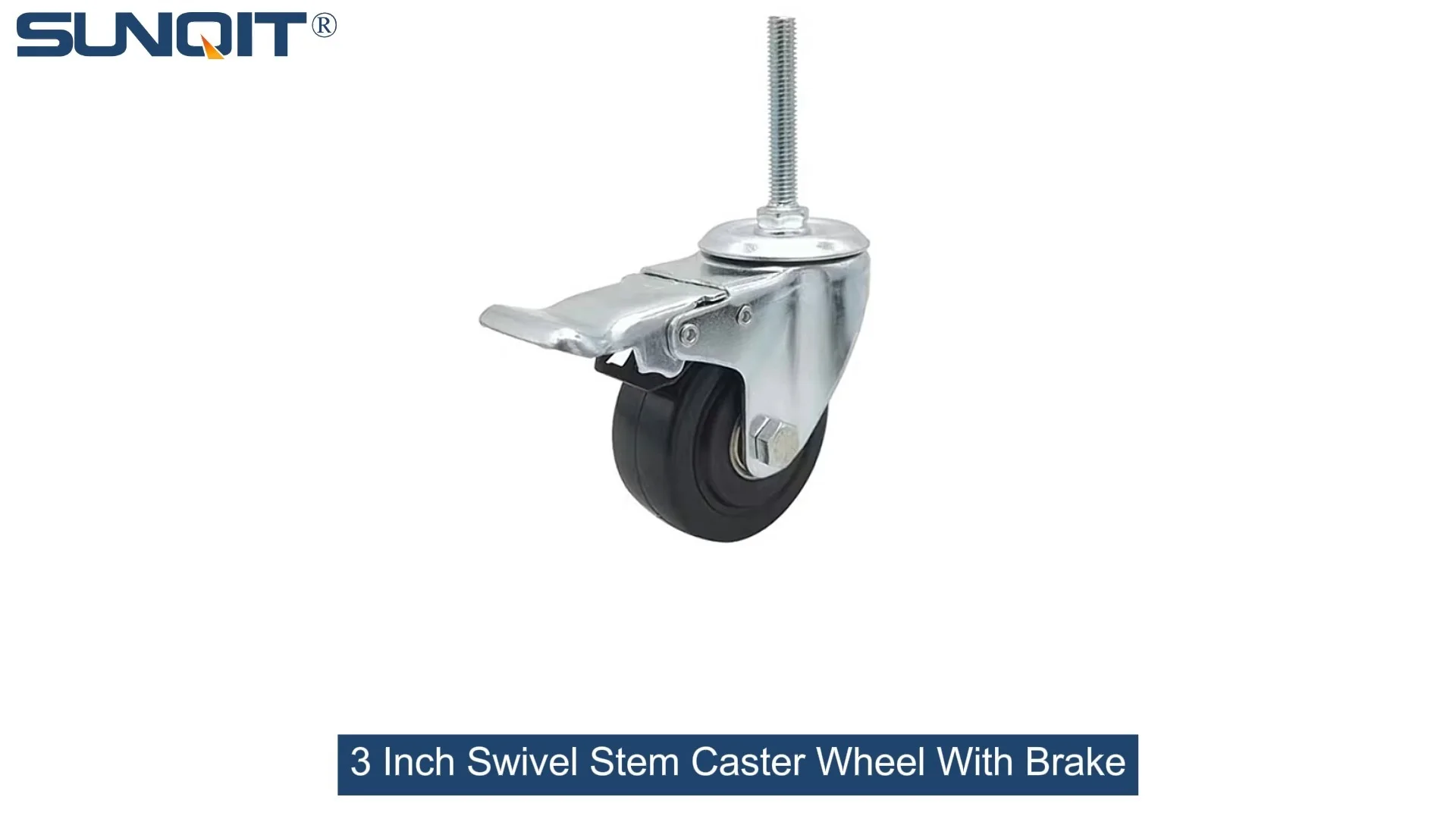
Swivel Stem Caster Wheel with Brake
360 Degree Swivel Stem Caster with brake. Threaded-post mount design, castors diameter 3 inch.Each swivel caster wheels loading 70KGS. Heavy enough and widely suit for carts, chairs, cabinet, flow rack, workbench, turnover rolley.
The Unsung Heroes of Your Workspace
Think about the last time you walked through a busy workshop, a bustling warehouse, or even a well-organized garage. What's one thing you probably didn't notice, but couldn't function without? Caster wheels. Those small, unassuming components quietly (carry) the weight of your workbench, your tool carts, your material racks—basically, the backbone of your daily operations. But not all casters are created equal. When you're dealing with heavy loads, frequent movement, and the need for stability, there's one type that stands out: the heavy-duty swivel stem caster wheel with brake. And at the heart of choosing the right one? Load capacity. Get that wrong, and you're looking at stuck equipment, damaged floors, or worse—safety hazards. Let's dive into why load capacity matters, how to calculate it, and how to pick the perfect caster for your needs.
What Even Is a Heavy-Duty Swivel Stem Caster with Brake?
First, let's break down the name. "Heavy-duty" tells you it's built to handle more than your average caster—think industrial-grade, not the flimsy ones on a office chair. "Swivel stem" means it mounts via a stem (a rod or bolt) into a socket or bracket, and the wheel can rotate 360 degrees, making maneuvering tight corners a breeze. "With brake" is self-explanatory: a mechanism to lock the wheel in place, so your equipment stays put when you need it to. Combine these, and you've got a caster that's strong, flexible, and secure—ideal for everything from a loaded workbench to a heavy machinery cart.
But what makes it "heavy-duty"? It starts with materials. The wheel might be made of polyurethane (urethane), rubber, steel, or cast iron. The swivel head is often reinforced with ball bearings or raceways for smooth rotation under load. The stem is typically steel, designed to withstand bending or snapping. And the brake? It could be a foot brake, a side brake, or a total lock (which locks both the wheel and swivel head) for maximum stability.

Components That Make or Break Load Capacity
Load capacity isn't just a number stamped on the box—it's the result of how every part of the caster works together. Let's break down the key components and how they affect how much weight your caster can handle:
- The Wheel: The star of the show. Wheel material matters—a steel wheel can handle more weight than rubber, but might damage floors. Urethane blends strength (like steel) with floor protection (like rubber). Wheel diameter also plays a role: larger wheels distribute weight better and roll easier over debris, so a 6-inch wheel will carry more than a 4-inch one of the same material. Tread width too—wider treads spread the load, reducing pressure on floors.
- The Swivel Head: This is the part that lets the wheel rotate. A cheap swivel head might bind under heavy loads, making the caster hard to turn. Heavy-duty versions use precision ball bearings or tapered roller bearings, which reduce friction and handle more weight without seizing up.
- The Stem: The stem connects the caster to your equipment. If it's too thin or made of weak metal, it can bend or snap under load. Look for stems made of cold-rolled steel or stainless steel, with a diameter that matches your mounting hole (common sizes are 1/2-inch, 5/8-inch, or 3/4-inch).
- The Brake Mechanism: Even the best brake won't help if the caster itself can't hold the load. But a quality brake (like a top-lock or side-lock) adds an extra layer of safety, ensuring the wheel doesn't roll when locked—critical for preventing accidents with heavy equipment.

Load Capacity 101: Dynamic vs. Static, and Why Safety Factors Matter
When shopping for casters, you'll see two load capacity numbers: dynamic and static. Let's clarify:
Dynamic Load Capacity: This is the maximum weight the caster can handle while in motion. Think pushing a loaded workbench across the shop floor—this is the number that matters for movement.
Static Load Capacity: The maximum weight when the caster is stationary. If you're storing heavy materials on a cart that rarely moves, this is key. Static capacity is almost always higher than dynamic, since movement adds stress (like bumps or uneven floors).
Then there's the safety factor . No one wants to cut it close—if your equipment weighs exactly the dynamic load capacity, one rough floorboard or sudden stop could push it over the edge. Most experts recommend a safety factor of 1.5 to 2.0. That means if your caster needs to handle 200 lbs dynamically, choose one rated for at least 300 lbs (200 x 1.5). Better safe than sorry, right?
| Wheel Material | Wheel Diameter (Inches) | Typical Dynamic Load Capacity (Lbs) | Typical Static Load Capacity (Lbs) |
|---|---|---|---|
| Polyurethane (Urethane) on Steel Core | 4 | 600-800 | 1,200-1,600 |
| Polyurethane (Urethane) on Steel Core | 6 | 1,200-1,500 | 2,400-3,000 |
| Rubber on Steel Core | 5 | 500-700 | 1,000-1,400 |
| Steel | 6 | 2,000-2,500 | 4,000-5,000 |
| Cast Iron | 8 | 3,000-4,000 | 6,000-8,000 |
Note: These are general ranges—always check the manufacturer's specs for your specific caster model.

Factors That Sneakily Affect Load Capacity
Load capacity isn't just about the caster's specs—it's also about your environment. Here are some factors you might not consider, but can drastically reduce how much weight your caster can handle:
- Floor Conditions: Rough, uneven floors or debris (like gravel, bolts, or oil spills) force the wheel to work harder. A caster rated for 1,000 lbs on smooth concrete might only handle 800 lbs on a cracked warehouse floor.
- Temperature and Chemicals: Extreme heat can soften urethane or rubber wheels, reducing their strength. Cold can make them brittle. Chemicals (like oils, solvents, or acids) can degrade wheel materials over time—if you work with chemicals, opt for chemical-resistant wheels (like polyurethane or stainless steel).
- Speed and Frequency of Movement: Casters aren't meant for high speeds. Pushing a cart fast over bumps increases impact load, which can exceed the dynamic capacity. Similarly, moving heavy loads back and forth all day wears down components faster than occasional use.
- Number of Casters: This is a big one. Most equipment uses 4 casters (one at each corner), but some use more. The total load is divided among all casters, so more casters mean less weight per caster. But remember: not all casters will bear equal weight if the load is uneven (like a workbench with tools stacked on one side). Always assume the worst-case scenario (e.g., 3 casters bearing the load if one is on a bump).
Calculating Load Capacity: It's Easier Than You Think
Okay, let's get practical. How do you figure out what load capacity you need? It's a simple formula:
Step 1: Calculate the total load. This is the weight of your equipment (e.g., a workbench) plus the maximum weight of whatever you'll put on it (tools, materials, parts). Let's say your workbench weighs 300 lbs, and you typically load it with 200 lbs of tools—total load = 500 lbs.
Step 2: Divide by the number of casters. Most workbenches use 4 casters, so 500 lbs ÷ 4 casters = 125 lbs per caster.
Step 3: Multiply by the safety factor. Using a 1.5 safety factor: 125 lbs x 1.5 = 187.5 lbs per caster.
So you need a caster with a dynamic load capacity of at least 187.5 lbs. Easy, right? Let's test another example: a material cart that holds 1,000 lbs of parts, plus the cart itself (200 lbs), using 4 casters. Total load = 1,200 lbs. Load per caster = 1,200 ÷ 4 = 300 lbs. With a safety factor of 1.5: 300 x 1.5 = 450 lbs. So you need casters rated for at least 450 lbs dynamic load.
Pro tip: If your load is uneven (like a rack with more weight on one side), calculate based on the side that will bear more weight. For example, if 60% of the load is on the front two casters, use that to find the per-caster load (e.g., 1,200 lbs x 0.6 = 720 lbs on 2 casters = 360 lbs each, x 1.5 safety factor = 540 lbs per front caster).
When to Use Heavy-Duty Swivel Stem Casters with Brakes (Spoiler: It's More Than You Think)
These casters aren't just for industrial factories. Here are some common (and not-so-common) places where they shine:
- Workbenches: A mobile workbench is a game-changer—you can roll it to where the work is, then lock it in place with the brake. Heavy-duty casters ensure it doesn't wobble or sink under the weight of tools, vices, or projects.
- Material Handling Carts: Whether you're moving raw materials, finished products, or tools, these casters make pushing heavy carts effortless (even with a full load) and keep them from rolling away on ramps.
- Medical Equipment: Hospitals use them on carts for supplies, patient lifts, or mobile exam tables—smooth swiveling and reliable brakes are critical for safety around patients.
- Warehouse Racks and Shelving: Mobile racks let you maximize space by moving shelves when needed. Heavy-duty casters with brakes ensure they stay put during loading/unloading.
- Food Service and Labs: In commercial kitchens or labs, where cleanliness is key, stainless steel casters (resistant to rust and chemicals) with brakes keep carts stable while prepping or transporting sensitive materials.
Choosing the Right Caster: It's Not Just About Load Capacity
Load capacity is the foundation, but there are other things to consider to make sure your caster fits your needs:
- Wheel Material: Urethane is a top pick for most workshops—it's durable, quiet, and protects floors (no scuffs!). Rubber is good for indoor use but can mark floors if overloaded. Steel is best for extreme loads or rough outdoor use but is noisy and hard on floors.
- Brake Type: Foot brakes are easy to use (just step on them), but side brakes might be better for tight spaces. Total-lock brakes (which lock both the wheel and swivel head) are best for uneven floors or when you need maximum stability.
- Caster Accessories: Don't sleep on accessories! Adjustable leveling feet, for example, are a game-changer. These attach to the equipment (often near the caster) and can be screwed down to lift the caster off the floor when stationary, providing extra stability on uneven surfaces. They're like training wheels for your caster—great for workbenches or carts that need to stay rock-solid during use.
- Mounting Type: Stem casters are great for equipment with pre-drilled holes, but if you're retrofitting, plate-mount casters (which bolt to a metal plate) might be easier. Make sure the stem length and diameter match your mounting hole—too short, and it won't secure; too long, and it will stick out the other side.
Maintenance: Keep Your Casters Rolling (and Carrying) for Years
Even the best caster won't last if you neglect it. Here's how to keep your heavy-duty swivel stem casters with brakes in top shape:
- Inspect Regularly: Check for cracks in the wheel, bent stems, or loose swivel heads. If a wheel wobbles or the swivel is stiff, it's time to fix or replace it.
- Clean the Wheels: Dirt, hair, or debris can get stuck in the wheel tread or swivel head, causing it to bind. Wipe wheels with a rag and use a brush to clean out crevices.
- Lubricate: Swivel heads and bearings need grease to stay smooth. Use a lithium-based grease (water-resistant) every 3-6 months, depending on use. Avoid over-lubricating—it attracts dirt.
- Check the Brake: Test the brake regularly to make sure it locks the wheel fully. If it's loose or slips, tighten the brake mechanism or replace worn parts (like brake pads).
- Tighten Stems: Vibration from movement can loosen the stem nut. Tighten it periodically to prevent the caster from wobbling or falling off.
Final Thoughts: Your Caster, Your Workflow, Your Success
Heavy-duty swivel stem caster wheels with brakes might not be the most glamorous part of your workspace, but they're one of the most critical. Get the load capacity right, and you'll have equipment that moves smoothly, stays stable, and lasts for years. Get it wrong, and you'll be dealing with frustration, downtime, and maybe even safety risks.
Remember: calculate your total load, factor in safety, consider your environment, and don't forget the little things (like adjustable leveling feet for stability). And when in doubt, ask a supplier—reputable caster suppliers (yes, like those who specialize in lean system components or workbench accessories) can help you pick the perfect match based on your needs.
At the end of the day, a good caster is like a good teammate: reliable, strong, and makes your job easier. So next time you're setting up a new workbench or upgrading your material cart, take a minute to think about the casters. Your back (and your workflow) will thank you.