- Company Articles
- Products and Technology
- Product knowledge
- High-Strength Applications: 3060 National Standard Profile A in Heavy-Duty Racks

High-Strength Applications: 3060 National Standard Profile A in Heavy-Duty Racks
Related Product
3060 National Standard Profile A
Workbench, production line, logistic rack, warehouse rack Industry: Manufacturer workshop, Automobile, Electronic, Assembling, logistic
Walk into any busy warehouse, manufacturing plant, or distribution center, and you'll quickly notice the unsung heroes keeping operations running smoothly: heavy-duty racks. These structures are the backbone of logistics, storing everything from bulky raw materials like steel sheets and engine parts to stacked pallets of finished goods. But not all racks are created equal. The difference between a rack that bends under pressure and one that stands strong for decades often comes down to the materials used—and in today's fast-paced industrial world, 3060 National Standard Profile A is emerging as the gold standard for building heavy-duty racks that don't just meet expectations, but exceed them.
In this article, we'll dive deep into why this aluminum extrusion profile has become a favorite among engineers, warehouse managers, and manufacturers. We'll explore its unique properties, how it outperforms traditional materials, and why pairing it with the right aluminum profile accessories can transform your storage systems from static structures into dynamic, adaptable tools that grow with your business. Whether you're setting up a new facility or upgrading an existing one, understanding the benefits of 3060 Profile A could be the key to unlocking safer, more efficient, and more cost-effective storage.
What Exactly Is 3060 National Standard Profile A?
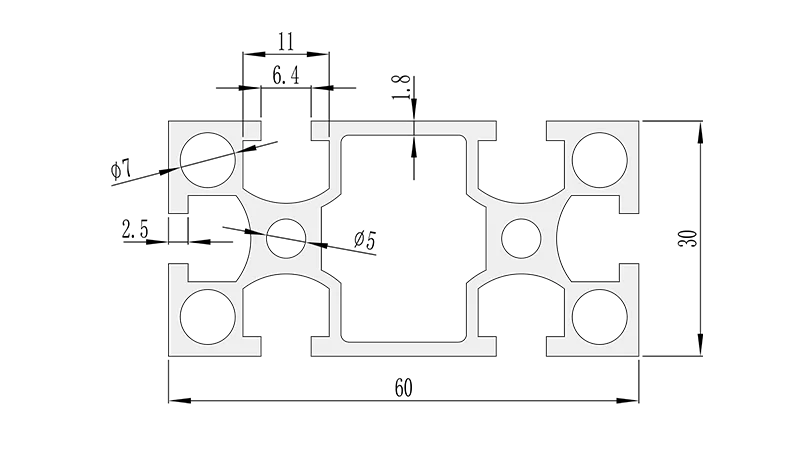
Let's start with the basics: 3060 National Standard Profile A is a type of aluminum extrusion profile designed to meet strict national manufacturing standards, ensuring consistency in dimensions, material quality, and performance across every piece. The name itself gives away its most defining feature: it measures 30 millimeters in width and 60 millimeters in height, making it a "rectangular" profile with a taller, slimmer shape than smaller profiles like the 2020 or 3030. But numbers alone don't tell the whole story—what really sets this profile apart is the thought put into its design and material composition.
At its core, 3060 Profile A is made from high-grade aluminum alloy, typically 6063-T5. This alloy is prized in industrial applications for its exceptional balance of strength, ductility, and corrosion resistance. The "T5" designation refers to its heat treatment process, which involves cooling the extruded profile quickly and then artificially aging it to enhance its mechanical properties—resulting in a material that's both rigid and surprisingly lightweight. Unlike steel, which can be cumbersome to handle, aluminum profiles like 3060 make installation and reconfiguration a breeze without sacrificing structural integrity.
Another key feature is its surface treatment: most 3060 Profile A pieces undergo anodization, a process that creates a protective oxide layer on the aluminum's surface. This layer not only gives the profile a sleek, uniform finish (usually silver or black) but also makes it resistant to scratches, corrosion, and even mild chemicals. For warehouses or factories with humid conditions or exposure to oils and solvents, this is a game-changer—no more worrying about rust weakening the frame over time.
But perhaps the most innovative aspect of 3060 Profile A is its T-slot design. Running along the length of the profile are precision-machined grooves (the "T-slots") that allow for easy attachment of aluminum profile accessories —think brackets, connectors, shelves, and even wheels—without the need for welding or drilling. This T-slot system is what makes the profile so versatile; it turns a simple length of aluminum into a building block that can be customized into almost any structure, from a basic shelving unit to a complex multi-tiered rack.
Why It's the Perfect Choice for Heavy-Duty Racks
Heavy-duty racks have one job: to hold heavy things—often very heavy things. We're talking pallets loaded with automotive parts, stacks of metal sheets, or crates of industrial machinery. For that, you need a material that can handle high static and dynamic loads without bending, warping, or failing. Here's why 3060 Profile A checks all the boxes:
1. Strength That Doesn't Weigh You Down
Aluminum has long been celebrated for its strength-to-weight ratio, and 3060 Profile A is no exception. While steel might seem like the obvious choice for "heavy-duty" applications, it comes with a major downside: weight. A steel rack of the same size as one made with 3060 Profile A can weigh twice as much, making installation a logistical nightmare (requiring forklifts or cranes) and increasing shipping costs. 3060 Profile A, by contrast, is light enough to be moved by a two-person team but strong enough to support. Tests show that a single 3-meter length of 3060 Profile A (with 1.5mm wall thickness) can comfortably bear up to 200kg of evenly distributed weight—more than enough for most industrial storage needs.
2. Corrosion Resistance for Longevity
Warehouses and factories are tough environments. Humidity, spills, and even exposure to chemicals can take a toll on metal racks. Steel racks, unless galvanized or painted, are prone to rust, which weakens the structure over time and creates safety hazards. 3060 Profile A, with its anodized surface, is virtually immune to corrosion. Even in damp environments or areas where water or oil might splash, the anodized layer acts as a barrier, preventing oxidation and keeping the profile looking and performing like new for years. This isn't just about aesthetics—corrosion resistance directly translates to lower maintenance costs and a longer lifespan for your racks.
3. Modularity: Adapt Without Starting Over
One of the biggest frustrations with traditional welded steel racks is their lack of flexibility. If your storage needs change—say, you start stocking taller items or need to rearrange your warehouse layout—you're often stuck tearing down the old racks and building new ones from scratch. With 3060 Profile A, that's a thing of the past. Thanks to its T-slot design and compatible aluminum profile accessories , you can easily add shelves, adjust heights, or even reconfigure the entire rack system using nothing more than a hex key and a few extra brackets. Need to add a workbench at the end of a rack for packing? Just attach a wooden or metal top using T-slot nuts. Want to split a wide rack into two narrower ones? Simply disassemble the joints and rebuild. This modularity saves time, money, and reduces waste—making it a favorite for businesses that expect to grow or evolve.
4. Precision Engineering for Safe, Stable Racks
National standard profiles like 3060 Profile A are manufactured to strict tolerances, meaning every piece is identical in size and shape. This precision is crucial when building racks, where even small inconsistencies can lead to wobbly structures or uneven weight distribution. When you use 3060 Profile A, you can trust that each connector will fit perfectly into the T-slot, each joint will align flawlessly, and the finished rack will stand straight and stable. This isn't just about peace of mind—it's about safety. A rack built with precision-engineered profiles is far less likely to shift or collapse, protecting both your inventory and your team.
| Feature | 3060 National Standard Profile A | Traditional Steel Angle Iron | 2020 National Standard Profile |
|---|---|---|---|
| Material | 6063-T5 Aluminum Alloy | Mild Steel | 6063-T5 Aluminum Alloy |
| Dimensions (WxH) | 30mm x 60mm | Varies (e.g., 50mm x 50mm) | 20mm x 20mm |
| Wall Thickness | 1.5mm–2.0mm | 2.0mm–3.0mm | 1.0mm–1.2mm |
| Weight (per meter) | 0.8kg–1.2kg | 3.0kg–4.5kg | 0.3kg–0.4kg |
| Max Load Capacity (per linear meter) | 150kg–200kg | 200kg–300kg | 30kg–50kg |
| Corrosion Resistance | High (Anodized Surface) | Low (Requires Painting/Galvanizing) | High (Anodized Surface) |
| Modularity | High (T-Slot Design) | Low (Welded Joints) | High (T-Slot Design) |
| Best For | Heavy-Duty Racks, Workbenches, Material Storage | Extreme Loads (e.g., Industrial Machinery) | Light-Duty Shelving, Small Parts Storage |
Aluminum Profile Accessories: The Secret to Unlocking 3060's Full Potential
A great profile is only as good as the accessories that bring it to life. 3060 National Standard Profile A is designed to work seamlessly with a wide range of aluminum profile accessories , turning a simple length of aluminum into a fully functional rack system. Let's take a look at some of the most essential accessories and how they enhance the profile's versatility:
Connectors: The Glue That Holds It All Together
No rack system is complete without connectors, and 3060 Profile A has no shortage of options. The most common is the 90° aluminum profile connector , which joins two profiles at a right angle—perfect for building the vertical uprights and horizontal beams of a rack. For more complex angles, there are 45° and 135° connectors, while three-way and four-way connectors let you branch out in multiple directions. What's great about these connectors is that they require no welding: simply slide a T-slot nut into the profile's groove, align the connector, and tighten with a hex bolt. It's fast, secure, and easy to disassemble if you need to reconfigure later.
Shelving Supports: Turning Profiles Into Surfaces
A rack isn't much use without shelves, and 3060 Profile A works with a variety of shelving supports to create sturdy, adjustable surfaces. Angle brackets, for example, attach to the vertical uprights and provide a ledge for wooden or metal shelves to rest on. For heavier loads, there are reinforced shelf supports that slot directly into the T-slot, distributing weight evenly across the profile. Even better, most supports are height-adjustable, so you can tweak shelf spacing to fit taller or shorter items—no need to cut shelves to size or drill new holes.
End Caps and Covers: Safety and Finishing Touches
Industrial environments are full of hazards, and sharp edges on metal profiles are a common culprit for cuts and scrapes. That's where 3060 aluminum profile end caps come in. These simple plastic or rubber caps snap onto the ends of the profile, covering sharp edges and preventing dust, debris, or small tools from falling into the T-slot. They're a small accessory, but they make a big difference in safety and cleanliness. For the T-slots themselves, rubber seal covers can be inserted to keep out dust and moisture when the slots aren't in use, maintaining the profile's smooth appearance and functionality.
Wheels and Casters: Making Racks Mobile
While many heavy-duty racks are stationary, there are times when mobility is key—think of a workbench that needs to be moved to a production line or a material cart that transports goods between stations. 3060 Profile A can be paired with heavy-duty casters (often with locking brakes) to create mobile racks that are still strong enough to carry heavy loads. The T-slot design makes attaching casters a breeze: simply bolt a caster mounting plate to the bottom of the profile, and you're ready to roll. It's a great example of how 3060 Profile A adapts to both fixed and mobile storage needs.
Real-World Success: How One Factory Transformed Its Storage with 3060 Profile A
To truly understand the impact of 3060 Profile A, let's look at a real-world example. A mid-sized automotive parts manufacturer in Guangdong was struggling with its existing storage system. Their old steel racks were rusting, difficult to adjust, and so heavy that reconfiguring the warehouse layout took days of downtime. They needed a solution that could handle the weight of their metal components (some parts weighed over 50kg each) while being flexible enough to adapt as their product line expanded.
After consulting with an industrial design firm, they decided to switch to racks built with 3060 National Standard Profile A andaluminum profile accessories. The results were dramatic:
- Faster Installation: The new racks were installed in just two days, compared to a week for the old steel racks. Since no welding was needed, the team could work around production schedules without shutting down the line.
- Improved Safety: The anodized aluminum surfaces were easier to clean, and the rounded edges (thanks to end caps) reduced workplace injuries. The racks also felt more stable, with no wobbling or creaking under load.
- Cost Savings: While the initial cost of aluminum profiles was slightly higher than steel, the manufacturer saved money on installation labor and future maintenance. They also avoided the cost of repainting or replacing rusted steel racks every few years.
- Flexibility: When the company introduced a new line of larger parts six months later, they simply adjusted the shelf heights and added a few extra beams—no need to buy new racks. The modular design meant the system grew with their business.
Today, the manufacturer estimates that their 3060 Profile A racks have increased warehouse efficiency by 20%, reduced downtime during reconfigurations, and created a safer working environment. It's a testament to how the right material choice can have a ripple effect across an entire operation.
Tips for Getting the Most Out of Your 3060 Profile A Racks
Investing in 3060 Profile A racks is a smart move, but like any tool, they work best when used correctly. Here are a few tips to ensure you get the longest life and best performance from your new storage system:
1. Don't Overload—Even If It Seems Strong
While 3060 Profile A is strong, every material has its limits. Always check the load capacity of your specific profile (which depends on wall thickness, length, and how it's supported) and never exceed it. Distribute weight evenly across shelves to avoid putting too much stress on a single point—for example, don't stack all your heaviest items on one end of a shelf. If you're unsure about a load, consult the manufacturer's specs or do a small test with lighter weights first.
2. Tighten Connections Regularly
Over time, vibrations from forklifts, machinery, or even foot traffic can loosen bolts and connectors. Make it a habit to inspect your racks monthly, tightening any loose fasteners with a hex key. This simple step can prevent small issues from turning into big problems (like a shelf collapsing) and extend the life of your racks.
3. Pair with Quality Accessories
Not all aluminum profile accessories are created equal. Cheap, poorly made connectors or brackets can bend or break under load, undermining the strength of your 3060 Profile A racks. Invest in accessories from reputable suppliers that are designed specifically for national standard profiles. Look for connectors made from durable materials like die-cast aluminum or steel, and check that T-slot nuts and bolts are the right size for your profile's groove.
4. Plan for Growth
One of the biggest advantages of 3060 Profile A is its modularity, so take advantage of it! When designing your initial rack system, leave room to expand. For example, install extra vertical uprights that you can add beams to later, or choose a layout that allows you to extend racks into adjacent space. This foresight will save you time and money down the line when your storage needs grow.
The Future of Heavy-Duty Racks: Why 3060 Profile A Is Here to Stay
As industries evolve, so do their storage needs. Today's warehouses are smarter, more automated, and more focused on sustainability than ever before—and 3060 National Standard Profile A is perfectly positioned to meet these demands. Here's why we believe it will remain a top choice for years to come:
Sustainability Matters
Aluminum is 100% recyclable, and recycling it uses just 5% of the energy needed to produce new aluminum. As more companies prioritize eco-friendly practices, choosing recyclable materials like 3060 Profile A aligns with green manufacturing goals and can even help meet sustainability certifications. Unlike steel, which often ends up in landfills when it rusts, aluminum profiles can be melted down and reused indefinitely without losing quality.
Automation and Precision
Modern warehouses are increasingly using automation—think robotic forklifts, automated storage and retrieval systems (AS/RS), and conveyor belts—to move goods. These systems require racks with precise dimensions and consistent spacing to operate safely and efficiently. 3060 Profile A, with its national standard specifications, is manufactured to tight tolerances, making it ideal for integration with automated systems. The smooth, uniform surfaces also reduce friction, allowing robots to glide past without getting stuck or damaging the racks.
Customization for Niche Industries
From aerospace to pharmaceuticals, niche industries have unique storage requirements—whether it's cleanroom-compatible materials or racks that can withstand extreme temperatures. 3060 Profile A's versatility makes it easy to customize: add specialized coatings for cleanrooms, use heat-resistant accessories for high-temperature environments, or design racks with built-in sensors for inventory tracking. The possibilities are nearly endless, making it a go-to choice for industries with specific needs.
Final Thoughts: More Than Just a Profile—A Storage Solution
At the end of the day, 3060 National Standard Profile A isn't just a piece of aluminum—it's a solution. It's a solution for businesses that need racks that are strong but not heavy, durable but not rigid, and cost-effective but not cheap. When paired with high-quality aluminum profile accessories , it becomes a foundation for storage systems that adapt, grow, and perform in even the toughest industrial environments.
Whether you're building a material rack B (3 row and 3 floor) for bulk storage, a heavy-duty workbench for assembly lines, or a custom rack system for specialized equipment, 3060 Profile A delivers the strength, flexibility, and longevity you need. It's no wonder that more and more manufacturers and warehouse managers are making the switch—once you experience the difference, it's hard to go back to anything else.
So, if you're ready to upgrade your storage system, don't just think about racks—think about the materials that make them strong. Think about 3060 National Standard Profile A. Your inventory, your team, and your bottom line will thank you.