- Company Articles
- Products and Technology
- Application Cases
- High-Temperature Resistance of Lean Pipe Clamps: Industrial Use Cases

High-Temperature Resistance of Lean Pipe Clamps: Industrial Use Cases
Related Product
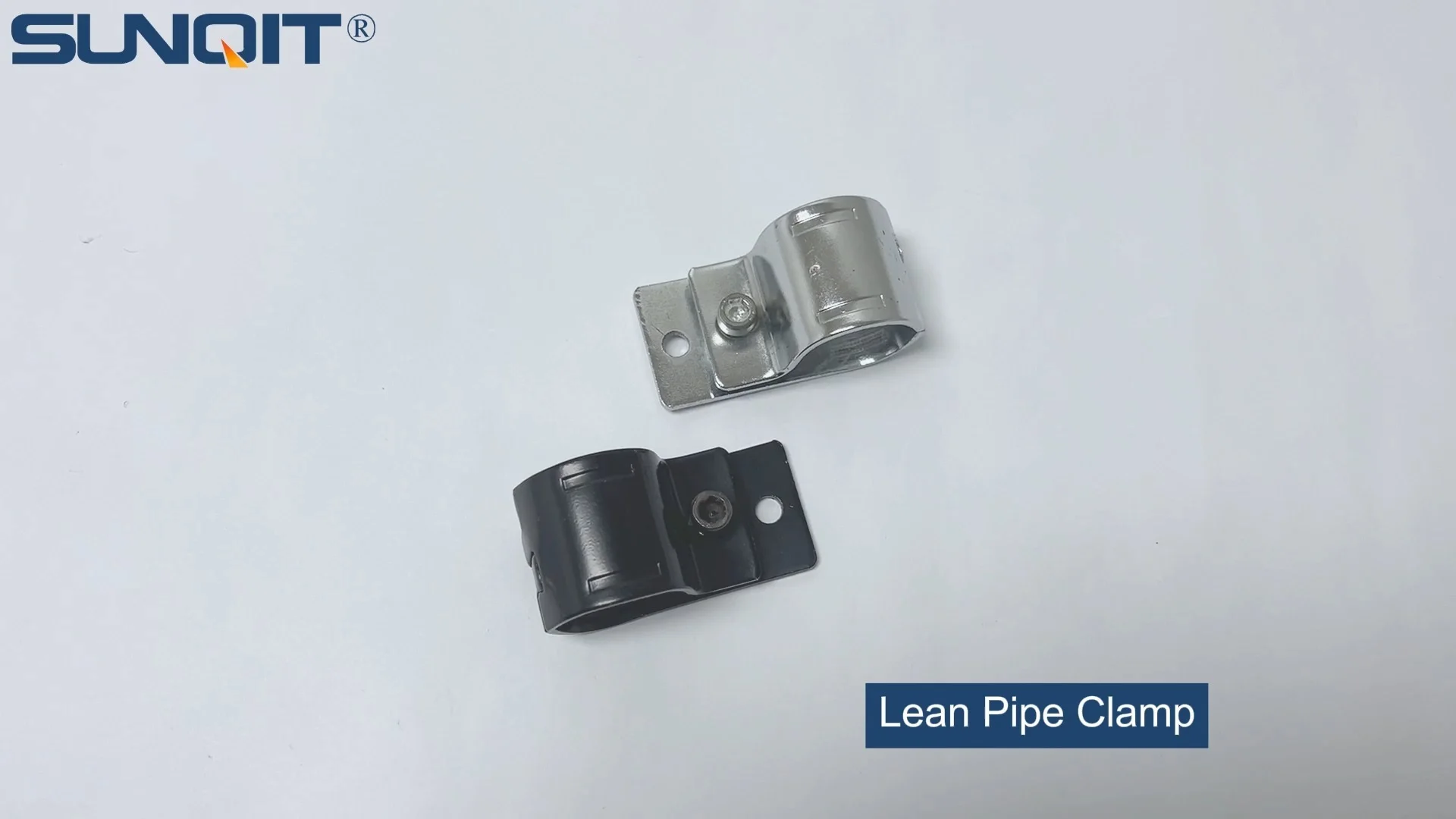
Lean Pipe Clamp
Lean pipe clamp is used for rack system hang monitor or other panel for workbenck, flowrack in production daily use.
It's a sweltering July afternoon on the factory floor of a mid-sized automotive parts manufacturer. The air smells of hot metal and machine oil, and the temperature near the welding stations hovers at 105°F (40°C). Maria, the production supervisor, pauses by a conveyor line carrying half-assembled engine components. She's thinking about last month's incident: a section of the line collapsed during peak production, sending parts crashing to the floor. The root cause? A failed clamp that couldn't handle the sustained heat, warping until it snapped. "We replaced those clamps with cheap ones to save costs," she mutters, shaking her head. "Never again."
Moments like these highlight a quiet but critical truth: in industrial settings where heat is a constant companion, the reliability of even the smallest components—like lean pipe clamps—can make or break productivity, safety, and profits. This article dives into the world of high-temperature resistant lean pipe clamps, exploring why they matter, the materials that make them tough, and the real-world industries where they're indispensable.
What Are Lean Pipe Clamps, Anyway? Breaking Down the Basics
Before we talk about heat resistance, let's ground ourselves in the basics. Lean pipe clamps are the unsung connectors that hold lean manufacturing systems together. Picture them as the "glue" between lean pipes, aluminum profiles, and workbenches—small, unassuming parts that bear the weight of tools, materials, and sometimes entire production lines. Paired with lean pipe joints, they form the backbone of structures like flow racks, conveyors, and ESD workstations, allowing factories to build flexible, customizable setups that adapt to shifting needs.
But not all clamps are created equal. Standard clamps might work in climate-controlled offices or low-heat assembly areas, but in environments where temperatures spike—think foundries, food processing plants, or aerospace testing facilities—they falter. That's where high-temperature resistant lean pipe clamps step in: designed to withstand extreme heat without warping, cracking, or losing their grip.
When Heat Becomes the Enemy: The Critical Need for High-Temperature Resistance
Heat is a silent saboteur in industrial settings. It softens plastics, weakens metals, and accelerates wear and tear. For lean pipe clamps, sustained exposure to high temperatures can lead to disaster. Imagine a conveyor belt in a bakery, moving trays of fresh bread through a 350°F (175°C) oven. If the clamps holding the conveyor's frame together start to melt or loosen, the belt could misalign, spilling hot loaves and shutting down the line. Or consider a workbench in a semiconductor lab, where delicate chips are soldered at 500°F (260°C); a failed clamp here could send expensive equipment crashing, risking both product loss and worker injury.
The stakes are even higher in safety-critical industries. In aerospace manufacturing, for example, a clamp securing a workbench holding jet engine parts must endure not just ambient heat but also occasional exposure to thermal testing environments. A single weak link could compromise the integrity of the entire setup, with consequences far graver than a production delay.

The Science Behind the Strength: Materials That Withstand the Burn
What makes a lean pipe clamp "heat resistant"? It all comes down to materials. Let's break down the options, from the everyday to the industrial-grade:
| Material Type | Max Temperature Resistance | Key Features | Ideal Applications | Limitations |
|---|---|---|---|---|
| Standard Steel (Zinc-Plated) | Up to 250°F (121°C) | Affordable, corrosion-resistant (short-term) | Climate-controlled assembly lines, office workbenches | Warping above 250°F; prone to rust in humid heat |
| Stainless Steel (304 or 316 Grade) | Up to 1400°F (760°C) | High strength, corrosion-resistant, non-magnetic | Food processing, chemical plants, high-heat welding areas | More expensive; heavier than aluminum |
| Aluminum (Anodized) | Up to 600°F (315°C) | Lightweight, rust-proof, good thermal conductivity | Electronics manufacturing, cleanrooms, moderate-heat conveyors | Less strength than steel; dents under heavy loads at high temps |
| PE-Coated Steel | Up to 200°F (93°C) | Cost-effective, scratch-resistant coating | Low-heat warehousing, material storage racks | Coating melts above 200°F; steel core still vulnerable to heat |
For most high-temperature industrial needs, stainless steel clamps (often paired with stainless steel pipe series) are the gold standard. Take 304-grade stainless steel: it contains chromium and nickel, which form a protective oxide layer that resists corrosion and retains strength even when heated. In extreme cases—like foundries or aerospace testing—316-grade stainless steel adds molybdenum for extra resistance to high temperatures and chemical exposure.

Use Case 1: Automotive Manufacturing – Where Every Degree Counts
Walk into any automotive plant, and you'll find heat around every corner: welding stations, paint curing ovens, and engine testing cells. Let's zoom in on a typical paint shop, where car bodies are baked at 450°F (232°C) to set their finishes. The conveyors that carry these bodies through the ovens are supported by a network of lean pipes and clamps. If those clamps fail, the conveyor could sag, misaligning the body and ruining the paint job—or worse, causing a collision with the oven walls.
"We used to replace clamps every 3 months in the paint shop," says Raj, a maintenance manager at a Detroit-based auto supplier. "The old zinc-plated ones would warp, and we'd have to shut down the line for repairs. Then we switched to 316 stainless steel clamps. Now they last 2+ years, even with daily exposure to oven heat. The savings in downtime alone paid for the upgrade in 6 months."
Beyond conveyors, workbenches near welding areas also rely on heat-resistant clamps. Welders use torches that reach 6,500°F (3,593°C), and while the immediate heat is localized, the ambient temperature around the bench can stay above 120°F (49°C) for hours. A standard clamp here would loosen over time, making the bench unstable. Stainless steel clamps, however, maintain their grip, ensuring tools and parts stay secure.

Use Case 2: Food Processing – Heat, Hygiene, and Lean Efficiency
Heat in food processing isn't just about cooking—it's about sterilization, drying, and baking. In a commercial bakery, for example, dough trays move through proofing ovens at 110°F (43°C) and then into baking ovens at 400°F (204°C). The conveyors and material racks (like the "material rack b (3 row and 3 floor)" from our keyword list) that handle these trays must withstand both heat and frequent washdowns with hot, soapy water.
Here, stainless steel clamps shine for two reasons: heat resistance and hygiene. Unlike standard steel, stainless steel doesn't rust when exposed to moisture and heat, preventing bacterial growth in crevices. "We had a problem with mold in our old bread racks," recalls Priya, a plant manager at a regional bakery chain. "The zinc-plated clamps would corrode, and the rust would flake off into the dough. Switching to stainless steel clamps eliminated that issue entirely. Plus, they don't warp near the ovens, so we haven't had a rack collapse in over a year."
Even in cold food processing—like frozen pizza production—heat resistance matters. Freezers are cold, but the "blast chill", where pizzas are flash-frozen at -40°F (-40°C), is followed by a warm-up area where condensation forms. Clamps here must handle rapid temperature swings without cracking, a job stainless steel handles effortlessly.
Use Case 3: Electronics and Semiconductor Production – Precision in the Heat
Electronics manufacturing is a study in contrasts: delicate components that demand precision, and processes that generate intense heat. Take semiconductor fabrication, where chips are soldered onto circuit boards using reflow ovens that reach 500°F (260°C). The ESD workstations where operators prep these boards must stay stable—even a tiny wobble can misalign a solder joint, rendering the chip useless.
ESD workstations are designed to dissipate static electricity, but their structural integrity depends on the clamps holding their frames together. "We use aluminum workbenches with stainless steel clamps," explains Tom, an engineer at a semiconductor plant in California. "The aluminum keeps the bench lightweight, and the steel clamps handle the heat from the nearby reflow ovens. If a clamp fails, the bench top could tilt, and we'd have to scrap $10,000 worth of boards. It's not a risk we can take."
Another example: battery production for electric vehicles. Lithium-ion battery cells are dried in ovens at 300°F (149°C) to remove moisture. The racks holding these cells are built with lean pipes and clamps that must maintain their shape and load capacity. A warped clamp here could cause cells to shift, leading to uneven drying or even short circuits.
Use Case 4: Aerospace Manufacturing – Extreme Conditions, Extreme Reliability
If automotive and food processing push clamps to their limits, aerospace manufacturing cranks the dial to 11. Jet engine components, for instance, are tested in thermal chambers that simulate temperatures up to 2,000°F (1,093°C). The workbenches and material racks used to handle these components must not only resist heat but also maintain dimensional stability—no warping, no flexing, no failure.
"We once had a supplier send us aluminum clamps for a test bench," says Jamie, a quality control specialist at an aerospace firm. "After two weeks in our thermal testing area, they'd shrunk by 0.2mm—enough to loosen the entire structure. We switched to Inconel clamps [a nickel-chromium superalloy] for that project, which withstood 1,800°F (982°C) without a hitch. They cost 10x more, but when you're building parts for a fighter jet, 'good enough' isn't an option."
While Inconel is overkill for most industries, aerospace's demands highlight a key point: high-temperature resistance isn't just about "withstanding heat"—it's about consistency. Even minor changes in a clamp's shape or strength can compromise precision in mission-critical applications.
The Hidden Costs of Cutting Corners: What Happens When Clamps Fail in the Heat
It's tempting to opt for cheaper, non-heat-resistant clamps to trim budgets. But as Maria's automotive plant learned, the short-term savings often lead to long-term pain. Let's crunch the numbers: a pack of 50 standard steel clamps costs $20, while high-temperature stainless steel clamps cost $80. For a small conveyor line needing 200 clamps, that's a $240 difference upfront. But if the standard clamps fail after 3 months, requiring a 4-hour shutdown to replace (at $500/hour in lost production), the total cost becomes $20 (clamps) + $2,000 (downtime) = $2,020. The stainless steel clamps, lasting 2 years, cost $80 (clamps) + $0 (downtime) = $80. The math is clear: investing in quality saves money.
Then there are safety costs. In 2019, a plastics factory in Ohio was fined $145,000 after a clamp failure caused a conveyor to collapse, injuring a worker. The root cause? The factory had used plastic-coated clamps near a heat gun station, and the coating melted, weakening the clamp. "We thought the heat gun was far enough away," the plant manager told OSHA investigators. "We were wrong."
Choosing the Right Lean Pipe Clamp: A Buyer's Guide for High-Temp Environments
So, how do you pick the right clamp for your high-temperature needs? Here's a step-by-step guide:
1. Measure Your Heat Exposure
Start by mapping your environment's temperature extremes. Is it sustained heat (like a bakery oven) or intermittent spikes (like welding torches)? Use a thermal gun to record max temps over a week—you might be surprised by how hot some areas get.
2. Match Material to Temperature
Stick to stainless steel (304 or 316 grade) for temps above 250°F (121°C). For 600°F (315°C) and below, anodized aluminum could work if the load is light. Avoid zinc-plated or plastic-coated clamps in any area with temps over 150°F (66°C).
3. Check Compatibility with Lean Pipe Joints
Clamps don't work alone—they pair with lean pipe joints to connect pipes and profiles. Ensure the clamp's design fits your existing joints (e.g., "90° straight lean pipe joint" or "parallel lean pipe joint"). Mismatched parts will loosen over time, even if the clamp itself is heat-resistant.
4. Test for Load Capacity
Heat weakens materials, so a clamp that holds 500 lbs at room temp might only hold 300 lbs at 300°F (149°C). Ask suppliers for heat-rated load charts, and if possible, test a sample clamp under your actual working conditions.
5. Prioritize Hygiene and Corrosion Resistance (When Needed)
In food, pharmaceutical, or chemical industries, choose 316 stainless steel (it resists salt and chemicals better than 304) and ensure clamps have smooth, crevice-free designs to prevent bacterial buildup.
Beyond the Clamp: Building a Heat-Resistant Lean System
High-temperature resistance isn't just about clamps—it's about the entire ecosystem. For example, a conveyor line in a foundry needs more than heat-resistant clamps; it also needs heat-resistant rollers (like "stainless steel swivel roller balls 1 inch") and casters (look for "caster wheel" models with high-temp grease). Similarly, a workbench near a furnace should use aluminum profiles (which conduct heat away) instead of plastic, and "aluminum honeycomb panel" tops that resist warping.
Suppliers often bundle these components—lean pipe clamps, joints, rollers, and profiles—into "lean solutions" tailored for high-heat environments. Working with a single supplier (like a "lean pipe supplier" from our keyword list) ensures compatibility and simplifies maintenance. As Raj, the auto plant manager, puts it: "We used to mix and match parts from five different vendors. Now we buy the whole system from one supplier. If a clamp fails, they replace it for free—no finger-pointing."
Conclusion: The Backbone of Efficient, Heat-Resistant Workspaces
Maria, the automotive supervisor, stands by the now-repaired conveyor line, watching it hum along smoothly. The new stainless steel clamps glint under the factory lights, unyielding to the heat. "We haven't had a single issue since we upgraded," she says, smiling. "No downtime, no lost parts, no stressed-out team. It's amazing what a difference the right clamp makes."
High-temperature resistant lean pipe clamps may be small, but their impact is huge. They're the quiet guardians of industrial efficiency, ensuring that even in the hottest, toughest environments, production lines keep moving, workers stay safe, and businesses thrive. So the next time you walk through a factory, take a second look at those unassuming clamps—they're not just holding pipes together. They're holding everything together.