- Company Articles
- Products and Technology
- Product knowledge
- How Aluminum Profile 3 Way Connectors Improve Assembly Line Efficiency

How Aluminum Profile 3 Way Connectors Improve Assembly Line Efficiency
Related Product
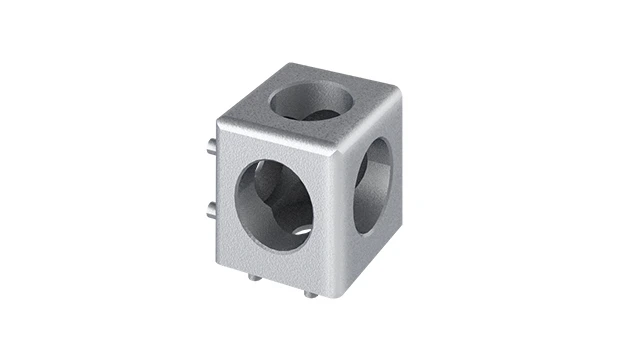
Aluminum Profile 3 Way Connector
The 3 way - squared corner connector is an external fastening method that is typically used to create a corner connection between three profiles. It is a heavy-duty connection that is simple to use and provides a polished look.
In the fast-paced world of manufacturing, where every second counts and productivity directly impacts the bottom line, assembly lines are the backbone of operations. Yet, many plants still grapple with outdated setups that hinder rather than help—rigid structures that take hours to build, inflexible workstations that can't adapt to new products, and material flow bottlenecks that slow down production. These challenges aren't just inconveniences; they translate to lost time, higher costs, and missed opportunities to stay competitive. But what if there was a solution that could transform these pain points into strengths? Enter aluminum profiles and their unsung heroes: aluminum profile 3 way connectors. These small but mighty components are revolutionizing how assembly lines are built, reconfigured, and optimized—turning inefficiency into agility and downtime into productivity.
The Problem with Traditional Assembly Line Setups
Before diving into the benefits of aluminum profile 3 way connectors, it's important to understand why traditional assembly line setups often fall short. For decades, manufacturers relied on welded steel structures, wooden workbenches, or bolted-together metal frames to build workstations, material racks, and conveyor systems. While these methods were functional, they came with significant drawbacks.
First, setup time was a major issue. Welding steel frames required skilled labor and hours (sometimes days) of work, delaying the launch of new production lines. If a company needed to expand or adjust a workstation to fit a new product, the process was even more cumbersome—old structures had to be cut apart, new parts welded on, and the entire setup re-inspected for safety. This rigidity meant that assembly lines couldn't keep up with the pace of product innovation, where lifecycles are shorter and customization is key.
Durability was another concern. Steel structures, while strong, were prone to rust and corrosion, especially in environments with moisture or chemicals. This led to frequent replacements, adding to long-term costs. Wooden workbenches, meanwhile, wore down quickly under heavy use, splintering or warping and creating safety hazards. And when it came to material flow—critical for keeping assembly lines moving—traditional roller tracks or conveyor systems were often fixed in place, making it hard to reroute materials when bottlenecks formed.
Safety wasn't overlooked, but traditional setups often fell short here too. Welded steel left sharp edges that could snag clothing or cause cuts, while unstable bolted connections risked collapse under heavy loads. Workers also faced ergonomic issues: fixed-height workbenches forced employees into uncomfortable positions, leading to fatigue and higher injury rates. All these factors added up to one thing: inefficiency that dragged down the entire operation.
Aluminum Profiles: A Foundation for Flexibility
Enter aluminum profiles—extruded aluminum bars with a unique T-slot design that has become the gold standard for modern manufacturing setups. Unlike rigid steel or wood, aluminum profiles are lightweight, corrosion-resistant, and infinitely customizable. Their T-slots act as built-in channels, allowing for easy attachment of accessories like shelves, hooks, panels, and, most importantly, connectors. This design transforms static structures into modular systems that can be assembled, disassembled, and reconfigured with minimal effort.
Aluminum itself brings a host of benefits: it's strong enough to support heavy loads (think automotive parts or electronic equipment) but light enough to be moved by a single worker. It resists rust and corrosion, even in harsh industrial environments, meaning it lasts longer and requires less maintenance. And because it's extruded, aluminum profiles come in a variety of shapes and sizes—from small 20x20mm bars for lightweight workstations to large 80x80mm beams for heavy-duty racks—making them suitable for almost any application.
But aluminum profiles alone are just pieces of a puzzle. To turn them into functional structures, you need the right accessories. This is where aluminum profile accessories shine—components like brackets, hinges, end caps, and, of course, connectors. Among these, 3 way connectors stand out for their ability to create multi-directional structures, enabling the kind of flexibility that traditional setups can't match.

Aluminum Profile 3 Way Connectors: Small Components, Big Impact
At first glance, an aluminum profile 3 way connector might seem unremarkable—a small, often L-shaped or T-shaped piece of metal or high-strength plastic. But its design is ingenious. These connectors are engineered to fit snugly into the T-slots of aluminum profiles, allowing three separate profiles to be joined at once at various angles (90°, 45°, or even 135°). They're secured with simple bolts, quick-release levers, or spring-loaded pins, eliminating the need for welding, drilling, or specialized tools.
So, what makes 3 way connectors so special? Let's break it down. Unlike 2 way connectors, which join two profiles in a straight line or at a right angle, 3 way connectors add a third dimension—literally. This means you can build structures that branch out in multiple directions: a workbench with a side shelf, a material rack with vertical and horizontal supports, or a roller track system that splits into two paths to feed different assembly stations. This versatility is game-changing for assembly lines, where space is often limited and every square foot needs to be optimized.
Take a simple workbench, for example. With traditional methods, building a workbench with a shelf, tool rack, and overhead light would require cutting and welding steel bars, drilling holes for bolts, and hoping everything lines up. With aluminum profiles and 3 way connectors, the process is: you cut the profiles to length (or order pre-cut lengths from suppliers), slide 3 way connectors into the T-slots at the desired angles, attach the shelf brackets and tool rack using additional accessories, and secure everything with a hex key. The result? A sturdy, custom workbench built in a fraction of the time—no welding required.
But the real magic happens when it's time to reconfigure. Let's say your company launches a new product that's larger than the previous model, and the workbench needs to be wider. With a traditional setup, you'd have to start from scratch. With aluminum profiles and 3 way connectors? Loosen the bolts on the connectors, add longer profile sections, reattach the connectors, and tighten—done. The entire process takes 30 minutes instead of a full day, and the old parts can be reused elsewhere, reducing waste. This kind of flexibility is why aluminum profiles and their accessories have become indispensable in modern manufacturing.

4 Key Ways Aluminum Profile 3 Way Connectors Boost Efficiency
Now that we understand what aluminum profile 3 way connectors are and how they work, let's dive into the specific ways they improve assembly line efficiency. From reducing setup time to enhancing safety, these components deliver value across every aspect of operations.
1. Slashing Setup and Reconfiguration Time
Time is money in manufacturing, and nowhere is this truer than in setup and reconfiguration. Traditional welded steel structures can take 8+ hours to build a single workstation; with aluminum profiles and 3 way connectors, that time drops to 2–3 hours. How? Because 3 way connectors eliminate the need for welding, drilling, or specialized labor. Workers can assemble structures using basic hand tools (like hex keys or Allen wrenches) or even tool-free quick-release connectors, which snap into place with a simple twist.
Reconfiguration is even more impressive. Suppose an assembly line needs to shift from producing small electronics to larger appliances. With traditional setups, this might require days of work: cutting old steel frames, welding new ones, and testing for stability. With 3 way connectors, it's a matter of loosening a few bolts, adjusting the profiles, and resecuring the connectors. A recent case study from a automotive parts manufacturer found that reconfiguring a material rack for a new engine component took just 45 minutes with aluminum profiles and 3 way connectors—compared to 3 days with their old steel setup. That's a 97% reduction in downtime, allowing the line to get back to full production almost immediately.
2. Enhancing Flexibility for Product Innovation
In today's market, product lifecycles are shorter than ever. A smartphone manufacturer might release 2–3 new models per year; a clothing brand could launch seasonal lines with entirely different packaging. For assembly lines, this means constant adaptation—and rigidity is the enemy. Aluminum profile 3 way connectors turn inflexible lines into agile systems that can keep up with innovation.
Consider a consumer electronics plant that produces smartwatches. When a new model with a larger battery is released, the assembly workstation needs to accommodate a bigger battery-installation fixture. With 3 way connectors, workers can quickly adjust the workstation's height, add a side bracket for the new fixture, and reposition the roller track that feeds batteries to the station—all without stopping production for more than an hour. The same workstation can then be reconfigured again when the next model comes out, eliminating the need to build new structures from scratch each time.
This flexibility also extends to scaling operations. As a company grows, it can easily expand workbenches, add more material racks, or extend roller track systems by simply adding new aluminum profiles and 3 way connectors. There's no need to buy entirely new setups—existing components can be reused, reducing costs and waste. It's a "build as you grow" approach that aligns perfectly with modern manufacturing's need for scalability.
3. Improving Durability and Reducing Long-Term Costs
While aluminum profile 3 way connectors save time upfront, their long-term benefits are equally impressive. Aluminum is naturally resistant to corrosion, so profiles and connectors won't rust or degrade, even in humid or chemical-heavy environments. This means structures last longer—often 10+ years compared to 3–5 years for welded steel or wooden setups. Fewer replacements translate to lower maintenance costs and less downtime for repairs.
Connectors themselves are built to withstand heavy use. Most are made from high-grade aluminum or reinforced nylon, which can handle repeated assembly and disassembly without wearing out. Unlike bolts, which can strip or loosen over time, 3 way connectors maintain a tight grip on profiles, ensuring stability even under heavy loads. A study by the Manufacturing Technology Association found that companies using aluminum profile systems with 3 way connectors saw a 40% reduction in maintenance costs over five years compared to traditional steel setups—savings that add up significantly for large operations.
4. Enhancing Safety and Ergonomics
Efficiency isn't just about speed—it's about keeping workers safe and comfortable. Injuries, fatigue, and discomfort lead to absenteeism and lower productivity, so any improvement in safety directly boosts the bottom line. Aluminum profile 3 way connectors excel here, too.
First, their design eliminates sharp edges. Unlike welded steel, which often has jagged welds or burrs, aluminum profiles have smooth, rounded edges, and connectors are precision-machined to fit flush, reducing the risk of cuts or snags. Stable connections also mean less risk of collapse: 3 way connectors distribute weight evenly across profiles, ensuring structures can handle heavy loads without wobbling or shifting.
Ergonomics is another area where 3 way connectors shine. With traditional fixed workbenches, workers often have to bend, stretch, or hunch to reach tools or materials, leading to back pain or repetitive strain injuries. Aluminum profiles with 3 way connectors allow for easy height adjustment: by adding or removing profile sections, workbenches can be raised or lowered to fit individual workers, reducing fatigue and improving posture. A study by the Occupational Safety and Health Administration (OSHA) found that ergonomic workstations reduce musculoskeletal injuries by up to 60%—a statistic that speaks to the impact of adjustable setups on worker well-being and productivity.
Real-World Impact: A Case Study
To put these benefits into perspective, let's look at a real-world example. PrecisionTech, a mid-sized manufacturer of medical devices, was struggling with its assembly line before switching to aluminum profiles and 3 way connectors. The company produced a range of diagnostic tools, each with different sizes and assembly requirements, but its workstations were fixed steel structures that couldn't adapt. Setup time for a new workstation took 8 hours, and reconfiguring for a new product model required 2 full days of welding and retooling. Material flow was also a problem: roller tracks were bolted to the floor, so when a bottleneck formed at the packaging station, there was no way to reroute materials without stopping production.
In 2023, PrecisionTech invested in aluminum profiles and aluminum profile accessories, including 3 way connectors. The results were transformative:
- Setup time for new workstations dropped from 8 hours to 2 hours, allowing the company to launch a new product line three weeks ahead of schedule.
- Reconfiguration time for product changes went from 2 days to 30 minutes. For example, when the company introduced a smaller diagnostic tool, workers simply adjusted the workstation height and repositioned the roller track (connected with 3 way connectors) to feed materials more efficiently.
- Material flow bottlenecks decreased by 40%. The flexible roller track system, built with 3 way connectors, could be quickly rerouted to bypass slow stations, keeping materials moving and reducing idle time.
- Worker productivity increased by 25%. Ergonomic, adjustable workbenches reduced fatigue, and the ability to customize tool placement (using 3 way connectors to add side shelves) cut down on time spent searching for tools.
- Maintenance costs fell by 35%. The corrosion-resistant aluminum profiles and durable connectors required no repainting or replacement, unlike the old steel structures that rusted and needed frequent repairs.
"It's like night and day," said Maria Gonzalez, PrecisionTech's production manager. "Before, we were always playing catch-up—welding, fixing, waiting. Now, we can adapt on the fly. The 3 way connectors are the reason we can turn a idea for a new workstation into reality in hours, not days. They've given us the agility to compete with bigger manufacturers, even with our smaller team."
Traditional vs. Aluminum Profile Setups: A Comparison
| Aspect | Traditional Setup (Welded Steel/Wood) | Aluminum Profile with 3 Way Connectors |
|---|---|---|
| Setup Time | 8+ hours (requires welding/skilled labor) | 2–3 hours (tool-free or basic tools) |
| Reconfiguration Ease | Difficult (requires cutting/welding; 2+ days) | Simple (30 minutes–1 hour; tool-free adjustment) |
| Durability | Prone to rust, warping, or splintering (3–5 year lifespan) | Corrosion-resistant, wear-resistant (10+ year lifespan) |
| Cost Over Time | High (frequent replacement, maintenance, and labor costs) | Low (reusable components, minimal maintenance) |
| Safety | Sharp edges, unstable connections, ergonomic issues | Smooth edges, stable connections, adjustable ergonomics |
| Flexibility for Innovation | Low (can't adapt to new products without major rework) | High (easily adjusted for new products, sizes, or processes) |
The Future of Assembly Lines: Beyond 3 Way Connectors
As manufacturing continues to evolve—with trends like automation, IoT, and smart factories—aluminum profiles and their connectors are evolving too. Today's 3 way connectors are already being integrated with smart technology: some models now include built-in sensors that monitor load weight or vibration, alerting workers if a structure is overloaded or connections are loose. This "smart connectivity" adds another layer of safety and efficiency, preventing failures before they happen.
Sustainability is also driving innovation. Aluminum is 100% recyclable, and aluminum profile systems are inherently eco-friendly—components can be disassembled and reused, reducing waste. Manufacturers are now developing even more lightweight yet strong aluminum alloys for profiles, and connectors made from recycled materials, further lowering the environmental impact.
Looking ahead, the integration of aluminum profiles with automation is set to deepen. Collaborative robots (cobots) are increasingly common on assembly lines, and aluminum profile workstations with 3 way connectors provide the perfect platform for mounting cobot arms, sensors, and grippers. The flexibility of 3 way connectors allows manufacturers to easily reposition cobots as production needs change, making automation accessible even for small to mid-sized companies.
Conclusion: Small Components, Big Results
In the world of manufacturing, efficiency isn't about grand gestures—it's about the small, smart choices that add up to big results. Aluminum profile 3 way connectors are exactly that: small components that deliver massive improvements in speed, flexibility, durability, and safety. By replacing rigid, time-consuming traditional setups with modular aluminum profiles and 3 way connectors, manufacturers are transforming their assembly lines from static obstacles into dynamic assets that can adapt, grow, and innovate.
Whether it's reducing setup time by 75%, cutting maintenance costs by 40%, or boosting worker productivity by a quarter, the impact of these connectors is clear. They're not just tools for building structures—they're tools for building resilience, agility, and competitiveness in an industry where every advantage counts. So the next time you walk through a manufacturing plant, take a closer look at the workbenches, the material racks, the roller tracks. Chances are, you'll spot aluminum profiles joined by 3 way connectors—quietly working to keep the line moving, the products flowing, and the future of manufacturing bright.