- Company Articles
- Products and Technology
- Application Cases
- How Aluminum Workbench D Enhances Team Collaboration in Manufacturing Cells

How Aluminum Workbench D Enhances Team Collaboration in Manufacturing Cells
Related Product
Aluminum Workbench D
Aluminum tube workbench is more flexible and durable, compared with traditional PE/ABS coated steel tube. It is easy to assemble, anti corrosion, rust protection, and recycle use after disassemble.
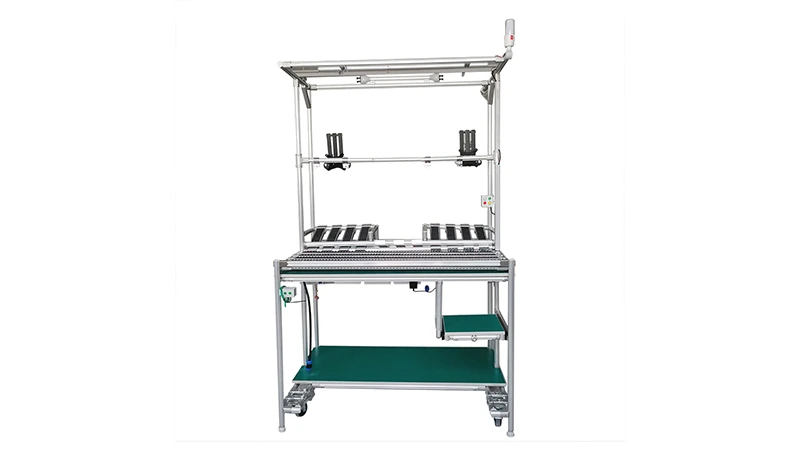
In the bustling heart of a manufacturing facility, where the hum of machinery blends with the rhythm of assembly lines, there's an unsung hero that often determines the success of daily operations: teamwork. A manufacturing cell isn't just a collection of machines and tools—it's a ecosystem where operators, assemblers, quality inspectors, and material handlers must move in sync, anticipating each other's needs, solving problems together, and keeping production flowing like a well-choreographed dance. Yet, anyone who's worked on the shop floor knows that collaboration here isn't always effortless. Cluttered workspaces, rigid equipment, and inefficient material flow can turn even the most skilled teams into a group of individuals working at cross-purposes.
This is where the right tools make all the difference. Enter the Aluminum Workbench D—a seemingly simple piece of equipment that, when designed with intention, becomes a catalyst for collaboration. More than just a table to place tools, this workbench, crafted from durable aluminum profile and engineered with modularity in mind, transforms how teams interact, share resources, and solve problems. In this article, we'll explore how Aluminum Workbench D isn't just a workspace upgrade, but a bridge that connects team members, streamlines workflows, and turns the chaos of manufacturing into a symphony of shared purpose.
The Collaboration Challenge in Modern Manufacturing Cells
Before diving into the specifics of Aluminum Workbench D, let's first understand the unique collaboration hurdles manufacturing cells face. Unlike traditional assembly lines, where workers often perform repetitive, isolated tasks, modern manufacturing cells thrive on flexibility—handling small-batch productions, custom orders, and rapid changeovers. This agility demands constant communication: an assembler might need a specific component from a material handler, a quality inspector might flag an issue that requires the operator's input, and supervisors need real-time visibility to adjust workflows.
Yet, these interactions are often hindered by workspace design. Traditional workbenches, for example, are often fixed in size and layout, leaving little room for teams to gather. Tools and materials might be scattered across multiple stations, forcing team members to step away from their tasks to fetch what they need. Ergonomic mismatches—like workbenches that are too high for some operators and too low for others—lead to fatigue, reducing focus and patience. And when equipment isn't designed to integrate with other tools (like flow racks or conveyors), bottlenecks form, and blame starts to creep in: "Why didn't you pass that part sooner?" or "I couldn't see the specs because the manual was buried under that pile."
The result? Collaboration becomes reactive instead of proactive. Teams spend more time resolving misunderstandings and less time innovating. Productivity suffers, and more importantly, the sense of shared ownership that drives high-performing teams starts to erode.
Meet Aluminum Workbench D: More Than Just a Workbench
Aluminum Workbench D was born from a simple question: What if a workbench was designed for people first ? Not just to hold tools, but to bring people together. Let's break down its key features and how they lay the groundwork for better collaboration.
1. Built on Aluminum Profile: Strength Meets Flexibility
At its core, Aluminum Workbench D is constructed from high-grade aluminum profile—a material chosen for its unique balance of lightness and durability. Unlike heavy steel workbenches that are impossible to reconfigure, aluminum profile is lightweight enough to adjust (with minimal effort) but strong enough to support heavy tools, components, and even automated equipment. This means the workbench can evolve with the team's needs: adding a shelf for shared tools one week, repositioning the surface to accommodate a new assembly process the next.
But the real magic of aluminum profile lies in its modularity. The workbench's frame uses standard aluminum profile accessories—like internal rotary aluminum joints and T-slot connectors—that allow teams to customize the setup without welding or specialized tools. A quality inspector might add a small shelf for checklists and measuring tools; an assembler could attach a tool holder for frequently used wrenches. This level of personalization ensures everyone feels invested in the workspace, fostering a sense of ownership that's critical for collaboration.
2. Ergonomic Design: Keeping Teams Comfortable and Connected
Fatigue is the enemy of collaboration. When operators are straining to reach tools or hunching over a poorly positioned work surface, their focus narrows to their own discomfort—not the team's goals. Aluminum Workbench D addresses this with adjustable height settings (a feature often missing in traditional workbenches) and a spacious single-deck surface (without casters, for stability) that encourages side-by-side work. At 30 inches high (adjustable up to 36 inches), the bench accommodates operators of different heights, reducing strain on backs and shoulders.
The surface itself is wide enough (typically 60 inches long by 30 inches deep) to allow two or three team members to work simultaneously without crowding. Imagine a scenario where an assembler is putting together a component, and a quality inspector stands beside them, checking measurements in real time. Instead of the inspector having to lean over the assembler's shoulder or wait until the task is done, they can work together, pointing out issues as they arise. This instant feedback loop turns potential errors into teachable moments, strengthening both the product and the team's bond.
3. Seamless Integration with Flow Racks and Material Handling
A workbench can't enhance collaboration in isolation—it needs to play well with other tools in the manufacturing cell. Aluminum Workbench D is designed to integrate seamlessly with flow racks, those gravity-fed shelving units that keep materials organized and easily accessible. By positioning a flow rack adjacent to the workbench, teams eliminate the most common collaboration killer: waiting for materials.
Here's how it works: The material handler stocks the flow rack with components needed for the day's production, arranging them in the order they'll be used (a practice known as "kanban"). As the assembler works, they simply reach over to the flow rack to grab the next part—no need to walk across the cell or radio for a delivery. The workbench's aluminum profile frame even allows for custom brackets to attach the flow rack directly to the bench, creating a continuous "material-to-work" pathway. This integration turns material handling from a separate task into a shared responsibility: the assembler signals when stock is low by moving a kanban card, and the material handler restocks—all without disrupting the workflow.

5 Ways Aluminum Workbench D Turns Workspace into Teamspace
Now that we understand the design of Aluminum Workbench D, let's dive into the tangible ways it enhances collaboration. These aren't just theoretical benefits—they're real-world changes that transform how teams interact, solve problems, and support each other.
1. Shared Workspace, Shared Responsibility
Traditional workbenches often enforce a "territorial" mindset: "This is my station; that's yours." Aluminum Workbench D breaks down these invisible walls with its open, spacious design. The single-deck surface (without casters, so it stays firmly in place) invites shared use: an operator might set up their tools on one end, while a trainee works on the other, learning by observation. During daily huddles, the bench becomes a meeting spot—no need to gather around a separate table—where the team reviews goals, discusses challenges, and assigns tasks.
This shared space fosters accountability. When everyone uses the same workbench, there's a collective incentive to keep it organized. Tools are returned to their designated holders (attached via aluminum profile accessories), debris is swept away promptly, and materials are stored in labeled bins on the integrated flow rack. A messy bench isn't just one person's problem—it affects the whole team. This shared responsibility turns individual habits into team norms, creating a culture of mutual respect.
2. Modularity: Adapting to the Team's Changing Needs
Manufacturing cells rarely stay the same for long. A new product line might require additional tools; a process improvement might call for rearranging the workflow. Traditional workbenches, fixed in their design, force teams to adapt around the equipment. Aluminum Workbench D flips this script: the bench adapts to the team.
Thanks to its aluminum profile frame and compatible accessories, the bench can be reconfigured in minutes. For example, if the team shifts from assembling small components to larger subassemblies, they can remove a shelf to make more surface space. If a new automated screwdriver is introduced, they can attach a custom mount using T-slot connectors. This flexibility means the team spends less time fighting the workspace and more time collaborating on solutions. It also empowers junior team members to suggest changes—after all, if reconfiguring the bench is as easy as swapping out a joint, there's less fear of "breaking" something. This sense of ownership over the workspace translates to ownership over the team's success.
3. Visual Communication: Making Collaboration Effortless
In fast-paced manufacturing cells, verbal communication can be unreliable—machinery noise drowns out voices, and team members might be focused on tasks. Aluminum Workbench D addresses this with built-in visual communication tools. The aluminum profile frame can support magnetic whiteboards or clip-on document holders, where teams post work instructions, standard operating procedures (SOPs), and daily production targets. A quick glance at the bench tells everyone what's priority, what's on hold, and where help is needed.
Even the flow rack integrated with the bench becomes a visual cue. Using color-coded bins (attached to the rack's shelves), teams can signal material status: green for "in stock," yellow for "low," red for "out of stock." A material handler doesn't need to ask—they can see at a glance which bins need refilling. This visual transparency reduces misunderstandings and keeps everyone aligned on the team's goals.
4. Reducing Waste, Increasing Interaction
Waste in manufacturing isn't just about materials—it's about time. When team members spend minutes walking to fetch tools, searching for documents, or waiting for materials, those minutes add up to lost collaboration opportunities. Aluminum Workbench D minimizes this waste by keeping everything the team needs within arm's reach.
The integrated flow rack ensures materials are always available; tool holders attached to the aluminum profile frame keep wrenches, screwdrivers, and gauges organized; and document holders keep SOPs visible. With less time spent on non-value-added tasks, team members have more bandwidth to check in with each other: "Need a hand with that assembly?" "Did you see the new spec for this component?" These small interactions build trust and camaraderie, turning coworkers into collaborators.
5. Safety First: Building Confidence in Collaboration
Collaboration thrives when team members feel safe—both physically and psychologically. Aluminum Workbench D prioritizes safety, which in turn strengthens trust. The aluminum profile frame is rounded at the edges to prevent bumps and scrapes; the surface is treated to resist scratches and chemical spills; and the integrated flow rack is designed to prevent materials from toppling. For cells handling sensitive electronics, the bench can even be equipped with ESD (electrostatic discharge) features, protecting components and giving the team confidence that their work won't be ruined by static damage.
This physical safety creates a foundation for psychological safety. When team members aren't worried about getting hurt or damaging products, they're more likely to speak up: "I think this process could be faster if we rearrange the tools." "Can we double-check this measurement together?" Psychological safety is the bedrock of collaboration, and Aluminum Workbench D lays that groundwork.
Case Study: How Aluminum Workbench D Transformed Collaboration at Precision Electronics
To bring these benefits to life, let's look at a real-world example: Precision Electronics, a mid-sized manufacturer of custom circuit boards. Before implementing Aluminum Workbench D, their assembly cell struggled with frequent delays and low team morale. Workbenches were old, wooden, and fixed in place; materials were stored in a separate room, requiring assemblers to walk 50 feet each time they needed a component. Collaboration was minimal—team members stayed at their stations, and communication happened mostly via radio, leading to miscommunications and errors.
In 2024, the team replaced three traditional workbenches with two Aluminum Workbench D units, paired with adjacent flow racks stocked with components. The results were striking:
- Assembly time per unit dropped by 18%: With materials at the bench and tools organized on aluminum profile accessories, assemblers spent less time fetching and more time building.
- Error rates fell by 24%: Side-by-side work on the spacious benches allowed for real-time quality checks—inspectors and assemblers caught issues together, before they escalated.
- Team satisfaction scores rose by 32%: In post-implementation surveys, team members cited "less frustration" and "feeling more connected" as key improvements. One operator noted, "I don't feel like I'm working alone anymore—we're all in this together."
The plant manager summed it up: "We didn't just buy workbenches—we bought a new way of working. The Aluminum Workbench D turned our cell from a group of individuals into a team."

The Future of Collaboration: Workbenches as Team Catalysts
As manufacturing continues to evolve—with trends like Industry 4.0, human-robot collaboration, and reshoring driving change—the need for effective teamwork will only grow. In this context, tools like Aluminum Workbench D are more than just equipment; they're strategic investments in people. By designing workspaces that prioritize connection, flexibility, and shared purpose, manufacturers aren't just improving productivity—they're building resilient teams that can adapt to whatever the future brings.
Aluminum Workbench D, with its aluminum profile construction, modular design, and focus on ergonomics, represents a shift in how we think about manufacturing workspaces. It's a reminder that collaboration isn't about fancy software or team-building workshops (though those help); it's about creating environments where people can easily work together, support each other, and take pride in their shared accomplishments.
In the end, manufacturing isn't just about making products—it's about making teams. And Aluminum Workbench D? It's the table where those teams are built.
Traditional vs. Aluminum Workbench D: A Collaboration Showdown
| Feature | Traditional Workbench | Aluminum Workbench D |
|---|---|---|
| Workspace Design | Fixed, cramped, single-user focus | Spacious, open, encourages shared use |
| Flexibility | Fixed design; difficult to reconfigure | Modular aluminum profile; reconfigurable in minutes |
| Material Integration | Separate from material storage; requires walking to fetch parts | Seamless integration with flow racks; materials at arm's reach |
| Ergonomics | One-size-fits-all; often causes strain | Adjustable height; supports team members of all sizes |
| Visual Communication | Limited; tools and docs often scattered | Built-in holders for visuals (SOPs, kanbans, checklists) |