- Company Articles
- Products and Technology
- Solution
- How Aluminum Workbench D Integrates with Conveyors and Automated Systems

How Aluminum Workbench D Integrates with Conveyors and Automated Systems
Related Product
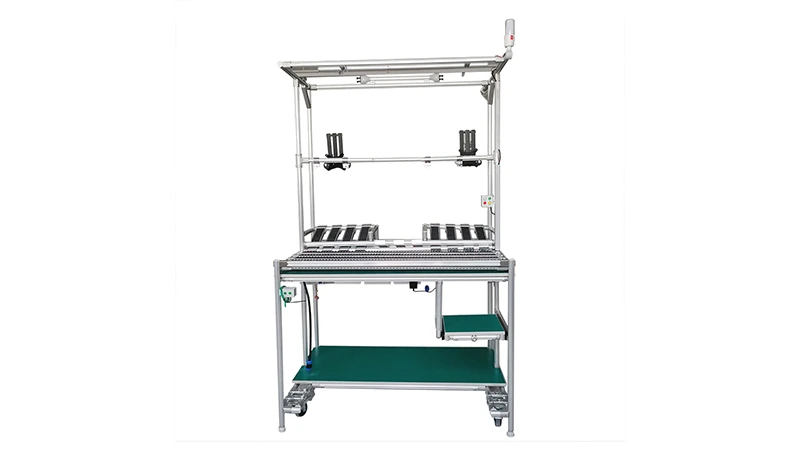
Aluminum Workbench D
Aluminum tube workbench is more flexible and durable, compared with traditional PE/ABS coated steel tube. It is easy to assemble, anti corrosion, rust protection, and recycle use after disassemble.
In the fast-paced world of modern manufacturing, where every second counts and efficiency is the backbone of success, the way workspaces are designed can make or break a production line. Today's factories and assembly plants aren't just collections of tools and machines—they're interconnected ecosystems where each component, from the smallest workbench to the largest conveyor, must work in harmony. At the heart of this ecosystem lies a critical question: How do we ensure that workstations, material transport, and automated systems communicate seamlessly to reduce waste, minimize downtime, and boost productivity? Enter Aluminum Workbench D—a modular, adaptable solution that's redefining how workspaces integrate with conveyors and automated systems. In this article, we'll explore the design, benefits, and real-world applications of Aluminum Workbench D, and how it serves as the linchpin in creating fluid, efficient workflows.
Meet Aluminum Workbench D: The Foundation of Modular Workflow
Before diving into integration, let's first understand what makes Aluminum Workbench D stand out in a crowded market of industrial workstations. Unlike traditional workbenches—often bulky, fixed, and limited in flexibility—Aluminum Workbench D is built on the principles of lean manufacturing and modularity. At its core is a frame constructed from high-grade aluminum extrusion profiles (commonly referred to as aluminum profiles), a material chosen for its unique blend of strength, lightness, and corrosion resistance. These profiles, with their T-slot design, allow for easy attachment of accessories, making the workbench infinitely customizable to fit specific tasks.
Aluminum Workbench D typically features a single-deck surface (though double-deck options are available) and is often configured without casters for stability, though casters can be added if mobility is needed. Its design prioritizes ergonomics: the height is adjustable (thanks to aluminum foot bases and anti-slip adjustable leveling feet), ensuring operators can work comfortably without straining. But what truly sets it apart is its compatibility with other industrial components—conveyors, flow racks, sensors, and even automated guided vehicles (AGVs). This isn't just a table to place tools on; it's a hub that connects every stage of the production process.
Real-World Context: A mid-sized electronics manufacturer in Ohio recently replaced its old steel workbenches with Aluminum Workbench D. Within three months, they reported a 22% reduction in time spent moving materials between stations, citing the workbench's ability to "talk" to their roller conveyors as a key factor. "Before, operators had to manually lift PCBs from the conveyor to the bench," said the plant manager. "Now, the bench aligns perfectly with the conveyor, and the materials glide right onto the workspace. It's like the bench and conveyor were made for each other."
Key Features Driving Integration
What specific design elements make Aluminum Workbench D such a strong candidate for integration? Let's break them down:
- Aluminum Profile Construction: The use of aluminum extrusion profiles (aluminum profiles) ensures the workbench is both lightweight and rigid. These profiles are engineered with precision, allowing for seamless connection to other aluminum-based systems like conveyors and flow racks using standard accessories such as aluminum guide rails and internal rotatary aluminum joints.
- Modular Joints and Accessories: Aluminum Workbench D relies on internal rotatary aluminum joints and parallel fixation aluminum pipe joints, which enable quick adjustments and reconfiguration. Need to add a side shelf for tools? Simply attach an aluminum profile to the frame using a 90° aluminum pipe joint inside connection. Want to mount a monitor arm? The T-slot profiles accept brackets without drilling or welding.
- Flat, Smooth Work Surface: The workbench's deck—often made of aluminum honeycomb panel or a durable composite—is designed to integrate with material handling systems. Its flatness ensures that roller conveyors or flow rack chutes can feed materials directly onto the surface without jams or snags.
- Adjustable Height and Alignment: With aluminum pipe adjustable leveling feet, the workbench can be fine-tuned to match the height of adjacent conveyors or flow racks. This alignment is critical for creating a continuous material flow, eliminating the need for operators to lift heavy items between different levels.
Bridging Workbench and Conveyors: The Role of Roller Conveyors
Conveyors are the arteries of any production line, transporting materials from one station to the next with minimal human intervention. Among the most common types in manufacturing are roller conveyors—systems of rotating rollers that use gravity or motorized power to move items. For Aluminum Workbench D, integrating with roller conveyors isn't just about placing the two side by side; it's about creating a unified pathway where materials transition smoothly from "transport" to "work" and back again.
The magic lies in the details: how the conveyor connects to the workbench, how heights are synchronized, and how accessories like guides and stops ensure materials stay on track. Let's take a closer look at this integration process.
Physical Connection: From Roller Track to Workbench Surface
To connect a roller conveyor to Aluminum Workbench D, manufacturers often use aluminum guide rails—specifically, aluminum guide rail A or aluminum guide rail B—to create a "bridge" between the two. These guide rails are mounted along the edge of the workbench, aligning with the conveyor's roller track. For example, a plastic roller track guide rail (yellow or grey) can be attached to the workbench's aluminum profile using roller track placon mount brackets, ensuring the conveyor's rollers are flush with the workbench surface.
Another critical component is the roller track placon mount for rail connection, a small but essential accessory that secures the conveyor's roller track to the workbench's frame. This mount is designed to fit into the T-slot of the aluminum profile, requiring no drilling—meaning the connection can be disassembled and reconfigured if the production line layout changes. For heavier loads, end support for roller track placon mount with stop brackets are added to prevent sagging and keep materials from sliding off the edge.
Technical Deep Dive: Consider a scenario where a manufacturer is assembling small appliances. The workbench needs to receive plastic housings from a motorized roller conveyor, hold them while operators install internal components, then send them to a testing station via a gravity-fed roller conveyor. Aluminum Workbench D is positioned between the two conveyors. The infeed conveyor (motorized) is connected using aluminum guide rail A, which guides the housings onto the workbench. A swivel roller ball (1 inch) mat is placed on the workbench surface to allow easy repositioning of the housing during assembly. Once assembled, the operator pushes the housing onto the outfeed conveyor, which uses plastic roller track guide rail yellow to keep it centered as it rolls to testing. The entire system is aligned to within 2mm of height difference, ensuring zero friction during transitions.
Synchronizing Motion: Sensors and Automated Triggers
Integration isn't just physical—it's also digital. Modern manufacturing relies on sensors and programmable logic controllers (PLCs) to automate workflows, and Aluminum Workbench D is designed to play nice with these systems. For example, a photoelectric sensor can be mounted above the workbench (using an aluminum profile bracket) to detect when a material arrives from the infeed conveyor. This sensor sends a signal to the conveyor to stop, holding the material in place while the operator works. Once the task is complete, a foot pedal or a proximity sensor (triggered when the operator steps back) sends a signal to restart the conveyor, moving the material to the next station.
In more advanced setups, Aluminum Workbench D can interface with IoT platforms. Data from sensors on the workbench—such as cycle time, operator activity, or material flow—can be fed into a central dashboard, allowing managers to identify bottlenecks. For instance, if the sensor detects that materials are piling up at the workbench, it may indicate that the conveyor speed needs adjustment or that the operator needs additional support.

Beyond Conveyors: Integrating Flow Racks for Material Accessibility
While conveyors handle the movement of work-in-progress, flow racks manage the storage and presentation of raw materials and components, ensuring they're within easy reach of operators. Aluminum Workbench D integrates seamlessly with flow racks, creating a "materials-to-operator" system that reduces wasted motion and speeds up assembly.
Flow racks—such as Material Rack B (3 row and 3 floor)—are designed with inclined shelves fitted with roller tracks or swivel roller balls, allowing materials to slide forward as the front item is removed (a principle known as "first in, first out," or FIFO). When paired with Aluminum Workbench D, these racks are positioned adjacent to the workbench, with their chutes aligned to feed components directly onto the workbench surface. For example, a flow rack stocked with screws, washers, and small plastic parts can be mounted to the side of the workbench using parallel aluminum joint A brackets, ensuring operators don't have to walk to a distant storage area to retrieve supplies.
The key to this integration is, again, the modularity of aluminum profiles. Flow racks are often built using the same aluminum extrusion profiles as the workbench, meaning they can share accessories and be reconfigured using the same internal rotatary aluminum joints. If production needs change—say, a new component is added to the assembly—the flow rack can be extended or modified without replacing the entire unit. This flexibility is a cornerstone of lean manufacturing, where adaptability is as important as efficiency.
| Feature | Traditional Workbench + Standalone Flow Rack | Aluminum Workbench D + Integrated Flow Rack |
|---|---|---|
| Material Compatibility | Mixed materials (wood, steel, plastic) may not align or connect easily. | Uniform aluminum profiles ensure seamless physical connection via shared accessories. |
| Adjustability | Fixed shelf heights and positions; reconfiguration requires tools or new parts. | Tool-free adjustment using internal rotatary aluminum joints; shelves can be moved in minutes. |
| Material Flow to Workbench | Operators must reach across gaps or walk to retrieve components. | Flow rack chutes align with workbench surface; components slide directly into reach. |
| Space Efficiency | Separate units take up more floor space; gaps between rack and workbench are wasted. | Integrated design eliminates gaps, reducing footprint by up to 15%. |
| Cost Over Time | High replacement costs when reconfiguring; incompatible parts lead to waste. | Modular components are reusable; long-term savings on retooling. |

The Material Advantage: Why Aluminum Makes Integration Possible
At this point, you might be wondering: Why aluminum? Couldn't steel or wood workbenches integrate with conveyors and flow racks too? The short answer is yes—but aluminum offers unique advantages that make integration simpler, more durable, and more cost-effective in the long run.
First, aluminum is lightweight yet strong. A typical Aluminum Workbench D weighs 30-40% less than a steel workbench of the same size, making it easier to reposition when production layouts change. This lightness doesn't compromise strength: aluminum extrusion profiles are engineered with internal ribs, giving them a high strength-to-weight ratio that can support heavy loads (often up to 500kg per square meter) without bending.
Second, aluminum is naturally corrosion-resistant. Unlike steel, it doesn't rust when exposed to moisture or chemicals—a critical feature in factories where spills or humidity are common. This resistance extends the life of the workbench and its integrated components (like roller conveyors or flow racks), reducing maintenance costs. For environments with strict cleanliness requirements (e.g., food processing or pharmaceuticals), stainless steel pipe series components can be used alongside aluminum, but aluminum remains the go-to for most general manufacturing due to its lower cost and weight.
Third, the T-slot design of aluminum profiles is a game-changer for integration. These slots—running the length of the profile—allow accessories (brackets, guides, sensors) to be attached anywhere along the frame, not just at pre-drilled holes. This flexibility means that as needs evolve, the workbench can adapt without major modifications. For example, adding a new sensor to monitor conveyor flow simply involves sliding a bracket into the T-slot and tightening a bolt—no drilling, welding, or specialized tools required.
Real-World Applications: Success Stories of Integration
To truly understand the impact of Aluminum Workbench D's integration capabilities, let's look at two case studies from different industries.
Case Study 1: Automotive Component Assembly
A tier-1 automotive supplier specializing in brake system components was struggling with bottlenecks in its assembly line. The existing workflow involved operators manually moving brake caliper housings from a conveyor to a steel workbench, assembling the internals, and then carrying the finished caliper to a quality control (QC) station. This manual handling led to delays, ergonomic complaints, and occasional damage to components.
The solution? The supplier replaced the steel workbenches with Aluminum Workbench D units and integrated them with motorized roller conveyors and flow racks. Here's how it worked:
- Infeed Conveyor: A motorized roller conveyor (using 40 steel roller track yellow wheels) transported caliper housings from the machining department. The conveyor was connected to the workbench via aluminum guide rail B and roller track placon mount for aluminum profile flat brackets, ensuring the housings slid smoothly onto the workbench surface.
- Flow Rack Integration: A 3-row, 3-floor material rack (similar to Material Rack B) was mounted to the side of the workbench using parallel aluminum joint B brackets. This rack held pistons, seals, and bolts, with each shelf fitted with 1-inch swivel roller balls to allow easy access.
- Outfeed to QC: A gravity-fed roller conveyor (using plastic roller track guide rail grey) was connected to the opposite side of the workbench. Once assembled, calipers were pushed onto this conveyor, which fed directly into the QC station.
The results were striking: assembly time per caliper dropped by 18%, operator fatigue complaints decreased by 40%, and damage to components fell by 90%. The plant manager noted, "The key was how the workbench, conveyor, and flow rack worked as one. Operators no longer waste time walking or lifting—everything they need is right there, and the materials move on their own. It's like the line thinks for itself."
Case Study 2: Electronics Manufacturing (ESD Workstations)
An electronics manufacturer producing printed circuit boards (PCBs) needed to upgrade its assembly line to meet stricter ESD (electrostatic discharge) requirements while improving throughput. ESD damage was a persistent issue, and the existing workstations—basic wooden benches with standalone ESD mats—lacked integration with the facility's conveyor system, leading to bottlenecks.
The solution involved deploying Aluminum Workbench D configured as ESD workstations (incorporating ESD workstation features like conductive surfaces and grounding straps). These workstations were integrated with anti-static roller conveyors and ESD-compliant flow racks:
- ESD Workbench Design: Aluminum Workbench D's surface was replaced with an ESD-safe aluminum honeycomb panel, and the frame was grounded via the aluminum foot base. Anti-slip adjustable leveling feet with conductive rubber ensured the workbench remained grounded even on uneven floors.
- Anti-Static Conveyors: Motorized roller conveyors with 40 steel roller track black ESD wheels were used to transport PCBs. These wheels dissipate static charge, preventing damage to sensitive components. The conveyors were connected to the workbench using aluminum guide rail A with ESD-safe plastic roller track guide rail yellow.
- ESD Flow Racks: Flow racks stocked with ESD-shielded component trays were mounted to the workbench, using stainless steel swivel roller balls 1 inch (ESD-safe) to allow smooth tray movement.
Within six months, ESD-related failures dropped by 75%, and the line's throughput increased by 25%. "The integration meant PCBs moved from solder paste to inspection without ever leaving an ESD-safe zone," said the production engineer. "And because the workbench and conveyor were aligned, operators could focus on soldering, not handling. It was a game-changer for quality and speed."
Future-Proofing Your Workflow: Scalability and Adaptability
In manufacturing, change is constant. New products are introduced, production volumes fluctuate, and technologies evolve. Aluminum Workbench D's greatest strength may be its ability to adapt to these changes, ensuring your workflow remains efficient for years to come.
Consider scalability: as production grows, additional Aluminum Workbench D units can be added to the line, each integrating with existing conveyors and flow racks using the same aluminum profiles and joints. If a new product requires a longer work surface, the bench can be extended by adding more aluminum profiles and internal rotatary aluminum joints—no need to buy a whole new workstation. Similarly, if a process is automated (e.g., a robot is added to handle a task), the workbench can be reconfigured to accommodate the robot's arm, with brackets and guides added via the T-slot profiles.
Adaptability also extends to sustainability. Aluminum is 100% recyclable, and because the workbench is modular, components can be repurposed when no longer needed. A flow rack that's no longer used for one product can be disassembled and rebuilt as a parts cart or a temporary workstation. This reduces waste and aligns with the circular economy principles many manufacturers are now adopting.
Conclusion: Integration as a Competitive Advantage
In the end, Aluminum Workbench D is more than just a workstation—it's a catalyst for integration, turning disjointed production lines into cohesive, efficient ecosystems. By leveraging aluminum profiles, modular design, and seamless compatibility with conveyors, flow racks, and automated systems, it addresses the core challenges of modern manufacturing: reducing waste, improving ergonomics, and adapting to change.
Whether you're assembling automotive parts, electronics, or consumer goods, the ability to connect workbench, conveyor, and automation isn't just a nice-to-have—it's a competitive necessity. Aluminum Workbench D doesn't just keep up with this demand; it sets the standard, proving that the future of manufacturing lies in systems that work together, not in isolation.
So, if you're looking to transform your production line, start with the foundation: a workstation designed for integration. Start with Aluminum Workbench D.