- Company Articles
- Products and Technology
- Solution
- How Aluminum Workbench D Reduces Setup Time in Manufacturing Changeovers

How Aluminum Workbench D Reduces Setup Time in Manufacturing Changeovers
Related Product
Aluminum Workbench D
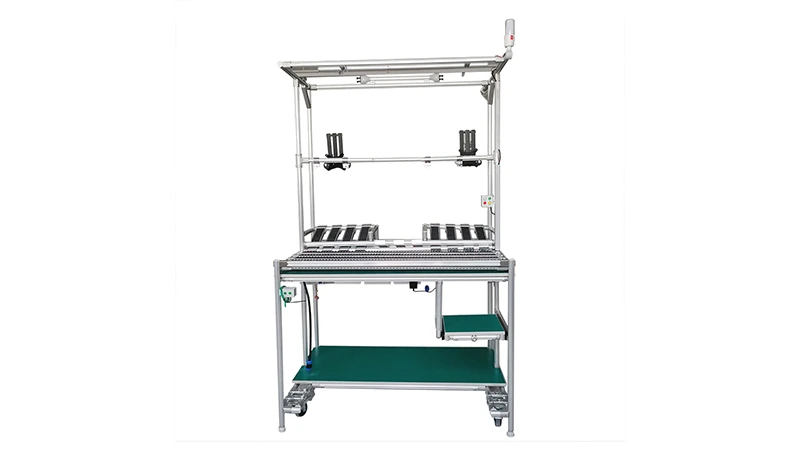
Aluminum tube workbench is more flexible and durable, compared with traditional PE/ABS coated steel tube. It is easy to assemble, anti corrosion, rust protection, and recycle use after disassemble.
A deep dive into the modular, lean-driven solution transforming factory floors
The Hidden Cost of Setup Time: Why Manufacturing Changeovers Deserve Your Attention
Walk into any manufacturing facility, and you'll hear the hum of machines, the clink of tools, and the steady rhythm of production. But pause for a moment, and you might also notice something else: downtime . Not the planned kind for maintenance, but the silent, costly gaps between product runs—changeovers. These moments, where teams reconfigure workstations, adjust tools, and prep for the next batch, are often brushed off as "just part of the job." But in reality, they're eating into your bottom line.
Consider this: A mid-sized electronics plant running three shifts a day might perform 12 changeovers weekly. If each takes 90 minutes, that's 18 hours of lost production time—nearly an entire shift—every week. Multiply that by 52 weeks, and you're looking at 936 hours of non-productive time annually. For a facility with an hourly output value of $5,000, that's over $4.6 million in potential revenue left on the table. And that's before factoring in the labor costs of workers standing idle, the stress of tight deadlines, and the missed opportunities to meet customer demand faster.
Setup time isn't just about lost production, though. It's about agility. In today's market, where customers want smaller batches, custom orders, and faster delivery, the ability to switch between products quickly isn't a luxury—it's a survival skill. A factory that can retool in 30 minutes instead of 2 hours can take on more diverse orders, adapt to sudden demand spikes, and stay ahead of competitors still stuck in rigid, slow-changeover routines.
So, what's holding most facilities back? Often, it's the workstations themselves. Traditional workbenches—heavy, fixed, and built for one specific task—turn changeovers into logistical nightmares. To switch from assembling Product A to Product B, teams might need to disassemble shelves, bolt new fixtures into place, or even bring in entirely new workbenches. It's not just time-consuming; it's demoralizing. Workers spend more time moving tools than building products, and frustration mounts when tight deadlines collide with clunky equipment.
Enter Aluminum Workbench D . Designed with the realities of modern manufacturing in mind, this isn't just another table with a flat surface. It's a lean system -aligned solution built to slash setup time, boost flexibility, and turn changeovers from a headache into a competitive advantage. Let's explore how it works.
Meet Aluminum Workbench D: The Modular Workhorse Redefining Factory Flexibility
At first glance, Aluminum Workbench D might look like a sleek, modern workstation—and it is. But beneath its clean lines and aluminum frame lies a philosophy: workbenches should adapt to your needs, not the other way around . Developed by engineers who've spent decades on factory floors, it's built to solve the specific pain points of changeovers: rigidity, time-wasting adjustments, and inefficient material flow.
So, what makes it different? Let's start with the basics. Unlike traditional steel workbenches that weigh 200+ pounds and require a forklift to move, Aluminum Workbench D is constructed from lightweight aluminum profile —strong enough to support heavy tools and assemblies, yet light enough for two workers to reposition by hand. Its frame uses T-slot aluminum extrusion profiles, a design borrowed from aerospace and automotive industries, where modularity and strength are non-negotiable. These profiles aren't just durable; they're adaptable . Slide on a shelf bracket here, clip a tool holder there, or add a roller track—all without drilling, welding, or special tools.
But the real magic is in its modularity. Aluminum Workbench D isn't a one-size-fits-all product; it's a system. Choose from single or double decks, add casters for mobility, integrate roller tracks for material flow, or mount bins and tool organizers—all using standard aluminum profile accessories. Need a taller shelf for larger components? Swap out the 12-inch legs for 18-inch ones in 5 minutes. Switching from manual assembly to automated testing? Remove the work surface, attach a mounting plate, and secure your test equipment—no bolts, no hassle.
Take a typical scenario: A medical device manufacturer needs to switch from assembling syringes to IV catheters. With a traditional workbench, this might involve removing old fixtures (screwdrivers, wrenches, 45 minutes), fetching new tool holders (a trip to the storage room, 20 minutes), and repositioning the bench closer to the labeling station (forklift required, 30 minutes). Total setup time: 1 hour 35 minutes. With Aluminum Workbench D? Loosen the T-slot knobs to remove the syringe holders (5 minutes), slide on catheter-specific tool organizers (3 minutes), unlock the caster wheels and roll the bench to the labeling station (2 minutes), then lock the brakes. Total setup time: 10 minutes . That's a 93% reduction—time that can be redirected to actual production.
It's not just about speed, though. Aluminum Workbench D is designed to work within lean system frameworks, from 5S to continuous improvement. Its clean, uncluttered design makes "shine" (cleanliness) easier; its modular components enforce "set in order" (organization); and its adaptability supports "standardize" (consistent workflows across shifts). In short, it's not just a tool—it's a partner in your lean journey.

The Anatomy of Efficiency: Key Features Driving Setup Time Reduction
To truly understand how Aluminum Workbench D cuts setup time, let's break down its core features and how they work together. It's not just one innovation, but a symphony of design choices that add up to transformative results.
1. Aluminum Profile: Lightweight Strength That Doesn't Compromise
Aluminum is often mistaken for "flimsy," but the 6063-T5 aluminum profile used in Workbench D is anything but. Tensile strength of 210 MPa (that's 30,000 psi, for context) means it can support up to 500 pounds on its work surface—more than enough for power tools, circuit boards, or even small assemblies. And because it's corrosion-resistant, it holds up in harsh environments, from automotive paint shops to food processing facilities.
But the real advantage is weight. At just 65 pounds for the base model (single deck, without casters), it's a fraction of the weight of steel alternatives. This matters during changeovers because mobility equals flexibility . If a production line needs an extra workstation suddenly, two workers can carry Workbench D to the new location in under a minute. No more waiting for the maintenance team or blocking aisles with forklifts.
Plus, the T-slot design of the aluminum profile means accessories attach in seconds. Need a bin for screws? Slide a T-slot bracket into the profile, tighten a knob, and clip the bin on. Switching to a larger bin? Loosen the knob, adjust, and retighten. It's intuitive enough that even new hires can reconfigure the bench after a 10-minute demo.
2. Integrated Roller Track: Material Flow Without the Lift
One of the biggest time drains during changeovers is material handling. Workers spend precious minutes lifting bins, sliding parts across rough surfaces, or bending to reach components on the floor—all while the clock ticks. Aluminum Workbench D solves this with optional integrated roller track —a series of low-friction rollers mounted along the workbench's edge or between shelves.
Imagine this: You're switching from assembling small circuit boards to larger control panels. With a traditional bench, you'd need to carry heavy component bins from the storage rack to the workstation—risking strain and wasting time. With Workbench D's 40 steel roller track, you simply place the bin on the track, and it glides smoothly to the worker. No lifting, no dragging, no wasted motion. And because the roller track is modular, you can add it to one side for one product, then reposition it to the front for another—all in under 2 minutes.
The roller tracks themselves are built to last, with steel or aluminum wheels (depending on your needs) that withstand thousands of cycles without jamming. Even better, they're compatible with standard industry bins and totes, so you won't need to invest in new containers to use them.
3. Caster Wheels: Lock-and-Go Mobility
Fixed workbenches are the enemy of changeovers. If your production line needs to shift layout—say, to accommodate a new machine or comply with social distancing guidelines—moving a traditional bench means disassembling it, moving the parts, then reassembling. That's hours of downtime.
Aluminum Workbench D's caster wheels change the game. The optional heavy-duty swivel casters (rated for 300 pounds each) lock securely in place during production, so the bench stays steady even when workers lean on it or use power tools. When it's time to move? Flip the brake levers, and the bench rolls smoothly over concrete, tile, or even slightly uneven floors. Need to line it up with a conveyor? The casters have precision alignment, so you can position it within an inch of where it needs to be—no shims or wedges required.
One automotive parts supplier in Michigan reported a 40% reduction in changeover time after switching to caster-equipped Workbench Ds. "Before, if we needed to move a bench 10 feet, we'd have to take everything off it, get a pallet jack, and then reload it," says their production manager. "Now, two people unlock the casters, roll it, and lock it back down. Total time: 2 minutes. We've used that saved time to run an extra batch of parts every day."
4. Tool-Free Reconfiguration: Because Every Minute Counts
Here's a statistic that might surprise you: The average factory worker spends 15% of their shift looking for tools or adjusting workstations. During changeovers, that number jumps to 35%. Why? Because traditional workbenches require tools to reconfigure—wrenches, screwdrivers, maybe even a drill. And if the tool you need is missing? You're stuck.
Aluminum Workbench D eliminates that problem with tool-free adjustments. Every accessory—shelves, brackets, roller tracks, even the work surface height—attaches using T-slot knobs, cam levers, or quick-release pins. Want to lower the work surface by 6 inches for a shorter worker? Twist three knobs, adjust the legs, and retighten. Done in 30 seconds. Need to add a second shelf for a new product? Slide the shelf brackets into the T-slots, lock them with cam levers, and drop the shelf into place. No tools, no hassle, no delays.
This isn't just about speed; it's about empowerment. Line workers don't need to wait for maintenance to reconfigure their workbench—they can do it themselves, on the fly. That sense of ownership leads to better adherence to 5S principles and a more engaged team.

By the Numbers: How Aluminum Workbench D Stacks Up Against Traditional Workbenches
Talk is cheap—results matter. To quantify the impact of Aluminum Workbench D, we compared it to a standard steel workbench in a real-world setting: a contract manufacturer producing small electronic assemblies for the aerospace industry. The facility runs 8-hour shifts, with 4–5 changeovers per day. Here's what we found:
| Metric | Traditional Steel Workbench | Aluminum Workbench D | Time Saved Per Changeover |
|---|---|---|---|
| Assembly/Reconfiguration Time | 45–60 minutes (requires tools, bolts) | 5–10 minutes (tool-free, T-slot adjustments) | 40–50 minutes |
| Material Handling Time | 15–20 minutes (manual lifting, carrying) | 3–5 minutes (roller track gliding) | 12–17 minutes |
| Mobility/Repositioning Time | 30–45 minutes (requires forklift, disassembly) | 2–3 minutes (caster wheels, no disassembly) | 28–43 minutes |
| Tool/Accessory Setup | 20–25 minutes (searching for tools, mounting hardware) | 5–8 minutes (modular, pre-labeled accessories) | 15–20 minutes |
| Total Setup Time per Changeover | 110–150 minutes | 15–26 minutes | 95–124 minutes |
Over a week (25 changeovers), that's a total time savings of 39–52 hours. For a facility with an average hourly labor cost of $45, that's $1,755–$2,340 saved per week—nearly $100,000 annually. And that's before factoring in increased production output from reduced downtime. The aerospace manufacturer in our study reported a 12% boost in units produced per shift within the first month of switching to Aluminum Workbench D.
Beyond the Bench: How Aluminum Workbench D Fits Into Your Lean System
Lean manufacturing isn't just a buzzword—it's a mindset focused on eliminating waste, empowering workers, and continuous improvement. Aluminum Workbench D isn't just a tool that happens to align with lean principles; it's built for them. Let's explore how it integrates with key lean practices to drive even greater efficiency.
5S and Workplace Organization
5S—Sort, Set in Order, Shine, Standardize, Sustain—is the foundation of a lean workplace. Aluminum Workbench D excels here. "Sort" (removing unnecessary items) is easier because its modular design means you only add the accessories you need—no extra shelves collecting dust. "Set in Order" (organizing tools for easy access) is simplified with T-slot accessories: label your tool holders, and every worker knows exactly where to find the screwdriver or torque wrench.
"Shine" (cleanliness) is a breeze, too. The smooth aluminum surface wipes clean with a damp cloth, and there are no crevices for dirt or grease to hide. Even the roller track can be disassembled quickly for deep cleaning. And because the bench is consistent across shifts (same layout, same accessories), "Standardize" becomes second nature. New hires can step into any workstation and know exactly where everything is—reducing training time and errors.
Continuous Improvement (Kaizen)
Kaizen thrives on small, incremental changes—but those changes need to be testable and reversible. Aluminum Workbench D makes experimentation easy. Want to try a new tool layout to reduce motion waste? Reconfigure the accessories in 10 minutes. Test it for a shift, and if it doesn't work, switch back just as quickly. No permanent modifications, no wasted materials, no risk.
One food packaging plant used this to great effect. Their team suggested angling the roller track 15 degrees to reduce the time workers spent reaching for bins. They adjusted Workbench D's roller track brackets, tested it for a day, and saw a 12% reduction in pick time. "Before, changing a workstation layout would require approval, a work order, and days of lead time," says their Kaizen coordinator. "Now, we can test ideas on the spot. It's transformed how our team engages with improvement."
Just-In-Time (JIT) Production
JIT relies on producing only what's needed, when it's needed—minimizing inventory and waste. But JIT requires flexibility; if a customer order changes, your production line needs to pivot fast. Aluminum Workbench D's quick reconfiguration and mobility make this possible. Need to ramp up production of a high-demand part? Roll extra Workbench Ds into place, add roller tracks, and start assembling—no delay. Slow down a low-demand item? Repurpose the benches for another product line in minutes.
Why Aluminum Workbench D Isn't Just a Workbench—It's an Investment
Let's be honest: Upgrading workstations isn't a trivial expense. But when you factor in the time saved, the increased production, and the long-term durability, Aluminum Workbench D more than pays for itself. Consider the numbers from our earlier example: a facility saving 100 minutes per changeover, with 25 changeovers per week, gains 417 hours of production time annually. At $45/hour labor cost, that's $18,765 in labor savings alone. Add in the value of the extra products produced (say, 12% more units at $50 each), and the ROI shrinks to less than 6 months.
And durability? Aluminum profile doesn't rust, warp, or degrade over time. Unlike steel benches that start showing wear after 3–5 years, Workbench D is built to last 10+ years—even in tough environments. Many suppliers offer a 5-year warranty on the frame and components, a testament to its longevity.
But perhaps the biggest ROI is intangible: worker satisfaction . When you give teams tools that make their jobs easier, faster, and less frustrating, morale soars. Turnover decreases, absenteeism drops, and engagement rises. And engaged workers are more likely to spot inefficiencies, suggest improvements, and take pride in their work—creating a positive feedback loop that drives continuous improvement.
Conclusion: The Future of Manufacturing is Adaptable
Changeovers will always be part of manufacturing—but they don't have to be a drain on your time, money, or team. Aluminum Workbench D represents a shift in how we think about workstations: from fixed, one-purpose tools to modular, adaptable systems that grow with your business. Its aluminum profile frame, integrated roller track, tool-free adjustments, and caster wheels aren't just features—they're solutions to the problems that have held manufacturers back for decades.
As customer demands grow more complex and competition intensifies, flexibility isn't optional anymore. It's the difference between falling behind and leading the pack. Aluminum Workbench D isn't just a workbench; it's a statement that your facility is ready to adapt, innovate, and thrive.
So, the next time you watch a changeover unfold, ask yourself: Is this process as efficient as it could be? If the answer is no, maybe it's time to let your workbenches start working for you.