- Company Articles
- Products and Technology
- Product knowledge
- How Does a Swivel Stem Caster Wheel with Brake Work? Mechanism Explained

How Does a Swivel Stem Caster Wheel with Brake Work? Mechanism Explained
Related Product
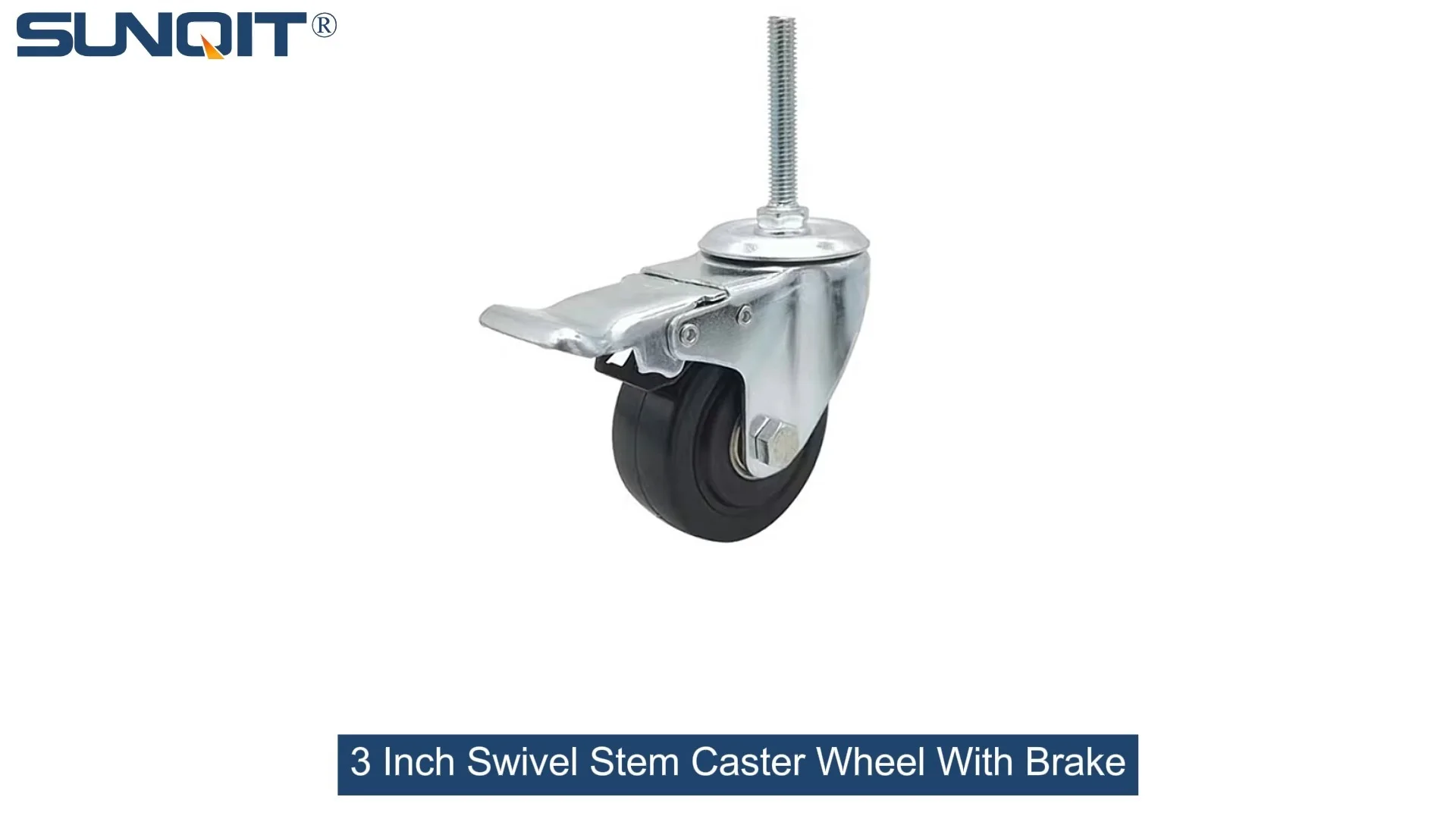
Swivel Stem Caster Wheel with Brake
360 Degree Swivel Stem Caster with brake. Threaded-post mount design, castors diameter 3 inch.Each swivel caster wheels loading 70KGS. Heavy enough and widely suit for carts, chairs, cabinet, flow rack, workbench, turnover rolley.
Picture this: You're in a busy workshop, rushing to move a heavy workbench loaded with tools across the floor. With a gentle push, it glides smoothly—no straining, no awkward shuffling. When you reach your spot, you tap a small lever with your foot, and suddenly, it's locked in place, solid as a rock. That seamless transition from mobility to stability? Thank the unsung hero beneath it all: the swivel stem caster wheel with brake. These tiny but mighty components are everywhere, from factory workbenches to hospital carts, yet most of us rarely stop to wonder how they work. Today, we're peeling back the curtain to explore the mechanics, components, and clever engineering that make these casters so indispensable. Whether you're a DIY enthusiast, a warehouse manager, or just curious about the tools that simplify daily tasks, let's dive into the world of swivel stem casters with brakes.
What Even Is a Swivel Stem Caster Wheel with Brake?
Before we get into the nitty-gritty, let's start with the basics. A caster wheel is essentially a wheel mounted on a frame (called a yoke or fork) that's designed to be attached to the bottom of an object, making it mobile. But not all casters are created equal. A "swivel" caster can rotate 360 degrees, allowing the object to move in any direction—think of a shopping cart wheel that turns as you steer. A "stem" caster, meanwhile, attaches to the object via a stem (a rod or shaft) that fits into a hole or bracket, rather than being bolted on with a plate. Add a "brake" to the mix, and you've got a caster that can both move freely and lock into place when needed. Combine all three—swivel, stem, brake—and you get the star of our show: the swivel stem caster wheel with brake. It's the ultimate blend of flexibility and control, and its design is a masterclass in functional engineering.
At first glance, it might look simple: a wheel, a stem, and a little brake lever. But inside that unassuming package, there's a symphony of parts working together. Let's break it down component by component, starting with the part that connects the caster to your equipment: the stem.
The Stem: The Unsung Connector
If the caster were a tree, the stem would be its roots—anchoring it to the object it's supposed to move. Without a strong, secure stem, even the best wheel would wobble, slip, or fail entirely. Stems come in a few different flavors, each tailored to specific needs, but they all share one goal: to create a rigid link between the caster and the equipment (like a workbench or a turnover trolley).
Threaded Stems: The Screw-In Solution
The most common type you'll encounter is the threaded stem. As the name suggests, it's a rod with threads (like a bolt) that screws into a matching threaded hole in the equipment. This is a favorite for its simplicity and strength—twist it in, and it locks tight. Threaded stems are measured by diameter (often 1/2 inch or 5/8 inch) and length (how much of the stem actually screws into the object). Pro tip: Always check the thread pitch (coarse vs. fine) to ensure it matches your equipment—mismatched threads can strip the hole, turning a simple install into a headache.
Expanding Stems: For Tight Fits
If your equipment has a smooth, unthreaded hole (maybe in a hollow leg or tube), an expanding stem is your go-to. These stems have a split end that expands when you tighten a bolt or nut, gripping the inside of the hole like a vice. They're ideal for lightweight to medium-duty use, like office chairs or small utility carts. The key here is the "expansion range"—make sure the stem's minimum and maximum expansion diameter matches the hole size to avoid a loose fit.
Grip Ring Stems: Snap-and-Go Convenience
Ever seen a caster that just "pops" into place? That's a grip ring stem. It has a spring-loaded metal ring (the grip ring) near the top that compresses when you push the stem into a hole, then expands to lock it in. These are quick to install and remove, making them popular for equipment that needs occasional caster swaps, like display racks or temporary workstations. They're not as strong as threaded stems, though—best for light loads only.
No matter the stem type, it rarely attaches directly to the equipment. Instead, it often uses a caster install base—a metal or plastic plate or bracket that's bolted to the equipment first, with a hole or socket to accept the stem. This base adds stability, distributes weight, and protects the equipment from damage (imagine screwing a stem directly into a flimsy plastic leg—yikes). Think of the install base as the stem's "bodyguard," ensuring a secure connection that can handle the bumps and jolts of daily use.

The Swivel Mechanism: Freedom to Move (in Any Direction)
Now, let's talk about the "swivel" in swivel stem caster. What makes these casters so maneuverable? It's all in the swivel mechanism—the part that lets the wheel rotate 360 degrees around the stem. Without this, your caster would only roll forward and backward, like a toy car with fixed wheels. The swivel mechanism turns a rigid object into something that can pivot, glide, and navigate tight corners with ease.
The Raceway and Ball Bearings: The Secret to Smooth Swiveling
At the heart of the swivel mechanism is the raceway—a circular groove or track—and a set of ball bearings (or sometimes roller bearings) that sit inside it. The raceway is usually part of the caster's top plate or stem housing, while the bearings rest between the raceway and the yoke (the frame that holds the wheel). When you push the object, the yoke rotates around the stem, and the bearings roll along the raceway, reducing friction to almost nothing. It's like sliding a heavy box on a bed of marbles instead of dragging it—the bearings turn a hard task into a smooth one.
Not all ball bearings are the same, though. Cheap casters might use a handful of large bearings, which can make swiveling feel "jerky." High-quality casters, on the other hand, use dozens of small, precision-machined bearings (often sealed to keep out dust and debris) that distribute weight evenly, ensuring a buttery-smooth rotation. Some even add a second set of bearings (called "double-ball raceways") for extra stability and load capacity—handy for heavy workbenches or industrial trolleys.
The Swivel Lock: When You Want to Go Straight
Wait, didn't we already talk about brakes? There's a difference between a swivel lock and a wheel brake. A swivel lock (sometimes called a "directional lock") prevents the caster from swiveling, forcing it to roll in a straight line. It's like putting training wheels on a bike—great for moving in long, straight paths without the object veering off course. Some swivel stem casters with brakes include a swivel lock as an extra feature, usually a separate lever or pin that locks the yoke in place. Not all have this, but it's a useful bonus for tasks like moving large loads down a warehouse aisle.

The Caster Wheel: Where the Rubber Meets the Floor
Now, let's focus on the star of the show: the caster wheel itself. After all, without a wheel, there's no rolling—just a metal stem scraping the floor (not ideal). The wheel's design, material, and size have a huge impact on how the caster performs: how smoothly it rolls, how much weight it can carry, how quiet it is, and even how it interacts with different floor surfaces.
Wheel Materials: Rubber, Polyurethane, Nylon… Oh My!
Caster wheels come in a rainbow of materials, each with its own superpowers. Let's break down the most common ones:
| Material | Key Advantages | Potential Drawbacks | Ideal Applications |
|---|---|---|---|
| Rubber | Soft, shock-absorbent, and whisper-quiet. Excellent grip on smooth floors (like tile or hardwood) and won't scratch them. | Not the most durable—can wear down quickly on rough surfaces (concrete with cracks, gravel). Low-quality rubber might leave black marks on floors. | Medical carts, office furniture, home use (think: kitchen islands). |
| Polyurethane (PU) | A hybrid of rubber and plastic—tough, flexible, and resistant to oils, chemicals, and abrasion. Handles heavier loads than rubber without sacrificing smoothness. | Stiffer than rubber, so it might transmit more vibrations. Heavier than rubber, which can slow down ultra-light equipment. | Industrial workbenches, warehouse trolleys, assembly line tools. |
| Nylon | Hard as nails—extremely durable, heat-resistant, and low-friction. Glides effortlessly on smooth floors and can handle heavy loads (we're talking hundreds of pounds). | Noisy on hard floors (think: clattering on concrete). No shock absorption, so bumps feel jarring. Can mark soft floors (like vinyl) if dragged. | Heavy machinery, outdoor equipment, workshops with concrete floors. |
| Polypropylene (PP) | Lightweight, affordable, and resistant to moisture. Good for light to medium loads. | Less durable than PU or nylon. Can crack under extreme weight or temperature changes. | Retail display racks, lightweight utility carts. |
Wheel Size: Bigger Isn't Always Better (But Sometimes It Is)
Wheel diameter matters more than you might think. Small wheels (2-3 inches) are great for tight spaces—they pivot easily and fit under low-clearance equipment. But they struggle with rough floors or debris; a small pebble can stop them in their tracks. Larger wheels (4-8 inches), on the other hand, roll over obstacles like speed bumps, cracks, or loose screws with ease. They also require less force to move heavy loads (physics 101: a bigger wheel has a longer "lever arm," making it easier to overcome friction). The tradeoff? They take up more space and might be too tall for low-profile equipment.
Tread Patterns: Grip vs. Glide
Look closely at a caster wheel, and you'll notice tiny grooves or patterns on the tread—the part that touches the floor. These aren't just for looks. A smooth tread glides best on clean, smooth floors (like a hospital corridor), while a tread with deep grooves or "knobs" provides extra grip on wet or uneven surfaces (like a warehouse with oil spills). Some wheels even have a "ribbed" tread, which channels water away to prevent hydroplaning (yes, casters can hydroplane too!).

The Brake: From Moving to Stationary in a Tap
Now, the feature that makes this caster a game-changer: the brake. Without it, your smoothly moving workbench would keep rolling right into a wall (or your toes). The brake's job is simple: stop the wheel from turning, or stop the swivel from rotating (or both), depending on the design. But how does that tiny lever or pedal do such a big job?
Foot-Operated Brakes: The Most Common (and Clever) Design
Chances are, the caster you've used has a foot brake—a small lever or pedal attached to the yoke. Step on it, and the wheel locks; step on it again (or lift it with your toe), and it releases. Let's break down how it works:
1. The Brake Pedal/Lever: This is the part you interact with. It's usually a metal or plastic arm that pivots on the yoke. When you press down, it activates the braking mechanism inside.
2. The Brake Pad or Shoe: Attached to the pedal is a rubber or metal pad (the brake shoe) that presses against the wheel's tread or hub when the brake is engaged. The friction between the pad and the wheel is what stops it from rolling.
3. The Spring: When you release the brake, a small spring pulls the pedal back up, lifting the brake pad off the wheel. This spring is crucial—it ensures the brake doesn't stick in the "on" position accidentally.
Some brakes don't just lock the wheel—they lock the swivel too. Called "total lock" brakes, these have two pads: one that clamps the wheel and another that jams the swivel raceway, preventing rotation. They're perfect for equipment that needs to stay put on slopes or uneven floors (like a food cart in a busy kitchen).
Hand Brakes: For Precision Control
Less common but equally useful are hand brakes, which are operated by a lever or knob instead of a foot pedal. These are often found on medical equipment or heavy machinery where you need to lock/unlock the caster without bending down. They work similarly to foot brakes but use a cable or rod to connect the hand lever to the brake pad. Think of them as the caster equivalent of a bicycle brake—pull the lever, and the pad squeezes the wheel.
Why Brakes Fail (and How to Fix Them)
Like any moving part, brakes can wear out or get stuck. The most common culprit? Debris. Dust, hair, or small bits of gravel can get between the brake pad and the wheel, preventing a tight grip. A quick clean with a brush or compressed air usually fixes it. If the brake feels "mushy" or doesn't lock the wheel fully, the spring might be weak or the brake pad could be worn down—both easy fixes with replacement parts (hello, caster accessories!).
Caster Accessories: The Extras That Make a Difference
We've mentioned a few already, but caster accessories are the unsung heroes that take a basic caster from "good" to "great." These add-ons enhance performance, durability, or safety, and they're worth knowing about if you're choosing casters for a specific job.
Brake Extensions: For Hard-to-Reach Casters
Ever tried to brake a caster under a low-slung cart? Your foot can't fit, so you end up kneeling—annoying. Brake extensions solve this by adding a longer pedal or a rod that sticks out from the caster, making it easy to reach even in tight spaces.
Wheel Guards: Keep Debris Out
If your caster will be rolling through dusty or debris-filled areas (like a construction site or woodworking shop), wheel guards are a must. These plastic or metal shields wrap around the wheel, blocking dirt, nails, or sawdust from getting stuck in the axle or brake mechanism.
Lubrication Kits: Keep It Rolling Smooth
Even the best casters need a little TLC. Lubrication kits (usually a small bottle of silicone or lithium grease and an applicator) help keep the swivel raceway and wheel bearings moving freely, preventing rust and reducing wear.
Putting It All Together: How the Mechanism Works as One
Now that we've dissected each part, let's see how they work together in real life. Imagine you're pushing a workbench with four swivel stem casters (two with brakes, two without—common for stability). Here's what happens step by step:
1. Movement: You push the workbench. The swivel mechanisms in all four casters rotate, allowing the wheels to turn in the direction of the push (thanks to those ball bearings in the raceway). The polyurethane wheels glide over the concrete floor, their tread gripping just enough to prevent slipping but not so much that they drag.
2. Braking: You reach your spot and step on the brake pedals of the two braked casters. The pedals pivot, pushing the brake pads against the wheel treads. Friction stops the wheels from rolling. Meanwhile, the stems (threaded, in this case) stay locked into the caster install bases, which are bolted securely to the workbench legs. The workbench doesn't budge—not even if someone leans on it.
3. Releasing: When you're ready to move again, you lift the brake pedals with your toes. The springs inside pull the brake pads away from the wheels, and the swivel mechanisms unlock. You push, and the workbench glides off—no fuss, no drama.
It's a beautiful example of mechanical synergy: the stem anchors, the swivel allows movement, the wheel rolls, and the brake secures. Each part relies on the others, and when they're all working well, the result is that magical feeling of effortlessness we take for granted.
Why Does This Matter? The Real-World Impact of Good Casters
You might be thinking, "Okay, cool—casters are clever. But why should I care about their design?" The answer is simple: good casters save time, reduce injury risk, and make work easier. A poorly designed caster can turn a 10-second task into a 2-minute struggle, or worse, lead to strained backs from pushing heavy, uncooperative equipment. In factories, where workers move materials all day, high-quality swivel stem casters with brakes can cut down on fatigue and boost productivity. In hospitals, quiet, smooth casters on medical carts prevent disturbing patients and make it easier for nurses to maneuver in tight spaces. Even at home, a well-castered bookshelf or kitchen cart can turn a clunky chore into a breeze.
Final Thoughts: Appreciating the Little Things
The next time you glide a cart across the room or lock a workbench in place, take a second to appreciate the swivel stem caster wheel with brake. It's a testament to human ingenuity—taking simple components (wheels, stems, springs) and turning them into something that solves a universal problem: how to move heavy things easily, then keep them still. From the threaded stem anchoring it to the caster install base, to the ball bearings in the swivel raceway, to the brake pad that clamps down with a tap of your foot, every part has a job. And together, they make our lives just a little bit easier.
So here's to the unsung heroes of mobility—the swivel stem casters with brakes. May they keep rolling smoothly, locking securely, and making our daily tasks that much simpler.