- Company Articles
- Products and Technology
- Product knowledge
- How Five Way Straight Lean Pipe Joints Support Continuous Improvement in Lean Systems

How Five Way Straight Lean Pipe Joints Support Continuous Improvement in Lean Systems
Related Product
Five Way Straight Lean Pipe Joint
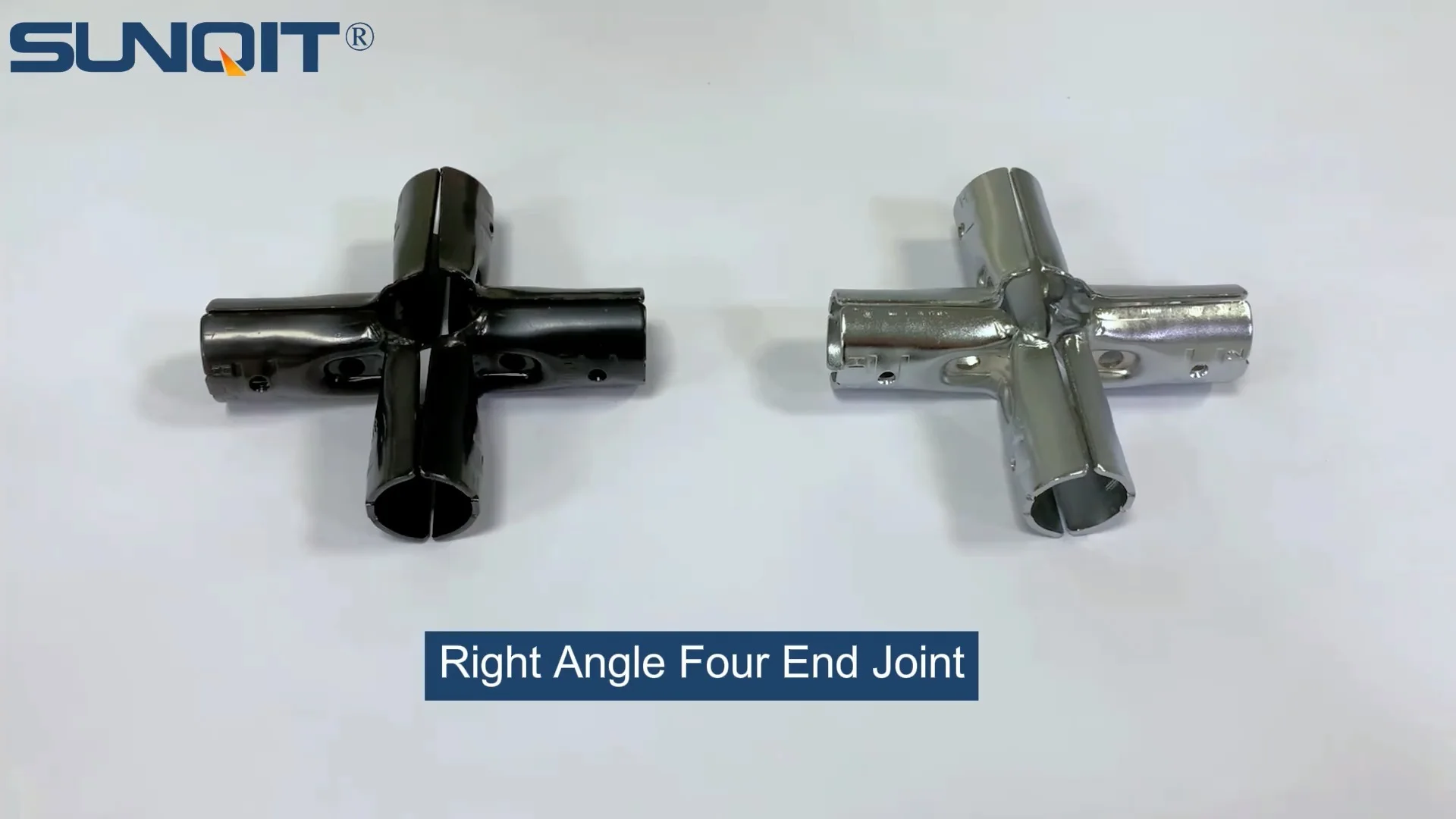
Five way straight lean pipe joint, for 5 pcs 28mm lean pipe connect in straight angle,which used widely in workbench, flow rack, hand trolley frame connection.
In the world of manufacturing and production, the phrase "lean system" has become more than just a buzzword—it's a philosophy that drives efficiency, reduces waste, and fosters a culture of constant evolution. At its core, lean manufacturing is about doing more with less: less time, less space, less resources, and less hassle. But here's the thing: even the best lean strategies can stumble if the physical infrastructure supporting them is rigid, outdated, or hard to adapt. That's where the unsung heroes of lean setups come into play: components like lean pipe joints , which quietly hold everything together while enabling the flexibility that makes continuous improvement possible. Today, we're zeroing in on one such component that's been gaining traction in forward-thinking facilities: the five way straight lean pipe joint. Let's unpack how this small but mighty part plays a big role in keeping lean systems agile, adaptable, and ready for whatever comes next.
Understanding Lean Systems: More Than Just a Process, It's a Mindset
Before diving into the specifics of five way straight lean pipe joints, let's take a step back to clarify what a "lean system" really means. Lean isn't just about cutting costs or speeding up production lines (though those are nice side effects). It's a mindset centered on continuous improvement —the idea that there's always a better way to do things. This could mean streamlining a workflow to reduce bottlenecks, reconfiguring a workstation to minimize worker movement, or adjusting a material handling setup to cut down on wasted time. The key here is that "better" isn't a one-time achievement; it's an ongoing journey. And for that journey to be possible, the tools and structures on the factory floor need to keep up.
Think about it this way: If your production line is built with fixed, welded metal frames, how easy is it to rearrange it when a new product comes in? Or when customer demand spikes and you need to scale up? Chances are, it's not easy at all. You'd be looking at days (or weeks) of downtime, costly modifications, and a lot of frustration. That's the opposite of lean. A true lean system demands infrastructure that can pivot quickly—something that can be taken apart, reconfigured, and reassembled without breaking a sweat. And that's where lean pipe systems shine. Made from lightweight yet durable materials like aluminum or steel, these pipes, paired with versatile joints, let teams build, modify, and rebuild workstations, racks, and conveyors on the fly. They're like the LEGO blocks of manufacturing: simple, modular, and infinitely customizable.
The Role of Lean Pipe Joints: The Glue That Holds Flexibility Together
If lean pipes are the "bricks" of a lean setup, then lean pipe joints are the mortar. They're the connectors that join pipes together to form everything from workbenches and flow racks to material carts and assembly lines. But not all joints are created equal. Traditional joints might only connect two or three pipes at a time, limiting how complex or compact a structure can be. Others might require tools to assemble, slowing down reconfiguration. And some might be made of flimsy materials that wear out after repeated use—hardly ideal for a system that's supposed to evolve.
Enter the five way straight lean pipe joint. As the name suggests, this joint is designed to connect up to five lean pipes in a straight line or at precise angles, all without the need for welding, drilling, or specialized tools. Picture a central hub with five connection points, each engineered to grip a pipe securely while still allowing for quick adjustments. It's a small innovation, but it's a game-changer for facilities that need to maximize space, adapt to new workflows, or experiment with different layouts. Let's break down why this matters.

What Makes Five Way Straight Lean Pipe Joints Unique? Design and Functionality
At first glance, a five way straight lean pipe joint might look like a simple metal or plastic piece with a few holes. But its design is the result of careful engineering, tailored to the needs of lean environments. Let's start with the basics: materials. Most high-quality five way joints are made from durable materials like aluminum, steel, or reinforced plastic. Aluminum is a popular choice because it's lightweight (making assemblies easier to move), resistant to corrosion (important in factories where moisture or chemicals might be present), and strong enough to support the weight of tools, materials, or finished products. Steel, on the other hand, is often used in heavier-duty applications where extra strength is needed, like in flow racks holding bulky items.
Then there's the "five way" aspect. Unlike standard two-way or three-way joints, which limit how pipes can branch out, a five way joint offers five connection points. This means you can build more complex structures in a smaller footprint. For example, imagine a workbench where you need to attach a tool rack above, a parts bin to the side, and a material feeder below—all while keeping the main work surface clear. A five way joint lets you connect all these components to a single vertical pipe, eliminating the need for extra supports or complicated assemblies. It's like having a Swiss Army knife for your lean setup: one joint, multiple functions.
Another key feature is the ease of assembly. Most five way joints use a friction-fit or clamping mechanism, meaning you can attach or detach pipes by hand, no wrenches or screws required. This might sound minor, but in a busy production environment, every minute counts. If a team needs to reconfigure a workstation to accommodate a new product, they shouldn't have to wait for a maintenance crew with tools. With these joints, line workers or supervisors can make adjustments on the spot, keeping downtime to a minimum. That's the kind of agility that turns "we can't do that" into "we can try that tomorrow."

Supporting Continuous Improvement: How Five Way Joints Enable Flexibility
Now, let's get to the heart of the matter: how do five way straight lean pipe joints actually support continuous improvement in lean systems? Let's break it down into four key areas: space optimization, workflow adaptability, cost efficiency, and scalability.
1. Space Optimization: Making the Most of Every Square Foot
In manufacturing, floor space is a precious commodity. Wasted space—whether from oversized workstations, inefficient material storage, or awkwardly placed equipment—translates to wasted money and missed opportunities. Five way joints help solve this by allowing for more compact, multi-functional setups. For example, a traditional flow rack might require separate vertical supports for each shelf, taking up extra width. With a five way joint, you can connect multiple horizontal shelves to a single vertical pipe, reducing the rack's footprint while still supporting the same (or more) materials. This frees up space for additional workstations, new equipment, or even just better traffic flow—all of which contribute to a leaner operation.
Take a small electronics assembly shop, for instance. Their production area is tight, but they need to build both small circuit boards and larger components. With five way joints, they can design a workbench that has a narrow main surface for circuit boards, with fold-down extensions (connected via joints) that can be raised when assembling larger parts. When not in use, the extensions fold up, reclaiming space. No more clunky, permanent workbenches that only serve one purpose—this setup adapts to the task at hand, making every square foot count.
2. Workflow Adaptability: Pivoting Fast When Needs Change
Continuous improvement often starts with identifying a bottleneck: a step in the process where work piles up, causing delays. Maybe it's a workstation where workers have to reach too far for tools, or a material feeder that's too slow. Fixing these issues often requires reconfiguring the physical layout. But if your infrastructure is bolted down, that reconfiguration can take days. With five way joints, it can take hours—or even minutes.
Consider a scenario where a food packaging plant notices that their labeling station is causing a backup. The current setup has the label printer on a separate table, so workers have to walk back and forth to grab labels. Using five way joints, they can quickly attach the printer to the side of the main packaging workbench , at eye level and within arm's reach. No need for new tables, no need for electricians to reroute cords—just a few adjustments to the existing pipe structure. Suddenly, the bottleneck is gone, and production speeds up. That's continuous improvement in action, made possible by flexible infrastructure.
3. Cost Efficiency: Reducing Waste in Time and Money
Lean systems are all about eliminating waste, and that includes waste in the form of unnecessary spending. Traditional rigid setups often require companies to buy new equipment or custom-built structures when their needs change. For example, if a company switches from producing small parts to large appliances, they might need to replace all their old workstations with bigger ones—a costly endeavor. Five way joints flip this script by making existing infrastructure reusable.
Because these joints allow for easy disassembly and reassembly, components like pipes, shelves, and brackets can be repurposed for new projects. A flow rack used for storing small parts today can be taken apart and rebuilt as a material trolley tomorrow, using the same pipes and joints. This reduces the need to purchase new equipment, cutting capital costs. It also cuts down on waste from discarded old structures, aligning with the lean principle of minimizing environmental impact.
Time is another resource saved. As mentioned earlier, reconfiguring with five way joints is a manual, tool-free process. A team of two workers can take apart a workstation and rebuild it in a fraction of the time it would take to install a new fixed structure. Less time spent on setup means more time spent on actual production—another win for efficiency.
4. Scalability: Growing Without Growing Pains
For many businesses, growth is the goal—but growth can bring growing pains, especially when it comes to production capacity. Scaling up often means adding more workstations, expanding material storage, or increasing the size of assembly lines. With rigid infrastructure, this can feel like trying to fit a square peg into a round hole: you either overspend on new facilities or cram more equipment into an already tight space, sacrificing efficiency.
Five way joints make scaling smoother by allowing for incremental expansion. Let's say a furniture manufacturer lands a big order and needs to double their assembly capacity. Instead of building an entirely new line from scratch, they can extend their existing lean pipe setup by adding more sections—using five way joints to connect new workbenches, material racks, and conveyors to the existing system. This modular approach means they can scale up (or down, if demand drops) without disrupting the entire operation. It's growth without the chaos, which is exactly what lean systems aim for.

Real-World Impact: A Case Study in Adaptability
To put this into perspective, let's look at a real-world example. A mid-sized automotive parts supplier was struggling with their assembly line for brake components. Their existing setup used traditional welded steel workstations, which were heavy, hard to adjust, and took up too much space. When they introduced a new brake model with different dimensions, they realized the workstations were too narrow to accommodate the new parts, causing workers to fumble and slow down. The maintenance team quoted them two weeks and $15,000 to rebuild the stations with new steel frames.
Instead, the company decided to switch to a lean pipe system using five way straight lean pipe joints. They purchased aluminum lean pipes, five way joints, and adjustable shelves. Over a weekend (yes, just two days), their production team disassembled the old steel stations and built new ones that were wider, had integrated tool holders (connected via five way joints), and even included a small flow rack for parts right next to the work surface. Total cost? Under $5,000—less than a third of the original quote. And the best part? When the next product change comes (and it will), they can adjust the workstations again in hours, not weeks. That's the power of flexibility driven by components like five way joints.
Comparing Traditional Joints vs. Five Way Straight Lean Pipe Joints
Still not convinced? Let's put five way straight lean pipe joints head-to-head with traditional joints in a quick comparison:
| Feature | Traditional Lean Pipe Joints | Five Way Straight Lean Pipe Joints |
|---|---|---|
| Connection Points | 2-3 points (limited branching) | 5 points (enables complex, multi-directional setups) |
| Assembly Time | Requires tools; 10-15 minutes per joint | Tool-free; 2-3 minutes per joint |
| Reconfigurability | Hard to adjust; often requires disassembly | Easy to reposition pipes without full disassembly |
| Space Efficiency | Requires more supports; bulkier setups | Compact design reduces need for extra supports |
| Cost Over Time | Higher (due to limited reuse and tooling costs) | Lower (reusable, no tooling, reduces need for new parts) |
Choosing the Right Components: What to Look for in Five Way Joints
If you're considering integrating five way straight lean pipe joints into your lean system, there are a few key factors to keep in mind. First, material quality: look for joints made from durable materials like anodized aluminum or high-grade steel, which resist rust and wear. Second, compatibility: ensure the joints fit your existing lean pipes (most are designed for standard diameters, but double-check). Third, load capacity: if you're using the joints for heavy materials (like metal parts), verify that they can support the weight without bending or slipping. Finally, ease of use: opt for joints with a user-friendly clamping mechanism—you want your team to be able to assemble and adjust them quickly, without frustration.
Conclusion: Small Components, Big Impact
At the end of the day, lean systems are only as strong as the components that build them. Continuous improvement can't thrive if the tools, workstations, and material handling setups are stuck in the past. Five way straight lean pipe joints might seem like small, unassuming parts, but they're a critical piece of the puzzle. By enabling flexibility, reducing waste, and making adaptation easy, they empower teams to experiment, iterate, and grow—all while staying true to the lean philosophy.
So the next time you walk through a production floor, take a closer look at the structures holding everything together. Chances are, there's a lean pipe joint (maybe even a five way one) quietly supporting the continuous improvement that keeps the operation running smoothly. And as manufacturers continue to face new challenges—from shifting consumer demands to tighter budgets—components like these will only become more essential. After all, in the world of lean, it's often the smallest changes that lead to the biggest results.