- Company Articles
- Products and Technology
- Product knowledge
- How Flat Rigid Castor Wheels Improve Material Flow in Lean Manufacturing Cells

How Flat Rigid Castor Wheels Improve Material Flow in Lean Manufacturing Cells
Related Product
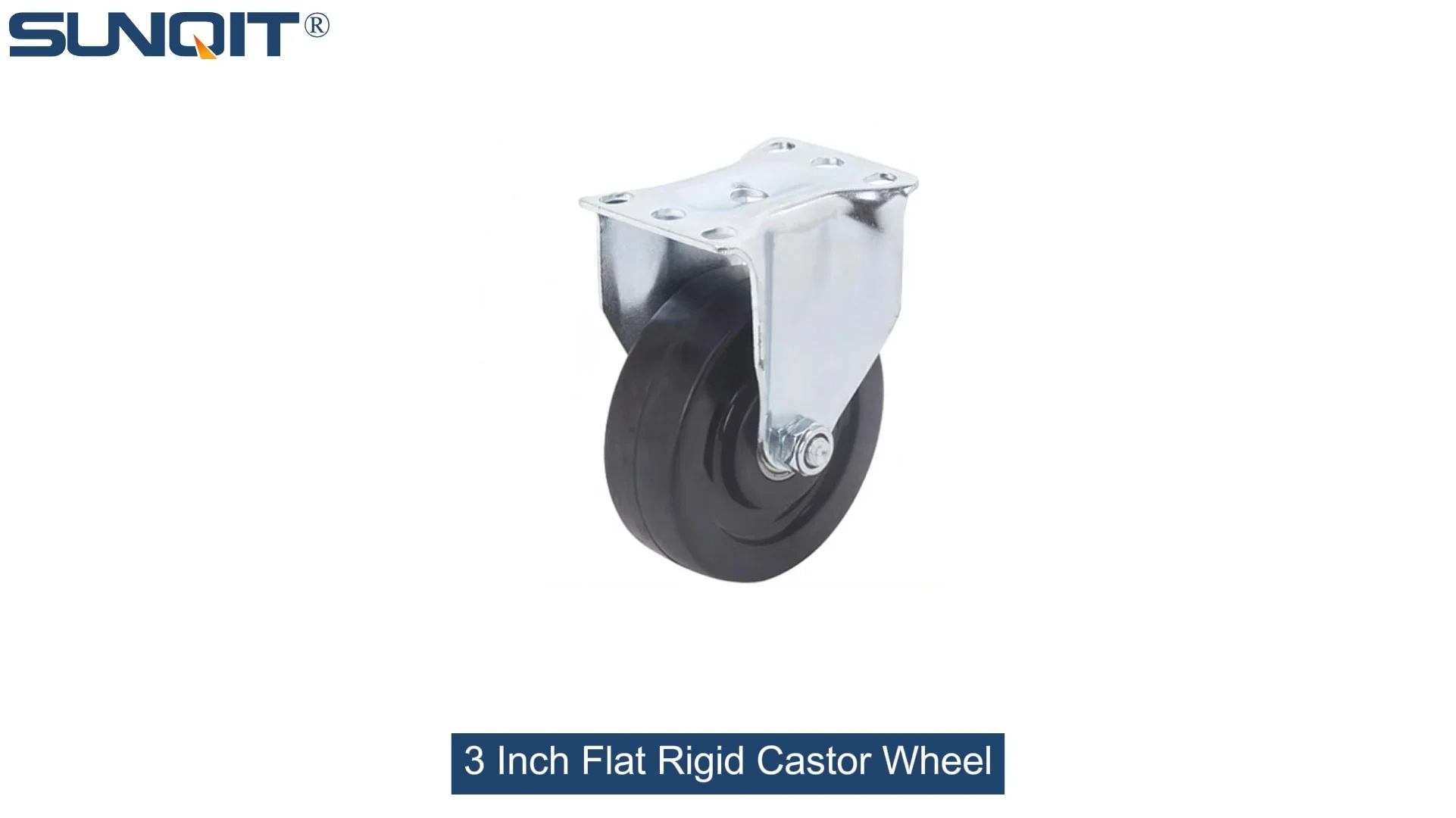
Flat Rigid Castor Wheel
Chair Casters Ball Bearing Wheels Rubber Base. Resistant to abrasion, impact and corrosion. Heavy payload can hold 70Kgs per pcs,which can make it works at a stable and smooth status.
In the fast-paced world of manufacturing, where every second counts and waste is the enemy, lean manufacturing has emerged as a guiding philosophy for businesses striving to do more with less. At its core, lean is about streamlining processes, eliminating inefficiencies, and creating a workflow that feels almost effortless—where materials glide from one station to the next, workers move without unnecessary steps, and productivity hums along like a well-tuned machine. But here's the thing: even the most carefully designed lean system can stumble over one small, often overlooked detail: how materials move. Enter flat rigid castor wheels—a humble component that's quietly revolutionizing material flow in lean manufacturing cells. In this article, we'll explore why these unassuming wheels matter, how they solve common workflow headaches, and why they've become a secret weapon for manufacturers aiming to turn "good" lean practices into "great" ones.
The Heartbeat of Lean: Why Material Flow Makes or Breaks Your Cell
Before we dive into the specifics of flat rigid castor wheels, let's take a step back and talk about why material flow is the lifeblood of any lean manufacturing cell. Imagine a busy kitchen during dinner rush: if the prep station is too far from the grill, or the plates take forever to reach the pass, orders back up, chefs get frustrated, and customers wait longer. Manufacturing cells work the same way. In lean, the goal is to produce goods just in time —not too early (which creates excess inventory) and not too late (which causes delays). To do that, materials need to move smoothly, predictably, and with minimal effort.
But in reality, many cells struggle with material flow bottlenecks. Maybe a turnover trolley loaded with parts wobbles as it's pushed, causing workers to slow down and navigate around corners. Or a workbench that's supposed to be "mobile" feels clunky, thanks to casters that swivel unexpectedly, making it hard to position precisely. Even flow racks—designed to let materials "flow" to the point of use—can become stagnant if the underlying movement system isn't up to par. These issues might seem minor on their own, but add them up over a shift, a day, or a month, and suddenly you're looking at lost productivity, increased worker fatigue, and a lean system that's not living up to its potential.
That's where flat rigid castor wheels come in. Unlike their swiveling counterparts, these wheels are fixed in direction, meaning they roll straight and true, no surprises. They're built for stability, designed to handle heavy loads without flexing, and engineered to work seamlessly with the structured, repetitive workflows that define lean cells. Let's break down what makes them so effective.
What Are Flat Rigid Castor Wheels, Anyway? A Closer Look
First things first: let's clarify what we mean by "flat rigid castor wheels." At their most basic, these are casters where the wheel is mounted on a fixed, non-swiveling frame (hence "rigid") and attached to equipment via a flat mounting plate (hence "flat"). Unlike swivel casters, which can rotate 360 degrees to allow movement in any direction, flat rigid casters lock the wheel in a straight line—forward and backward, no side-to-side wobble. This might sound limiting at first, but in the context of lean manufacturing cells, where workflows are often repetitive and paths are well-defined, that "limitation" becomes a superpower.
Flat rigid castor wheels are typically made from durable materials like hardened steel, polyurethane, or rubber, depending on the application. The wheels themselves might have a smooth tread for use on concrete floors or a textured surface for better grip on slippery surfaces. The mounting plate is usually made from thick steel or aluminum, ensuring that the caster can handle heavy loads without bending or warping. And while they might not have the flashy features of some high-tech casters, their simplicity is part of their appeal: fewer moving parts mean less maintenance, fewer breakdowns, and a longer lifespan—all key considerations in lean, where downtime is the ultimate waste.
But why "flat" mounting? The flat plate design ensures a secure, stable connection to equipment like turnover trolleys, workbenches, or material racks. Unlike stem-mounted casters, which screw into a hole and can loosen over time, flat rigid casters bolt directly to the base of the equipment, distributing weight evenly and reducing the risk of tipping. This stability is crucial when transporting heavy loads—think stacks of raw materials, finished products, or tooling—where even a small wobble can lead to spills, damage, or injury.

5 Ways Flat Rigid Castor Wheels Solve Lean Manufacturing's Trickiest Flow Problems
Now that we know what flat rigid castor wheels are, let's get to the good stuff: how they actually improve material flow in lean cells. Here are five key benefits that make them a must-have for any manufacturer serious about lean efficiency.
1. Stability That Eliminates "White Knuckle" Transport
Anyone who's ever pushed a loaded trolley with swivel casters knows the feeling: you start walking, the front wheels suddenly veer to the left, you overcorrect, and now you're heading toward a wall. It's frustrating, time-consuming, and—worst of all—dangerous. In a lean cell, where workers are focused on assembling products or performing quality checks, the last thing they need is to wrestle with unruly equipment. Flat rigid castor wheels eliminate this problem by keeping the equipment moving in a straight line. No more sudden swerves, no more overcorrection, no more "white knuckle" pushes. Workers can move materials with confidence, knowing the trolley will follow the path they set—saving time and reducing the risk of accidents.
2. Predictable Paths for Just-In-Time Delivery
Lean manufacturing thrives on predictability. Just-in-time (JIT) production, for example, relies on materials arriving at the exact moment they're needed—not a minute early, not a minute late. But if your material transport system is unreliable, JIT falls apart. A trolley that veers off course might delay a critical part from reaching the assembly line, causing workers to stand idle while they wait. Flat rigid castor wheels solve this by creating predictable paths. Since they only move forward and backward, you can map out precise routes for your turnover trolleys and material racks—from the warehouse to the production line, from the line to the packaging station, and back again. Over time, workers learn these routes by heart, and materials arrive like clockwork—keeping JIT on track and waste (in the form of waiting time) to a minimum.
3. Heavy-Duty Performance Without the Bulk
Lean cells often have limited space, which means equipment needs to be compact but still capable of handling heavy loads. Flat rigid castor wheels are designed to punch above their weight. Thanks to their rigid frame and sturdy mounting plate, they can support hundreds—even thousands—of pounds without flexing or failing. This is especially important for turnover trolleys and material racks that carry dense materials like metal parts or automotive components. Unlike flimsy casters that bend under pressure, flat rigid casters keep the load stable and level, reducing the risk of damage to both the materials and the equipment. And because they're low-profile, they don't add unnecessary height to the trolley or rack, making it easier to fit under workbenches or through narrow doorways—another space-saving win for tight lean cells.
4. Reduced Maintenance for Continuous Improvement
Lean isn't just about optimizing workflows—it's about continuous improvement, and that includes reducing maintenance costs and downtime. Swivel casters, with their ball bearings, swivel plates, and multiple moving parts, require regular lubrication, cleaning, and occasional replacement. Every time a swivel caster jams or breaks, it brings material flow to a halt, forcing workers to stop production and fix the problem. Flat rigid castor wheels, by contrast, have minimal moving parts: just the wheel and the axle. This simplicity means less to maintain, fewer breakdowns, and longer intervals between replacements. For busy lean cells, this translates to more uptime, lower repair costs, and a workforce that can focus on making products, not fixing equipment.
5. Compatibility with Lean Tools Like Flow Racks and Workbenches
Lean manufacturing cells are built around a ecosystem of tools: flow racks that feed parts to the line, workbenches where assembly happens, turnover trolleys that move materials between stations. Flat rigid castor wheels play well with all of them. For example, a workbench mounted on flat rigid casters can be easily rolled into position for a specific task, then locked in place (using optional brakes, if needed) to stay stable during use. A flow rack with flat rigid casters on its lower shelf can be pulled out slightly to allow easy replenishment of parts, then pushed back into place without worrying about it swiveling into the path of workers. Even turnover trolleys, which are the workhorses of material transport, benefit from flat rigid casters—their straight-line movement ensures they can be nested together when not in use, saving valuable floor space in the cell.

Flat Rigid vs. Swivel vs. Locking Casters: Which Is Right for Your Lean Cell?
Of course, flat rigid castor wheels aren't the only option out there. Swivel casters, swivel casters with locks, and even heavy-duty industrial casters all have their place. So how do you know which one to choose for your lean cell? Let's break it down with a quick comparison:
| Caster Type | Mobility | Stability | Load Capacity | Best For |
|---|---|---|---|---|
| Flat Rigid | Straight-line only (forward/backward) | High (no swiveling, minimal wobble) | High (up to 2,000+ lbs per caster) | Fixed-path transport (e.g., turnover trolleys, material racks), heavy loads, narrow spaces |
| Swivel | 360° rotation (any direction) | Low (prone to swiveling unexpectedly) | Medium to high (up to 1,500 lbs per caster) | Equipment needing frequent direction changes (e.g., mobile tools, cleaning carts) |
| Swivel with Lock | 360° rotation (lockable to straight-line) | Medium (stable when locked, unstable when unlocked) | Medium to high (up to 1,800 lbs per caster) | Equipment with mixed needs (e.g., workbenches that move occasionally, then stay in place) |
As you can see, flat rigid casters excel in scenarios where stability and predictability are key—exactly the priorities in lean manufacturing cells. Swivel casters might be better for equipment that needs to maneuver in tight spaces or change direction frequently, but for the repetitive, high-volume material transport that's the backbone of lean, flat rigid casters are the clear winner.

Real-World Impact: How One Manufacturer Boosted Efficiency with Flat Rigid Casters
To put this all in perspective, let's look at a real-world example. Consider a mid-sized automotive parts manufacturer that recently redesigned its lean cell to produce brake calipers. The cell included a workbench for assembly, a flow rack for storing raw materials, and a turnover trolley to move finished calipers to the quality control station. Initially, the turnover trolley was equipped with swivel casters, and the flow rack had no casters at all—materials had to be manually lifted onto the rack, which was time-consuming and physically demanding for workers.
The Problem
The swivel casters on the turnover trolley were causing delays: workers reported that pushing the trolley from the assembly workbench to quality control took twice as long as it should, thanks to constant swerving. Additionally, the flow rack was fixed in place, so workers had to walk 10 feet to the warehouse to restock parts—adding unnecessary steps to their day. The plant manager estimated that these two issues alone were costing the cell 2-3 hours of productive time per shift.
The Solution
The manufacturer replaced the swivel casters on the turnover trolley with flat rigid castor wheels and added flat rigid casters to the base of the flow rack. They also mapped out a fixed path for the trolley, from the workbench to quality control, ensuring a straight, unobstructed route.
The Results
Within a week, the results were clear: pushing the turnover trolley now took half the time, as workers no longer had to fight against swiveling wheels. The flow rack, now mobile, could be rolled directly to the warehouse for restocking, cutting the restocking time from 15 minutes per hour to 5 minutes. Over the course of a month, the cell's productivity increased by 15%, and worker fatigue complaints dropped significantly. Best of all, the investment in flat rigid casters paid for itself in less than two months—a classic example of how small changes in material flow can lead to big wins in lean manufacturing.
Integrating Flat Rigid Casters into Your Lean System: Tips for Success
Ready to add flat rigid castor wheels to your lean manufacturing cell? Here are a few tips to ensure a smooth integration and maximum impact:
1. Map Your Material Flow First
Before installing flat rigid casters, take the time to map out your current material flow. Where do materials start? Where do they need to go? Are there bottlenecks or unnecessary detours? By identifying the key paths your turnover trolleys, workbenches, and material racks take, you can determine which equipment would benefit most from flat rigid casters. For example, a trolley that travels the same straight path 20 times a day is a perfect candidate; a tool cart that needs to weave between stations might not be.
2. Choose the Right Caster for the Job
Not all flat rigid casters are created equal. Consider factors like load capacity (how much weight will the equipment carry?), floor type (concrete, tile, or carpet?), and environment (is the cell wet, dusty, or exposed to chemicals?). For heavy loads, opt for steel wheels with a polyurethane tread (which offers better floor protection). For cleanrooms or food processing cells, stainless steel casters might be necessary to resist corrosion. Taking the time to match the caster to the environment will ensure longevity and performance.
3. Train Your Team on the "Why"
Change can be met with resistance, even when it's for the better. Workers who've grown used to swivel casters might initially feel frustrated by the "limitation" of flat rigid casters. Take the time to explain why the change is happening: how it will make their jobs easier, reduce fatigue, and improve safety. Let them test the new casters and share feedback—their input can help fine-tune the integration and build buy-in for the new system.
4. Combine with Other Lean Tools
Flat rigid casters work best when paired with other lean tools. For example, use them on a turnover trolley that's part of a kanban system to ensure parts are delivered exactly when needed. Or mount them on a workbench that's designed for 5S (sort, set in order, shine, standardize, sustain), making it easy to clean underneath and keep the cell organized. The more you integrate flat rigid casters into your existing lean framework, the more impact they'll have.
Conclusion: Small Wheels, Big Lean Wins
In the grand scheme of lean manufacturing, flat rigid castor wheels might seem like a small detail. But as any lean practitioner knows, it's the small details that add up to big results. By improving stability, predictability, and efficiency in material flow, these unassuming wheels help eliminate waste, reduce downtime, and create a workflow that feels intuitive and effortless. They turn frustrating, time-consuming tasks into smooth, seamless processes—freeing up workers to focus on what they do best: making high-quality products.
So if you're looking to take your lean manufacturing cell to the next level, don't overlook the power of flat rigid castor wheels. They might not be the flashiest part of your system, but they just might be the one that makes all the difference.