- Company Articles
- Products and Technology
- Product knowledge
- How Four Way Straight Lean Pipe Joint Enables Modular & Reconfigurable Production Lines

How Four Way Straight Lean Pipe Joint Enables Modular & Reconfigurable Production Lines
Related Product
Four Way Straight Lean Pipe Joint
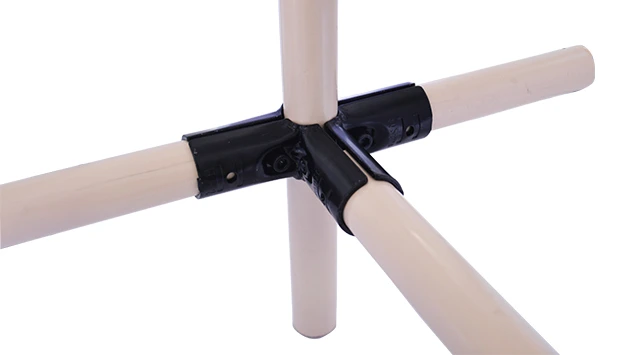
Four way lean pipe joint for 4 pcs 28MM lean pipe connection in straight angle, which used widely in workbench, flow rack, hand trolley frame connection.
The Need for Flexibility in Modern Manufacturing
In today's fast-paced manufacturing landscape, change is the only constant. Product life cycles are shorter than ever—what's trending today might be obsolete tomorrow. Consumer demands for customization mean factories must shift from mass production to small-batch, tailored output. And global supply chain disruptions force teams to adapt workflows on a dime. In this environment, rigid, one-size-fits-all production systems are no longer just inefficient—they're liabilities.
Traditional manufacturing setups, built with fixed steel frames, welded structures, or custom-machined components, were designed for stability. But stability often translates to inflexibility. When a new product line is introduced, or a workflow needs optimization, these systems require costly overhauls, lengthy downtime, and sometimes complete replacement. For small to mid-sized manufacturers, in particular, this rigidity can innovation and eat into already tight profit margins.
Enter lean systems—a philosophy built on efficiency, waste reduction, and adaptability. At the heart of these systems lies a simple yet powerful idea: production lines should be as dynamic as the markets they serve. And central to making that dynamism possible is a humble but revolutionary component: the lean pipe. But lean pipe alone isn't enough. To truly unlock modularity and reconfigurability, manufacturers rely on a critical connector: the four way straight lean pipe joint. Let's explore how this unassuming part is transforming factory floors worldwide.
Lean Systems and Lean Pipe: The Foundation of Flexibility
Before diving into the specifics of the four way straight lean pipe joint, it's important to understand the ecosystem it operates within: lean systems. Rooted in Toyota's production principles, lean manufacturing aims to eliminate waste (muda) in all forms—whether that's excess inventory, unnecessary movement, or downtime. But lean isn't just about cutting costs; it's about creating systems that respond —to customer needs, to process inefficiencies, and to change.
Lean pipe, also known as "flexible pipe" or "modular pipe," is the backbone of these responsive systems. Typically made from steel with a plastic coating (or increasingly, durable aluminum profile for lightweight strength), lean pipe is lightweight, easy to handle, and—most importantly—compatible with a range of connectors. Unlike rigid steel pipes, it doesn't require welding or specialized tools to assemble. This simplicity is key: it puts the power to modify systems directly into the hands of floor managers and operators, not just engineers or contractors.
But lean pipe's versatility is only as strong as the joints that hold it together. Early lean systems relied on basic two-way or three-way joints, which limited the complexity of structures. As manufacturers demanded more intricate, multi-directional setups—think workbenches with integrated shelving, flow racks with adjustable tiers, or conveyors that branch and merge—the need for a more adaptable connector became clear. That's where the four way straight lean pipe joint stepped in.

The Four Way Straight Lean Pipe Joint: A Connector with Purpose
At first glance, the four way straight lean pipe joint might seem like a simple piece of hardware. But its design is a masterclass in functional engineering. Let's break it down:
Design and Material: Most four way straight lean pipe joints are made from high-strength plastic, zinc-plated steel, or aluminum—materials chosen for durability, corrosion resistance, and lightweight handling. The joint features four equally spaced ports (hence "four way"), each sized to snugly fit standard lean pipe diameters (often 28mm or 30mm). Inside each port, a spring-loaded pin or set screw secures the pipe in place, ensuring a tight connection without damaging the pipe's surface.
Functionality: Unlike two-way joints (which connect pipes in a straight line) or three-way joints (which add a perpendicular branch), the four way straight joint allows for connections in four directions —typically up, down, left, and right. This multi-directional capability is game-changing. Imagine building a lean pipe workbench: with a four way joint, you can add a shelf above, a tool rack to the side, and a material bin below—all from a single connection point. No need for multiple joints or complicated assemblies.
Simplicity of Use: Perhaps most importantly, the four way joint requires no special tools. Operators can assemble or disassemble connections by hand, using just a hex key (for set screws) or even their fingers (for spring-loaded designs). This ease of use means reconfigurations that once took hours (or days) with traditional tools can now be done in minutes.
In short, the four way straight lean pipe joint is the "Swiss Army knife" of lean system components. It turns individual lean pipes into a modular building kit, where the only limit is the user's imagination (though we won't use that word here). But how does this translate to real-world production line flexibility?

Modularity: Building Systems That Grow with You
Modularity is the ability to build complex systems from simple, interchangeable parts. Think of it like building with Lego blocks: each piece (lean pipe, joint, accessory) works with every other piece, so you can create anything from a small storage rack to a full-scale assembly line—then take it apart and build something new. The four way straight lean pipe joint is the linchpin of this modularity.
Let's take a common example: the lean pipe workbench. In a traditional factory, a workbench is often a fixed piece of furniture—built to specific dimensions, with permanent shelves and tool holders. If a new product requires a wider workspace, or taller shelves, or a different layout, you either live with the mismatch (and suffer inefficiency) or buy a new workbench (and waste money). With a lean pipe workbench built using four way joints, the story is different.
Suppose your team needs to add a second level to the workbench to hold more tools. Using four way joints, you can simply attach vertical lean pipes to the existing frame, add horizontal pipes across the top, and secure a shelf—all in under an hour. If next month, you need to reposition the workbench to align with a new conveyor line, you can disassemble the upper shelves, move the base, and reassemble the structure in its new location. No saws, no welders, no wasted materials.
Another example: flow racks. These gravity-fed racks are essential for kanban systems, where materials flow from "supermarkets" to assembly lines. With traditional flow racks, the number of lanes and shelf heights are fixed. If you introduce a new component with a larger box, you might need to replace the entire rack. But with flow racks built using four way joints, you can adjust shelf heights by simply moving the joints up or down the vertical pipes, or add new lanes by connecting horizontal pipes to the existing frame. The system adapts to your materials, not the other way around.
Modularity also simplifies scaling. As your production volume grows, you don't need to invest in an entirely new system—just add more lean pipes and four way joints to expand your existing setup. A small assembly line can become a larger one; a single workbench can become a bank of workstations. This "pay-as-you-grow" model is a boon for startups and expanding businesses alike.
Reconfigurability: Adapting to Change in Minutes, Not Months
While modularity is about building systems from interchangeable parts, reconfigurability is about changing those systems quickly and efficiently. In manufacturing, downtime is the enemy—every minute a production line is idle costs money. The four way straight lean pipe joint slashes downtime by making reconfigurations faster, easier, and less disruptive than ever.
Consider a scenario common in electronics manufacturing: a factory that produces both smartphones and tablets. Smartphones are small, requiring compact workstations with precise tool placement. Tablets are larger, needing more surface area and different material flow paths. With a rigid production line, the factory might need two separate setups—one for each product. With a lean system built on four way joints, they can reconfigure the same line in hours.
Here's how it works: The base structure (lean pipes connected via four way joints) remains in place. Operators remove the small-part bins and replace them with larger ones, adjust the height of the conveyor rails using vertical joints, and reposition tool holders by moving horizontal pipes. By the end of the shift, the line is ready for tablets. The next day, if a rush order for smartphones comes in, the process reverses—all without calling in contractors or halting production for days.
The benefits of this reconfigurability are tangible:
- Cost Savings: Instead of investing in duplicate systems for different products, you use one system that adapts. A 2023 study by the Lean Manufacturing Institute found that manufacturers using modular lean systems with four way joints reduced equipment costs by 30-40% compared to rigid setups.
- Time Efficiency: Reconfiguring a lean pipe-based conveyor line takes an average of 2-3 hours, compared to 2-3 days for a traditional welded conveyor. That's a 90% reduction in downtime.
- Employee Empowerment: When operators can adjust their own workstations to fit their needs, morale and productivity rise. A survey by the Manufacturing Performance Institute found that factories with reconfigurable workbenches reported 15% higher operator satisfaction.
Reconfigurability also future-proofs your operation. When a new technology emerges—a collaborative robot, a automated inspection system—you don't need to redesign your entire line. Just add the new component using four way joints, and you're ready to go.
From Theory to Practice: Real-World Impact
To understand the true value of the four way straight lean pipe joint, let's look at a real-world case study (names changed for privacy).
Case Study: Automotive Parts Supplier
A mid-sized automotive parts supplier in the Midwest faced a challenge: their customers (major car manufacturers) were shifting to electric vehicles (EVs), which required smaller, more intricate components than traditional internal combustion engine parts. The supplier's existing production line, built with fixed steel workbenches and welded conveyors, was designed for larger parts and couldn't efficiently handle the new components.
Their options? Either invest $500,000 in a new dedicated EV parts line, or find a way to adapt their existing setup. They chose the latter, partnering with a lean pipe supplier to rebuild their workstations and material flow systems using lean pipe, aluminum profile, and—you guessed it—four way straight lean pipe joints.
Within two weeks, the team had transformed their line:
- Lean pipe workbenches were reconfigured with adjustable shelves (using four way joints) to hold smaller tools and component bins.
- Flow racks, previously used for large engine parts, were adapted with narrower lanes (connected via four way joints) to hold EV component trays.
- A section of conveyor was split into two smaller conveyors (using four way joints to redirect the flow) to separate incoming and outgoing parts.
The total cost? $75,000—less than 15% of the cost of a new line. Downtime? Just three days, compared to the estimated two weeks for a traditional overhaul. Six months later, the supplier reported a 25% increase in throughput and a 40% reduction in material handling errors—all thanks to a system that could adapt to the new parts.
This case study isn't an anomaly. From electronics assembly to food packaging, manufacturers across industries are leveraging four way joints to turn rigid lines into flexible ecosystems. And as customization demands grow, this trend is only accelerating.
Comparing Traditional vs. Lean Pipe Systems with Four Way Joints
Still not convinced? Let's put traditional rigid systems and lean pipe systems (with four way joints) head-to-head in a side-by-side comparison:
| Factor | Traditional Rigid Systems | Lean Pipe Systems with Four Way Joints |
|---|---|---|
| Setup Time | Weeks to months (requires welding, custom machining) | Hours to days (assembled by hand with basic tools) |
| Reconfiguration Time | Days to weeks (often requires disassembly and rebuilding) | Minutes to hours (modular parts can be rearranged on-site) |
| Cost (Initial + Long-Term) | High initial cost; high long-term cost (replacement needed for changes) | Lower initial cost; lower long-term cost (adaptable to changes) |
| Flexibility | Low (fixed dimensions and layout) | High (adjustable for size, layout, and function) |
| Scalability | Limited (adding capacity requires new systems) | High (easily expandable with additional pipes and joints) |
| Waste Reduction | High (discarded systems contribute to landfill waste) | Low (parts are reusable and recyclable) |
The data speaks for itself. Lean pipe systems with four way joints aren't just a "nice-to-have"—they're a strategic advantage in today's manufacturing landscape.
The Future of Lean Systems: Beyond the Four Way Joint
As manufacturing continues to evolve, so too will lean systems and their components. We're already seeing innovations like aluminum lean pipe (lighter and more durable than traditional steel) and smart joints with built-in sensors (to monitor vibration or stress, alerting teams to loose connections). But even with these advancements, the four way straight lean pipe joint will remain a cornerstone of modular design.
Why? Because its value lies in simplicity. In a world of increasingly complex technology, the ability to build, adapt, and rebuild systems with basic, reliable components is more valuable than ever. Whether paired with cutting-edge aluminum profile or classic steel lean pipe, the four way joint bridges the gap between old and new, ensuring that lean systems can evolve without losing their core strength: flexibility.
Conclusion: Building for a Flexible Future
The four way straight lean pipe joint is a small component with a big impact. It transforms lean pipe from a simple material into a dynamic building block, enabling manufacturers to create production lines that are modular, reconfigurable, and ready for whatever the future brings. In an industry where change is constant, this flexibility isn't just about efficiency—it's about survival.
Whether you're building a lean pipe workbench for a small workshop or a full-scale conveyor system for a multinational factory, the four way joint is the key to unlocking your system's full potential. It's proof that sometimes, the most revolutionary innovations aren't the flashy new technologies—but the simple, smart solutions that make everyday work easier, faster, and more adaptable.
So the next time you walk through a factory, take a closer look at the workbenches, racks, and conveyors. Chances are, you'll spot a four way straight lean pipe joint holding it all together—quietly, efficiently, and ready for whatever comes next.