- Company Articles
- Products and Technology
- Solution
- How Free Flow Chain Conveyors Support Just-In-Time (JIT) Manufacturing

How Free Flow Chain Conveyors Support Just-In-Time (JIT) Manufacturing
Related Product
Free Flow Chain Conveyor
The free flow conveyor system uses a free flow chain that can increase the speed of the tooling board that supports the products. This can improve the efficiency and quality of the production process, as well as reduce the wear and tear of the system.
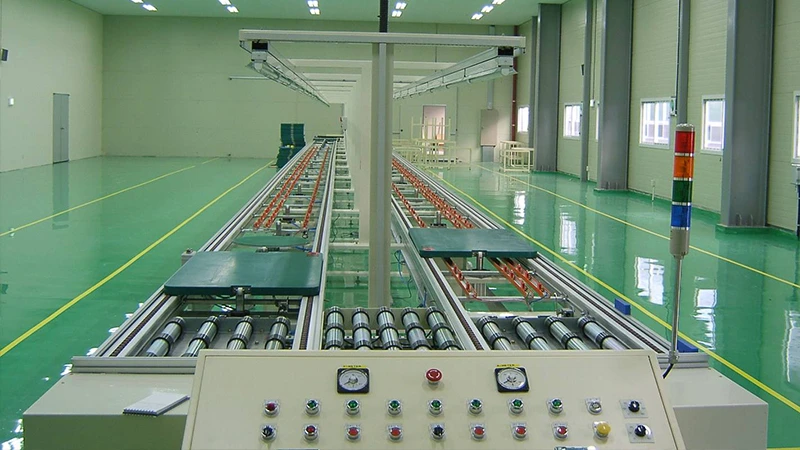
Bridging material flow and lean principles for smarter, more efficient production
Understanding Just-In-Time (JIT) Manufacturing
In the fast-paced world of manufacturing, where every second and every cent counts, Just-In-Time (JIT) manufacturing has emerged as more than just a buzzword—it's a philosophy that redefines how products are made. At its core, JIT is about producing exactly what is needed, when it is needed, and in the exact quantity needed . Originating in post-WWII Japan, popularized by Toyota, this approach was born from the need to do more with less: less space, less inventory, and less waste. Today, it's a cornerstone of lean manufacturing, adopted by industries worldwide from automotive to electronics, and its success hinges on one critical element: seamless material flow .
JIT's guiding principles read like a manifesto for efficiency: eliminate waste (or muda ), prioritize continuous improvement ( kaizen ), empower workers, and build quality into every step. Waste, in JIT terms, isn't just physical trash—it includes overproduction, excess inventory, waiting times, unnecessary transportation, and even unused worker creativity. To stamp out these inefficiencies, manufacturers need systems that respond to demand in real time, minimize delays, and keep production lines moving without bottlenecks. And that's where material handling solutions—specifically, free flow chain conveyors—step into the spotlight.
The Make-or-Break Role of Material Handling in JIT
Imagine a factory floor where piles of (semi-finished goods) clutter corners, workers spend hours hunting for parts, and materials sit idle for days before being used. This is the antithesis of JIT. In a JIT system, materials must flow like water: smoothly, precisely, and only when called upon. Without a reliable way to move parts from storage to assembly lines, or from one workstation to the next, the entire JIT framework collapses. Excess inventory piles up, production delays creep in, and the "just-in-time" promise fades into just-in-case chaos.
Material handling isn't just about moving things—it's about orchestrating movement. It's the circulatory system of a manufacturing plant, ensuring that the right components reach the right place at the right time. For JIT, this means handling systems must be flexible enough to adapt to changing production schedules, precise enough to avoid over-delivery, and efficient enough to eliminate waiting. Traditional conveyors, with their fixed speeds and rigid paths, often fall short here. They can't easily adjust to sudden shifts in demand or integrate with the smaller, more frequent material transfers that JIT requires. This is where free flow chain conveyors shine: they're designed to align with JIT's need for responsiveness and precision.
Free Flow Chain Conveyors: What Are They, and How Do They Work?
At first glance, a free flow chain conveyor might look like any other conveyor system—a series of rollers or chains moving along a track. But look closer, and you'll notice a key difference: the chain (or roller) movement is unpowered, relying instead on gravity or gentle manual pushing . This design choice is intentional. Unlike motorized conveyors that run continuously, free flow chain conveyors let materials move only when triggered by downstream demand. Think of it as a "pull" system for parts: a worker at an assembly station takes a component from the conveyor, and gravity (or a light push) pulls the next component forward, ready for use. No wasted energy, no unnecessary movement—just materials in motion only when needed .
Most free flow chain conveyors consist of a track (often aluminum or steel) with mounted rollers or a continuous chain. The track is typically sloped slightly (a 3-5 degree incline is common) to leverage gravity, ensuring parts glide forward smoothly. Some designs include plastic or rubber rollers to reduce noise and prevent damage to delicate components, making them ideal for electronics or automotive parts. What truly sets them apart, though, is their modularity. Sections can be added or removed, tracks can be curved or straight, and they can easily integrate with other lean tools like flow racks, workbenches, and roller tracks. This flexibility makes them a cornerstone of adaptable manufacturing systems—exactly what JIT demands.
5 Ways Free Flow Chain Conveyors Support JIT Principles
Free flow chain conveyors aren't just tools—they're enablers of JIT. Let's break down how they align with the philosophy's core goals:
1. Enabling the Pull System: Materials Move When Demand Calls
JIT's "pull" system is the opposite of traditional "push" manufacturing, where production plans dictate material flow (and often result in overproduction). In a pull system, production is triggered by actual customer orders or downstream workstation needs. For example, when a worker at a final assembly workbench finishes a unit, they signal for the next subassembly to be sent from the previous station. Free flow chain conveyors make this pull system tangible. Because materials only move when manually or gravity-assisted, there's no risk of parts piling up at a workstation that isn't ready for them. A worker simply takes what they need, and the next part slides into place—no excess, no waiting, just a steady, demand-driven flow.
2. Slashing Inventory Waste: No More "Just-In-Case" Stockpiles
Inventory waste is JIT's arch-nemesis. Storing excess parts ties up capital, takes up floor space, and risks obsolescence (especially in fast-changing industries like tech). Free flow chain conveyors combat this by limiting the number of parts that can be on the line at any time. The conveyor track's length and roller spacing act as a natural "buffer" for inventory—you can only fit so many components before the track is full. This forces manufacturers to replenish parts in small, frequent batches (a practice called kanban , or "signal card" replenishment). For example, a flow rack feeding into a free flow conveyor might hold 10 subassemblies. When the 10th is taken, a kanban card is sent to the warehouse, triggering a refill of exactly 10 more. No overstock, no understock—just the right amount, just in time.
3. Smoothing Production Flow: Eliminating Bottlenecks and Delays
In JIT, a single bottleneck can disrupt the entire production line. If one workstation is waiting for parts, downstream stations slow down, and upstream stations may overproduce to compensate. Free flow chain conveyors reduce this risk by creating a continuous, visible flow of materials. Because parts are always in motion (when needed), workers can see at a glance if a station is running low or if there's a backup. For example, a supervisor walking the line might notice that parts are piling up before a workbench—signaling that the worker there might need help, or that the conveyor's incline needs adjustment. This visibility makes it easy to spot and fix issues before they escalate into bottlenecks.
4. Supporting Continuous Improvement (Kaizen)
JIT isn't a one-and-done system—it's a journey of constant tweaking and improvement. Free flow chain conveyors are built for this. Their modular design means they can be reconfigured in hours, not days. Need to add a new workstation? Simply extend the conveyor track. Switching to a larger part? Swap out the rollers for wider ones. This adaptability lets manufacturers experiment with layout changes, test new workflows, and refine their processes without major downtime. Over time, these small adjustments add up, driving greater efficiency and aligning the production line even more closely with JIT goals.
5. Integrating with Other Lean Tools: A Holistic Approach
JIT success rarely comes from a single tool—it's the sum of many lean systems working together. Free flow chain conveyors excel at playing well with others. For example, they often pair with flow racks (tilted racks that use gravity to feed parts into the conveyor) to create a seamless path from storage to assembly. Workbenches are positioned alongside the conveyor, so workers can grab parts without walking away from their stations, reducing motion waste. Even roller tracks (short, gravity-fed tracks) can connect different conveyor sections, ensuring materials move smoothly around corners or between floors. Together, these tools form a lean ecosystem where every component supports the goal of efficient, demand-driven production.
Real-World Impact: How Free Flow Conveyors Transform JIT in Action
Let's paint a picture of how this all comes together in a real manufacturing setting. Imagine a small electronics plant producing smartwatches—a product with hundreds of tiny components, where precision and speed are critical. The plant adopted JIT five years ago but struggled with material delays and excess inventory until it installed free flow chain conveyors.
Today, here's what the line looks like: Raw circuit boards arrive from the supplier in small kanban batches and are stored in flow racks near the production floor. Each flow rack feeds into a free flow chain conveyor, which slopes gently toward the first assembly workbench. A worker at the bench takes a circuit board from the conveyor, attaches a battery (also delivered via a parallel conveyor line), and pushes the partially assembled unit onto a connecting roller track. The roller track sends it to the next station, where a screen is added, and so on. At each step, the conveyor only moves when the next worker takes a unit—no piles, no waiting.
The results? Inventory costs dropped by 35% in the first year, since the plant no longer stores weeks of components. Production lead times shortened from 10 days to 3 days, as materials flow directly to where they're needed. And workers report less fatigue, since they no longer walk to storage areas to fetch parts—everything comes to them, right at their workbench. It's JIT in action, powered by the quiet efficiency of free flow chain conveyors.
Beyond JIT: Additional Benefits of Free Flow Chain Conveyors
While JIT support is their biggest selling point, free flow chain conveyors offer advantages that extend beyond lean manufacturing:
- Cost savings: No motors or complex electrical systems mean lower upfront and maintenance costs compared to powered conveyors.
- Quiet operation: Gravity-driven movement reduces noise, creating a more pleasant work environment.
- Ergonomics: Conveyors can be adjusted to waist height, reducing bending and lifting for workers.
- Scalability: Start small with a single conveyor line, then add sections as production grows.
Choosing the Right Free Flow Chain Conveyor for Your Lean System
Not all free flow chain conveyors are created equal. To maximize JIT benefits, consider these factors when selecting a system:
Load capacity: Will you be moving small electronics (ounces) or heavy automotive parts (pounds)? Choose a conveyor with rollers/chains rated for your typical load.
Incline angle: Too steep, and parts might slide too fast; too shallow, and they might get stuck. Test different angles with your actual parts to find the sweet spot.
Environment: For cleanrooms (like semiconductor manufacturing), look for stainless steel or aluminum conveyors with anti-static rollers. For warehouses with dust, opt for enclosed chain designs to prevent jamming.
Integration with existing tools: Ensure the conveyor can connect with your flow racks, workbenches, and roller tracks. Many suppliers offer custom adapters for seamless integration.
Supplier support: A good lean system supplier will help you design the conveyor layout, train your team, and provide ongoing maintenance tips. Look for suppliers with experience in JIT implementations—they'll understand your unique needs.
Free Flow Chain Conveyors vs. Traditional Conveyors: A Quick Comparison
| Feature | Free Flow Chain Conveyors | Traditional Motorized Conveyors | JIT Advantage |
|---|---|---|---|
| Power Source | Gravity or manual push | Electric motor | Free flow: No energy waste; runs only when needed |
| Material Flow | Pull-based (demand-driven) | Push-based (scheduled) | Free flow: Reduces overproduction and inventory |
| Flexibility | Modular; easy to reconfigure | Rigid; fixed path/speed | Free flow: Supports continuous improvement (kaizen) |
| Cost | Lower upfront and maintenance | Higher (motors, electrical systems) | Free flow: Better ROI for small-batch production |
| Noise Level | Quiet (no motor) | Can be loud (motor/chain noise) | Free flow: Improves worker comfort and focus |
Conclusion: Free Flow Chain Conveyors—The Unsung Heroes of JIT
Just-In-Time manufacturing is about more than cutting costs—it's about building a smarter, more responsive production system that puts customer demand at the center. And at the heart of that system is material flow. Free flow chain conveyors may not have the flash of high-tech robotics, but their quiet, gravity-driven efficiency makes them indispensable for JIT success. By enabling pull-based production, reducing inventory waste, smoothing flow, and integrating with other lean tools like flow racks and workbenches,they turn the abstract principles of JIT into tangible results: lower costs, faster lead times, and happier workers.
So, if you're on the journey to JIT, don't overlook the power of a well-designed conveyor system. It might just be the missing link between your lean system goals and real-world success.