- Company Articles
- Products and Technology
- Product knowledge
- How Height Adjustment Works in Flat Adjustable Swivel Castor Wheels

How Height Adjustment Works in Flat Adjustable Swivel Castor Wheels
Related Product
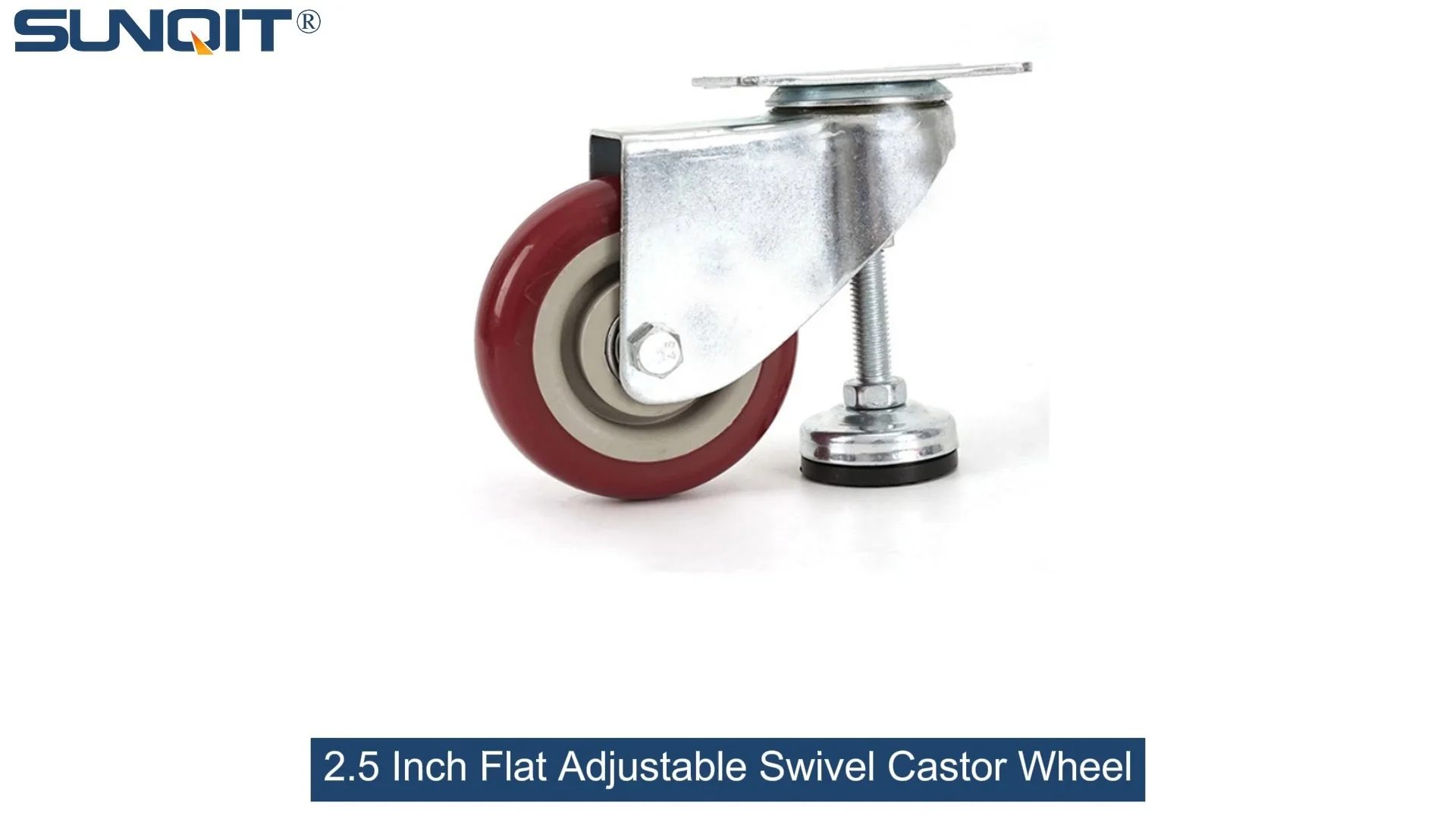
Flat Adjustable Swivel Castor Wheel
Swivel Chair Casters Ball Bearing Wheels Rubber Base with adjustable height function. Resistant to abrasion, impact and corrosion. Heavy payload can hold 80Kgs per pcs,which can make it works at a stable and smooth status.
Introduction: The Unsung Heroes of Workplace Mobility
In the bustling world of manufacturing plants, warehouses, and laboratories, there's a quiet workhorse that keeps operations moving smoothly: the caster wheel. These small but mighty components attach to everything from workbenches and material trolleys to medical equipment and assembly line stations, allowing for easy movement and repositioning. But not all casters are created equal. Among the most versatile and problem-solving types are flat adjustable swivel castor wheels—devices designed not just to roll, but to adapt. Their defining feature? Height adjustment. This seemingly simple function can mean the difference between a wobbly workstation, inefficient material flow, and even safety hazards, versus a stable, precise, and productive workspace.
Think about a typical scenario: a busy electronics assembly line where delicate components are moved from one station to another. The floor, though leveled as best as possible, has subtle dips from years of heavy equipment use. A standard caster might roll fine, but the workbench it supports tilts slightly, causing parts to slide or workers to strain their wrists adjusting to the uneven surface. Now, replace those standard casters with flat adjustable swivel castor wheels. With a quick twist or turn, the height of each caster can be (fine-tuned) to compensate for the floor's imperfections, stabilizing the workbench and ensuring everything stays in place. That's the power of height adjustment—and it's why these casters have become indispensable in precision-driven industries.
In this article, we'll dive deep into how height adjustment works in flat adjustable swivel castor wheels. We'll break down their components, explore the mechanics behind the adjustment, discuss their real-world applications, and even touch on maintenance tips to keep them performing at their best. Whether you're a facility manager looking to optimize your workspace, a purchasing agent researching caster options, or simply curious about the engineering that makes modern workplaces run, this guide will give you a comprehensive understanding of these essential tools.
What Are Flat Adjustable Swivel Castor Wheels?
Before we get into the nitty-gritty of height adjustment, let's clarify what exactly a flat adjustable swivel castor wheel is. At its core, it's a caster wheel assembly that combines three key features: "flat" (referring to the mounting plate, which is typically flat and designed to attach to the bottom of equipment), "adjustable" (the ability to change the height of the wheel relative to the mounting plate), and "swivel" (the wheel can rotate 360 degrees, allowing for multidirectional movement). Unlike fixed casters, which only roll forward and backward, or non-adjustable swivel casters, which offer movement but no height control, these wheels are a hybrid of mobility, flexibility, and precision.
Flat adjustable swivel castor wheels are engineered for stability and adaptability. They're commonly used in settings where equipment needs to be both mobile and stationary for extended periods—think workbenches that are moved to a new line for a production run, then locked in place and leveled for hours of assembly work. The "flat" mounting plate ensures a secure connection to the equipment, distributing weight evenly to prevent wobbling, while the swivel function allows for easy maneuvering in tight spaces. But the star feature, of course, is the height adjustment mechanism, which turns a basic caster into a tool for customization.
These casters come in various sizes, load capacities, and materials to suit different environments. For example, in cleanrooms or food processing facilities, you might find stainless steel versions with non-marking wheels, while in heavy-duty manufacturing, reinforced steel or aluminum components with larger wheels are more common. But regardless of the material, the height adjustment mechanism remains a central design element, tailored to the specific demands of the application.

Key Components: The Building Blocks of Adjustment
To understand how height adjustment works, we first need to unpack the components of a flat adjustable swivel castor wheel. While designs can vary slightly between manufacturers, most share these core parts:
- Mounting Plate: The flat, metal (often steel or aluminum) plate that attaches to the bottom of the equipment. It's drilled with holes for bolts or screws, ensuring a rigid connection.
- Swivel Head: The mechanism that allows the caster to rotate 360 degrees. It sits between the mounting plate and the wheel assembly, containing bearings or bushings to reduce friction during rotation.
- Adjustment Housing: A cylindrical or rectangular casing that houses the height adjustment mechanism. It's connected to the swivel head and contains internal threads, gears, or levers that control the height.
- Stem or Screw Mechanism: The part that actually moves up or down to adjust height. This is often a threaded rod or stem that, when rotated, extends or retracts relative to the adjustment housing.
- Wheel Assembly: The wheel itself, mounted on an axle, along with a bracket that connects to the bottom of the stem. Wheels can be made of rubber, polyurethane, nylon, or steel, depending on load capacity and floor type.
- Locking Mechanism: Some models include a lock to secure the adjusted height, preventing unintended movement once set. This could be a nut that tightens against the adjustment housing or a cam lever that clamps the stem in place.
- Caster Accessories: Optional add-ons like brake pedals (to lock the wheel in place when stationary), dust covers for the adjustment mechanism, or non-slip pads on the mounting plate for extra stability.
Each component plays a role in the adjustment process, but the stars are the adjustment housing and the stem/screw mechanism. Together, they form a system that converts rotational motion (turning a knob or tool) into linear motion (raising or lowering the wheel). Let's take a closer look at how this conversion happens.

The Mechanics of Height Adjustment: How It All Moves
At its simplest, height adjustment in flat adjustable swivel castor wheels relies on one of two primary mechanisms: threaded stems or cam levers. Threaded stems are the most common, favored for their precision and ability to handle heavy loads. Cam levers, on the other hand, are faster to adjust but are typically used for lighter applications where quick, incremental changes are needed. Let's break down each mechanism.
1. Threaded Stem Mechanism: Precision Through Rotation
Imagine a bolt and nut: twist the bolt, and it moves up or down relative to the nut. That's the basic idea behind the threaded stem mechanism. In a flat adjustable swivel castor, the adjustment housing acts as the "nut," with internal threads, while the stem (connected to the wheel assembly) is the "bolt," with matching external threads. When you rotate the stem (via a knob, hex key, or wrench), it screws into or out of the housing, raising or lowering the wheel relative to the mounting plate.
Here's a step-by-step breakdown of how it works in action:
- Initiating Adjustment: The user grips a knob attached to the top of the stem (or inserts a tool, like an Allen wrench, into a socket on the stem). Some models have a plastic or rubber grip for easy manual turning, while others require a tool for added torque, especially in heavy-duty applications.
- Rotating the Stem: Turning the stem clockwise (righty-tighty) causes it to screw into the adjustment housing, shortening the distance between the mounting plate and the wheel. This lowers the overall height of the caster. Turning it counterclockwise (lefty-loosey) unscrews the stem from the housing, increasing the distance and raising the height.
- Fine-Tuning: Threaded stems allow for precise, incremental adjustments—often as small as 0.5mm per full rotation. This is critical in applications like laboratory workbenches, where even a tiny tilt can affect measurements or experiments.
- Locking in Place: Once the desired height is reached, some models include a lock nut on the stem. Tightening this nut against the adjustment housing prevents the stem from rotating back due to vibration or weight, securing the height setting.
The key advantage of the threaded mechanism is its stability. Threads create a mechanical lock that resists movement under load, making it ideal for heavy equipment (think 500kg+ workbenches). The tradeoff? Adjustment can take a few extra seconds compared to lever-based systems.
2. Cam Lever Mechanism: Speed and Simplicity
For applications where quick height changes are needed—like in retail settings, where display racks are frequently reconfigured—cam lever mechanisms shine. Instead of threads, these use a lever and a cam (a rotating, egg-shaped or triangular piece) to adjust height. When the lever is flipped, the cam presses against a plate or rod, lifting or lowering the wheel assembly.
Here's how it operates:
- Releasing the Lever: The user lifts or pulls the lever, which unlocks the cam from its current position.
- Adjusting Height: With the cam released, the stem (connected to the wheel) can be moved up or down manually. Some models have preset height notches or detents, allowing for quick, click-stop adjustments at specific intervals (e.g., 5mm increments).
- Locking the Lever: Flipping the lever back down rotates the cam, which presses against the adjustment housing or a locking plate, clamping the stem in place. The cam's shape creates a mechanical advantage, ensuring a tight lock even under moderate loads.
Cam lever systems are faster to adjust than threaded ones—no twisting, just flip and set—but they typically have lower load capacities (often under 200kg) and less precise adjustment increments. They're popular in light-duty settings where mobility and quick reconfiguration are prioritized over heavy lifting.

Types of Height Adjustment: Manual vs. Tool-Assisted
Beyond the mechanism (threaded vs. cam), height adjustment in flat adjustable swivel castor wheels can also be categorized by how the user initiates the adjustment: manually (by hand) or with a tool. Each has its place, depending on the application's needs.
Manual Adjustment: Convenience at Your Fingertips
Manual adjustment is exactly what it sounds like: the user adjusts the height by turning a knob or lever with their hand, no tools required. These models often have large, ergonomic knobs made of rubber or plastic, designed for easy gripping even with gloves on (common in manufacturing). They're ideal for applications where adjustments are frequent and need to be done quickly—for example, in a warehouse where trolleys are moved between different floor surfaces (concrete, tile, carpet) and need height tweaks to maintain stability.
Pros: Fast, no tools needed, user-friendly. Cons: Limited torque—can't handle extremely tight or heavy adjustments without risking hand strain. Best for loads under 300kg and environments where quick changes are key.
Tool-Assisted Adjustment: Torque for Heavy-Duty Needs
Tool-assisted adjustment requires a wrench, hex key, or socket to turn the stem. This design is common in heavy-duty flat adjustable swivel castor wheels, where the stem threads are larger (for higher load capacity) and require more torque to rotate. For example, a steel workbench in an automotive factory that weighs 800kg would need tool-adjustable casters—the extra torque from a wrench ensures the stem can be tightened securely, preventing it from unscrewing under the bench's weight.
Pros: Higher torque, better for heavy loads, more secure (less likely to accidentally adjust). Cons: Requires a tool, slower adjustment. Best for heavy equipment, high-stability applications, or environments where vibration might loosen manual knobs.
Applications: Where Height Adjustment Makes a Difference
Flat adjustable swivel castor wheels aren't just a "nice-to-have"—they're a "need-to-have" in specific industries and scenarios. Here are some of the most common applications where their height adjustment feature proves invaluable:
1. Manufacturing and Assembly Workbenches
In manufacturing, especially precision sectors like electronics, aerospace, or medical device production, workbenches must be level to within millimeters. Even a slight tilt can cause small parts to roll off, misalign components during assembly, or lead to worker fatigue (from hunching or straining to compensate). Flat adjustable swivel castor wheels allow each corner of the workbench to be leveled independently, ensuring the surface is perfectly flat regardless of floor imperfections. They also make it easy to reposition the workbench for line reconfigurations, then re-level it in minutes.
2. Laboratory and Cleanroom Equipment
Laboratories rely on stable surfaces for experiments, balances, and microscopes. A wobbly centrifuge or microscope stage can ruin hours of work. Additionally, cleanrooms often have strict protocols for equipment placement and mobility—components must be moved without scratching floors or creating dust. Flat adjustable swivel castor wheels with non-marking, soft rubber wheels and precise height adjustment meet both needs: they protect floors, allow for easy cleaning around equipment, and ensure instruments stay level during use.
3. Material Handling Trolleys
Trolleys used to transport goods in warehouses or distribution centers often need to interface with conveyor belts, racks, or loading docks of varying heights. For example, a trolley carrying boxes might need to align perfectly with a conveyor to slide items on smoothly. With height-adjustable casters, the trolley's deck can be raised or lowered to match the conveyor's height, eliminating the need for ramps or manual lifting—reducing worker strain and speeding up loading/unloading.
4. Medical and Healthcare Equipment
In hospitals, mobile carts (for medications, surgical tools, or patient monitors) must be stable during use but easy to move between rooms. Floors in hospitals are often uneven due to thresholds between departments or wear from constant foot traffic. Height-adjustable casters ensure carts stay level when parked, preventing items from spilling, and their swivel function allows for easy maneuvering in tight hallways. Some models even include brakes and height locks for added safety during procedures.
Benefits: Why Height Adjustment Matters
At this point, it's clear that height adjustment is more than a gimmick—it's a functional feature with tangible benefits for workplaces. Let's summarize the key advantages of flat adjustable swivel castor wheels:
- Stability: By compensating for uneven floors, these casters prevent equipment from wobbling, reducing the risk of spills, falls, or damaged goods.
- Precision: In applications like assembly or lab work, precise height control ensures surfaces are level, improving accuracy and reducing errors.
- Safety: A stable workstation reduces worker strain (no more leaning to counteract tilting) and lowers the risk of trips or falls from unstable equipment.
- Flexibility: Easily reconfigure workspaces, align equipment with varying heights (e.g., conveyors, racks), or adapt to changing floor conditions.
- Cost Savings: Reduced damage to equipment and goods, fewer workplace injuries, and increased productivity all add up to lower operational costs over time.
Comparing Caster Types: When to Choose Flat Adjustable Swivel
Flat adjustable swivel castor wheels aren't the only option on the market. To understand when they're the best choice, let's compare them to other common caster types:
| Caster Type | Height Adjustment | Swivel Ability | Load Capacity | Best For |
|---|---|---|---|---|
| Flat Adjustable Swivel | Yes (manual/tool-assisted) | 360° | Medium to heavy (200-1000kg+) | Precision workbenches, lab equipment, adjustable-height trolleys |
| Fixed Caster | No | No (only forward/backward) | Heavy (500-2000kg+) | Straight-line movement (e.g., conveyor systems, large machinery) |
| Non-Adjustable Swivel | No | 360° | Light to heavy (100-1500kg) | General mobility (e.g., office chairs, light trolleys) |
| Heavy-Duty Adjustable (Non-Flat) | Yes (often hydraulic/pneumatic) | 360° (some) | Very heavy (1000kg+) | Industrial machinery, forklift attachments |
As the table shows, flat adjustable swivel castor wheels strike a balance between mobility (swivel), adaptability (height adjustment), and load capacity, making them the go-to for applications where precision and flexibility are key. They're not the best choice for ultra-heavy machinery (that's where hydraulic adjustable casters come in) or purely straight-line movement (fixed casters excel there), but for most medium-duty, precision-driven tasks, they're unmatched.
Maintenance: Keeping Adjustment Smooth
Like any mechanical device, flat adjustable swivel castor wheels require regular maintenance to keep their height adjustment mechanisms working smoothly. Here are some tips to ensure longevity and performance:
- Clean Regularly: Dust, debris, and grease can clog the adjustment housing or threads. Wipe down the caster with a damp cloth, and use a small brush (like a toothbrush) to clean around the stem and swivel head.
- Lubricate Threads: For threaded mechanisms, apply a light machine oil or silicone lubricant to the stem threads every 3-6 months (more often in dusty or wet environments). This prevents rust and ensures smooth rotation.
- Inspect for Wear: Check the threads for stripping, the swivel head for loose bearings, and the wheel for cracks or flat spots. replace worn parts promptly—stripped threads, for example, can make height adjustment impossible or unsafe.
- Tighten Lock Nuts: If your caster has a lock nut to secure the height, check it periodically. Vibration can loosen it over time, causing the stem to adjust unintentionally.
- Avoid Overloading: Exceeding the caster's load capacity can bend the stem or strip the threads, rendering height adjustment useless. Always check the manufacturer's load rating before installation.
By following these steps, you can extend the life of your flat adjustable swivel castor wheels and ensure their height adjustment feature remains reliable for years.
Conclusion: The Future of Adaptive Mobility
Flat adjustable swivel castor wheels may not be the most glamorous pieces of equipment in a factory or lab, but their impact is undeniable. By combining mobility (swivel), stability (flat mounting), and adaptability (height adjustment), they solve a common workplace problem: uneven floors and varying height needs. Whether through threaded stems for precision or cam levers for speed, their height adjustment mechanisms turn a basic wheel into a tool for efficiency, safety, and productivity.
As workplaces continue to evolve—becoming more automated, more flexible, and more focused on worker well-being—the demand for adaptive tools like these casters will only grow. Manufacturers are already innovating, adding features like integrated brakes, corrosion-resistant materials, and even electronic height adjustment for ultra-precise applications. But at their core, the principle remains the same: making workspaces not just functional, but adaptable.
So the next time you see a stable workbench, a smoothly loading trolley, or a level lab instrument, take a moment to look down. Chances are, there's a flat adjustable swivel castor wheel hard at work—quietly adjusting, supporting, and keeping the world of work moving forward.