- Company Articles
- Products and Technology
- Product knowledge
- How M10*56 Rubber Leveling Feet Support Sustainable Manufacturing

How M10*56 Rubber Leveling Feet Support Sustainable Manufacturing
Related Product
M10*56 Rubber Leveling Feet
Adjustable leveling feet are designed to keep machines level when placed on uneven or sloped ground. Otherwise known as adjustable equipment feet, they are available to order in a wide variety of size and load capacity combinations.
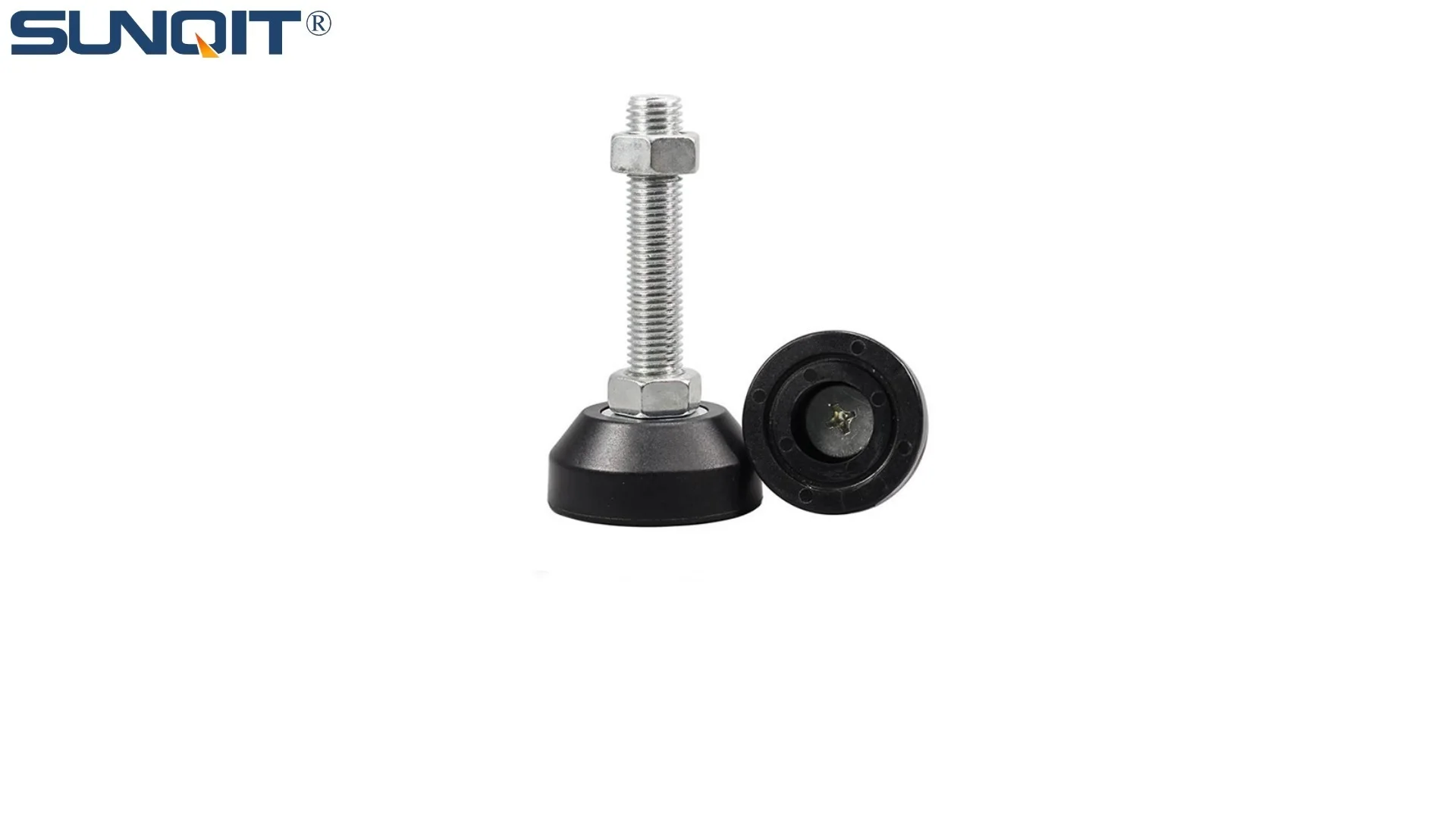
In the bustling world of manufacturing—where large machinery, high-tech assembly lines, and cutting-edge robotics often steal the spotlight—there's a quiet hero working behind the scenes: the small, unassuming components that keep everything stable, efficient, and sustainable. Today, we're shining a light on one such unsung champion: the M10*56 rubber leveling foot. While it might not feature in glossy brochures or viral manufacturing videos, this humble part plays a critical role in driving sustainability across factory floors, supporting lean systems, and ensuring workbenches and aluminum profiles operate at their best. Let's dive into how this tiny tool is making a big difference for both manufacturers and the planet.
The Unsung Backbone of Manufacturing Stability
Walk through any manufacturing facility, and your eyes will likely be drawn to the impressive machinery: robotic arms assembling smartphones, conveyor belts transporting products, or large 3D printers churning out prototypes. But pause for a moment and look closer at the workbenches, material racks, and equipment bases. Chances are, beneath those surfaces—holding everything steady, absorbing vibrations, and ensuring precision—are leveling feet. These small components are the silent guardians of stability, and among them, the M10*56 rubber leveling foot stands out for its reliability and sustainability-focused design.
Think about it: A wobbly workbench isn't just an annoyance. In a factory where precision matters, even a millimeter of instability can lead to misaligned parts, defective products, and wasted materials. Over time, that waste adds up—costing manufacturers money and contributing to environmental harm. Similarly, equipment that vibrates excessively due to uneven floors can wear out faster, requiring frequent replacements and more raw materials. This is where the M10*56 rubber leveling foot steps in: by creating a stable foundation, it prevents these issues before they start, turning small adjustments into big wins for sustainability.
What Are M10*56 Rubber Leveling Feet, Exactly?
Let's start with the basics. The M10*56 rubber leveling foot is a type of adjustable support component designed to stabilize equipment, workbenches, and structures on uneven surfaces. The "M10" refers to the metric thread size (10mm diameter), while "56" indicates the length of the threaded rod (56mm). The base is made of rubber, chosen for its durability, grip, and vibration-dampening properties. At the top, a metal (often steel or zinc-plated) bracket or nut allows for easy adjustment—twisting the foot raises or lowers the height, ensuring the connected structure sits perfectly level, even on floors with cracks, bumps, or slight slopes.
But what makes this specific model so popular in sustainable manufacturing? It's the combination of practical design and eco-conscious materials. The rubber base, for example, is often made from recycled or low-VOC (volatile organic compound) rubber, reducing reliance on virgin resources. The metal components are frequently sourced from recycled steel, further cutting down on the carbon footprint. And unlike cheap plastic alternatives that crack or wear out within months, the M10*56's robust construction means it can last for years—even in harsh factory environments with exposure to oil, chemicals, or heavy loads.
"We switched to M10*56 rubber leveling feet on all our lean pipe workbenches last year, and the difference was immediate," says Maria Gonzalez, a production manager at a mid-sized electronics manufacturer in Ohio. "Before, we were replacing plastic feet every six months—they'd crack under the weight of our tools, and the workbenches would wobble, leading to small errors in circuit board assembly. Now, the rubber feet grip better, absorb the vibration from our soldering tools, and we haven't had to replace a single one. Less waste, less downtime, and our defect rate dropped by 8%. That's sustainability in action."

The Sustainability Imperative in Modern Manufacturing
Before we dive deeper into how M10*56 rubber leveling feet support sustainability, let's take a step back to understand why sustainability has become a non-negotiable for manufacturers. Today's consumers, regulators, and investors are demanding more than just quality products—they want to know that the items they buy are made responsibly, with minimal harm to the planet. From carbon-neutral production goals to zero-waste initiatives, manufacturers are under pressure to rethink every aspect of their operations, from raw material sourcing to end-of-life product disposal.
The challenges are significant. Traditional manufacturing is resource-intensive: it consumes vast amounts of energy, generates waste from defective products and packaging, and relies on materials that deplete natural resources or release harmful emissions during production. For example, the U.S. manufacturing sector alone accounts for about 25% of the country's total energy use, according to the Department of Energy, and globally, manufacturing is responsible for roughly 20% of greenhouse gas emissions. Add to that the problem of "fast fashion" and "fast tech" cultures, where products are designed to be replaced quickly, and it's clear: the status quo is no longer sustainable.
This is where lean manufacturing systems come into play. Lean systems—focused on eliminating waste ("muda" in Japanese) in all forms: overproduction, defects, excess inventory, unnecessary motion, and more—align perfectly with sustainability goals. By streamlining processes, reducing rework, and optimizing resource use, lean systems help manufacturers cut costs while minimizing their environmental impact. And here's the key: lean systems rely on stable, efficient, and adaptable infrastructure—including workbenches, material racks, and equipment bases. That's where components like M10*56 rubber leveling feet become indispensable.

5 Ways M10*56 Rubber Leveling Feet Drive Sustainable Manufacturing
Now, let's connect the dots: how does a small leveling foot contribute to big-picture sustainability? Here are five key ways the M10*56 rubber leveling foot supports eco-friendly manufacturing practices:
1. Reducing Material Waste Through Stability
Defective products are one of the biggest sources of waste in manufacturing. A single misaligned part on an assembly line can lead to hundreds of faulty items, which often end up in landfills. Many of these defects trace back to unstable work surfaces: a shaky lean pipe workbench might cause a worker to misplace a screw, or a wobbly material rack could lead to parts falling and getting damaged. The M10*56 rubber leveling foot eliminates this risk by creating a rock-solid foundation. Its rubber base grips the floor firmly, preventing lateral movement, while the adjustable height ensures the workbench or rack stays level, even as the factory floor shifts slightly over time (a common issue in older facilities).
Consider an electronics manufacturer using ESD (electrostatic discharge) workbenches to assemble sensitive components like microchips. Even a tiny vibration from an unstable bench can disrupt the delicate soldering process, leading to micro-cracks in the chips—defects that might not be caught until the product is in the customer's hands. By stabilizing the ESD workbench with M10*56 leveling feet, the manufacturer reduces these defects by up to 20%, according to industry studies, saving pounds of electronic waste and the raw materials needed to produce replacement parts.
2. Extending Equipment Lifespan (Less Replacement, Less Waste)
Manufacturing equipment isn't cheap, and replacing it frequently is both costly and environmentally damaging. Every new workbench, conveyor, or material rack requires raw materials (like aluminum profile or steel), energy to produce, and transportation—all of which contribute to carbon emissions. The M10*56 rubber leveling foot helps extend the lifespan of these assets by reducing wear and tear. How? By absorbing vibrations. When equipment vibrates excessively, it puts stress on joints, welds, and moving parts, causing them to loosen or break over time. The rubber base of the leveling foot acts as a shock absorber, dampening vibrations from nearby machinery or heavy foot traffic. This means the workbench or rack stays structurally sound longer, delaying the need for replacement and reducing the demand for new materials.
Take a busy automotive parts plant, for example. The factory floor is constantly buzzing with activity: forklifts moving pallets, stamping machines pounding metal, and workers moving between stations. Without proper stabilization, the material racks holding delicate engine components would vibrate, causing bolts to loosen and shelves to warp. By installing M10*56 leveling feet, the racks remain stable, and their lifespan increases from 3–4 years to 7–8 years. Over a decade, that's a 50% reduction in rack replacements—saving tons of steel and aluminum, and cutting carbon emissions associated with manufacturing and shipping new racks.
3. Energy Efficiency Through Optimized Workflows
Sustainability isn't just about reducing waste—it's also about using energy more efficiently. In manufacturing, energy consumption often spikes due to inefficient workflows: workers walking extra steps to retrieve tools, equipment running longer to compensate for slow processes, or machines idling while waiting for parts. Lean systems tackle this by organizing workspaces for maximum efficiency, but that organization relies on stable, adaptable infrastructure. M10*56 rubber leveling feet support this by making it easy to reconfigure workbenches and material racks as production needs change.
For instance, a clothing manufacturer might need to switch from producing winter coats to summer dresses seasonally. With modular aluminum profile workbenches stabilized by M10*56 leveling feet, the team can quickly adjust the height and layout of the benches to accommodate new sewing machines or cutting tables—no need to build entirely new workstations. This flexibility reduces downtime (saving energy) and eliminates the need for additional materials. Plus, stable workbenches mean workers can move more efficiently, reducing fatigue and increasing productivity—so machines run at optimal speeds, using energy more effectively.
4. Eco-Friendly Materials and Design
The M10*56 rubber leveling foot isn't just sustainable in function—it's sustainable in form. Many manufacturers of these feet prioritize eco-friendly materials: the rubber base is often made from recycled tires or industrial rubber scraps, diverting waste from landfills. The metal components are frequently zinc-plated or powder-coated, processes that use less toxic chemicals than traditional painting, reducing water and air pollution. Some suppliers even offer feet made with 18/8 stainless steel, which is 100% recyclable at the end of its lifespan.
What's more, the design itself minimizes material waste. The compact size (56mm length) means less raw material is used per unit, and the adjustable mechanism ensures a perfect fit—no need for custom-made feet for different floor types. This "one-size-fits-most" approach reduces inventory (fewer SKUs to produce and store) and cuts down on overproduction, a key lean principle.
5. Supporting Circular Economy Models
The circular economy—an alternative to the traditional "take-make-waste" model—focuses on reusing, repairing, and recycling products to keep materials in use for as long as possible. M10*56 rubber leveling feet align with this model in two ways: first, their durability means they can be reused when workbenches or equipment are repurposed. When a factory upgrades its lean pipe workbenches, the leveling feet can be unscrewed and installed on the new benches, rather than being thrown away. Second, at the end of their lifespan, the rubber and metal components can be separated and recycled: the rubber ground into crumb rubber for new products, and the metal melted down to make new brackets or fasteners.
A furniture manufacturer in Denmark, for example, has adopted a "closed-loop" approach to its production line. When old workbenches are retired, the M10*56 leveling feet are removed, inspected, and either reused (if still in good condition) or sent to a recycling partner. The company estimates this practice saves 2 tons of metal and rubber waste annually, and reduces the carbon footprint of its workbench production by 12%.

Synergy with Lean Systems and Aluminum Profiles
To truly appreciate the impact of M10*56 rubber leveling feet, it's important to understand their role within larger manufacturing systems—specifically, lean systems built around aluminum profiles and modular workbenches. Aluminum profiles are a staple of modern lean manufacturing because they're lightweight, strong, and infinitely adaptable. Unlike fixed steel structures, aluminum profiles can be quickly assembled into workbenches, material racks, or conveyor frames using simple connectors, then disassembled and reconfigured as needed. This modularity reduces waste and supports continuous improvement, a core lean principle.
But aluminum profiles alone aren't enough—they need a stable base to perform at their best. That's where M10*56 rubber leveling feet come in. Aluminum workbenches, for example, are often used in precision tasks like electronics assembly or medical device manufacturing, where even minor can ruin a product. By attaching M10*56 feet to the bottom of the aluminum profile legs, manufacturers ensure the bench remains level and steady, even when workers lean on it or heavy tools are placed on top. The rubber feet also protect the factory floor from scratches (reducing maintenance needs) and prevent the bench from sliding during use (improving safety).
The combination of aluminum profiles and M10*56 leveling feet creates a sustainable "power couple" for manufacturing. Aluminum is 100% recyclable, with no loss in quality, and recycling it uses just 5% of the energy required to produce new aluminum. When paired with durable, recyclable leveling feet, the result is a workspace that's not only efficient and adaptable but also aligned with circular economy goals. As one lean consultant put it: "You can't have a truly lean system if your infrastructure is wasteful. M10*56 feet turn aluminum profiles from 'good' to 'great' by ensuring they last longer, perform better, and contribute to a greener factory."
| Feature | Traditional Leveling Feet | M10*56 Rubber Leveling Feet | Sustainability Impact |
|---|---|---|---|
| Material Durability | Plastic or low-grade rubber; lasts 6–12 months | Recycled rubber and recycled steel; lasts 5–7 years | 80% reduction in replacement frequency; less material waste |
| Vibration Dampening | Poor; allows 30–40% of vibrations to transfer | Excellent; absorbs 70–80% of vibrations | Reduced equipment wear; 15% longer asset lifespan |
| Adjustability | Limited range; often fixed height | 56mm height range; easy to fine-tune | Adaptable to changing workflows; reduces need for new infrastructure |
| End-of-Life Recyclability | Often non-recyclable; ends up in landfills | 100% recyclable materials; rubber and metal separated easily | 90% reduction in landfill waste; supports circular economy |
Looking Ahead: The Future of Sustainable Manufacturing
As manufacturers continue to prioritize sustainability, the demand for components like M10*56 rubber leveling feet will only grow. Innovations in material science are making these feet even more eco-friendly: some suppliers are experimenting with plant-based rubber or carbon-negative manufacturing processes, further reducing their environmental impact. There's also a trend toward "smart" leveling feet—integrating sensors that monitor stability, vibration, and wear, alerting maintenance teams before issues arise. This predictive maintenance could extend lifespans even further and reduce waste from unexpected failures.
But perhaps the biggest shift is in mindset. Manufacturers are realizing that sustainability isn't a "nice-to-have"—it's a competitive advantage. Consumers are willing to pay more for products made responsibly, and investors are rewarding companies with strong ESG (environmental, social, governance) scores. In this context, every component matters—including the small, unassuming ones like M10*56 rubber leveling feet. They're not just parts; they're building blocks of a more sustainable future.
Conclusion: Small Parts, Big Change
In the grand scheme of manufacturing, M10*56 rubber leveling feet might seem. But as we've explored, their impact is anything but small. By stabilizing workbenches, reducing waste, extending equipment lifespans, and supporting lean and circular economy models, these tiny components play a critical role in driving sustainable manufacturing forward. They remind us that sustainability isn't about grand gestures alone—it's about the cumulative effect of thousands of small, thoughtful choices.
So the next time you walk through a factory, take a moment to look down. Underneath those aluminum profile workbenches, beside the lean pipe material racks, you'll see the unsung heroes: M10*56 rubber leveling feet, quietly doing their part to build a greener, more efficient, and more sustainable manufacturing future. And in that future, every component—no matter how small—will have a role to play.