- Company Articles
- Products and Technology
- Product knowledge
- How One Way Rotatory Straight Lean Pipe Joints Enable Quick Line Reconfiguration

How One Way Rotatory Straight Lean Pipe Joints Enable Quick Line Reconfiguration
Related Product
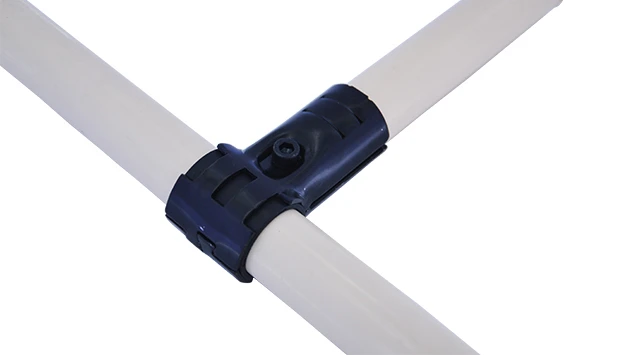
One Way Rotatory Straight Lean Pipe Joint
Two way lean pipe joint for 2 pcs 28MM lean pipe connection in straight angle with rotatory fucntion, which used widely in workbench, flow rack, hand trolley frame connection.
The Pressure of Agility in Modern Manufacturing
Picture this: It's 8 AM on a Tuesday at a bustling electronics assembly plant. The production scheduler rushes into the manager's office, holding a printed order. "The client just moved up the launch date for the new smartwatch—we need to start full-scale production by Friday." The manager's heart sinks. The current line is configured for the older model, with fixed workbenches bolted to the floor and rigid material racks that took three days to build last month. Disassembling and rebuilding them in three days? It seems impossible. But in today's manufacturing landscape, this scenario isn't an exception—it's the norm. Consumer demands shift overnight, product lifecycles shrink from years to months, and competitors lurk around every corner. The ability to reconfigure production lines quickly isn't just a competitive advantage anymore; it's a matter of staying in business. This is where the one way rotatory straight lean pipe joint emerges as an unsung hero, quietly transforming rigidity into adaptability.
Lean Systems 101: The Backbone of Efficient Manufacturing
To understand the value of the one way rotatory joint, we first need to grasp the fundamentals of lean systems. Born from the Toyota Production System in the 1950s, lean manufacturing is all about eliminating waste—whether that's wasted time, excess inventory, or unnecessary movement. Lean systems are the physical structures that make this philosophy tangible: modular workbenches, flexible flow racks, and dynamic roller tracks designed to minimize waste and maximize efficiency. At the core of these systems are lean pipes—lightweight, durable tubes typically made from steel (often coated in plastic or chrome) or aluminum, which form the framework of everything from assembly stations to material handling carts. But lean pipes are just the building blocks; the real magic lies in how they're connected. Traditional joints, like fixed 90-degree connectors or rigid T-joints, do a reliable job of holding pipes together, but they lack a critical feature: adaptability. Once assembled, they lock the structure into a single configuration, turning even minor adjustments into major undertakings.
Consider a simple example: A workbench built with fixed joints. If a new operator joins the team who is 6'4" (taller than the average worker), the bench surface, set at 36 inches, is too low. With fixed joints, adjusting the height would require unbolting the entire structure, cutting new pipes to length, and reassembling—wasting hours of production time. This is where the one way rotatory straight lean pipe joint changes the game. It's not just a connector; it's a flexibility enabler, designed to make reconfiguration not just possible, but fast.

Introducing the One Way Rotatory Straight Lean Pipe Joint
At first glance, the one way rotatory straight lean pipe joint looks unassuming. It's a small, cylindrical component with two openings for lean pipes, often finished in chrome for durability (hence the common industry term "one way rotatory straight lean pipe joint chrome"). But its simplicity is deceptive. Unlike fixed joints that lock pipes into static angles, or multi-directional joints that offer too many adjustment options (and thus complexity), this joint strikes a perfect balance: it allows rotation in one direction while maintaining structural stability. Imagine a hinge that lets you swing a door open and shut, but once you set it at a 45-degree angle, it stays there firmly. That's the essence of this joint.
The design is elegantly functional. Inside the joint, a spring-loaded locking mechanism or a manual setscrew holds a rotating sleeve in place. When unlocked, the sleeve pivots smoothly around the fixed axis, allowing the connected pipe to rotate up to 180 degrees. When locked, the mechanism engages with precision, creating a connection so sturdy that even under heavy loads—like a workbench holding 200 pounds of tools—it doesn't budge. This combination of mobility and stability is what makes the joint indispensable for manufacturers who need to adapt quickly without sacrificing safety or efficiency.

How It Works: A Step-by-Step Breakdown
Let's demystify the mechanics with a practical example. Suppose you're setting up a flow rack for automotive parts using lean pipes and one way rotatory straight joints. The rack has three levels, each holding bins of different components. On Monday, the bins are arranged for assembling brake calipers, with heavy cast-iron parts on the bottom shelf. On Tuesday, the line switches to fuel injectors, which are lighter but require easier access—so the top shelf needs to be lowered by 6 inches. Here's how the joint makes this adjustment possible:
- Release the lock: Most joints feature a simple lever or a hex-head setscrew. Flip the lever up or loosen the screw a quarter-turn, and the rotating sleeve disengages from the fixed base. You'll feel a subtle "click" as the brake releases.
- Rotate to the desired position: Grasp the pipe connected to the rotating sleeve and pivot it downward. The joint's internal bearings ensure smooth movement, even with the bin still attached. No need to empty the shelf first—this joint handles dynamic loads with ease.
- Secure the lock: Once the shelf is at the new height, push the lever down or tighten the setscrew. The brake re-engages, and the joint locks into place with a satisfying resistance. Give the shelf a firm shake—you'll notice no wobble, no play, just solid stability.
Total time per joint? About 30 seconds. For a three-level rack with eight joints, the entire adjustment takes 4 minutes. Compare that to traditional fixed joints, which would require removing the bins, unbolting the shelves, cutting new pipes, re-threading, and reattaching—easily a two-hour project. Multiply that across a factory with 50 such racks, and the difference is days of production time saved.
The Transformative Benefits of This Simple Joint
The one way rotatory straight lean pipe joint isn't just a time-saver; it's a catalyst for operational transformation. Here's how it delivers value across manufacturing environments:
1. Unmatched Speed of Reconfiguration
In manufacturing, time is quite literally money. Every hour a line is down for reconfiguration is an hour of lost production, missed deadlines, and frustrated customers. A cosmetics manufacturer in Ohio recently shared that after switching to these joints, they reduced line changeover time for lipstick packaging from 8 hours to 90 minutes. "We used to have to disassemble the entire conveyor system to adjust the angle of the product chutes," said their production manager. "Now, two workers can reposition all 12 joints in under an hour, and we're back to running at full capacity."
2. Adaptability Across Applications
This joint isn't limited to workbenches and flow racks. It shines in nearly every lean system component: roller tracks that feed parts to assembly stations, turnover trolleys that transport materials between departments, and even custom storage solutions. For instance, a medical device manufacturer uses roller tracks with these joints to adjust the incline based on part weight—steeper for metal surgical tools, gentler for delicate plastic components. When a new tool is introduced, they simply rotate the track's support joints to the optimal angle, ensuring smooth, jam-free transport.
3. Durability That Withstands Industrial Wear
Skeptics often ask: "If it rotates, won't it wear out quickly?" The answer, thanks to high-quality materials and engineering, is a resounding no. Most one way rotatory straight lean pipe joints are made from cold-drawn steel with a chrome plating that resists corrosion and scratches. The internal locking mechanism uses hardened steel components designed to withstand tens of thousands of adjustments. A automotive parts supplier in Michigan reported using the same joints on their main assembly line for over three years, with zero failures or replacements needed. "We adjust them at least twice a week for different part runs," their maintenance supervisor noted. "They still lock as tightly as the day we installed them."
4. Ergonomic Flexibility for Workers
Modern manufacturing prioritizes worker well-being, and ergonomics plays a central role. Fixed workbenches force operators to adapt to the equipment; with adjustable joints, the equipment adapts to the operator. A study by the Manufacturing Ergonomics Institute found that workstations with height-adjustable components (enabled by joints like this one) reduced worker fatigue by 32% and cut musculoskeletal injuries by nearly half. For example, a 5'2" operator assembling circuit boards can lower their workbench to 32 inches, while a 6'1" colleague at the next station raises theirs to 40 inches—all without disrupting the production flow.
How It Stacks Up: A Comparison of Joint Types
To truly appreciate the one way rotatory joint's value, it helps to compare it with other common lean pipe connectors. Below is a breakdown of key attributes:
| Joint Type | Flexibility | Installation Time | Reconfiguration Ease | Best For | Cost (Relative) |
|---|---|---|---|---|---|
| Fixed 90° Joint | None (locks at 90°) | 5-7 minutes (requires tools) | Poor (requires disassembly) | Permanent structures (e.g., storage racks) | Low |
| Multi-Directional Joint | High (360° rotation, multiple axes) | 10-15 minutes (complex alignment) | Moderate (adjustable but time-consuming) | Custom, low-volume setups (e.g., R&D labs) | High |
| One Way Rotatory Straight Joint | Moderate (180° rotation, single axis) | 2-3 minutes (tool-free in some models) | Excellent (adjusts in seconds) | High-mix, high-volume production lines | Moderate |
The table reveals a clear pattern: fixed joints are cheap but rigid, multi-directional joints are flexible but slow, and the one way rotatory joint offers the ideal middle ground for most manufacturers. It's not overengineered for simple tasks, nor underpowered for dynamic environments.
Real-World Impact: Stories from the Factory Floor
The true measure of any manufacturing tool is how it performs in real-world conditions. Here are two examples of how the one way rotatory straight lean pipe joint has transformed operations:
Case Study 1: Automotive Tier 1 Supplier
A supplier of door panels to a major automaker was struggling with frequent model changes. Each new car design required a different panel shape, which meant reconfiguring their assembly workbenches—specifically, adjusting the angle of the clamping fixtures. With fixed joints, this took a team of four workers two full shifts. After switching to one way rotatory joints, they trained two workers to adjust all 16 fixtures in 90 minutes. "We used to schedule reconfigurations over weekends to avoid production loss," said their operations director. "Now we can do it during a lunch break and be back to full speed by 1 PM. That's saved us over $200,000 in overtime alone this year."
Case Study 2: Consumer Electronics Manufacturer
A company producing smart speakers faced a unique challenge: their products came in three sizes, each requiring a different roller track incline to prevent damage during transport. With traditional fixed joints, they had to build three separate tracks, wasting floor space and materials. By installing one way rotatory joints, they consolidated to a single track that adjusts in minutes. "For the small speaker, we set the track at 5°; for the medium, 8°; and for the large, 12°," explained their lean coordinator. "A single operator flips the locks, rotates the supports, and locks them back—no tools, no hassle. We've reclaimed 300 square feet of floor space and cut material costs by 40%."
Choosing the Right Partner: Why Supplier Quality Matters
Not all one way rotatory straight lean pipe joints are created equal. To ensure you're getting a product that delivers on its promises, look for a lean pipe supplier that prioritizes these qualities:
- Material Quality: Opt for joints made from high-carbon steel with a chrome or zinc plating to resist corrosion. Avoid cheap aluminum alloys, which can deform under heavy loads.
- Precision Engineering: The rotating mechanism should feel smooth, not gritty. A well-made joint will rotate with consistent resistance, indicating quality bearings and machining.
- Testing and Certification: Ask if the supplier tests joints for durability—specifically, how many rotations they can withstand before showing wear. Look for joints rated for at least 50,000 cycles.
- Technical Support: A good supplier won't just sell you parts; they'll help you design your system. Look for companies that offer layout assistance or can recommend joint placement for optimal flexibility.
Remember: A slightly higher upfront cost for quality joints will pay off in reduced downtime, fewer replacements, and longer system life. Skimping on cheap joints might save money today, but it will cost you dearly when they fail during a critical production run.
The Future of Manufacturing: Flexibility as Standard
As manufacturing continues to evolve—driven by trends like mass customization, shorter product lifecycles, and reshoring—the demand for flexible systems will only grow. The one way rotatory straight lean pipe joint is more than just a tool for today; it's a foundation for tomorrow's factories. It embodies the lean principle of "adaptability as a competitive edge," proving that sometimes the most powerful innovations are the simplest ones.
So, the next time you walk through a factory and see a workbench that adjusts to a worker's height in seconds, or a roller track that reangles for a new product in minutes, take a closer look at the joints holding it all together. Chances are, you'll find the one way rotatory straight lean pipe joint—quietly, reliably, making the impossible possible, one rotation at a time.