- Company Articles
- Products and Technology
- Product knowledge
- How Temperature Affects Aluminum Profile 3 Way Connector Performance

How Temperature Affects Aluminum Profile 3 Way Connector Performance
Related Product
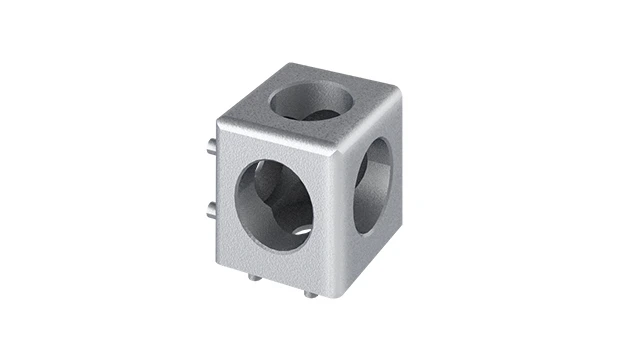
Aluminum Profile 3 Way Connector
The 3 way - squared corner connector is an external fastening method that is typically used to create a corner connection between three profiles. It is a heavy-duty connection that is simple to use and provides a polished look.
Walk through any modern factory, warehouse, or assembly line, and you'll see them—sleek, silver structures holding up workbenches, material racks, and conveyor systems. These are aluminum extrusion profiles, the backbone of lean manufacturing and efficient production. But for all their strength and versatility, these profiles rely on a quiet hero: the connectors that bind them together. Among these, the aluminum profile 3 way connector stands out, quietly bearing the weight of productivity by joining profiles at critical angles. Yet, despite their unassuming nature, these small components face a hidden challenge that can make or break an entire operation: temperature.
Whether it's the sweltering heat of a summer factory floor, the biting cold of a winter warehouse, or even the subtle temperature swings of a climate-controlled facility, thermal changes play havoc with materials. For aluminum profile 3 way connectors—those unglamorous but essential pieces that hold lean systems together—temperature isn't just a background factor; it's a silent test of their performance. In this article, we'll dive into how heat and cold alter the behavior of these connectors, why that matters for your aluminum extrusion profile setups, and what you can do to keep your operations running smoothly, no matter the thermometer reading.
The Unsung Backbone: Aluminum Profiles in Lean Systems
Aluminum extrusion profiles have revolutionized manufacturing. Lightweight yet surprisingly strong, resistant to corrosion, and infinitely customizable, they've become the go-to choice for building everything from workbenches to automated conveyor frames. What makes them so indispensable? Their ability to adapt. Thanks to aluminum extrusion—a process where heated aluminum is pushed through a die to create specific cross-sectional shapes—profiles can be tailored to fit almost any need. Add in aluminum profile accessories like end caps, brackets, and yes, connectors, and you have a modular system that grows and changes with your operation.
This flexibility is why aluminum profiles are the cornerstone of lean systems. Lean manufacturing thrives on efficiency, minimizing waste, and maximizing flow—all of which depend on structures that can be reconfigured quickly. A well-designed lean system might use aluminum extrusion profiles to build a material rack that feeds parts directly to an assembly line, or a workbench that adjusts height to reduce worker fatigue. But here's the catch: every joint, every connection, every 3 way connector in that system is a potential weak point if not built to withstand the environment.
Consider a typical scenario: a factory uses aluminum profiles to construct a flow rack, with 3 way connectors joining vertical supports to horizontal rails. The rack holds heavy components, and throughout the day, workers slide parts along its roller tracks. If the connectors loosen or warp due to temperature changes, the rack could sag, parts might jam, and suddenly, that lean system becomes a bottleneck. It's a reminder that even the most advanced aluminum extrusion profile is only as reliable as the connectors holding it together.
Inside the 3 Way Connector: More Than Just a Joint
To appreciate why temperature matters, let's first understand what an aluminum profile 3 way connector does. As the name suggests, it's designed to join three aluminum extrusion profiles at a single point, often at 90-degree angles, though some models allow for adjustable angles. Think of it as a three-armed hub: each arm slides over or clamps onto a profile, and screws or bolts secure the connection. Simple, right? But simplicity belies complexity. A well-engineered 3 way connector must balance tightness (to prevent wobbling) with just enough flexibility (to absorb minor shocks) while maintaining structural integrity.
Aluminum profile accessories like washers, locknuts, and gaskets often work alongside these connectors to enhance performance. For example, a locknut might prevent the connector from loosening due to vibration, while a rubber gasket could cushion the joint against impact. But when temperatures fluctuate, even these accessories can't always compensate for the connector's own response to heat or cold. That's because aluminum—like all materials—expands when heated and contracts when cooled. The connector, typically made from the same or a similar aluminum alloy as the profiles, undergoes these changes too. The problem? The 3 way connector's job is to hold profiles rigidly in place, even as both the connector and the profiles around it shift in size.
Let's break it down: imagine a 3 way connector joining two horizontal profiles and one vertical profile to form a corner of a workbench. On a hot day, the aluminum extrusion profiles expand slightly. If the connector is too rigid, this expansion could create stress at the joint—like trying to fit a growing puzzle piece into a fixed slot. Over time, that stress might loosen screws, warp the connector's arms, or even crack the profiles themselves. On a cold day, the opposite happens: the profiles contract, pulling away from the connector, which might then feel loose, leading to wobbling or misalignment. Either way, the connector's ability to "hold the line" is compromised.

Temperature 101: Why Heat and Cold Wreak Havoc
To understand how temperature affects aluminum profile 3 way connectors, we need to revisit a basic principle of physics: thermal expansion. All materials expand when heated and contract when cooled; the degree depends on their coefficient of thermal expansion (CTE). Aluminum has a relatively high CTE compared to, say, steel—about 23.1 x 10^-6 per °C, versus steel's 11.7 x 10^-6 per °C. What does that mean in real terms? A 10-foot length of aluminum extrusion profile will expand by roughly 0.03 inches for every 10°F increase in temperature. That might sound tiny, but multiply it across a system of interconnected profiles and connectors, and suddenly those small shifts add up.
But thermal expansion is just the start. Temperature also affects aluminum's mechanical properties. At high temperatures, aluminum becomes more ductile—meaning it can bend more easily—but less strong. At low temperatures, it becomes stiffer and more brittle, losing some of its ability to absorb impacts. For a 3 way connector, which relies on both strength (to hold weight) and flexibility (to adapt to minor shifts), these changes are critical. Add in the fact that connectors often interface with other materials—like plastic washers or stainless steel screws—and you have a mix of CTEs that can amplify stress at the joint.
Consider a connector with a plastic insert designed to grip the profile. Plastics typically have much higher CTEs than aluminum—some as high as 100 x 10^-6 per °C. On a hot day, the plastic insert might expand far more than the aluminum connector around it, causing it to bulge or crack. On a cold day, it might shrink, losing its grip and allowing the profile to slip. Suddenly, that "simple" connection becomes a complex interplay of materials responding differently to the same temperature change.

When the Heat Rises: High Temperature Effects on Connectors
Let's start with heat—the enemy of many industrial components, and aluminum profile 3 way connectors are no exception. In factories without air conditioning, summer temperatures can easily climb above 38°C (100°F), and near machinery like ovens or welding stations, temps might soar even higher. What happens to your connectors then?
Loosening Connections: The Silent Sabotage
Heat causes aluminum extrusion profiles to expand, and as they grow, they push against the 3 way connectors holding them. If the connector is secured with screws, the expanding profile can create extra tension on the threads. Over time, as the temperature cycles (hot days, cooler nights), this tension can cause the screws to loosen—a phenomenon known as "thermal cycling fatigue." A loose connector might not seem like a big deal at first, but in a lean system where precision matters, even a 1-millimeter shift can throw off alignment. A material rack might tilt, causing parts to slide off; a conveyor guide rail might misalign, jamming products mid-flow. In one case study, a automotive parts manufacturer traced a 20% increase in production delays to loose 3 way connectors on their assembly line racks—all because summer heat had slowly weakened the joints.
Warping and Deformation: When Connectors Lose Their Shape
Extreme heat can also warp the connector itself. Aluminum's yield strength—the point at which it permanently deforms—drops as temperature rises. For most aluminum alloys used in profiles and connectors, the yield strength decreases by about 10-15% when temperatures reach 100°C (212°F). If a 3 way connector is under heavy load (say, supporting a fully stocked material rack), prolonged exposure to high heat can cause its arms to bend or twist. Once warped, the connector can no longer grip the profiles evenly, leading to uneven stress distribution. This might not break the connection immediately, but it creates weak spots that fail under additional stress—like when a worker slams a heavy bin onto the rack.
Corrosion Accelerated: Heat and Humidity's Ugly Partnership
Heat alone is bad, but heat plus humidity is worse. Aluminum is naturally corrosion-resistant thanks to a thin oxide layer that forms on its surface. However, high temperatures can accelerate chemical reactions, especially if the factory environment includes moisture, oils, or chemicals. A 3 way connector with a compromised finish (scratched during installation, for example) might start to corrode in hot, humid conditions. Corrosion weakens the metal, making the connector more prone to cracking. In coastal factories, where salt air adds to the mix, this problem is even more pronounced. One supplier of aluminum profile accessories reported that customers in tropical climates often needed to replace connectors 30% more frequently than those in temperate zones—all due to heat-driven corrosion.
When the Cold Sets In: Low Temperature Risks
While heat gets a lot of attention, cold temperatures can be just as damaging to aluminum profile 3 way connectors. In cold storage facilities, winter warehouses, or factories in northern climates, temperatures can plummet below freezing, and aluminum reacts dramatically to the chill.
Brittleness: When Flexibility Fades
Aluminum becomes more brittle as temperatures drop. At -10°C (14°F), its impact strength—the ability to absorb sudden shocks—can decrease by up to 20%. For a 3 way connector, this means less tolerance for bumps or jolts. Imagine a worker pushing a loaded turnover trolley into a material rack; in warm weather, the connector might flex slightly and absorb the impact. In cold weather, it might crack instead. This brittleness is especially risky for connectors with thin walls or sharp corners, which concentrate stress. A study by an aluminum profile supplier found that 40% of connector failures in cold environments were due to brittle fracture, often during routine operations like adjusting a shelf height.
Contraction and Gapping: When Joints Pull Apart
Just as heat causes expansion, cold causes contraction. Aluminum extrusion profiles shrink in the cold, and if the 3 way connector doesn't contract at the same rate (or if it's clamped too tightly), gaps can form between the connector and the profiles. These gaps allow movement: the rack might sway, profiles might rattle, and over time, the repeated motion can wear down the connector's grip. In a lean system where precision is key—like a conveyor guiding small electronics—even a tiny gap can lead to misaligned parts, jams, or defective products. One food packaging plant learned this the hard way when cold winter temperatures caused their aluminum profile conveyor guides to contract, creating gaps that trapped plastic packaging film, leading to a 4-hour production shutdown.
Frozen Accessories: When the Little Parts Fail
Aluminum profile accessories often bear the brunt of cold temperatures. Rubber gaskets can harden and crack, plastic washers can become brittle, and even metal screws can seize up. A 3 way connector might rely on a plastic insert to create friction and prevent slipping, but in sub-zero temps, that insert could become so stiff it no longer grips. Or a locknut, designed to stay tight under vibration, might freeze solid, making it impossible to adjust the connection if needed. In one warehouse, workers struggled to reconfigure a workbench during winter because the cold had frozen the screws in the 3 way connectors—turning a 15-minute task into a 2-hour battle with pliers and heat guns.
The Ripple Effect: How Connector Failures Disrupt Lean Systems
So, why does all this matter? Because a failed or underperforming aluminum profile 3 way connector isn't just a broken part—it's a threat to your entire operation. Lean systems are built on interdependence: each component relies on the next to keep the flow of materials and products moving. A wobbly material rack might cause parts to fall and get damaged; a misaligned conveyor might slow down assembly; a cracked workbench might force workers to pause production. The costs add up quickly: downtime, wasted materials, overtime to catch up, and even safety risks if a structure collapses.
Consider a hypothetical but all-too-real example: a electronics manufacturer uses aluminum extrusion profiles and 3 way connectors to build a flow rack for circuit boards. The rack is part of a lean system designed to deliver boards directly to the soldering station, minimizing handling. One summer, a heatwave hits, and the factory's AC can't keep up. The aluminum profiles expand, and the 3 way connectors loosen. Over a week, the rack slowly tilts. One day, a stack of circuit boards slides off, crashing to the floor. The result: 50 damaged boards (costing $200 each), 2 hours of downtime while the rack is repaired, and a backlog that requires evening shifts to fix. Total cost: over $15,000—all from a few loose connectors.
Or take a cold storage facility using aluminum profile workbenches to pack frozen goods. The workbenches, held together with 3 way connectors, are exposed to -18°C (0°F) temperatures daily. Over time, the cold makes the connectors brittle. One morning, a worker leans on the bench while reaching for a box, and the corner connector cracks. The bench top sags, spilling frozen products onto the floor. Now, there's a safety hazard (slippery ice), wasted inventory, and a workbench out of commission until a replacement connector arrives. Again, the cost is far more than the price of a new connector.
Testing for Temperature Resilience: What to Look For in a Supplier
Not all aluminum profile 3 way connectors are created equal. The best suppliers subject their products to rigorous temperature testing to ensure they hold up in real-world conditions. When choosing a connector (and an aluminum profile supplier), look for these key tests:
- Thermal Cycling Test: Connectors are exposed to repeated cycles of high and low temperatures (e.g., -40°C to 80°C) to simulate seasonal changes. This reveals how well the connector withstands expansion and contraction over time.
- High Temperature Load Test: The connector is heated to extreme temps (e.g., 100°C) while under load, to check for warping or deformation.
- Low Temperature Impact Test: At sub-zero temps, the connector is struck with a hammer or pendulum to measure impact strength and resistance to brittle fracture.
- Corrosion Resistance Test: Exposing connectors to salt spray or humid, hot environments to evaluate how well they resist rust and degradation.
A reputable aluminum profile supplier will provide test reports showing that their 3 way connectors can handle the temperature extremes of your facility. Don't settle for vague claims like "temperature resistant"—ask for specific numbers: "Withstands -30°C to 70°C under 50kg load" is far more reassuring than generic promises.
Protecting Your Connectors: Practical Solutions for Any Climate
The good news? You don't have to accept temperature-related connector failures as inevitable. With the right strategies, you can protect your aluminum extrusion profiles and 3 way connectors, ensuring your lean system stays strong year-round.
Choose the Right Alloy
Not all aluminum alloys react the same to temperature. For high-heat environments, look for alloys like 6061-T6, which has better high-temperature strength than pure aluminum. For cold environments, 5052-H32 offers superior impact resistance at low temps. Ask your aluminum profile supplier about alloy options—they can recommend the best fit for your climate.
Design with Thermal Expansion in Mind
When building structures, allow for thermal movement. Use slotted holes in connectors instead of fixed holes, so profiles can expand and contract without stress. Leave small gaps between profiles and connectors, or use flexible aluminum profile accessories like rubber gaskets to absorb shifts. A little flexibility in design goes a long way.
Insulate and Ventilate
In hot environments, insulate areas near heat sources (like ovens) to protect nearby aluminum structures. Use fans or AC to keep factory temps stable. In cold environments, insulate cold storage walls to prevent condensation (which accelerates corrosion) and consider heating work areas where connectors are most stressed.
Regular Maintenance Checks
Schedule seasonal inspections of 3 way connectors. In spring and fall, when temperatures start to shift, tighten loose screws, check for warping or corrosion, and replace damaged connectors. A little preventive maintenance can catch issues before they become failures.
Upgrade to Heavy-Duty Connectors
For critical areas or extreme temperatures, invest in heavy-duty 3 way connectors. These often have thicker walls, reinforced corners, or special coatings (like anodizing) to resist corrosion and warping. They cost more upfront but save money in the long run by reducing replacements and downtime.
Temperature Effects at a Glance: How Your Connectors React
| Temperature Range | Effect on Aluminum Extrusion Profiles | Effect on 3 Way Connectors | Recommended Action |
|---|---|---|---|
| Above 38°C (100°F) | Significant expansion; reduced yield strength | Loosening screws, warping, corrosion risk | Use heat-resistant alloys; insulate near heat sources; tighten connections monthly |
| 20°C–38°C (68°F–100°F) | Moderate expansion; minimal strength loss | Slight loosening; low corrosion risk | Check connections quarterly; ensure proper ventilation |
| -10°C–20°C (14°F–68°F) | Moderate contraction; stable strength | Minor brittleness; possible gap formation | Use impact-resistant alloys; avoid sharp impacts |
| Below -10°C (14°F) | Significant contraction; reduced impact strength | Brittleness, cracking, frozen accessories | Use cold-resistant alloys; heat work areas; replace plastic accessories with metal |
The Bottom Line: Temperature-Proof Your Lean System
Aluminum extrusion profiles and 3 way connectors are the unsung heroes of modern manufacturing, quietly enabling the efficiency and flexibility that lean systems demand. But as we've explored, temperature—whether scorching heat or freezing cold—can turn these heroes into liabilities. From loosening screws to brittle fractures, thermal changes undermine connector performance, threatening downtime, waste, and safety.
The solution isn't to avoid aluminum; it's to respect its properties and plan accordingly. By choosing the right alloys, designing for thermal movement, maintaining connections, and working with a trusted aluminum profile supplier who prioritizes temperature testing, you can build a lean system that stands strong in any climate. After all, in manufacturing, the smallest components often have the biggest impact—and your 3 way connectors deserve as much attention as the machines they support.
So the next time you walk through your factory, take a moment to look at those silver joints holding everything together. They might be small, but they're the difference between a smooth, efficient operation and a costly breakdown. And with the right care, they'll keep your lean system running—no matter what the weather brings.