- Company Articles
- Products and Technology
- Product knowledge
- How to Calculate Required 60 Aluminum Roller Track Grey Length for Your Line

How to Calculate Required 60 Aluminum Roller Track Grey Length for Your Line
Related Product
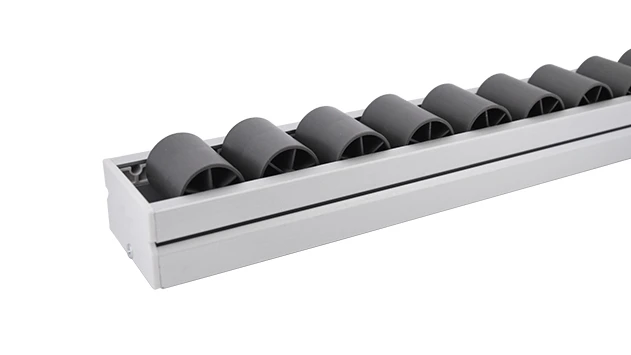
60 Aluminum Roller Track Grey
Modular system roller tracks aluminum gravity roller tracks are an excellent solution for transporting materials within industrial environments, warehouses and distribution centres.
If you've ever stood in front of a production line where products jostle for space, get stuck mid-flow, or leave gaps that waste valuable floor area, you know how critical every inch of your setup is. The 60 aluminum roller track grey is a staple in lean manufacturing—found in flow racks, conveyors, and even integrated into lean pipe workbenches. But calculating the right length isn't just a matter of measuring from one point to another. It's about aligning with your product's unique needs, your line's speed, and the core lean principles of efficiency and waste reduction. This guide will walk you through every step to get the exact length you need, so you can build a line that flows smoothly, saves costs, and adapts to your changing production demands.
Pre-Calculation Prep: Gather Your Key Data
Before you pick up a tape measure, you need to collect four critical pieces of information. Skipping any of these will lead to guesswork—and guesswork leads to wasted materials or a line that doesn't function as intended.
1. Product Dimensions & Orientation
First, note the exact dimensions of the product that will rest on the 60 aluminum roller track grey: length, width, and height. Most importantly, decide how the product will be oriented on the track—will it move lengthwise (along the direction of the track) or widthwise? This choice directly impacts the space each product takes up.
For example: A smartphone case (15cm long ×8cm wide) moving lengthwise will occupy more linear space than if it's placed widthwise. But orientation also depends on your line's needs—lengthwise might be better for faster flow, while widthwise could help with easier access at workstations.
2. Line Speed & Throughput
Line speed refers to how fast products move along the track (usually measured in meters per minute). Throughput is the number of products you want to process per minute. These two numbers work together to determine the spacing between products.
Let's say your line runs at 10 meters per minute and you need to process 60 products per minute. That means one product passes a fixed point every second. The distance between each product (spacing) must be enough to prevent collisions but not so much that you waste track length.
3. Buffer Zone Requirements
Buffer zones are extra track length reserved for temporary storage when downstream stations pause (e.g., if a worker needs to fix a defect or a machine needs a quick adjustment). Without a buffer, your entire line will stop every time a downstream process slows down—wasting time and violating lean's "eliminate waste" rule.
How much buffer do you need? A good starting point is to calculate the time your downstream station typically pauses (e.g., 10 seconds) and multiply it by your line speed to get the buffer length. For a line speed of 10 m/min (0.1667 m/sec), a 10-second buffer would need 1.667 meters of extra track.
4. Standard Track Lengths
Most suppliers sell 60 aluminum roller track grey in standard segments (e.g., 1m,1.5m,2m,2.5m,3m). Knowing these lengths upfront will help you round your calculated length to the nearest standard size—avoiding the need for costly custom cuts or leftover pieces.
Step-by-Step Calculation: A Practical Example
Let's use a real-world scenario to put these steps into action. Suppose you're setting up a 3C assembly line for smartphone chargers. Here's your data:
- Product: Charger (length=12cm, width=6cm)
- Orientation: Lengthwise (to fit into the downstream packaging station)
- Line speed: 8 m/min
- Throughput: 40 units per minute
- Buffer zone: 2 meters (for when packaging pauses)
Step 1: Calculate Product Pitch
Product pitch is the distance from the start of one product to the start of the next. It's calculated using your line speed and throughput:
Pitch = Line Speed / Throughput
For our example: Pitch =8 m/min ÷40 units/min =0.2 meters (20cm) per product.
Step2: Determine Spacing Between Products
Spacing is the gap between the end of one product and the start of the next. It's calculated by subtracting the product's length (or width, depending on orientation) from the pitch:
Spacing = Pitch - Product Length (if oriented lengthwise)
Our example: Spacing=20cm -12cm=8cm. This gap is safe enough to prevent collisions but small enough to avoid wasting space.
Step3: Calculate Active Zone Length
The active zone is the part of the track where products are actively moving. It should hold enough products to keep your downstream station running smoothly until the upstream supply resumes. Let's say we need to cover 5 seconds of operation:
First, find how many products pass through in 5 seconds: Throughput=40 units/min → 0.666 units/sec →5 sec ×0.666=3.33 units (round up to 4).
Active length= Number of products × Pitch → 4 ×20cm=80cm (0.8 meters).
Step4: Add Buffer Zone
Total length= Active zone length + Buffer zone →0.8m +2m=2.8 meters.
Step5: Round to Standard Length
The nearest standard length to2.8 meters is3 meters. Choosing this gives you extra room to adjust the buffer zone later if needed—without buying new track.

Key Factors to Adjust Your Calculation
Your initial calculation is a starting point, but you need to adjust it for real-world variables. Here are the most important factors:
1. Incline of the Track
If your 60 aluminum roller track grey is sloped (gravity-fed), products will move faster as they go down. You need to increase the spacing to prevent them from sliding into each other. A general rule: Add 20% to the spacing for every 5-degree incline.
2. Product Weight
Heavier products (like small medical devices) take longer to stop. Increase the buffer zone by 10% for every 1kg of product weight to account for slower deceleration.
3. Multi-Lane Setup
If you're using multiple parallel tracks (e.g., in a flow rack), each track's length should align with the rack's depth. For example, a flow rack with 3 lanes each holding 4 bins (30cm per bin) would need 3×1.2m tracks (4×30cm=1.2m).
4. Integration with Other Components
If your track is part of a larger lean solution (like a conveyor system connected to lean pipe workbenches), you need to adjust the length to fit seamlessly with these components. For example: If your lean pipe workbench is 1.5m wide, the track leading to it should be long enough to reach the workbench without gaps.

Common Mistakes to Avoid
Even small errors in calculation can lead to big problems. Here are the most frequent mistakes:
1. Ignoring Buffer Zones
Skipping the buffer zone is the #1 mistake. It leads to frequent line stops when downstream stations pause—wasting time and reducing productivity. Always add a buffer zone, even if it's small.
2. Wrong Orientation
Placing a product widthwise instead of lengthwise can lead to either too much spacing (wasting track) or too little (collisions). Always test the orientation with a sample product before finalizing.
3. Overestimating Length
Buying longer track than needed increases costs and takes up valuable floor space. Stick to the standard length closest to your calculated total—lean manufacturing is all about eliminating waste.
4. Forgetting Customization Needs
If your line uses custom components (like a flow rack with non-standard bin sizes), you need to adjust your track length to fit these components. Don't assume standard lengths will work for every setup.
Calculation Table for Common Scenarios
To make your job easier, here's a table of common product scenarios and their recommended 60 aluminum roller track grey lengths:
| Product Type | Orientation | Line Speed (m/min) | Throughput (units/min) | Buffer Zone (m) | Calculated Length (m) | Recommended Standard Length (m) |
|---|---|---|---|---|---|---|
| Smartphone Case | Lengthwise | 10 | 60 | 2 | 2.83 | 3 |
| Small Medical Device | Widthwise | 8 | 40 | 1.5 | 2.3 | 2.5 |
| Automotive Sensor | Lengthwise | 5 | 30 | 3 | 3.83 | 4 |
| Warehouse Bin (Flow Rack) | Lengthwise | N/A (Gravity-Fed) | N/A | 0.5 | 1.7 | 2 |
Final Tips for Success
Calculating the right length of 60 aluminum roller track grey is just the first step. Here are a few more tips to ensure your line works perfectly:
1. Test Before Full Installation
Use a small segment of track to test your product's flow. Check for collisions, gaps, and how well it integrates with your lean pipe workbench or conveyor system. Adjust the length if needed before installing the full line.
2. Consult a Lean Solution Expert
If your setup is complex (like a multi-lane conveyor or custom 3C assembly line), don't hesitate to consult a supplier who specializes in lean solutions. They can help you calculate the exact length and design a setup that fits your unique needs.
3. Plan for Future Adjustments
Lean manufacturing is about adaptability. Choose modular components (like standard-length 60 aluminum roller track grey) so you can reconfigure your line as your product line changes. This will save you time and money in the long run.