- Company Articles
- Products and Technology
- Product knowledge
- How to Calculate the Required Load Rating for Your Castor Install Base

How to Calculate the Required Load Rating for Your Castor Install Base
Related Product
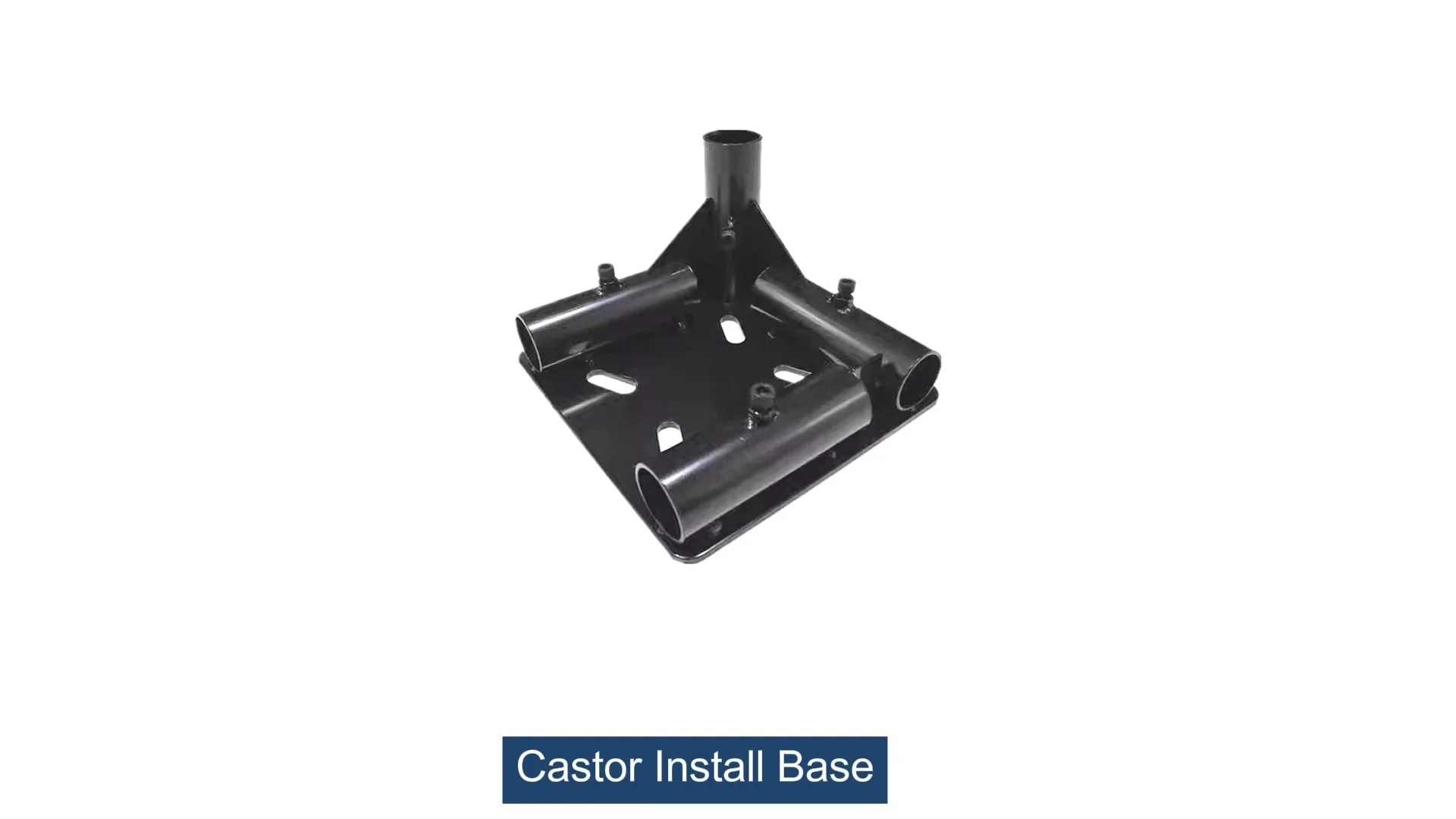
Castor Install Base
Castor install base, used for connection between pipe and castor, it can connect 4 pcs pipe by 1 pcs castor base, to make the structure strong and stable.
Introduction: Why Load Rating Matters More Than You Think
When you're setting up a workspace—whether it's a factory floor, a warehouse, or a small workshop—every component plays a role in keeping operations running smoothly. But if there's one part that often gets overlooked until something goes wrong, it's the castor install base. This unassuming component is the foundation that connects your caster wheels to the equipment they support, and its load rating can make or break your daily workflow. Choose a base that's too weak, and you risk equipment failure, damaged goods, or even workplace injuries. Choose one that's overkill, and you're wasting money on unnecessary strength. So, how do you strike the right balance? Let's break it down.
In this guide, we'll walk through the step-by-step process of calculating the required load rating for your castor install base. We'll cover everything from understanding the total weight your setup needs to support, to factoring in real-world conditions like movement and floor surfaces. Along the way, we'll touch on key components like caster wheels and caster accessories, and even how your base might interact with larger systems—like when it's connected via a lean pipe joint to a lean manufacturing setup. By the end, you'll have the knowledge to choose a castor install base that's safe, efficient, and perfectly suited to your needs.
What Is Load Rating, Anyway? Let's Start with the Basics
Before we dive into calculations, let's clarify what "load rating" actually means. Simply put, the load rating of a castor install base is the maximum weight it can safely support under specific conditions. But here's the catch: it's not just about static weight (the weight when the equipment is sitting still). There's also dynamic weight to consider—the force exerted when the equipment is moving, turning, or hitting a bump. For example, a cart loaded with boxes might weigh 500 lbs when parked, but when you push it quickly and stop suddenly, that dynamic force could spike to 600 lbs or more. Your castor install base needs to handle both.
Load rating is usually measured in pounds (lbs) or kilograms (kg) and is determined by the base's material, design, and construction. Common materials include steel, aluminum, and reinforced plastics, each with different strength characteristics. For instance, a steel castor install base will typically have a higher load rating than a plastic one, but it might also be heavier and more expensive. The key is to match the material to your load needs—not just today, but for any future changes in your workflow.
Quick Tip:
Always check the manufacturer's specs for both static and dynamic load ratings. If a product only lists one, ask for the other. Dynamic load is especially critical if your equipment will be moved frequently (think assembly line trolleys or warehouse carts).

Step 1: Calculate the Total Weight Your Setup Needs to Support
The first step in determining your castor install base's load rating is figuring out the total weight it will bear. This isn't just the weight of the equipment itself—you need to account for everything that will be on or in that equipment, too. Let's break this down into three parts:
1.1 The Weight of the Equipment (Base Weight)
Start with the "empty" weight of the equipment the castors will support. This could be a workbench, a mobile shelf unit, a tool cart, or even a custom-built assembly station. If you're not sure of the exact weight, check the manufacturer's manual or look for a label on the equipment itself. If it's a custom build (like a frame made from aluminum lean pipe), add up the weight of each component: the pipes, the lean pipe joints, the shelves, and any built-in features like tool hooks or bins.
1.2 The Weight of Loaded Materials (Payload Weight)
Next, consider the materials or goods that will be placed on the equipment. For a warehouse cart, this might be boxes of inventory; for a workbench, it could be tools, raw materials, or finished products. Be realistic here—don't just use the "average" load. Think about the heaviest possible scenario. For example, if your workbench usually holds 200 lbs of tools but occasionally needs to support a 300 lbs machine during maintenance, use 300 lbs as your payload weight. It's better to overestimate than underestimate.
1.3 Additional Weight (People, Tools, or Unexpected Loads)
Finally, factor in any "unplanned" weight. Will someone stand on the equipment to reach a high shelf? Will tools or equipment be temporarily placed on it during repairs? Even small additions can add up. A good rule of thumb is to add 10-15% to your total base + payload weight to account for these unexpected loads. For example, if your base weight is 150 lbs and your payload is 300 lbs, your total so far is 450 lbs. Adding 15% brings it to 517.5 lbs. Round up to 520 lbs to keep things simple.
Let's put this into a formula:
Total Weight = (Base Weight + Payload Weight) × 1.15 (Safety Factor for Additional Loads)
Example:
Suppose you have a mobile workbench made from aluminum profile and aluminum lean pipe. The workbench itself weighs 180 lbs (base weight). On a typical day, it holds 250 lbs of tools and materials (payload weight). Using the formula: (180 + 250) × 1.15 = 430 × 1.15 = 494.5 lbs. So your total weight is approximately 495 lbs.

Step 2: Determine the Number of Casters (and Castor Install Bases) in Your Setup
Now that you know the total weight, you need to figure out how many caster install bases (and thus casters) your equipment will use. Most setups use 4 casters (one at each corner), but some heavier or larger equipment might use 6 or even 8 for added stability. The number of casters directly affects how much weight each castor install base needs to support—more casters mean each base bears less weight, and vice versa.
2.1 Why 4 Casters Is the Standard (and When to Use More)
Four casters are the most common because they provide a stable, balanced base for most equipment. They're also cost-effective, as you're using fewer components. However, if your equipment is very long, wide, or has an uneven weight distribution, 4 casters might not be enough. For example, a long conveyor system might use 6 casters (two at each end and two in the middle) to prevent sagging in the middle. Similarly, a tall shelving unit with a high center of gravity might benefit from 6 casters to reduce the risk of tipping.
2.2 The "Rule of 3" for Uneven Loads
Here's a critical point: even if you have 4 casters, you can't assume the weight will be perfectly distributed across all 4. In real-world use, floors are rarely perfectly flat, and loads can shift. To account for this, engineers often use the "rule of 3": assume that only 3 out of 4 casters will bear the full weight at any given time. This is a safety precaution to ensure that even if one caster is slightly off the ground (due to a bump or uneven floor), the remaining 3 can still support the load without failing.
Example:
If you have 4 casters and a total weight of 495 lbs (from Step 1), you'd calculate the load per caster as 495 lbs ÷ 3 = 165 lbs per castor install base. If you used 6 casters, the "rule of 3" would become the "rule of 4" (since 6 casters would realistically have 4 bearing weight), so 495 lbs ÷ 4 = 123.75 lbs per base.
| Number of Casters | Realistic Weight-Bearing Casters (Rule of Thumb) | Load per Castor Install Base (for 495 lbs Total Weight) |
|---|---|---|
| 4 | 3 | 495 ÷ 3 = 165 lbs |
| 6 | 4 | 495 ÷ 4 = 123.75 lbs |
| 8 | 5 | 495 ÷ 5 = 99 lbs |

Step 3: Factor in Dynamic Loads (Movement, Bumps, and Real-World Use)
So far, we've focused on static weight—the weight when the equipment is sitting still. But when you start moving the equipment, things get more complicated. Dynamic loads (the forces exerted during movement) can significantly increase the stress on your castor install base. For example, pushing a cart up a slight incline, stopping suddenly, or hitting a floor crack can all create "shock loads" that temporarily exceed the static weight.
3.1 Understanding Dynamic Load Multipliers
To account for dynamic loads, we use a "dynamic load multiplier." This is a number (greater than 1) that we multiply by the static load per caster to get the total dynamic load the base needs to handle. The multiplier depends on how the equipment is used:
- Low movement (rarely moved): Multiplier = 1.2. Examples: A stationary workbench that's only moved during deep cleaning.
- Moderate movement (moved occasionally on smooth floors): Multiplier = 1.5. Examples: A tool cart used in a workshop with concrete floors.
- High movement (frequently moved, uneven floors, or inclines): Multiplier = 2.0. Examples: A warehouse cart used on rough asphalt or a delivery trolley that goes up ramps.
3.2 Applying the Multiplier to Your Load
Let's go back to our example: 4 casters, total static weight of 495 lbs, so 165 lbs per castor install base (using the "rule of 3"). If this cart is moved moderately (say, a few times a day on a smooth factory floor), we use a multiplier of 1.5. So the dynamic load per base would be 165 lbs × 1.5 = 247.5 lbs. This means your castor install base needs a dynamic load rating of at least 248 lbs to handle both static and moving conditions.
Pro Tip:
If your equipment will be moved by powered machinery (like a forklift towing a train of carts), use a higher multiplier (2.0 or even 2.5). Powered movement can create larger shock loads than manual pushing.
Step 4: Consider the Environment and Floor Conditions
Your floor surface and working environment play a big role in how much stress your castor install base endures. A smooth, polished concrete floor is easy on casters, but a floor with cracks, debris, or uneven tiles can create extra friction and shock loads. Here's how to adjust your load rating based on environment:
4.1 Floor Surface Impact
Rough or uneven floors force the caster wheels to "bounce" slightly as they move, increasing dynamic loads. For example, a gravel floor or a warehouse with worn concrete might require adding 10-20% to your calculated dynamic load. Conversely, a smooth epoxy floor might let you stick with the base dynamic load rating.
4.2 Temperature and Chemical Exposure
Extreme temperatures (very hot or very cold) can weaken materials like plastic or rubber, reducing their load-bearing capacity. Similarly, exposure to chemicals (oils, solvents, or cleaning agents) can degrade caster accessories like wheel bearings or the castor install base itself. If your workspace has these conditions, look for bases made from corrosion-resistant materials (like stainless steel) and add a 10% safety buffer to your load rating.
4.3 Caster Wheel Material Matters, Too
While we're focused on the castor install base, the caster wheel itself affects load distribution. Softer wheels (like rubber or polyurethane) absorb shocks better than hard wheels (like steel), reducing the stress on the base. If you're using steel wheels on a rough floor, you might need a higher base load rating to compensate for the extra shock. On the flip side, polyurethane wheels on a smooth floor can help keep dynamic loads lower.
Step 5: Adding It All Up – Choosing the Right Castor Install Base
Now that we've considered total weight, number of casters, dynamic loads, and environment, let's put it all together to find your required load rating. Here's a recap of our example:
- Total static weight (base + payload + additional): 495 lbs
- Number of casters: 4 (using "rule of 3" for distribution)
- Static load per caster: 495 lbs ÷ 3 = 165 lbs
- Dynamic load multiplier (moderate movement): 1.5
- Dynamic load per caster: 165 lbs × 1.5 = 247.5 lbs
- Environmental buffer (smooth floor, no chemicals): 0% (so 247.5 lbs remains)
So, the required load rating for the castor install base in this scenario is approximately 248 lbs (dynamic load). When shopping for bases, look for a product with a dynamic load rating of at least 248 lbs. It's also smart to round up to the next available rating (e.g., 250 lbs) for an extra safety margin.
5.1 Checking Compatibility with Caster Wheels and Accessories
Your castor install base doesn't work alone—it's part of a system that includes caster wheels, caster accessories (like brakes or locks), and sometimes even connections to other structures (like a lean pipe joint if you're using a lean system). Make sure the load rating of the base matches or exceeds the load rating of the caster wheel. For example, if your wheel has a dynamic load rating of 300 lbs but the base only has 250 lbs, the base will be the weak link and could fail first.
5.2 When to Consult a Professional
If your setup is complex—like a custom conveyor system with multiple casters, or equipment that will carry extremely heavy loads (over 1000 lbs)—it's a good idea to consult an engineer or the manufacturer. They can help you account for unique factors like vibration, uneven weight distribution, or specialized caster accessories that might affect load rating.
Common Mistakes to Avoid
Even with careful calculations, it's easy to make mistakes. Here are the most common pitfalls to watch out for:
6.1 Underestimating the Total Weight
This is the biggest culprit. People often forget to include "hidden" weights, like tools left on a workbench or packaging materials in a cart. Always add 10-15% to your estimated payload to cover these surprises.
6.2 Ignoring Dynamic Loads
Buying a base based solely on static load rating is a recipe for failure. Remember: movement creates extra force, and that force needs to be accounted for.
6.3 Using the Wrong Number of Casters
Adding more casters than needed can waste money, but using too few can overload your bases. Stick to the "rule of 3" (or 4 for 6 casters) to ensure stability.
6.4 Overlooking Caster Accessories
Accessories like brakes or swivel locks can add extra weight or stress to the base. Make sure your base's load rating includes the weight of these accessories.
Conclusion: Invest in the Right Base, Avoid Headaches Later
Calculating the load rating for your castor install base might seem like a lot of work, but it's a small investment compared to the cost of equipment failure or workplace accidents. By following these steps—calculating total weight, considering the number of casters, factoring in dynamic loads, and checking compatibility with caster wheels and accessories—you can choose a base that's strong enough for the job, but not so strong that you're overpaying.
Remember, your castor install base is the foundation of your mobile equipment. Treat it with the same care you'd give any other critical component, and it will support your workflow reliably for years to come. Whether you're setting up a simple tool cart or a complex lean system with lean pipe joints, the right load rating ensures everything runs smoothly—no broken bases, no delays, and no safety risks.