- Company Articles
- Products and Technology
- Product knowledge
- How to Calculate the Right Load Capacity for Swivel Stem Caster Wheels

How to Calculate the Right Load Capacity for Swivel Stem Caster Wheels
Related Product
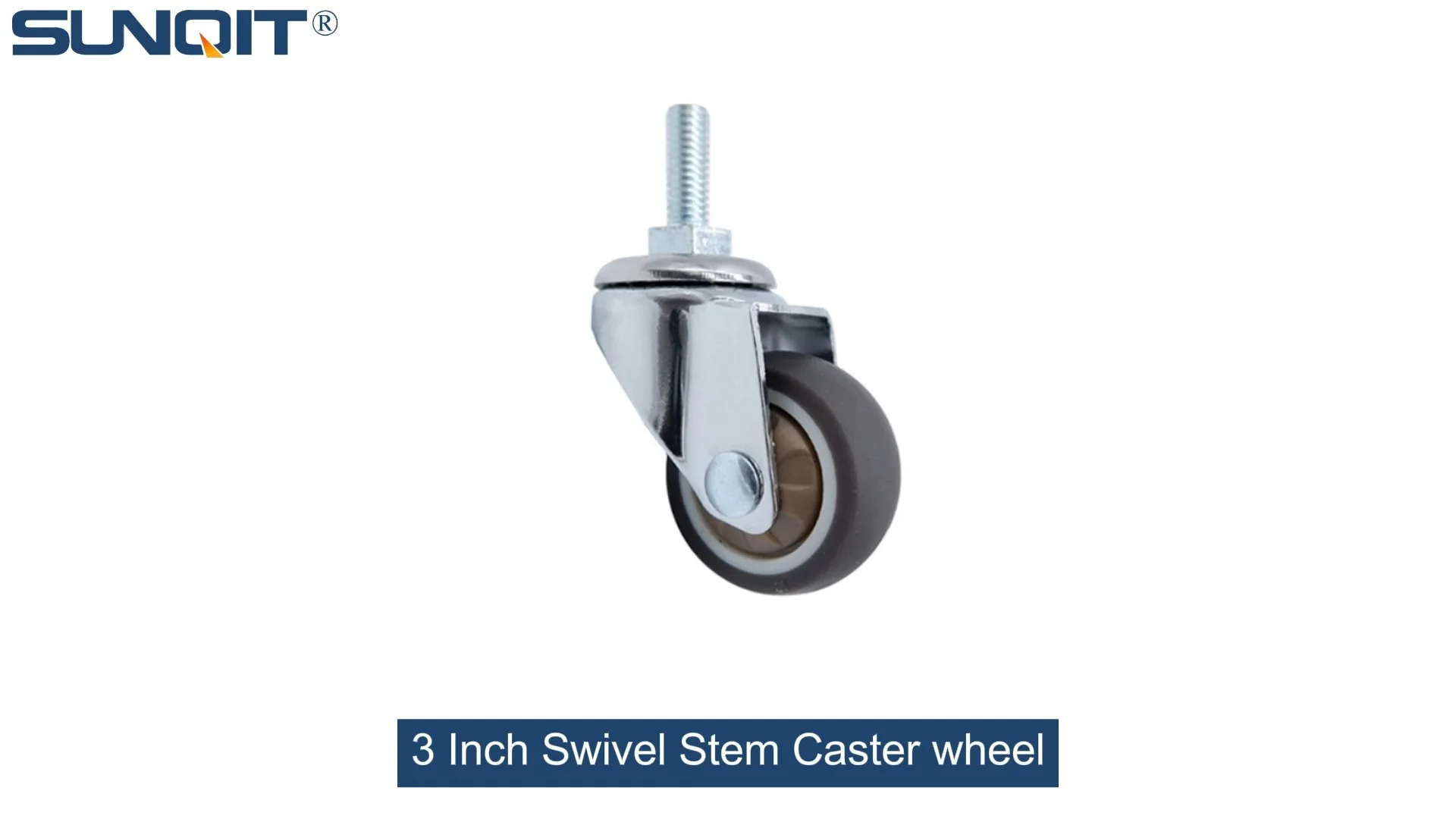
Swivel Stem Caster wheel
360 Degree Swivel Stem Caster. Threaded-post mount design, castors diameter 3 inch.Each swivel caster wheels loading 70KGS. Heavy enough and widely suit for carts, chairs, cabinet, flow rack, workbench, turnover rolley.
Walk into any busy workshop, warehouse, or manufacturing floor, and you'll notice something but absolutely critical: the wheels under workbenches, material racks, and turnover trolleys. These aren't just any wheels—they're caster wheels, and among the most versatile are swivel stem caster wheels . They let you glide heavy equipment around corners, reposition a workbench in seconds, or roll a loaded material rack from one station to another with minimal effort. But here's the thing: if you choose the wrong caster wheel—especially one with insufficient load capacity—you're not just risking a stuck trolley or a wobbly workbench. You're gambling with safety, efficiency, and even the longevity of your equipment.
In this guide, we'll break down everything you need to know about calculating the right load capacity for swivel stem caster wheels. Whether you're setting up a new workbench, upgrading a material rack, or just curious about what makes these small but mighty components tick, we'll keep it practical, conversational, and free of jargon. Let's dive in.
What Are Swivel Stem Caster Wheels, Anyway?
Before we get to load capacity, let's make sure we're all on the same page about what swivel stem caster wheels actually are. Unlike fixed casters (which only roll straight) or plate casters (which attach to equipment via a flat metal plate), swivel stem casters have two key features: a stem and a swivel head.
The stem is the metal rod that sticks up from the caster's housing, designed to fit into a pre-drilled hole or socket on the bottom of your equipment—think of it like a "leg" that locks the caster in place. The swivel head is the mechanism that lets the wheel rotate 360 degrees, so you can turn corners or pivot without having to lift the entire load. Combine these two, and you get a wheel that's both easy to install (no complicated bolting required) and incredibly maneuverable—perfect for tight spaces, like between production lines or around a crowded workbench.
But here's where it gets tricky: not all swivel stem casters are built the same. Some have small, hard plastic wheels for light loads, while others feature large, rubber tires for heavy-duty use. And that's where load capacity comes in. It's the maximum weight a caster can safely support, and getting this number right is make-or-break for your setup.
Why Load Capacity Isn't Just a "Nice-to-Know"—It's a Safety Must
Let's start with the obvious: if a caster wheel can't handle the weight you're putting on it, bad things happen. A wheel might crack, a stem could bend, or the swivel head might seize up. But the consequences go beyond a broken caster. Imagine this: you're pushing a fully loaded turnover trolley stacked with heavy parts. The caster wheels, which you thought could handle 500 lbs, are actually only rated for 300 lbs. Mid-roll, one wheel collapses. The trolley tips, spilling parts everywhere—and worse, someone could get hurt. That's not just a productivity killer; it's a safety hazard.
Even if disaster doesn't strike immediately, underrated casters wear out faster. The wheels might develop flat spots from constant stress, or the swivel bearings could overheat and fail. This means more frequent replacements, higher maintenance costs, and unexpected downtime—all things no business needs. On the flip side, overrating casters (choosing a 1000-lb capacity wheel for a 200-lb load) isn't ideal either. Oversized casters are bulkier, harder to maneuver, and more expensive than necessary. So, getting the load capacity just right is about balance: safety, efficiency, and cost-effectiveness.

Key Factors That Influence Load Capacity
Calculating load capacity isn't as simple as looking at a number on a product label. It depends on several factors, some obvious and some that might surprise you. Let's break them down:
1. Total Weight of the Load (Including the Equipment Itself)
This is the starting point. You need to know the total weight the casters will support, not just the weight of the items you're moving. For example, if you're adding casters to a workbench , you need to account for:
- The weight of the workbench itself (frame, tabletop, etc.)
- Any tools or machinery permanently mounted on the workbench (drills, saws, etc.)
- The maximum weight of materials you'll place on the workbench (boxes, parts, inventory)
- Even the weight of a person leaning on or standing at the workbench (if applicable)
Add all these up, and you've got your "gross load." Let's say your workbench weighs 150 lbs, you'll put up to 300 lbs of tools and materials on it, and occasionally someone might lean 100 lbs against it. Your total gross load is 150 + 300 + 100 = 550 lbs. That's the number we'll use to calculate how much each caster needs to support.
2. Number of Casters Supporting the Load
Most equipment uses 4 casters (one at each corner), but some heavier setups might use 6 or 8. The more casters you have, the less weight each one has to bear. The basic formula here is:
Load per caster = Total gross load ÷ Number of casters
But wait—this assumes the weight is perfectly evenly distributed, which almost never happens in real life. A loaded material rack might have heavier boxes on one side, or a workbench might have a bulky tool hanging off one corner. To account for this, we use a safety factor (usually 1.5x to 2x the calculated load per caster). This ensures that even if the weight shifts, no single caster is overloaded.
Let's stick with our workbench example: 550 lbs total, 4 casters. Load per caster without safety factor: 550 ÷ 4 = 137.5 lbs. With a safety factor of 1.5x: 137.5 x 1.5 = 206.25 lbs. So each caster needs to have a load capacity of at least 207 lbs (we round up for safety).
3. Dynamic vs. Static Load Capacity
Caster wheels have two load ratings: static and dynamic . Static load is the weight a caster can support when it's not moving (e.g., a workbench sitting in place all day). Dynamic load is the weight it can support when it's rolling (e.g., pushing that workbench across the floor). Dynamic load is almost always lower than static load because rolling creates additional stress—bumps in the floor, sudden stops, and turns all put extra pressure on the wheel and swivel mechanism.
For most applications, you'll want to focus on dynamic load capacity, especially if the equipment will be moved frequently. If your workbench rarely moves, static load might be sufficient, but it's safer to use dynamic load as your baseline. Always check the product specs to see which rating is listed—some manufacturers only show static load, so you might need to ask for the dynamic rating separately.
4. Wheel Material and Size
Rubber wheels absorb shocks better than plastic ones but might have lower load capacities. Steel wheels are tough but can damage floors. Larger wheels (5" or 6") distribute weight over a bigger area, so they can handle more load than smaller wheels (2" or 3"). For example, a 5" steel wheel might have a dynamic load capacity of 800 lbs, while a 3" plastic wheel might only handle 200 lbs. The material and size also affect maneuverability—larger wheels roll more easily over cracks or uneven floors, which reduces the strain on the caster (and your back).
5. Floor Conditions
Smooth, flat floors (like polished concrete) are easy on casters. Rough surfaces (cracked concrete, gravel) or uneven floors (thresholds, cables) increase friction and stress on the wheels, which can lower the effective load capacity. If your workspace has rough floors, you might need to bump up the safety factor to 2x to account for the extra strain.

Step-by-Step: How to Calculate Load Capacity for Swivel Stem Caster Wheels
Let's put it all together with a step-by-step process. We'll use a real-world example: calculating casters for a turnover trolley that will carry heavy automotive parts in a warehouse.
Step 1: Determine the Total Gross Load
- Trolley weight: 80 lbs (frame, handle, shelves)
- Maximum load of parts: 400 lbs (boxes of engine components)
- Weight of operator pushing/pulling: 50 lbs (occasional leaning or pushing force)
Total gross load = 80 + 400 + 50 = 530 lbs
Step 2: Decide on the Number of Casters
This trolley has 4 corners, so we'll use 4 casters.
Step 3: Calculate Load per Caster (Without Safety Factor)
Load per caster = Total gross load ÷ Number of casters = 530 ÷ 4 = 132.5 lbs
Step 4: Apply a Safety Factor
Warehouse floors are concrete with some cracks, so we'll use a safety factor of 2x (higher than the workshop example due to rougher conditions).
Load per caster with safety factor = 132.5 x 2 = 265 lbs
Step 5: Choose Between Dynamic and Static Load
The trolley will be moved frequently (dynamic load), so we need casters with a dynamic load capacity of at least 265 lbs.
Step 6: Account for Wheel Material and Size
Rubber wheels are better for absorbing shocks on rough floors. A 5" rubber wheel with a dynamic load capacity of 300 lbs would work here (300 lbs > 265 lbs, giving us a buffer).
Final result: We need 4 swivel stem caster wheels with a dynamic load capacity of at least 265 lbs each. A 5" rubber swivel stem caster rated for 300 lbs dynamic load would be a safe, practical choice.

Common Mistakes to Avoid (So You Don't Learn the Hard Way)
Even with the formula, it's easy to slip up. Here are the most common mistakes people make when calculating caster load capacity:
Mistake 1: Forgetting to Include the Equipment's Own Weight
It's easy to focus on the "stuff" you're moving (the 400 lbs of parts) and forget the weight of the trolley or workbench itself. But that 80-lb trolley frame adds up, and skipping it can leave you with underrated casters.
Mistake 2: Assuming Perfect Weight Distribution
No one loads a material rack perfectly evenly. Always use a safety factor—1.5x for smooth, controlled environments (like a workshop), 2x for rough or busy spaces (like a warehouse).
Mistake 3: Confusing Static and Dynamic Load
If you buy casters based on static load but use them for moving equipment, you're setting yourself up for failure. Dynamic load is the critical number for anything that rolls regularly.
Mistake 4: Ignoring Caster Accessories
Accessories like brakes, locks, or heavy-duty stems can add weight or change how the caster performs. A brake mechanism might add 5 lbs per caster, or a longer stem could reduce stability. Factor these into your total load if you're using them.
Real-World Example: When Load Capacity Got It Right (and Wrong)
Let's look at two scenarios to see how load capacity calculations play out in practice.
Success Story: The Workshop Workbench
A small machine shop needed a mobile workbench for assembling small parts. They calculated a total gross load of 400 lbs (workbench: 100 lbs, tools/materials: 250 lbs, operator lean: 50 lbs), used 4 casters, and a 1.5x safety factor. Load per caster: 400 ÷ 4 x 1.5 = 150 lbs. They chose 4 swivel stem caster wheels with a dynamic load capacity of 200 lbs (a buffer over 150 lbs). Six months later, the workbench is still rolling smoothly, no broken wheels, and no safety incidents.
Cautionary Tale: The Overloaded Material Rack
A warehouse manager ordered a material rack B (3 row and 3 floor) and added 4 casters rated for 300 lbs dynamic load. They assumed the rack would hold 1000 lbs of boxes, divided by 4 casters = 250 lbs per caster (no safety factor). But the rack itself weighed 200 lbs, so total load was 1200 lbs. 1200 ÷ 4 = 300 lbs per caster—exactly the caster's rating. One day, a worker loaded heavier boxes on one side, shifting the weight. The casters on that side failed, the rack toppled, and boxes were damaged. The fix? Upgrading to 400-lb capacity casters with a 1.5x safety factor.
Choosing the Right Swivel Stem Caster: Beyond Load Capacity
Once you've nailed the load capacity, there are a few more things to consider to ensure your casters work as hard as you do:
Wheel Material
- Rubber: Good for shock absorption, quiet, and protects floors (great for workshops or offices).
- Polyurethane: Durable, handles heavy loads, and rolls easily on rough surfaces (ideal for warehouses).
- Nylon/Plastic: Lightweight, low-cost, but less shock-absorbent (best for light loads on smooth floors).
Stem Type and Size
Swivel stem casters come with different stem lengths and diameters (e.g., 1/2" diameter, 2" length). Make sure the stem fits snugly into your equipment's mounting hole—too loose, and the caster will wobble; too tight, and you might crack the equipment frame.
Swivel Locking Mechanisms
Some casters have brakes or swivel locks to keep equipment stationary when needed. If your workbench or trolley needs to stay put during use, look for casters with reliable locks.
Conclusion: Your Casters Are Only as Good as Your Calculation
Swivel stem caster wheels might seem like small parts, but they're the foundation of mobility in any workplace. Getting their load capacity right ensures safety, efficiency, and longevity for your equipment—whether it's a workbench, a material rack, or a turnover trolley. By following the steps above—calculating total load, accounting for safety factors, and considering real-world conditions—you can choose casters that keep your operations rolling smoothly (literally).
Remember: When in doubt, round up. It's better to have a caster with a little extra capacity than to cut corners and risk a breakdown. After all, the best caster is the one you never have to think about—because it's doing its job, day in and day out.
| Equipment Type | Total Gross Load (lbs) | Number of Casters | Safety Factor | Required Load per Caster (lbs) |
|---|---|---|---|---|
| Small Workbench | 400 | 4 | 1.5x | 150 |
| Material Rack B (3 row, 3 floor) | 1200 | 4 | 2x | 600 |
| Turnover Trolley | 530 | 4 | 2x | 265 |