- Company Articles
- Products and Technology
- Product knowledge
- How to Calculate the Right Number of Flat Rigid Castor Wheels for Material Rack B

How to Calculate the Right Number of Flat Rigid Castor Wheels for Material Rack B
Related Product
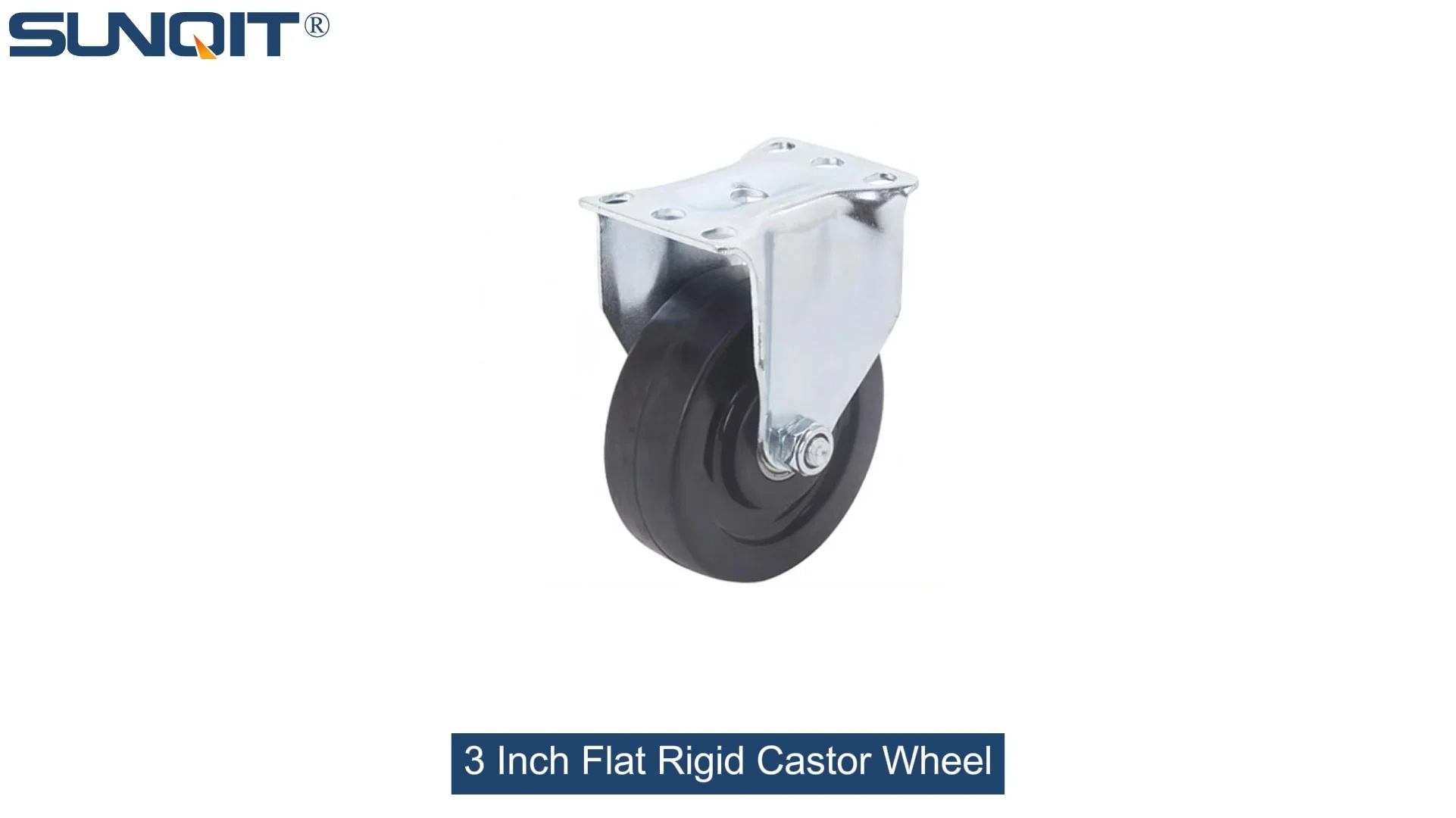
Flat Rigid Castor Wheel
Chair Casters Ball Bearing Wheels Rubber Base. Resistant to abrasion, impact and corrosion. Heavy payload can hold 70Kgs per pcs,which can make it works at a stable and smooth status.
Introduction: The Unsung Hero of Warehouse Efficiency
Walk into any busy warehouse or manufacturing facility, and you'll likely spot rows of material racks standing tall, organizing everything from raw components to finished products. Among these, the Material Rack B (3 row and 3 floor) is a workhorse—its three-tiered, three-row design maximizes vertical space, making it a favorite for facilities aiming to optimize storage without sacrificing accessibility. But here's the thing: even the sturdiest rack is only as reliable as the foundation it stands on. For many Material Rack B units, that foundation includes castor wheels, and not just any wheels—flat rigid castor wheels. These fixed, non-swiveling wheels are chosen for their stability, making them ideal for racks that need to stay put once positioned, yet still be movable when necessary (with a little effort, of course).
But how do you know how many flat rigid castor wheels your Material Rack B actually needs? It's a question that's easy to overlook, but getting it wrong can lead to wobbly racks, damaged floors, or worse—safety hazards like collapsed loads. In this guide, we'll break down the process step by step, covering everything from weight calculations to safety margins, so you can ensure your rack is stable, efficient, and ready to handle whatever your facility throws at it. Along the way, we'll touch on key elements like load distribution, caster accessories, and why cutting corners on wheel count is never worth the risk.
Understanding the Basics: What Are Flat Rigid Castor Wheels?
Before diving into calculations, let's clarify what we're working with. Flat rigid castor wheels are a type of caster where the wheel is mounted on a fixed axle, meaning it doesn't swivel. Unlike swivel casters, which allow 360-degree movement, flat rigid casters keep the rack moving in a straight line—great for stability but less maneuverable. This makes them perfect for Material Rack B units that are positioned in a fixed spot most of the time but may need to be shifted occasionally for cleaning, reconfiguration, or inventory checks.
These wheels come in various sizes and materials, from rubber to steel, and each has a specific load rating—the maximum weight it can safely support. When paired with the right caster accessories, like mounting plates or bolts, they form a secure connection to the rack's base, ensuring the entire unit stays grounded. For Material Rack B, which often holds heavy loads across three floors, choosing the correct number of these wheels isn't just about mobility; it's about distributing weight evenly to prevent stress on any single wheel, the rack itself, or the floor beneath.

Key Factors That Determine Wheel Count
Calculating the number of flat rigid castor wheels for your Material Rack B isn't a one-size-fits-all equation. It depends on several critical factors, each of which we'll unpack below. Think of it as a puzzle—each piece (weight, distribution, floor type) must fit together to get the full picture.
1. Total Weight: The Rack + Its Load
The first step is figuring out how much weight the wheels will actually need to support. This includes two parts: the weight of the Material Rack B itself (the "empty weight") and the maximum load it will carry (the "payload"). Let's break that down.
Empty Weight of Material Rack B: Material Rack B (3 row and 3 floor) is typically made of steel or aluminum, with a frame, shelves, and cross-bracing. While exact weights vary by manufacturer, a standard unit might weigh between 150–250 kg (330–550 lbs). For example, a steel-framed rack with plywood shelves could lean toward the heavier end, around 250 kg, while an aluminum version might be lighter, closer to 150 kg. Check your rack's specifications for the exact empty weight—don't guess here, as underestimating can throw off your entire calculation.
Payload: Maximum Load Capacity of the Rack: Next, consider the heaviest load the rack will ever carry. Material Rack B's 3-row, 3-floor design means it can hold a lot. Let's say each shelf is 1.2 meters long and 0.5 meters deep—common dimensions for this rack type. If each shelf can hold 100 kg per linear meter (a conservative estimate for medium-duty racks), a single shelf might hold up to 120 kg (1.2m x 100 kg/m). With 3 shelves per floor and 3 floors, that's 3 shelves/floor x 3 floors = 9 shelves total. At 120 kg per shelf, the maximum payload would be 9 x 120 kg = 1,080 kg (2,380 lbs). Again, check your rack's load rating label—this is non-negotiable. Exceeding the rack's payload capacity is dangerous, regardless of how many wheels you use.
Total Weight = Empty Weight + Payload: Using our earlier example: 250 kg (empty) + 1,080 kg (payload) = 1,330 kg (2,932 lbs). This is the total weight your flat rigid castor wheels must support.
2. Weight Distribution: Is the Load Even?
Now, here's a curveball: weight isn't always evenly spread across a rack. Imagine loading the top shelf of your Material Rack B with heavy machinery parts while the bottom shelves hold lightweight packaging materials. Suddenly, the weight shifts upward and to one side, putting more stress on the wheels closest to that heavy load. In contrast, a rack loaded with uniformly weighted boxes (think identical cartons of screws) will distribute weight more evenly.
Why does this matter? Because uneven weight can cause some wheels to bear more load than others. For example, if 60% of the total weight sits over the front two wheels, those wheels will take a bigger hit than the rear ones. To account for this, we need to assume the worst-case scenario: the most uneven load your rack will ever experience. Industry best practice is to assume that at least 70% of the total weight could be concentrated over any subset of wheels, depending on how the rack is loaded.
3. Floor Conditions: Smooth vs. Rough Terrain
The surface your rack sits on plays a role, too. A smooth, polished concrete floor is forgiving—wheels distribute weight evenly, and there's less risk of one wheel sinking into a crack or uneven spot. But if your facility has rough, pitted floors or thresholds, even a slight dip can cause a wheel to lose contact with the ground, shifting all the weight onto the remaining wheels. In these cases, more wheels mean more points of contact, reducing the chance of uneven loading due to floor imperfections.
Flat rigid castor wheels, with their fixed orientation, are less prone to "tipping" on rough floors than swivel wheels, but they still rely on consistent contact. For Material Rack B units in facilities with less-than-ideal floors, adding an extra wheel or two can provide that extra stability buffer.
4. Flat Rigid Castor Wheel Load Rating: Know Your Wheel's Limits
Every flat rigid castor wheel has a load rating—a maximum weight it can support under normal conditions. This is set by the manufacturer and is non-negotiable. For example, a common 4-inch flat rigid castor wheel might have a load rating of 200 kg (440 lbs) per wheel. But here's the catch: load ratings are tested under ideal conditions (even weight distribution, smooth floors, proper installation). In real-world scenarios, we need to be more conservative.
Always check the load rating of the specific flat rigid castor wheels you plan to use. Don't assume—different materials (rubber vs. steel), wheel diameters, and bearing types all affect load capacity. For instance, a steel wheel with ball bearings might have a higher load rating than a rubber wheel with plain bearings, even if they're the same size.
5. Safety Margin: Because "Just Enough" Isn't Enough
Even if your calculations say a certain number of wheels "should" work, you need to factor in a safety margin. Why? Because life is unpredictable. Maybe a forklift bumps the rack, causing a sudden jolt. Or the payload is heavier than expected one day. Or a wheel is slightly damaged and can't support its full rated load. The safety margin acts as a buffer against these unknowns.
Industry standards recommend a safety margin of 1.5x to 2x the calculated load. That means if your wheels need to support 1,000 kg, you'd design for 1,500–2,000 kg to be safe. For critical applications (like racks holding hazardous materials), a 2x margin is often mandatory. For most Material Rack B units, a 1.5x margin is a good starting point.

Step-by-Step Calculation: Finding Your Wheel Count
Now that we've covered the factors, let's put it all together into a step-by-step process. We'll use a hypothetical Material Rack B to walk through the numbers, but you can plug in your own rack's specs at home.
Example Scenario
Let's define our variables for clarity:
- Material Rack B (3 row and 3 floor) empty weight: 200 kg
- Maximum payload: 1,200 kg (so total weight = 200 kg + 1,200 kg = 1,400 kg)
- Floor condition: Smooth concrete (no major cracks or unevenness)
- Flat rigid castor wheel load rating: 250 kg per wheel (manufacturer's spec)
- Weight distribution: Assume up to 70% of total weight could be concentrated on any subset of wheels (uneven load worst case)
- Safety margin: 1.5x
Step 1: Calculate the "Worst-Case Load" on Wheels
First, account for uneven weight distribution. If 70% of the total weight could end up on a subset of wheels, we need to calculate that:
Worst-case load = Total weight x 0.70 = 1,400 kg x 0.70 = 980 kg
This means, in the worst scenario, some wheels could be supporting up to 980 kg combined. (Note: If your rack is always loaded evenly, you might use 0.50 instead of 0.70, but it's safer to assume uneven loading.)
Step 2: Apply the Safety Margin
Now, multiply the worst-case load by the safety margin (1.5x):
Adjusted load = Worst-case load x Safety margin = 980 kg x 1.5 = 1,470 kg
This is the total load capacity we need from our wheels, accounting for both uneven weight and safety.
Step 3: Determine the Number of Wheels Needed
Next, divide the adjusted load by the load rating of a single flat rigid castor wheel:
Number of wheels = Adjusted load / Load rating per wheel = 1,470 kg / 250 kg per wheel ≈ 5.88 wheels
Since we can't use a fraction of a wheel, we round up to the nearest whole number: 6 wheels.
Step 4: Verify Stability (The "Tipping Test")
Even if the math says 6 wheels, we need to ensure the rack won't tip over. For a rack with flat rigid castor wheels (fixed direction), stability depends on the wheelbase (distance between front and rear wheels) and the rack's height. A taller rack with a narrow wheelbase is more prone to tipping.
A quick rule of thumb: The wheelbase should be at least 1/3 the height of the rack. For example, if Material Rack B is 2 meters tall, the wheelbase (distance between front and rear wheels) should be at least 0.67 meters (2m / 3). If your wheelbase is shorter, you may need more wheels to widen the base.
In our example, if the rack is 2m tall and we use 6 wheels (3 on each side, spaced 0.8m apart), the wheelbase is 0.8m, which is greater than 0.67m—so stability is good.
Step 5: Check Wheel Spacing and Rack Design
Finally, ensure the rack's base can accommodate the number of wheels. Material Rack B typically has a rectangular base—say, 1.5m long and 0.8m wide. Adding 6 wheels (3 along each long side, spaced evenly) would work, as there's enough room to mount them without overlapping or weakening the frame. If the rack is too narrow for 6 wheels, you might need to use larger wheels with higher load ratings instead.
Summary Table: Calculation Example
| Step | Calculation | Result |
|---|---|---|
| 1. Total weight (empty + payload) | 200 kg + 1,200 kg | 1,400 kg |
| 2. Worst-case load (70% of total) | 1,400 kg x 0.70 | 980 kg |
| 3. Adjusted load (safety margin 1.5x) | 980 kg x 1.5 | 1,470 kg |
| 4. Number of wheels (250 kg/wheel) | 1,470 kg / 250 kg per wheel | ≈ 6 wheels |

Common Mistakes to Avoid
Even with the steps above, it's easy to slip up. Here are the most common mistakes facilities make when choosing flat rigid castor wheels for Material Rack B:
Mistake 1: Ignoring the Rack's Empty Weight
It's tempting to only think about the payload, but the rack itself adds significant weight. A 200 kg rack plus 1,200 kg payload is 1,400 kg total—skipping the 200 kg empty weight would lead you to calculate for 1,200 kg, resulting in too few wheels.
Mistake 2: Using the Wheel's "Advertised" Load Rating Without Safety Margin
A wheel rated for 250 kg doesn't mean you can load 250 kg on it. Always apply the safety margin—otherwise, you're gambling with failure.
Mistake 3: Assuming Even Weight Distribution
Warehouse staff aren't perfect. A hurried employee might stack all heavy items on one shelf, creating uneven weight. Plan for it.
Mistake 4: Forgetting Caster Accessories
Even the best wheels won't perform if the caster accessories (like mounting plates or bolts) are low-quality. A weak mounting plate can bend, causing the wheel to shift and bear more load than intended. Invest in accessories that match the wheel's load rating.
Mistake 5: Overlooking Floor Slopes
A sloped floor (even a slight one) can cause weight to shift toward the lower side. If your facility has sloped floors, you may need extra wheels on the downhill side to counteract this.
Real-World Case Study: When 4 Wheels Weren't Enough
Let's look at a real example to drive this home. A mid-sized electronics manufacturer recently installed 10 Material Rack B units, each fitted with 4 flat rigid castor wheels (250 kg load rating per wheel). The team calculated total weight as 1,200 kg (payload) + 200 kg (rack) = 1,400 kg, then divided by 4 wheels: 1,400 kg / 4 = 350 kg per wheel. But wait—they forgot the safety margin and uneven weight distribution.
Within weeks, several racks began to wobble. Upon inspection, the team found that the top shelves were loaded with heavy circuit boards, concentrating weight toward the top and front. The front two wheels were bearing nearly 800 kg combined (400 kg each), their 250 kg rating. The fix? Upgrading to 6 wheels per rack, which reduced the load per wheel to ~233 kg (well within the 250 kg rating, even with safety margin). The wobbling stopped, and the racks have been stable ever since.
Conclusion: Stability = Safety = Efficiency
Calculating the right number of flat rigid castor wheels for your Material Rack B isn't just about math—it's about protecting your team, your products, and your bottom line. By considering total weight, distribution, floor conditions, wheel load ratings, and safety margins, you can ensure your rack stands firm, even under the toughest conditions. And remember: when in doubt, add an extra wheel. It's a small investment compared to the cost of a collapsed rack or injured employee.
So, the next time you're setting up a Material Rack B, take a moment to crunch the numbers. Your warehouse's efficiency (and safety) will thank you.