- Company Articles
- Products and Technology
- Product knowledge
- How to Choose 4040E EU Standard Aluminum Profile: Factors for Manufacturing Projects

How to Choose 4040E EU Standard Aluminum Profile: Factors for Manufacturing Projects
Related Product
4040E EU Standard Aluminum Profile
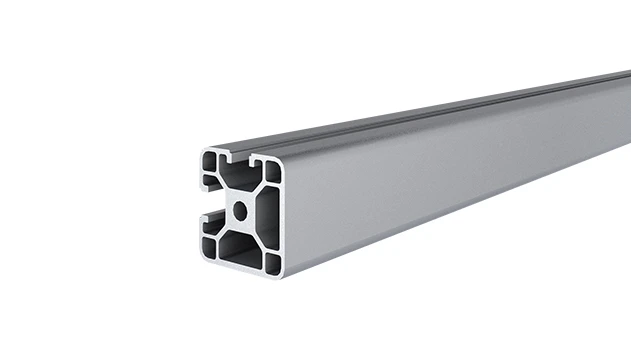
4040E is a 4.00x4.00 CM fractional 40 series square extrusion T-slot profile with two side open T-slots, two side with closed face, each side with 4.00cm face. The profile has align-a-grooves to assist in aligning connecting profiles.
Walk into any modern manufacturing facility, and you'll likely spot aluminum profiles holding up workbenches, organizing material racks, or forming the backbone of conveyor systems. These unassuming structures are the silent workhorses of production lines, quietly supporting everything from small-scale assembly tasks to large-scale lean manufacturing operations. But here's the thing: not all aluminum profiles are created equal. When it comes to choosing one for your next project, especially in industries where precision, durability, and compliance matter, the stakes feel surprisingly high. That's where the 4040E EU Standard Aluminum Profile comes into play—a popular choice for manufacturers, but one that still requires careful consideration to ensure it aligns with your specific needs. In this guide, we'll break down the key factors to keep in mind when selecting 4040E profiles, helping you avoid common pitfalls and make a choice that boosts efficiency, reduces waste, and stands the test of time.
Understanding the 4040E EU Standard Aluminum Profile
First, let's get clear on what exactly the 4040E EU Standard Aluminum Profile is. At its core, it's a type of aluminum extrusion profile —meaning it's formed by pushing heated aluminum through a die to create a specific cross-sectional shape. The "4040" in its name refers to its dimensions: 40mm in width and 40mm in height, making it a square profile. The "E" denotes a specific series within EU standard profiles, often characterized by unique slot designs, wall thicknesses, or structural features that set it apart from other 4040 variants like the 4040A or 4040B.
But what really makes the "EU Standard" label important? EU standards (often governed by organizations like DIN or EN) ensure consistency in manufacturing, material quality, and safety. For manufacturers operating in Europe or exporting to EU markets, compliance with these standards isn't just a nice-to-have—it's a legal requirement. Even beyond regulations, EU-standard profiles are engineered with precision in mind, which translates to better compatibility with accessories, more reliable performance, and a lower risk of unexpected failures down the line. So, when we talk about 4040E, we're not just talking about a piece of aluminum; we're talking about a profile designed to meet rigorous benchmarks, making it a solid foundation for critical manufacturing systems.
Key Factor 1: Material Quality and Durability
Let's start with the basics: the material itself. Aluminum profiles are only as good as the aluminum they're made from, and 4040E is no exception. Most high-quality 4040E profiles are crafted from 6000-series aluminum alloys—typically 6063 or 6061—known for their excellent balance of strength, corrosion resistance, and machinability. 6063, in particular, is a favorite for extrusions because it's easy to shape into complex profiles (like the 4040E's T-slots) and offers good surface finish, which is important if your application requires painting or anodizing.
But material quality goes beyond just the alloy. The extrusion process itself matters, too. A well-extruded 4040E profile will have uniform wall thickness, smooth surfaces, and minimal defects like cracks or warping. Why does this matter? Imagine building a workbench where one section of the profile is slightly thinner than the others—over time, that weak spot could lead to sagging, compromising the stability of the entire structure. Similarly, surface imperfections might make it harder to attach accessories like brackets or end caps, creating gaps that collect dust or hinder smooth operation.
Durability is also tied to how the profile is treated post-extrusion. Many 4040E profiles undergo anodizing—a process that forms a protective oxide layer on the surface—boosting corrosion resistance. This is a game-changer if your facility deals with moisture, chemicals, or even just high humidity. For example, in food processing or pharmaceutical manufacturing, where cleanliness is critical, anodized 4040E profiles are easier to sanitize and less likely to degrade from frequent washdowns. So, when evaluating suppliers, don't hesitate to ask about their material sourcing, extrusion techniques, and finishing processes—these details will tell you a lot about how well the profile will hold up in your workspace.

Key Factor 2: Dimensional Accuracy and Consistency
If you've ever tried to assemble furniture with misaligned holes or ill-fitting parts, you know how frustrating dimensional inconsistencies can be. Now, multiply that frustration by 100 when you're building a production line with dozens of interconnected aluminum profiles. That's why dimensional accuracy is non-negotiable when choosing 4040E profiles. EU standards set strict tolerances for these profiles—for example, the width and height (40mm) might have a tolerance of ±0.2mm, ensuring that each piece you order is nearly identical to the last.
Why does this matter in practice? Let's say you're constructing a workbench using 4040E profiles as the frame. If one profile is 0.5mm wider than the others, the pre-drilled T-slots (the grooves that allow accessories to attach) might not line up with the brackets you've ordered. Suddenly, you're spending extra time filing down edges or improvising with shims—time that could have been spent on actual production. In lean manufacturing systems, where every minute counts, these delays add up quickly. Consistency also matters for scalability: if you need to replicate the same workbench design across multiple facilities, you want to be confident that the profiles from batch to batch will behave the same way.
To check for dimensional accuracy, ask potential suppliers for a certificate of conformity (CoC) that includes measurements from a recent batch. You can also request a sample and measure it yourself using calipers—pay attention to the overall dimensions, slot width, and wall thickness. Even small discrepancies here can throw off your entire project, so it's worth the extra effort upfront.
Key Factor 3: Load Capacity and Structural Integrity
How much weight will your 4040E profile need to support? It's a simple question, but one that's surprisingly easy to overlook. A profile that works perfectly for a lightweight assembly workbench might buckle under the weight of heavy machinery or stacked materials. So, before making a purchase, you need to calculate the maximum load your structure will bear—both static (like a workbench holding tools) and dynamic (like a conveyor carrying moving parts).
The load capacity of 4040E profiles depends on several factors, including wall thickness, alloy type, and the way the profile is supported. For example, a 4040E with a 2.0mm wall thickness will generally handle more weight than one with a 1.5mm wall. The profile's design also plays a role: some 4040E variants have reinforced internal ribs that distribute weight more evenly, making them better suited for heavy-duty applications like material racks or machine guards. To get a sense of what's possible, look for load charts provided by the manufacturer—these often list maximum deflection (how much the profile bends under load) for different spans and support configurations.
Let's take a concrete example: suppose you're building a material rack using 4040E profiles. The rack needs to hold 50kg per shelf, with three shelves spaced 800mm apart. Using the manufacturer's load chart, you might find that a 4040E with a 2.0mm wall can support 60kg over an 800mm span with minimal deflection—plenty for your needs. But if you opt for a thinner-walled profile to save costs, you might find the shelves sagging under the weight, risking damage to both the materials and the rack itself. Remember: it's better to overestimate your load needs slightly than to cut corners and end up with a structure that fails.
| Profile Type | Wall Thickness (mm) | Max Static Load (kg) @ 800mm Span | Common Applications |
|---|---|---|---|
| 4040E EU Standard | 2.0 | 60-70 | Heavy-duty workbenches, material racks, machine frames |
| 4040A EU Standard | 1.5 | 40-50 | Light assembly stations, shelving, small conveyors |
| 3030 EU Standard | 1.5 | 25-35 | Small workbenches, display racks, cart frames |
Key Factor 4: Compatibility with Aluminum Profile Accessories
Aluminum profiles are rarely used alone—they're meant to be paired with aluminum profile accessories like connectors, end caps, hinges, and brackets. These accessories turn a simple length of aluminum into a fully functional structure, whether it's a workbench, a conveyor, or a turnover trolley. But here's the catch: not all accessories work with all profiles. The 4040E, with its specific slot design and dimensions, requires accessories that are engineered to fit its T-slots perfectly. Choosing incompatible accessories can lead to loose connections, wobbly structures, or even safety hazards.
Let's say you've decided on 4040E profiles for a lean manufacturing cell. You order corner brackets, thinking they'll snap right into the T-slots—but when they arrive, the tabs on the brackets are too wide to fit. Now you're stuck: either return the brackets (delaying your project) or modify the slots (weakening the profile). To avoid this, always check that the accessories you plan to use are explicitly listed as compatible with 4040E EU Standard profiles. Look for accessories with adjustable clamps or universal designs, but even these should be tested with a sample profile first.
Common accessories to consider include: end caps (to cover sharp edges and prevent dust buildup), angle brackets (for connecting profiles at 90° or 135° angles), and panel mounts (for attaching shelves or tool boards). Some suppliers offer accessory kits specifically designed for 4040E profiles, which can simplify the ordering process and reduce the risk of incompatibility. When evaluating suppliers, ask if they stock a full range of compatible accessories—or if they can source them from trusted partners. A supplier that understands the ecosystem of 4040E profiles and accessories will save you countless headaches down the line.
Key Factor 5: Alignment with Lean System Goals
In today's manufacturing landscape, lean principles—eliminating waste, streamlining processes, and maximizing value—are more critical than ever. Your choice of aluminum profile should support these goals, not hinder them. The 4040E, with its modular design and compatibility with accessories, is inherently lean-friendly, but only if you choose it with your specific lean objectives in mind.
For example, if your goal is to reduce changeover time between production runs, you need a profile that allows for quick reconfiguration. 4040E's T-slot system makes it easy to add or remove accessories (like tool holders or material bins) without drilling or welding, letting you adapt the workspace in minutes instead of hours. In a lean system focused on visual management, you might use colored end caps or brackets to organize tools by function—4040E's smooth surface and consistent slot spacing make this kind of customization straightforward.
Another lean consideration is material flow. If you're building a flow rack or conveyor using 4040E profiles, the profile's load capacity and rigidity will impact how smoothly materials move through the line. A flimsy profile might cause jams or require frequent adjustments, creating bottlenecks. On the flip side, a well-chosen 4040E profile can support gravity-fed roller tracks or automated conveyors, ensuring materials arrive at the right place at the right time—exactly what lean manufacturing aims for.
Key Factor 6: Choosing the Right Aluminum Profile Supplier
Even the best 4040E profile won't live up to its potential if it comes from an unreliable supplier. When evaluating aluminum profile suppliers , look beyond just the price tag—focus on factors that will impact your project's success in the long run. Here are a few questions to ask:
- Do they specialize in EU standard profiles? Suppliers with expertise in EU standards will be more familiar with the specific requirements of 4040E, from material certifications to dimensional tolerances.
- Can they provide customization? Maybe you need 4040E profiles cut to specific lengths, or with custom holes drilled for your unique application. A supplier that offers in-house machining can save you time and reduce the risk of errors.
- What's their lead time? In manufacturing, delays can be costly. Ask about typical lead times for standard orders and rush options for emergencies.
- Do they offer technical support? If you're unsure about load capacities or accessory compatibility, a supplier with knowledgeable technical staff can help you make informed decisions. Look for suppliers that provide CAD files or design guides for 4040E profiles.
- What's their quality control process? A reputable supplier will have strict quality checks in place, from raw material inspection to final packaging. Ask about their defect rate and how they handle returns if a profile doesn't meet specifications.
Don't be afraid to ask for references from other manufacturers in your industry. A supplier that's worked with companies similar to yours will have a better understanding of your unique challenges and needs.
Common Mistakes to Avoid
Even with careful planning, it's easy to fall into common traps when choosing 4040E profiles. Here are a few to watch out for:
Overlooking accessory compatibility: As we mentioned earlier, assuming all accessories fit all profiles is a recipe for frustration. Always confirm compatibility before placing a large order.
Ignoring environmental factors: Will the profile be used indoors or outdoors? In a humid environment or one with exposure to chemicals? Anodized 4040E profiles are great for most indoor settings, but if you need extra corrosion resistance, you might opt for a stainless steel coating (though this will add cost).
Choosing based solely on price: It's tempting to go with the cheapest supplier, but low-cost profiles often cut corners on material quality or dimensional accuracy. The savings upfront might not be worth the cost of repairs, delays, or replacements later.
Underestimating load requirements: It's easy to assume "strong enough" is good enough, but over time, consistent overloading can weaken profiles, leading to safety risks. Err on the side of caution when calculating load capacity.
Conclusion: Making the Right Choice for Your Project
Choosing a 4040E EU Standard Aluminum Profile might seem like a small decision in the grand scheme of a manufacturing project, but it's one that ripples through every stage—from design to assembly to daily operation. By focusing on material quality, dimensional accuracy, load capacity, accessory compatibility, lean system alignment, and supplier reliability, you can ensure that the profiles you select will support your goals, rather than create new challenges.
Remember, the best 4040E profile isn't just a piece of aluminum—it's a partner in your manufacturing process. It should make your workflow smoother, your workspace more adaptable, and your operations more efficient. With the right approach, you'll not only find a profile that meets your current needs but one that can grow with your business for years to come.