- Company Articles
- Products and Technology
- Product knowledge
- How to Choose 4080A EU Standard Aluminum Profile for Your Assembly Line

How to Choose 4080A EU Standard Aluminum Profile for Your Assembly Line
Related Product
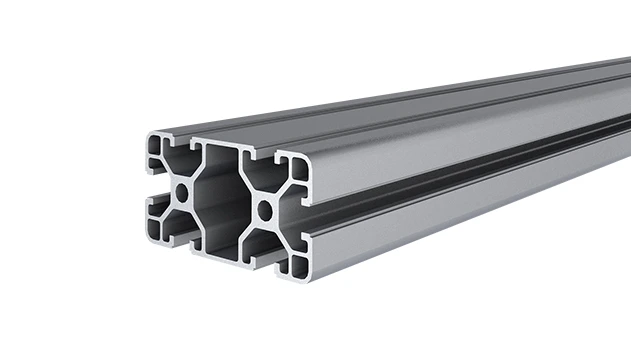
4080A EU Standard Aluminum Profile
4080A is a 4.00x8.00 CM fractional 40 series square extrusion T-slot profile with two side open T-slots, each side with 4.00cm face, two side with 8.00cm face. The profile has align-a-grooves to assist in aligning connecting profiles.
Let's start with a scenario we've all heard (or lived) in manufacturing: A production supervisor walks the assembly line, sighing as they notice a workbench wobbling under the weight of tools, a conveyor track that's starting to bend, and a material rack that takes two people to reposition. These small hiccups—wasted time adjusting unstable structures, parts getting stuck on misaligned tracks, or teams avoiding using a rack because it's too flimsy—add up. Fast. Over a week, they might cost hours of productivity. Over a month? That's a noticeable hit to your bottom line. The culprit? Often, it's the foundation: the materials you build your assembly line with. And if you're in the market for a material that balances strength, flexibility, and durability, chances are you've come across the 4080A EU Standard Aluminum Profile. But how do you know if it's the right fit for your line? Let's break it down, step by step.
First Things First: What Even Is 4080A EU Standard Aluminum Profile?
Before diving into "how to choose," let's make sure we're on the same page about what 4080A actually is. At its core, it's an extruded aluminum profile—think of it as a long, rigid beam with a specific cross-section—designed to meet strict EU manufacturing standards. The "4080" refers to its dimensions: 40mm in width and 80mm in height. The "A" might sound like a mysterious code, but it's usually a manufacturer's way of indicating a specific version within the 4080 family, often with slight variations in T-slot design (those grooves running along the profile) or wall thickness.
What makes the "EU Standard" part important? Unlike generic aluminum profiles, EU-standard ones undergo rigorous testing for things like dimensional accuracy (so your 40x80mm profile is actually 40x80mm, not 39.5x79.2), material strength, and corrosion resistance. If you've ever bought a cheap aluminum profile only to find the slots don't line up with accessories or it bends under half the weight it promised, you know why standards matter. EU compliance is like a quality seal—you're less likely to get stuck with a dud.
And aluminum? Well, that's the star here. Aluminum alloy (usually 6063-T5, the go-to for profiles) is lightweight but surprisingly tough. It's resistant to rust, easy to cut or drill if you need custom lengths, and—crucially—works with a huge range of accessories, from brackets to casters. That modularity is why aluminum profiles have become the backbone of modern assembly lines: they let you build, adapt, and rebuild without starting from scratch.
What makes the "EU Standard" part important? Unlike generic aluminum profiles, EU-standard ones undergo rigorous testing for things like dimensional accuracy (so your 40x80mm profile is actually 40x80mm, not 39.5x79.2), material strength, and corrosion resistance. If you've ever bought a cheap aluminum profile only to find the slots don't line up with accessories or it bends under half the weight it promised, you know why standards matter. EU compliance is like a quality seal—you're less likely to get stuck with a dud.
And aluminum? Well, that's the star here. Aluminum alloy (usually 6063-T5, the go-to for profiles) is lightweight but surprisingly tough. It's resistant to rust, easy to cut or drill if you need custom lengths, and—crucially—works with a huge range of accessories, from brackets to casters. That modularity is why aluminum profiles have become the backbone of modern assembly lines: they let you build, adapt, and rebuild without starting from scratch.
Key Factor #1: Load Capacity—How Much Weight Will Your Line Actually Handle?
Let's get practical: Your assembly line isn't just holding air. It's holding tools, parts, maybe even heavy machinery. A workbench might need to support 50kg of tools and components. A conveyor track could be moving 20kg bins every minute. A material rack might stack 100kg of raw materials. If your 4080A profile can't handle that, you're back to the wobbling workbench scenario.
So, how do you figure out if 4080A is up to the task? Start by checking the "static load capacity" and "dynamic load capacity" specs from the supplier. Static load is how much weight it can hold when stationary (like a workbench with tools). Dynamic load is when weight is moving (like parts sliding down a conveyor track or a trolley being pushed).
For 4080A, typical static load capacities range from 300kg to 800kg per meter, depending on wall thickness and alloy grade. That might sound like a wide range, but here's why it matters: A thin-walled 4080A (say, 1.5mm wall) might hit 300kg, while a thicker one (2.5mm wall) could handle 600kg+. If your workbench is 1.2 meters long and needs to hold 400kg, the thin-walled version? Risky. The thicker one? Safe.
Pro tip: Don't just take the supplier's word for it. Ask for test reports. Reputable suppliers will have data from third-party labs showing how their 4080A performs under stress. And when in doubt, overestimate. It's better to have a profile that can handle 100kg more than you need than 10kg less.
So, how do you figure out if 4080A is up to the task? Start by checking the "static load capacity" and "dynamic load capacity" specs from the supplier. Static load is how much weight it can hold when stationary (like a workbench with tools). Dynamic load is when weight is moving (like parts sliding down a conveyor track or a trolley being pushed).
For 4080A, typical static load capacities range from 300kg to 800kg per meter, depending on wall thickness and alloy grade. That might sound like a wide range, but here's why it matters: A thin-walled 4080A (say, 1.5mm wall) might hit 300kg, while a thicker one (2.5mm wall) could handle 600kg+. If your workbench is 1.2 meters long and needs to hold 400kg, the thin-walled version? Risky. The thicker one? Safe.
Pro tip: Don't just take the supplier's word for it. Ask for test reports. Reputable suppliers will have data from third-party labs showing how their 4080A performs under stress. And when in doubt, overestimate. It's better to have a profile that can handle 100kg more than you need than 10kg less.

Key Factor #2: Compatibility with Aluminum Profile Accessories—Because a Profile Alone Isn't Enough
Imagine buying a 4080A profile, excited to build a custom workbench, only to realize the brackets you ordered don't fit the T-slots. Or the casters won't lock into the profile's grooves. Now you're stuck, waiting for replacement parts, and your line is delayed. That's why compatibility with aluminum profile accessories is non-negotiable.
4080A's T-slots are its superpower. Those grooves let you attach accessories without welding—just slide in a bolt, tighten, and you're done. But not all T-slots are the same. EU standard 4080A typically uses "M8" or "M10" T-slots (referring to the bolt size they accept). So, when shopping for accessories—like 90° aluminum profile connectors, caster wheels, or workbench shelves—double-check that they're designed for M8/M10 T-slots.
Common accessories you'll likely pair with 4080A include:
- Connectors : 90° joints for building right angles (like workbench legs), 135° joints for corners, or 45° joints for sloped surfaces (useful for gravity-fed conveyors).
- Casters : Swivel casters with brakes for mobile workbenches or trolleys—look for ones with a plate that fits 4080A's T-slots (avoid generic casters that require drilling holes).
- Panels : Aluminum honeycomb panels or plywood sheets for workbench tops—these attach via bracket clips that slide into T-slots.
A quick test: Ask the supplier for a sample accessory pack (a connector, a caster, a bracket) when you order your 4080A sample. Assemble a small structure—if everything clicks into place without forcing, you're good. If parts wobble or don't fit, move to a supplier with better accessory compatibility.
4080A's T-slots are its superpower. Those grooves let you attach accessories without welding—just slide in a bolt, tighten, and you're done. But not all T-slots are the same. EU standard 4080A typically uses "M8" or "M10" T-slots (referring to the bolt size they accept). So, when shopping for accessories—like 90° aluminum profile connectors, caster wheels, or workbench shelves—double-check that they're designed for M8/M10 T-slots.
Common accessories you'll likely pair with 4080A include:
- Connectors : 90° joints for building right angles (like workbench legs), 135° joints for corners, or 45° joints for sloped surfaces (useful for gravity-fed conveyors).
- Casters : Swivel casters with brakes for mobile workbenches or trolleys—look for ones with a plate that fits 4080A's T-slots (avoid generic casters that require drilling holes).
- Panels : Aluminum honeycomb panels or plywood sheets for workbench tops—these attach via bracket clips that slide into T-slots.
A quick test: Ask the supplier for a sample accessory pack (a connector, a caster, a bracket) when you order your 4080A sample. Assemble a small structure—if everything clicks into place without forcing, you're good. If parts wobble or don't fit, move to a supplier with better accessory compatibility.
Key Factor #3: Application Scenarios—Is 4080A Right for Your Specific Line?
4080A is versatile, but that doesn't mean it's the best fit for every assembly line task. Let's map out common scenarios and whether 4080A shines here:
Workbenches : If your line uses workbenches for assembly, testing, or packaging, 4080A is a rockstar. Its 40x80mm cross-section provides stability (no more wobbling), and the T-slots let you add shelves, tool hooks, or even LED lights above the workspace. For example, a "Workbench E (single deck-without caster)" (a common model) built with 4080A can easily hold tools, a laptop, and parts without flexing.
Conveyors and Roller Tracks : Conveyors need to be rigid but also smooth—if the track bends, parts get stuck. 4080A's rigidity makes it ideal for roller track systems. Pair it with "plastic roller track guide rails" (yellow or grey, depending on your line's color coding) and "roller track placon mounts" (brackets that attach the track to the profile), and you've got a conveyor that moves parts consistently, even under repeated use.
Material Racks and Trolleys : Material racks (like "Material Rack B (3 row and 3 floor)") often need to stack heavy items. 4080A's vertical strength means you can build taller racks without worrying about bowing. Trolleys built with 4080A are sturdy enough to push around the line but light enough that one person can maneuver them—no more "two people to move a trolley" inefficiencies.
When Might You Choose a Different Profile? If you're building something tiny (like a small parts bin) or super lightweight (a tool holder that hangs from the ceiling), a smaller profile (like 2020 or 3030) might be overkill. But for most mid-to-heavy assembly line tasks, 4080A hits the sweet spot of strength and flexibility.
Workbenches : If your line uses workbenches for assembly, testing, or packaging, 4080A is a rockstar. Its 40x80mm cross-section provides stability (no more wobbling), and the T-slots let you add shelves, tool hooks, or even LED lights above the workspace. For example, a "Workbench E (single deck-without caster)" (a common model) built with 4080A can easily hold tools, a laptop, and parts without flexing.
Conveyors and Roller Tracks : Conveyors need to be rigid but also smooth—if the track bends, parts get stuck. 4080A's rigidity makes it ideal for roller track systems. Pair it with "plastic roller track guide rails" (yellow or grey, depending on your line's color coding) and "roller track placon mounts" (brackets that attach the track to the profile), and you've got a conveyor that moves parts consistently, even under repeated use.
Material Racks and Trolleys : Material racks (like "Material Rack B (3 row and 3 floor)") often need to stack heavy items. 4080A's vertical strength means you can build taller racks without worrying about bowing. Trolleys built with 4080A are sturdy enough to push around the line but light enough that one person can maneuver them—no more "two people to move a trolley" inefficiencies.
When Might You Choose a Different Profile? If you're building something tiny (like a small parts bin) or super lightweight (a tool holder that hangs from the ceiling), a smaller profile (like 2020 or 3030) might be overkill. But for most mid-to-heavy assembly line tasks, 4080A hits the sweet spot of strength and flexibility.
Key Factor #4: Lean System Integration—Does It Support Your "Do More with Less" Goals?
Lean manufacturing isn't just a buzzword—it's about cutting waste: wasted time, wasted space, wasted effort. And 4080A plays surprisingly well here. Let's see how:
Quick Reconfiguration : Lean lines need to adapt. Maybe next month, you're switching from assembling Product A to Product B, which requires a wider workbench or a longer conveyor. With 4080A and its T-slot accessories, you don't need to weld or drill new holes. Loosen the bolts, adjust the connectors, add a new section of profile, and you're done. A team of two could reconfigure a workbench in 30 minutes instead of waiting a day for a welder.
Space Efficiency : 4080A is slim (40x80mm) but strong, so you can build compact structures that use vertical space. For example, a material rack built with 4080A can have 3 rows and 3 floors (like "Material Rack B") without taking up more floor space than a smaller, weaker rack. That frees up room for other equipment or team movement.
Reduced Maintenance Waste : Aluminum is corrosion-resistant, so you won't spend time sanding rust or repainting profiles. And because accessories attach via T-slots, replacing a broken caster or bracket is as easy as sliding out the old one and popping in a new one—no need to replace the entire profile.
One manufacturer we worked with recently switched their line to 4080A and reported a 15% reduction in "adjustment time" (time spent fixing wobbly structures) and a 20% faster reconfiguration when launching a new product. Lean wins, all thanks to choosing the right profile.
Quick Reconfiguration : Lean lines need to adapt. Maybe next month, you're switching from assembling Product A to Product B, which requires a wider workbench or a longer conveyor. With 4080A and its T-slot accessories, you don't need to weld or drill new holes. Loosen the bolts, adjust the connectors, add a new section of profile, and you're done. A team of two could reconfigure a workbench in 30 minutes instead of waiting a day for a welder.
Space Efficiency : 4080A is slim (40x80mm) but strong, so you can build compact structures that use vertical space. For example, a material rack built with 4080A can have 3 rows and 3 floors (like "Material Rack B") without taking up more floor space than a smaller, weaker rack. That frees up room for other equipment or team movement.
Reduced Maintenance Waste : Aluminum is corrosion-resistant, so you won't spend time sanding rust or repainting profiles. And because accessories attach via T-slots, replacing a broken caster or bracket is as easy as sliding out the old one and popping in a new one—no need to replace the entire profile.
One manufacturer we worked with recently switched their line to 4080A and reported a 15% reduction in "adjustment time" (time spent fixing wobbly structures) and a 20% faster reconfiguration when launching a new product. Lean wins, all thanks to choosing the right profile.
Comparing 4080A to Other Profiles: A Quick Cheat Sheet
| Profile Type | Dimensions | Best For | Why 4080A Might Be Better |
|---|---|---|---|
| 2020 EU Standard | 20x20mm | Small tool holders, light shelves | Too narrow for workbenches/conveyors; 4080A handles 5x more weight |
| 3030 EU Standard | 30x30mm | Medium shelves, small trolleys | 4080A's 80mm height adds stability for longer spans (e.g., 2m conveyors) |
| 4040 EU Standard | 40x40mm | Basic workbenches, light conveyors | 4080A's wider 80mm side offers more T-slot space for accessories (e.g., dual brackets) |
| Steel Profiles | Various | Extreme heavy loads (1000kg+) | 4080A is 30-50% lighter, easier to move, and won't rust |
The table says it all: 4080A isn't the only profile out there, but it balances strength, size, and flexibility for most assembly line needs. Unless you're moving tanks (steel might be better) or building a tiny parts bin (2020 works), 4080A is a solid default.
Key Factor #5: Supplier Selection—Don't Overlook the "Human" Part
You've checked load capacity, tested accessories, and confirmed 4080A fits your line. Now, who are you buying it from? A supplier with slow shipping, vague specs, or unresponsive support can turn a great profile into a headache.
Here's what to ask potential suppliers:
- "Can you provide EU standard certification?" Reputable suppliers will have CE or RoHS certifications proving compliance with EU quality and safety standards. No certification? Walk away.
- "What's your lead time for custom lengths?" Maybe you need 4080A cut to 1.8m instead of the standard 3m. A good supplier can do this in 2-3 days, not 2 weeks.
- "Do you have a technical support team?" Suppose you're building a complex conveyor and aren't sure which brackets to use. A supplier with engineers on call can save you hours of trial and error.
- "What's your return policy for defective profiles?" Even the best suppliers have duds. You want to know they'll replace a bent profile or mismatched accessory without arguing.
A quick litmus test: Order a small batch first (say, 5 meters of 4080A and a few accessories). How easy is the ordering process? Do they answer emails within a day? Does the product match the specs? If yes, you've found a keeper.
Here's what to ask potential suppliers:
- "Can you provide EU standard certification?" Reputable suppliers will have CE or RoHS certifications proving compliance with EU quality and safety standards. No certification? Walk away.
- "What's your lead time for custom lengths?" Maybe you need 4080A cut to 1.8m instead of the standard 3m. A good supplier can do this in 2-3 days, not 2 weeks.
- "Do you have a technical support team?" Suppose you're building a complex conveyor and aren't sure which brackets to use. A supplier with engineers on call can save you hours of trial and error.
- "What's your return policy for defective profiles?" Even the best suppliers have duds. You want to know they'll replace a bent profile or mismatched accessory without arguing.
A quick litmus test: Order a small batch first (say, 5 meters of 4080A and a few accessories). How easy is the ordering process? Do they answer emails within a day? Does the product match the specs? If yes, you've found a keeper.
Final Thought: It's About Investing in Your Line's Future
Choosing 4080A EU Standard Aluminum Profile isn't just about buying metal—it's about investing in your assembly line's efficiency, flexibility, and longevity. It's about the supervisor who no longer sighs at wobbling workbenches. The team that can reconfigure a conveyor in an hour instead of a day. The bottom line that gets a boost from reduced waste and faster production.
So, take your time. Test load capacities. Check accessory compatibility. Talk to suppliers. And when you finally install that first 4080A workbench or conveyor, step back and notice the difference: parts move smoothly, tools stay put, and your team can focus on what they do best—building great products. That's the power of choosing the right profile.
So, take your time. Test load capacities. Check accessory compatibility. Talk to suppliers. And when you finally install that first 4080A workbench or conveyor, step back and notice the difference: parts move smoothly, tools stay put, and your team can focus on what they do best—building great products. That's the power of choosing the right profile.