- Company Articles
- Products and Technology
- Product knowledge
- How to Choose Between 3030 National Standard Profile A and Custom Profiles

How to Choose Between 3030 National Standard Profile A and Custom Profiles
Related Product
3030 National Standard Profile A
Workbench, production line, logistic rack, warehouse rack Industry: Manufacturer workshop, Automobile, Electronic, Assembling, logistic
Let's start with a familiar scene: You're standing on your production floor, clipboard in hand, staring at a jumble of workbenches, material racks, and conveyor systems that feel more like a maze than a streamlined operation. Your team has been complaining about inefficiencies—parts getting stuck on uneven flow racks, workbenches that are too low for ergonomic comfort, and a general sense that the space isn't working with your team, but against them. You've heard about aluminum profiles as a solution—lightweight, modular, and adaptable—but now you're stuck: Should you go with a tried-and-true option like the 3030 National Standard Profile A, or invest in custom profiles tailored to your unique needs? It's a decision that could save you time, money, and headaches down the line. Let's break it down.
Understanding the Basics: What Even Are Aluminum Profiles?
First, let's get on the same page. Aluminum profiles are extruded aluminum bars with standardized cross-sections, designed to be easily connected with accessories like brackets, joints, and fasteners. Think of them as the building blocks of lean manufacturing—they're the reason you can build a workbench one day and reconfigure it into a material rack the next. They're lightweight yet strong, resistant to corrosion, and compatible with a wide range of aluminum profile accessories, making them a staple in factories, warehouses, and assembly lines worldwide.
Now, within the world of aluminum profiles, there are two main paths: standard profiles (like the 3030 National Standard Profile A) and custom profiles . Standard profiles are mass-produced, with fixed dimensions and specifications, while custom profiles are designed from scratch to meet unique needs. The question isn't which is "better"—it's which is better for you .
Deep Dive: What Is 3030 National Standard Profile A?
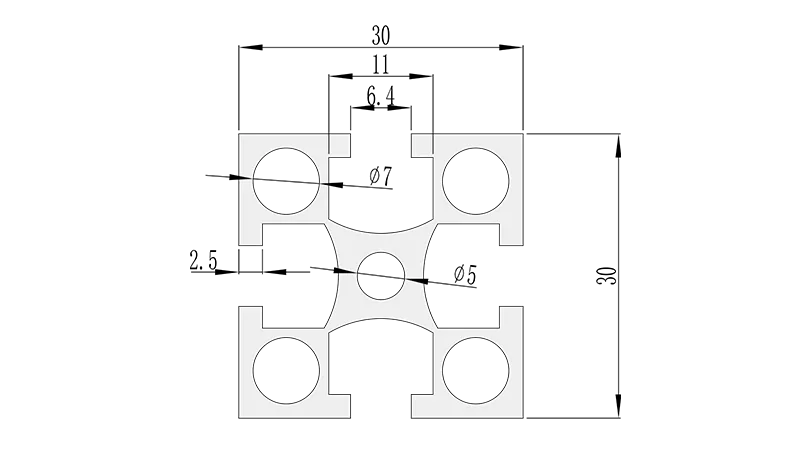
Let's start with the workhorse of the standard profile world: the 3030 National Standard Profile A. If you've ever walked into a well-organized factory, chances are you've seen this profile in action. Its name gives away the key detail: "3030" refers to its cross-section—30mm by 30mm—and "National Standard" means it adheres to uniform (dimensions) and tolerances set by industry regulations. This isn't just a random number; that 30x30mm size strikes a sweet spot between strength and versatility, making it ideal for a wide range of applications.
Key Features of 3030 National Standard Profile A
Material & Durability: Made from high-grade aluminum alloy (typically 6063-T5), this profile balances lightweight design with impressive strength. It can support moderate loads—think workbenches holding tools and components, or material racks storing small to medium-sized parts—without bending or warping. Plus, aluminum's natural resistance to rust means it holds up well in factory environments, even with occasional spills or humidity.
Modularity: Here's where standard profiles shine. The 3030 National Standard Profile A is designed to work seamlessly with aluminum profile accessories like T-slot nuts, angle brackets, and hinges. Need to add a shelf to a workbench? Just slide a bracket into the T-slot and tighten a screw. Want to extend a flow rack? Connect two profiles with a joint—no welding or specialized tools required. This modularity makes it easy to adapt as your needs change.
Cost-Effectiveness: Since it's mass-produced, the 3030 National Standard Profile A is significantly cheaper than custom options. Suppliers keep it in stock, so you won't pay extra for tooling or production delays. Even better, its compatibility with off-the-shelf aluminum profile accessories means you won't have to splurge on custom connectors or brackets.
Availability: Walk into any lean system supplier or check an industrial supply website, and you'll find 3030 National Standard Profile A ready to ship. No waiting weeks for a custom extrusion—if you need parts fast, this is your go-to.
When to Choose 3030 National Standard Profile A
This profile isn't a one-trick pony, but it excels in specific scenarios: - General Manufacturing: From assembly workbenches to small parts storage racks, the 3030 profile handles everyday tasks with ease. - Startups & Small Businesses: If you're on a tight budget or need to scale quickly, its low cost and quick availability make it a smart choice. - Prototyping: Testing a new production layout? Use 3030 profiles to build temporary workstations or flow racks. If something doesn't work, you can disassemble and reconfigure without wasting money. - Standardized Processes: If your operations follow common workflows (e.g., electronics assembly, light mechanical work), the 3030 profile's versatility will cover most needs.
The Other Side: What Are Custom Profiles?
Now, let's talk about the rebels of the aluminum profile world: custom profiles. These are the profiles that don't fit in a box—literally. Custom profiles are designed from scratch, with unique cross-sections, materials, or features tailored to solve specific problems that standard profiles can't address.
When Would You Need a Custom Profile?
Custom profiles aren't about being "fancy"—they're about solving pain points. Here are scenarios where they make sense:
Unique Space Constraints: Imagine your factory has an awkwardly shaped corner, or your production line requires a conveyor system that needs to fit through a narrow doorway. A standard 3030 profile might be too wide, or its T-slots might not align with your mounting points. A custom profile can be designed with a slimmer cross-section or specialized slots to fit the space.
Heavy-Duty Loads: If you're building a material rack for large automotive parts or a workbench for heavy machinery, the 3030 profile's 30x30mm size might not cut it. A custom profile could have thicker walls or a reinforced cross-section (e.g., 50x50mm with internal ribs) to handle higher weights.
Specialized Environments: Cleanrooms, food processing facilities, or chemical plants often have strict requirements. Maybe you need a profile with rounded edges to prevent dust buildup, or a corrosion-resistant coating (like anodized aluminum) to withstand harsh chemicals. Custom profiles can be engineered to meet these specs.
Integrated Functions: Sometimes, you need more than just a "bar." For example, a custom profile might include built-in channels for wiring, or a lip to guide parts along a conveyor. These integrated features eliminate the need for extra brackets or accessories, streamlining your design.
Drawbacks of Custom Profiles
Before you rush to design a custom profile, it's important to weigh the downsides:
Higher Costs: Custom profiles require tooling (a die to shape the aluminum during extrusion), which can cost thousands of dollars upfront. Plus, since they're not mass-produced, each unit costs more than a standard profile. If you only need a few pieces, the math might not add up.
Longer Lead Times: Designing, prototyping, and producing a custom profile takes time—often 4-8 weeks, compared to a day or two for standard profiles. If you're on a tight deadline, this delay could disrupt production.
Limited Flexibility: Once a custom profile is made, it's fixed. If your needs change (e.g., you need to support a heavier load later), you can't just swap out a bracket—you might have to redesign the entire profile.
3030 National Standard Profile A vs. Custom Profiles: A Side-by-Side Comparison
| Factor | 3030 National Standard Profile A | Custom Profiles |
|---|---|---|
| Cost | Low upfront cost; affordable per unit | High upfront tooling costs; expensive per unit |
| Lead Time | Immediate (in stock at most suppliers) | 4-8 weeks (design + production) |
| Flexibility | Highly modular; easy to reconfigure with accessories | Fixed design; hard to adapt to new needs |
| Accessory Compatibility | Widely compatible with standard aluminum profile accessories | Requires custom accessories (if T-slots or joints differ) |
| Best For | General manufacturing, workbenches, small to medium loads, startups | Unique space constraints, heavy loads, specialized environments |
Real-World Examples: When to Pick Which
Case Study 1: Electronics Assembly Plant Chooses 3030 National Standard Profile A
A mid-sized electronics company needed to upgrade its assembly line workbenches. Their old wooden benches were warped, and employees complained about back pain from hunching over. They considered custom profiles but quickly realized the 3030 National Standard Profile A was the better fit.
Why? Their needs were straightforward: adjustable-height workbenches (using aluminum profile accessories like height-adjustable feet), integrated tool rails, and small parts storage shelves. The 3030 profile's modularity let them build each bench in a day, and they could easily adjust the height or add shelves as new employees joined the team. Best of all, the total cost was 60% lower than custom profiles, freeing up budget for ergonomic chairs and anti-fatigue mats.
Case Study 2: Automotive Supplier Opts for Custom Profiles
A supplier for electric vehicle manufacturers needed a material rack to hold large battery packs (each weighing 50kg). The standard 3030 profile couldn't support the weight, and even larger standard profiles (like 4040) were too wide to fit through their warehouse doors. They worked with a lean system supplier to design a custom profile: 40mm wide (to fit through doors) with reinforced walls and internal ribs for extra strength.
Was it expensive? Yes—the tooling cost $5,000, and each profile was twice the price of a standard 4040. But the custom design let them fit 20 battery packs per rack (vs. 12 with standard profiles), increasing storage capacity by 67%. Over time, the efficiency gains offset the upfront cost.
Common Mistakes to Avoid
Choosing between standard and custom profiles isn't always black and white, and it's easy to fall into traps. Here are pitfalls to watch for:
Mistake #1: Over-Customizing "Just in Case" Many teams assume they need a custom profile because they can't find a standard one that's "perfect." But "perfect" is often unnecessary. For example, if a 3030 profile is 10mm too long, you can easily cut it to size with a saw. Don't pay for custom tooling unless the standard option truly can't meet your core needs.
Mistake #2: Underestimating Lead Time for Custom Profiles A custom profile might seem like the solution, but if your project deadline is in two weeks, it's not feasible. Always check with suppliers about production timelines—you might need to use standard profiles as a temporary fix while waiting for custom parts.
Mistake #3: Ignoring Future Scalability Custom profiles lock you into a specific design. If your business grows and you need to expand your production line, you'll either have to order more custom profiles (delaying the project) or mix custom and standard profiles (which might not be compatible). Standard profiles, with their universal accessories, make scaling much easier.
How to Make Your Decision: A Step-by-Step Guide
Step 1: Define Your Needs
Start by asking: What will the profile be used for? (Workbench? Material rack? Conveyor?) What load does it need to support? What space constraints exist? Are there environmental factors (moisture, chemicals) to consider? Write down these requirements—they'll be your roadmap.
Step 2: Check Standard Options First
Visit a lean system supplier or browse their catalog to see if standard profiles (like 3030 National Standard Profile A) or larger options (4040, 5050) can meet your needs. Ask about aluminum profile accessories—sometimes, a clever combination of standard profiles and brackets can solve the problem.
Step 3: Calculate Total Cost of Ownership
Don't just compare upfront costs. For custom profiles, factor in tooling, lead time delays (which can cost money in lost production), and future adaptability. For standard profiles, consider long-term flexibility—can you reconfigure them if your needs change? Often, the "cheaper" option upfront (standard) ends up being more cost-effective over time.
Step 4: Test Before Committing
If you're on the fence, buy a small quantity of 3030 National Standard Profile A and build a prototype. Does it work? If not, identify exactly what's missing—maybe the T-slots are in the wrong place, or the profile is too weak. Use that feedback to decide if custom is necessary.
Step 5: Consult the Experts
Lean system suppliers have seen it all. Explain your project, and ask for their input. They might suggest a standard profile you hadn't considered, or confirm that custom is the way to go. A good supplier will even help you design a custom profile if needed, ensuring it meets your specs.
Final Thoughts: It's About Balance
At the end of the day, the choice between 3030 National Standard Profile A and custom profiles comes down to balance: balancing cost and functionality, flexibility and specificity, short-term needs and long-term goals. For most businesses—especially startups, small manufacturers, or teams with standard workflows—the 3030 profile will be the workhorse, offering reliability, affordability, and adaptability.
But if your operation has unique challenges—tight spaces, heavy loads, or specialized environments—custom profiles can be the key to unlocking efficiency. The trick is to be honest about your needs: Do you need custom, or do you just want it? With careful planning, you'll choose the profile that turns your chaotic production floor into a streamlined, productive space.
And remember: Whether you go standard or custom, the goal is the same—to build a lean system that works for your team, not against them. With the right profile, you're one step closer to that goal.