- Company Articles
- Products and Technology
- Solution
- How to Customize Aluminum Workbench B for Specific Industry Requirements (3C, Medical, Automotive)

How to Customize Aluminum Workbench B for Specific Industry Requirements (3C, Medical, Automotive)
Related Product
Aluminum Workbench B
Aluminum tube workbench is more flexible and durable, compared with traditional PE/ABS coated steel tube. It is easy to assemble, anti corrosion, rust protection, and recycle use after disassemble.
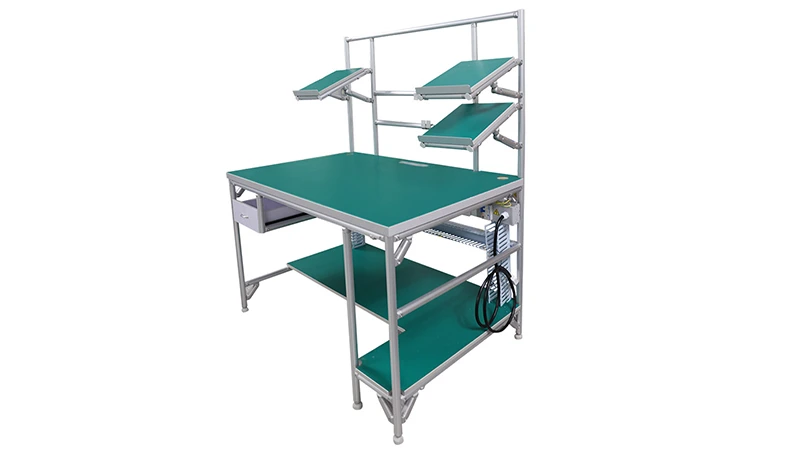
In the bustling world of manufacturing, where every second counts and precision is non-negotiable, the workbench stands as more than just a piece of equipment—it's the silent backbone of production lines. It's where ideas take tangible form, where components merge into finished products, and where teams spend hours crafting quality that reaches consumers worldwide. But not all workbenches are created equal. For industries as diverse as 3C (computers, communication, consumer electronics), medical device manufacturing, and automotive assembly, a one-size-fits-all approach to workbenches can lead to inefficiencies, safety risks, and missed opportunities for optimization. This is where Aluminum Workbench B shines—a modular, adaptable solution designed to evolve with your specific needs. In this article, we'll explore how to tailor Aluminum Workbench B to the unique demands of 3C, medical, and automotive industries, ensuring your production line isn't just functional, but truly optimized for success.
Understanding Aluminum Workbench B: The Foundation of Customization
Before diving into industry-specific tweaks, let's start with the basics: What makes Aluminum Workbench B such a versatile canvas for customization? At its core, this workbench is built around
aluminum profile
—a material celebrated for its winning combination of lightweight maneuverability and industrial-grade durability. Unlike traditional steel workbenches that are heavy and hard to modify, aluminum profiles offer a modular framework that can be easily adjusted, extended, or reconfigured as your production needs change. Add to that corrosion resistance (critical for clean environments) and a sleek, professional finish, and it's clear why aluminum has become the go-to for modern manufacturing setups.
Standard Aluminum Workbench B typically comes with a single deck (without casters, as noted in its base specification) and a simple frame. But its true power lies in the ecosystem of
aluminum profile accessories
that accompany it—think adjustable shelves, tool hooks, cable management clips, and even integrated lighting mounts. These accessories transform the basic structure into a tailored workstation, allowing you to add, remove, or rearrange components without needing to replace the entire bench. It's this modularity that makes customization not just possible, but practical—even for small to mid-sized manufacturers working with tight budgets.
Customizing for the 3C Industry: Precision, ESD Protection, and Micro-Organization
The 3C industry is a world of tiny components and high stakes. When assembling smartphones, laptops, or smartwatches, a single misplaced screw or static charge can render a product useless. For Aluminum Workbench B to thrive here, customization must prioritize three key areas: electrostatic discharge (ESD) protection, micro-component organization, and ergonomic precision.
1. ESD Workstation Integration: Guarding Against Invisible Threats
Static electricity is the silent enemy of 3C manufacturing. A single electrostatic discharge can fry sensitive microchips, leading to costly defects and product returns. This is where
esd workstation
features become non-negotiable. Customizing Aluminum Workbench B for 3C starts with integrating ESD-safe materials: conductive aluminum surfaces treated to dissipate static, ESD mats that ground workers, and even anti-static tool holders. Some setups go a step further by adding ionizers or grounding wristband ports directly into the bench frame, ensuring every tool and operator remains static-free throughout the shift. For example, a Shenzhen-based smartphone manufacturer we worked with recently added ESD-compliant drawer liners to their Aluminum Workbench B units, reducing static-related defects by over 30% in the first quarter alone.
2. Flow Racks: Streamlining Micro-Component Access
3C assembly lines deal with hundreds of tiny parts—resistors, capacitors, connectors—each no larger than a fingernail. Scrambling to find the right component mid-assembly disrupts workflow and increases error rates. Enter
flow rack
integration: shallow, sloped shelves attached to the sides or rear of Aluminum Workbench B that allow components to "flow" forward as the front row is used. Customizing these flow racks to fit 3C needs means sizing them for small parts bins (think 4x6 inch containers), adding dividers to separate similar components, and angling the shelves for easy visibility. A Shanghai-based electronics assembler, for instance, mounted two-tier flow racks on their Aluminum Workbench B units, cutting time spent searching for parts by 22% and freeing up tabletop space for actual assembly work.
3. Ergonomics: Reducing Fatigue in High-Precision Tasks
3C workers often spend 8+ hours a day hunched over microscopes or using precision tools, making ergonomics critical to preventing repetitive strain injuries. Aluminum Workbench B's height can be adjusted using telescopic aluminum profile legs (a common accessory), but for 3C, we take it further: adding tilting work surfaces to reduce neck strain during microscope use, integrating tool rails at elbow height to keep tweezers and soldering irons within easy reach, and even adding footrests to promote better posture. One 3C manufacturer in Guangdong reported a 15% decrease in worker fatigue after customizing their benches with these features—translating to fewer errors and higher overall productivity.

Customizing for the Medical Industry: Sterility, Compliance, and Contamination Control
In medical device manufacturing, the stakes are even higher: a single contaminated surface or misaligned tool could compromise patient safety. Aluminum Workbench B, with its smooth aluminum surfaces and modular design, is inherently well-suited for this industry—but customization is still needed to meet strict regulatory standards (like FDA and ISO 13485) and ensure sterility from assembly to packaging.
1. Seamless Surfaces and Easy-to-Clean Design
Medical workbenches must withstand frequent cleaning with harsh disinfectants, from alcohol wipes to hydrogen peroxide sprays. Standard Aluminum Workbench B's aluminum profile frame is already corrosion-resistant, but customization here means eliminating crevices where bacteria could hide. This involves swapping out traditional bolted joints for
internal rotary aluminum joints
(smooth, recessed connectors that leave no gaps), adding seamless phenolic resin tops (instead of wooden or composite decks) that resist staining and chemical damage, and rounding all edges to prevent debris buildup. A medical device manufacturer in Suzhou, for example, modified their benches with these features and passed their ISO 13485 audit with zero non-conformities related to workstation hygiene.
2. Compliance-Focused Storage: Traceability and Access Control
Medical manufacturing requires meticulous traceability—every component, from a surgical screw to a sensor, must be tracked from arrival to installation. Customizing Aluminum Workbench B to support this means integrating lockable drawers with RFID or barcode scanners, allowing workers to log component usage in real time. Additionally, clear acrylic dividers in flow racks (instead of opaque plastic) make it easy to visually verify stock levels without opening containers, reducing contamination risks. One orthopedic implant manufacturer we collaborated with added these features and reduced time spent on compliance audits by 30%, as auditors could quickly verify traceability records directly from the workbench.
3. Cleanroom Compatibility: Minimizing Particle Generation
Many medical products, like pacemakers or IV catheters, are assembled in cleanrooms where even a single dust particle can ruin a batch. Aluminum Workbench B can be customized for cleanroom use by swapping standard casters (which generate dust) for static-dissipative, non-marking alternatives, adding HEPA-filtered air curtains above the work surface to trap airborne particles, and using low-shedding materials for accessories (e.g., silicone tool holders instead of fabric). A biotech firm in Beijing took this a step further, painting their aluminum profiles with antimicrobial coatings, further reducing the risk of microbial contamination during assembly.

Customizing for the Automotive Industry: Heavy-Duty Durability, Workflow Integration, and Space Efficiency
Automotive assembly lines are a study in controlled chaos: heavy components (engines, transmissions, body panels), fast-paced workflows, and a constant need to adapt to new vehicle models. Aluminum Workbench B, while lightweight, can be fortified to handle these demands—with customization focused on load capacity, integration with
conveyor
systems, and flexible storage for bulky tools.
1. Reinforced Frames for Heavy Loads
Standard Aluminum Workbench B is designed for medium loads, but automotive work often requires supporting 50kg+ components during assembly. Customization here starts with upgrading the aluminum profile thickness from 1.2mm to 2.0mm (or even 3.0mm for extreme cases) and adding cross-bracing between legs to prevent wobbling. Some manufacturers also opt for steel-reinforced aluminum joints, which combine aluminum's corrosion resistance with steel's tensile strength. A car parts supplier in Chongqing modified their benches this way, allowing workers to assemble brake calipers directly on the bench without worrying about structural strain.
2. Conveyor and Roller Track Integration: Streamlining Material Flow
In automotive plants, time is lost when workers have to walk to fetch components. Aluminum Workbench B can be customized to connect directly to existing conveyor systems, using
roller track
accessories (like 40 steel roller track with yellow wheels) mounted to the bench's side or rear. This allows parts to "roll" directly to the workstation, reducing movement and speeding up assembly. For example, a sedan assembly line in Hubei added roller tracks to their benches, enabling door panels to glide from the painting station to the assembly bench—cutting part transfer time by 40% and freeing up workers to focus on installation.
3. Mobile Workstations for Adaptive Layouts
Automotive manufacturers frequently reconfigure production lines to accommodate new models, making fixed workbenches a liability. Aluminum Workbench B solves this with lockable, heavy-duty casters (added via custom mounting brackets) that allow the entire bench to be moved with minimal effort. Some setups even include retractable power cords and air hose reels, ensuring the bench remains functional wherever it's positioned. A commercial vehicle manufacturer in Shandong used this feature to reconfigure their line for electric truck production in just two days—far faster than the week it would have taken with fixed steel benches.
Key Considerations for Successful Customization
While the specifics of customization vary by industry, three universal principles apply when tailoring Aluminum Workbench B: start with your workflow, prioritize compliance, and plan for future growth. Let's break these down.
1. Map Your Workflow First
Before adding any accessories, spend a day observing your production line. Where do workers pause? What tools are consistently out of reach? Which components cause bottlenecks? For example, a 3C team might notice workers bending to retrieve parts from floor bins—prompting the addition of under-bench flow racks. A medical team might see frequent wipe-downs of cluttered surfaces—leading to a minimalist design with fewer accessories. By aligning customization with actual workflow pain points, you ensure every modification adds value, rather than creating new inefficiencies.
2. Compliance Isn't Optional
Industries like medical and automotive are governed by strict regulations, and a customized workbench must meet or exceed these standards. For 3C, this means ESD certification (e.g., ANSI/ESD S20.20); for medical, ISO 13485 or FDA 21 CFR Part 820; for automotive, IATF 16949. Work with your supplier to ensure all materials (like ESD mats or antimicrobial coatings) and design features (like seamless joints) are certified. Cutting corners here can lead to fines, product recalls, or loss of customer trust.
3. Build for Tomorrow, Not Just Today
Manufacturing needs evolve—new products, new processes, new team sizes. Aluminum Workbench B's modularity is its greatest strength here, but you'll need to plan for growth. For example, if you anticipate adding automated tools in the future, leave space for mounting brackets. If your team might expand, choose a bench width that can be extended with additional aluminum profiles. A electronics manufacturer in Zhejiang did this by installing extra T-slot aluminum profiles on their benches, allowing them to add new accessories (like barcode scanners) six months later without replacing the entire setup.
Customization Features Across Industries: A Quick Reference
| Feature | 3C Industry | Medical Industry | Automotive Industry |
|---|---|---|---|
| Core Material | 1.2-1.5mm aluminum profile | 1.5-2.0mm aluminum profile (seamless joints) | 2.0-3.0mm reinforced aluminum profile |
| Key Accessory | ESD mats, micro flow racks | Lockable traceability drawers, antimicrobial coatings | Roller tracks, heavy-duty casters |
| Regulatory Focus | ANSI/ESD S20.20 | ISO 13485, FDA 21 CFR Part 820 | IATF 16949 |
| Primary Goal | Precision and static control | Sterility and compliance | Durability and workflow speed |
Conclusion: Your Workbench, Your Way
Aluminum Workbench B isn't just a piece of equipment—it's a canvas for innovation. By understanding the unique demands of your industry—whether it's the micro-precision of 3C, the sterility of medical manufacturing, or the heavy-duty needs of automotive assembly—you can transform this basic structure into a workstation that elevates productivity, ensures compliance, and grows with your business. Remember, the best customization isn't about adding every accessory available; it's about listening to your team, mapping your workflow, and choosing features that solve real problems. With Aluminum Workbench B, the power to build a production line that works
for
you is quite literally in your hands.