- Company Articles
- Products and Technology
- Product knowledge
- How to Determine if Aluminum Workbench B Is Right for Your 3C Assembly Line

How to Determine if Aluminum Workbench B Is Right for Your 3C Assembly Line
Related Product
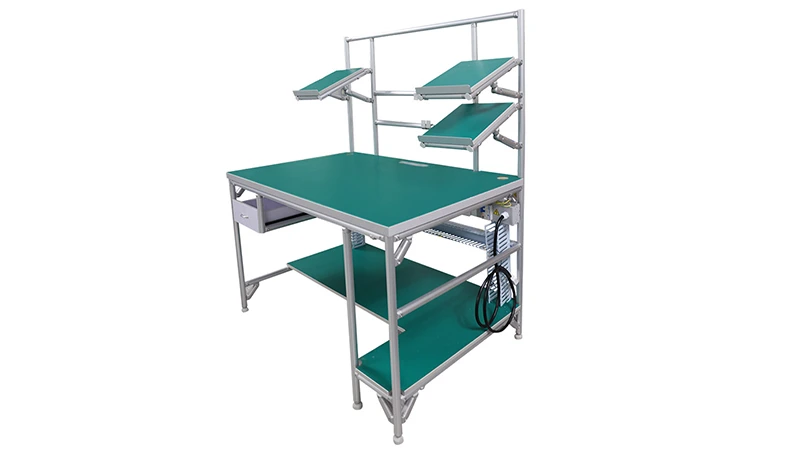
Aluminum Workbench B
Aluminum tube workbench is more flexible and durable, compared with traditional PE/ABS coated steel tube. It is easy to assemble, anti corrosion, rust protection, and recycle use after disassemble.
The Heartbeat of 3C Assembly: Why Your Workbench Matters More Than You Think
Walk into any 3C (computers, communications, consumer electronics) assembly line, and you'll notice a rhythm—a symphony of precision, speed, and order. Circuit boards glide from station to station, tiny components are placed with microscopic accuracy, and workers move with the quiet focus of artisans. But beneath this harmony lies a critical, often overlooked foundation: the workbench. It's not just a table; it's the stage where your team's skills, your equipment's efficiency, and your products' quality collide.
In 3C manufacturing, where margins are tight and competition is fierce, even small inefficiencies can ripple into big losses. A wobbly surface might lead to misaligned parts. A lack of static protection could fry a $500 chip in seconds. A cluttered layout might slow down a worker by 10 seconds per unit—adding up to hours of lost productivity by day's end. That's why choosing the right workbench isn't just a purchase; it's a strategic decision that impacts everything from daily operations to long-term profitability.
Enter Aluminum Workbench B. If you've been researching lean system solutions or scrolling through supplier catalogs, you've probably come across it. Sleek, lightweight, and built with aluminum profile, it's marketed as a "game-changer" for modern assembly lines. But is it right for your line? Let's cut through the marketing jargon and break down what matters most. By the end of this article, you'll have a clear framework to decide if Aluminum Workbench B deserves a spot in your production floor's lineup.
First Things First: What Is Aluminum Workbench B, Anyway?
Before we dive into whether it's a fit, let's get familiar with the star of the show. Aluminum Workbench B is part of a new generation of industrial workbenches designed for flexibility, durability, and compatibility with lean manufacturing principles. Unlike clunky steel workbenches of the past, it's built using aluminum profile—think of those modular, T-slot aluminum extrusions you've seen in modern factories—and comes standard with a single deck (no casters, though you can add them as accessories). Its design prioritizes clean lines, easy customization, and integration with other lean tools like roller track and material racks.
But what really sets it apart? For starters, aluminum. Aluminum profile is lightweight (about a third the weight of steel) but surprisingly strong, making the workbench easy to reposition without sacrificing stability. It's also resistant to corrosion—a big plus in environments where spills, humidity, or cleaning chemicals are common. And because it's modular, you can bolt on accessories like tool holders, monitor arms, or ESD mats without drilling holes or welding. Need to add a shelf? Screw on an aluminum profile bracket. Want to attach a roller track for parts to slide in? Just clip on a connector. It's like building with industrial Legos—adaptable to whatever your day throws at you.

Key Consideration 1: Do You Need ESD Protection? (Hint: If You Build Electronics, the Answer Is "Yes")
Let's start with the elephant in the room: static electricity. In 3C assembly, electrostatic discharge (ESD) isn't just a nuisance—it's a silent killer. A single static spark, invisible to the human eye, can damage sensitive components like microchips, capacitors, or LCD screens. The cost? Defective products, warranty claims, and even reputational damage if faulty devices reach customers.
Traditional workbenches often "solve" this by slapping an ESD mat on top. But mats wear out, peel at the edges, or get torn by sharp tools. Aluminum Workbench B takes a different approach. Many models come with ESD-safe surfaces built into the aluminum deck—no extra mats needed. The aluminum profile itself can be grounded, creating a continuous path for static to dissipate harmlessly into the floor. It's a more reliable, low-maintenance solution than mats, especially in high-traffic areas where workers are constantly moving tools and parts.
But here's the catch: Not all Aluminum Workbench B models are ESD-rated. Some suppliers offer "standard" versions with non-conductive aluminum, which won't protect against static. So if ESD safety is non-negotiable for your line (and let's be real, if you're assembling phones, laptops, or circuit boards, it is), double-check the specs. Look for phrases like "ESD-compliant," "groundable surface," or "static-dissipative aluminum." If the supplier can't confirm these details, keep shopping—your components are too valuable to risk.

Space and Layout: Does Aluminum Workbench B Play Well in Your Factory's "Neighborhood"?
3C assembly lines are rarely spacious. Whether you're operating in a compact urban facility or a sprawling warehouse, floor space is prime real estate. Every square foot not used for production, storage, or worker movement is a square foot wasted. That's why the dimensions and flexibility of your workbench matter as much as its features.
Aluminum Workbench B typically measures around 1200mm (length) x 600mm (depth) x 800mm (height)—a standard size that fits most assembly tasks without hogging space. But its real space-saving superpower is its modularity. Since it's built with aluminum profile, you can add or remove shelves, tool hooks, or side extensions on the fly. Need to squeeze an extra workstation into a tight corner? Swap out the standard legs for shorter ones. Want to align it with a roller track to create a seamless material flow? Attach a bracket to the side in 10 minutes. No welding, no drilling, no waiting for a technician.
Compare that to traditional steel workbenches, which are often "one and done." Once they're bolted to the floor, moving or modifying them means bringing in heavy equipment or cutting metal—disrupting production for hours. Aluminum Workbench B, by contrast, is like a puzzle piece that adapts to your layout, not the other way around. This is especially valuable if your line runs multiple product types (e.g., smartphones one week, tablets the next) and needs to reconfigure quickly.
But there's a flip side: If your workbench needs to support extremely heavy loads (think 500kg+), aluminum might not be the best choice. While aluminum profile is strong for its weight, steel still wins in raw load capacity. For example, if you're assembling large appliances or industrial electronics, a steel workbench might be more practical. But for most 3C tasks—handling circuit boards, small tools, or subassemblies—Aluminum Workbench B's 200-300kg weight capacity is more than enough.
Workflow Integration: Does It Play Nice with Your Roller Track and Lean System?
Lean manufacturing isn't just a buzzword; it's a mindset that revolves around eliminating waste—whether that's wasted time, wasted movement, or wasted materials. At the heart of lean systems is the idea of "flow": getting materials from point A to point B with minimal friction. That's where tools like roller track come in—they let parts glide smoothly between workstations, reducing the need for manual carrying.
Aluminum Workbench B was designed with this flow in mind. Most models feature pre-drilled holes or T-slot channels along the edges, making it easy to connect to roller track systems. Imagine this: A circuit board arrives via roller track, slides right onto the workbench, gets assembled, and then glides off the other side onto the next roller track segment—all without a worker lifting a finger. That's the lean dream, and Aluminum Workbench B makes it achievable.
But integration goes beyond just physical connections. It's about how the workbench fits into your team's daily rhythm. For example, if your line uses "kanban" systems (visual signals to trigger material replenishment), Aluminum Workbench B's flat, uncluttered surface makes it easy to place kanban cards or color-coded bins. If your workers follow 5S (sort, set in order, shine, standardize, sustain), the workbench's modular design lets you assign specific spots for tools, reducing "searching" waste. Even small touches, like built-in cable management channels (to keep power cords and USB cables from tangling), add up to smoother, more efficient workflows.
To test if it's a fit, map out your current workflow. Where do bottlenecks happen? Is there a step where workers are constantly reaching for parts or walking to grab tools? Could a roller track-connected workbench eliminate that? If the answer is yes, Aluminum Workbench B might be the missing link in your lean system.
Durability and Maintenance: Will It Last in the "Real World" of Your Factory?
Let's talk about the "ugly" side of factory life: spills, scrapes, and daily wear and tear. 3C assembly lines are messy places. Soldering flux drips, cleaning solvents splash, and tools get dropped. A workbench that looks shiny on day one but rusts, dents, or warps by month three is a waste of money.
Aluminum profile is surprisingly tough in this regard. Unlike steel, it doesn't rust—so even if you spill a cleaning solution, you won't wake up to orange stains. It's also scratch-resistant; those accidental tool drops might leave a mark, but they won't chip off chunks of material. And because it's lightweight, moving it (say, to clean underneath or reconfigure the line) doesn't require a forklift—reducing the risk of dents from heavy machinery collisions.
Maintenance is another win. Steel workbenches often need repainting every year or two to prevent rust. Wood tops warp or get water-damaged. Aluminum Workbench B? A quick wipe with a damp cloth is usually all it takes. The aluminum profile's T-slot design also resists dust buildup—no more crumbs or debris getting stuck in crevices, which is crucial for keeping sensitive electronics clean.
That said, aluminum isn't indestructible. If your line involves heavy metalworking or sledgehammer-like impacts (unlikely in 3C, but possible in some sub-assembly tasks), steel might still be better. But for the typical 3C environment—light to medium assembly, occasional spills, and daily use—Aluminum Workbench B should hold up for 5-7 years with minimal maintenance. That's a solid return on investment, especially compared to cheaper particleboard workbenches that need replacing every 1-2 years.
Cost vs. Value: Is It Worth the Premium Price Tag?
Let's get real: Aluminum Workbench B isn't the cheapest option out there. A basic model will set you back more than a standard steel workbench or a budget particleboard table. But here's the thing: In manufacturing, cost and value are rarely the same. A $200 workbench that breaks in a year costs more in the long run than a $500 workbench that lasts five years and boosts productivity.
To decide if the premium is worth it, let's break down the potential savings:
- Reduced downtime: No need to replace warped or rusted workbenches every year. Less time spent on repairs means more time producing.
- Lower ESD damage: If even one expensive component is saved from static damage, the workbench could pay for itself.
- Improved productivity: Smoother workflows, less searching for tools, and better ergonomics (adjustable height options) can boost output by 5-10% per worker.
- Flexibility savings: Reconfiguring the workbench costs nothing (no new parts, no labor fees), whereas reconfiguring a steel workbench might require hiring a welder or buying a new one.
Still on the fence? Let's put it in numbers. Suppose your line produces 1,000 units per day, and a more efficient workbench saves each worker 10 seconds per unit. With 10 workers, that's 100,000 seconds saved per day—about 28 extra hours of production time per week. At $20 per hour labor cost, that's $560 in weekly savings. Even a $1,000 workbench would pay for itself in under two weeks.
Comparing Your Options: Aluminum Workbench B vs. the Alternatives
To make this decision even clearer, let's stack Aluminum Workbench B against two common alternatives: a traditional steel workbench and a dedicated ESD workstation. Use this table to see how they measure up across key factors:
| Feature | Aluminum Workbench B | Traditional Steel Workbench | Dedicated ESD Workstation |
|---|---|---|---|
| Material | Aluminum profile | Steel frame + wood/steel top | Steel frame + ESD laminate top |
| ESD Protection | Optional (built-in grounded aluminum) | Requires ESD mat (adds cost) | Built-in (laminate + grounding) |
| Weight | ~40kg (light, movable by 2 people) | ~80kg (heavy, needs forklift to move) | ~60kg (moderate weight) |
| Customization | High (T-slot aluminum, easy add-ons) | Low (fixed design, welding needed for mods) | Moderate (some add-ons, but limited by frame) |
| Roller Track Integration | Excellent (pre-drilled for brackets) | Poor (needs custom drilling) | Fair (possible with adapters) |
| Durability | High (corrosion-resistant, scratch-proof) | High (but rusts without maintenance) | Moderate (laminate can peel over time) |
| Cost (Basic Model) | $400-$600 | $200-$300 | $500-$800 |
As you can see, Aluminum Workbench B strikes a balance between ESD protection, flexibility, and cost. It's not the cheapest, but it offers more customization than steel and better value than a dedicated ESD workstation—especially if you need to integrate with roller track or reconfigure often.
The Final Checklist: 5 Questions to Ask Before You Buy
By now, you have a good sense of what Aluminum Workbench B brings to the table. To wrap up, here's a quick checklist to help you decide if it's right for your 3C assembly line:
1. Do we need ESD protection for our products?
If you assemble circuit boards, semiconductors, or other static-sensitive components, Aluminum Workbench B's optional ESD features are a must. If you work with non-sensitive parts (e.g., plastic casings), you might get by with a cheaper option—but you'll still miss out on its flexibility.
2. Is our production layout static or dynamic?
If you reconfigure your line monthly (for new product launches, seasonal demand, etc.), Aluminum Workbench B's modularity will save you time and hassle. If your layout never changes, a steel workbench might be sufficient.
3. Do we use roller track or plan to implement it?
If material flow is a priority, Aluminum Workbench B's easy roller track integration is a game-changer. Traditional workbenches will require custom modifications, adding cost and delays.
4. How much weight do we need to support?
Most 3C tasks (up to 300kg) are fine for Aluminum Workbench B. If you're lifting heavy machinery onto the bench daily, steel is still king.
5. What's our long-term cost tolerance?
If you're looking for a "set it and forget it" solution that lasts 5+ years, the upfront cost of Aluminum Workbench B is worth it. If you're on a shoestring budget and plan to upgrade in a year, a cheaper workbench might suffice (but expect more maintenance headaches).
Final Thoughts: Aluminum Workbench B—A Tool for the Future of 3C Assembly
At the end of the day, there's no one-size-fits-all answer. But for most modern 3C assembly lines—those focused on lean systems, flexibility, and ESD safety—Aluminum Workbench B is more than just a workbench. It's an investment in smoother workflows, happier workers, and more reliable products.
Think of it this way: Your assembly line is a team. Every tool, every process, and every workbench is a player. Aluminum Workbench B is the teammate who's adaptable, reliable, and always ready to step up—whether you're launching a new smartphone model, scaling production, or just trying to squeeze a little more efficiency out of your day.
So, is it right for you? If you answered "yes" to most of the checklist questions, if you value flexibility and long-term savings, and if you're ready to level up your lean system, then the answer is likely "yes." And if you're still unsure? Reach out to a supplier and ask for a demo. See it in person, test its weight, attach a roller track segment, and imagine it on your floor. Sometimes, the best way to know if something fits is to try it on.
Your assembly line's rhythm deserves a workbench that can keep up. Aluminum Workbench B just might be the beat that makes all the difference.